
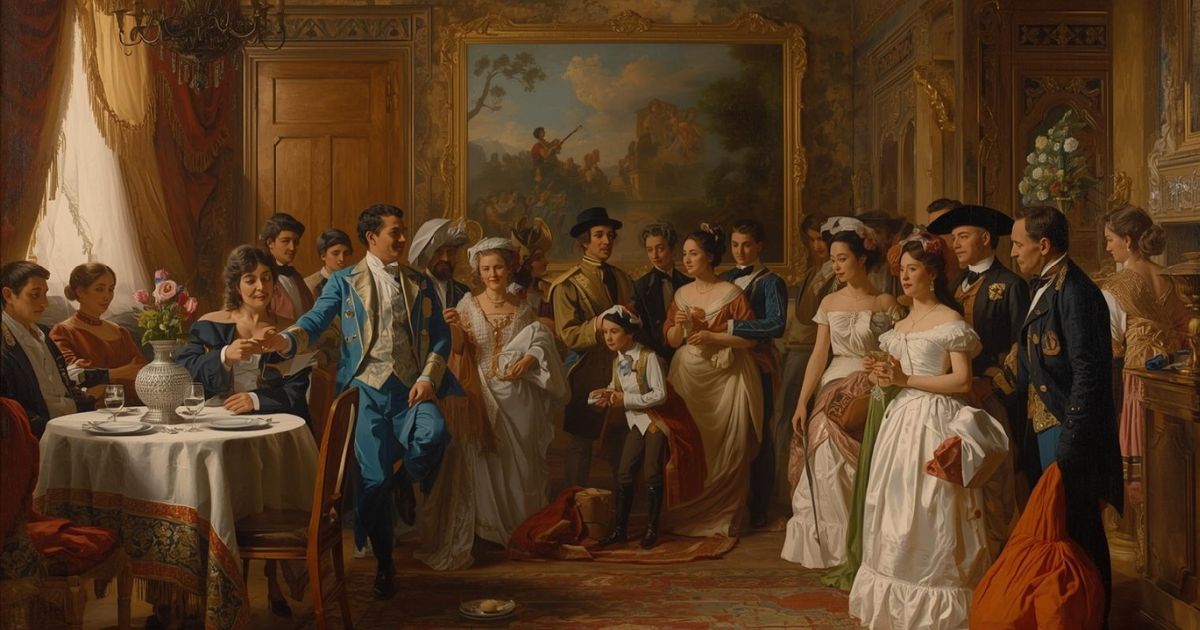
An excerpt from the original text.(complete · 4094 words)
the Wood
Early, very early indeed, somewhat differently from his usual custom,
Padre Salvi had celebrated mass and cleansed a dozen sinful souls in a
few moments. Then it seemed that the reading of some letters which he
had received firmly sealed and waxed caused the worthy curate to lose
his appetite, since he allowed his chocolate to become completely cold.
"The padre is getting sick," commented the cook while preparing another
cup. "For days he hasn't eaten; of the six dishes that I set before
him on the table he doesn't touch even two."
"It's because he sleeps badly," replied the other servant. "He has
nightmares since he changed his bedroom. His eyes are becoming more
sunken all the time and he's getting thinner and yellower day by day."
Truly, Padre Salvi was a pitiable sight. He did not care to touch the
second cup of chocolate nor to taste the sweet cakes of Cebu; instead,
he paced thoughtfully about the spacious sala, crumpling in his bony
hands the letters, which he read from time to time. Finally, he called
for his carriage, got ready, and directed that he be taken to the
wood where stood the fateful tree near which the picnic was being held.
Arriving at the edge of the wood, the padre dismissed his carriage
and made his way alone into its depths. A gloomy pathway opened a
difficult passage through the thickets and led to the brook formed
by certain warm springs, like many that flow from the slopes of
Mr. Makiling. Adorning its banks grow wild flowers, many of which
have as yet no Latin names, but which are doubtless well-known to
the gilded insects and butterflies of all shapes and colors, blue and
gold, white and black, many-hued, glittering with iridescent spots,
with rubies and emeralds on their wings, and to the countless beetles
with their metallic lusters of powdered gold. The hum of the insects,
the cries of the cicada, which cease not night or day, the songs of
the birds, and the dry crashing of the rotten branch that falls and
strikes all around against the trees, are the only sounds to break
the stillness of that mysterious place.
For some time the padre wandered aimlessly among the thick underbrush,
avoiding the thorns that caught at his guingón habit as though to
detain him, and the roots of the trees that protruded from the soil
to form stumbling-blocks at every step for this wanderer unaccustomed
to such places. But suddenly his feet were arrested by the sound of
clear voices raised in merry laughter, seeming to come from the brook
and apparently drawing nearer.
"I'm going to see if I can find one of those nests," said a beautiful,
sweet voice, which the curate recognized. "I'd like to see him
without having him see me, so I could follow him everywhere."
Padre Salvi hid behind the trunk of a large tree and set himself
to eavesdrop.
"Does that mean that you want to do with him what the curate does with
you?" asked a laughing voice. "He watches you everywhere. Be careful,
for jealousy makes people thin and puts rings around their eyes."
"No, no, not jealousy, it's pure curiosity," replied the silvery voice,
while the laughing one repeated, "Yes, jealousy, jealousy!" and she
burst out into merry laughter.
"If I were jealous, instead of making myself invisible, I'd make him
so, in order that no one might see him."
"But neither would you see him and that wouldn't be nice. The best
thing for us to do if we find the nest would be to present it to the
curate so that he could watch over us without the necessity of our
seeing him, don't you think so?"
"I don't believe in those herons' nests," interrupted another voice,
"but if at any time I should be jealous, I'd know how to watch and
still keep myself hidden."
"How, how? Perhaps like a Sor Escucha?" [73]
This reminiscence of school-days provoked another merry burst of
laughter.
"And you know how she's fooled, the Sor Escucha!"
From his hiding-place Padre Salvi saw Maria Clara, Victoria, and Sinang
wading along the border of the brook. They were moving forward with
their eyes fixed on the crystal waters, seeking the enchanted nest of
the heron, wet to their knees so that the wide folds of their bathing
skirts revealed the graceful curves of their bodies. Their hair was
flung loose, their arms bare, and they wore camisas with wide stripes
of bright hues. While looking for something that they could not find
they were picking flowers and plants which grew along the bank.
The religious Acteon stood pale and motionless gazing at that chaste
Diana, but his eyes glittered in their dark circles, untired of staring
at those white and shapely arms and at that elegant neck and bust,
while the small rosy feet that played in the water awoke in his starved
being strange sensations and in his burning brain dreams of new ideas.
The three charming figures disappeared behind a bamboo thicket
around a bend in the brook, and their cruel allusions ceased to be
heard. Intoxicated, staggering, covered with perspiration, Padre Salvi
left his hiding-place and looked all about him with rolling eyes. He
stood still as if in doubt, then took a few steps as though he would
try to follow the girls, but turned again and made his way along the
banks of the stream to seek the rest of the party.
At a little distance he saw in the middle of the brook a kind of
bathing-place, well enclosed, decorated with palm leaves, flowers,
and streamers, with a leafy clump of bamboo for a covering, from
within which came the sound of happy feminine voices. Farther on
he saw a bamboo bridge and beyond it the men bathing. Near these a
crowd of servants was busily engaged around improvised kalanes in
plucking chickens, washing rice, and roasting a pig. On the opposite
bank in a cleared space were gathered men and women under a canvas
covering which was fastened partly to the hoary trees and partly to
newly-driven stakes. There were gathered the alferez, the coadjutor,
the gobernadorcillo, the teniente-mayor, the schoolmaster, and many
other personages of the town, even including Sinang's father, Capitan
Basilio, who had been the adversary of the deceased Don Rafael in
an old lawsuit. Ibarra had said to him, "We are disputing over a
point of law, but that does not mean that we are enemies," so the
celebrated orator of the conservatives had enthusiastically accepted
the invitation, sending along three turkeys and putting his servants
at the young man's disposal.
The curate was received with respect and deference by all, even the
alferez. "Why, where has your Reverence been?" asked the latter,
as he noticed the curate's scratched face and his habit covered with
leaves and dry twigs. "Has your Reverence had a fall?"
"No, I lost my way," replied Padre Salvi, lowering his gaze to examine
his gown.
Bottles of lemonade were brought out and green coconuts were split
open so that the bathers as they came from the water might refresh
themselves with the milk and the soft meat, whiter than the milk
itself. The girls all received in addition rosaries of sampaguitas,
intertwined with roses and ilang-ilang blossoms, to perfume their
flowing tresses. Some of the company sat on the ground or reclined
in hammocks swung from the branches of the trees, while others
amused themselves around a wide flat rock on which were to be seen
playing-cards, a chess-board, booklets, cowry shells, and pebbles.
They showed the cayman to the curate, but he seemed inattentive
until they told him that the gaping wound had been inflicted by
Ibarra. The celebrated and unknown pilot was no longer to be seen,
as he had disappeared before the arrival of the alferez.
At length Maria Clara came from the bath with her companions, looking
fresh as a rose on its first morning when the dew sparkling on its fair
petals glistens like diamonds. Her first smile was for Crisostomo and
the first cloud on her brow for Padre Salvi, who noted it and sighed.
The lunch hour was now come, and the curate, the coadjutor, the
gobernadorcillo, the teniente-mayor, and the other dignitaries took
their seats at the table over which Ibarra presided. The mothers
would not permit any of the men to eat at the table where the young
women sat.
"This time, Albino, you can't invent holes as in the bankas," said
Leon to the quondam student of theology. "What! What's that?" asked
the old women.
"The bankas, ladies, were as whole as this plate is," explained Leon.
"Jesús! The rascal!" exclaimed the smiling Aunt Isabel.
"Have you yet learned anything of the criminal who assaulted Padre
Damaso?" inquired Fray Salvi of the alferez.
"Of what criminal, Padre?" asked the military man, staring at the
friar over the glass of wine that he was emptying,
"What criminal! Why, the one who struck Padre Damaso in the road
yesterday afternoon!"
"Struck Padre Damaso?" asked several voices.
The coadjutor seemed to smile, while Padre Salvi went on: "Yes, and
Padre Damaso is now confined to his bed. It's thought that he may be
the very same Elias who threw you into the mudhole, señor alferez."
Either from shame or wine the alferez's face became very red.
"Of course, I thought," continued Padre Salvi in a joking manner,
"that you, the alferez of the Civil Guard, would be informed about
the affair."
The soldier bit his lip and was murmuring some foolish excuse, when
the meal was suddenly interrupted by the appearance of a pale, thin,
poorly-clad woman. No one had noticed her approach, for she had come
so noiselessly that at night she might have been taken for a ghost.
"Give this poor woman something to eat," cried the old women. "Oy,
come here!"
Still the strange woman kept on her way to the table where the
curate was seated. As he turned his face and recognized her, his
knife dropped from his hand.
"Give this woman something to eat," ordered Ibarra.
"The night is dark and the boys disappear," murmured the wandering
woman, but at sight of the alferez, who spoke to her, she became
frightened and ran away among the trees.
"Who is she?" he asked.
"An unfortunate woman who has become insane from fear and sorrow,"
answered Don Filipo. "For four days now she has been so."
"Is her name Sisa?" asked Ibarra with interest.
"Your soldiers arrested her," continued the teniente-mayor, rather
bitterly, to the alferez. "They marched her through the town on
account of something about her sons which isn't very clearly known."
"What!" exclaimed the alferez, turning to the curate, "she isn't the
mother of your two sacristans?"
The curate nodded in affirmation.
"They disappeared and nobody made any inquiries about them," added Don
Filipo with a severe look at the gobernadorcillo, who dropped his eyes.
"Look for that woman," Crisostomo ordered the servants. "I promised
to try to learn where her sons are."
"They disappeared, did you say?" asked the alferez. "Your sacristans
disappeared, Padre?"
The friar emptied the glass of wine before him and again nodded.
"Caramba, Padre!" exclaimed the alferez with a sarcastic laugh,
pleased at the thought of a little revenge. "A few pesos of your
Reverence's disappear and my sergeant is routed out early to hunt for
them--two sacristans disappear and your Reverence says nothing--and
you, señor capitan--It's also true that you--"
Here he broke off with another laugh as he buried his spoon in the
red meat of a wild papaya.
The curate, confused, and not over-intent upon what he was saying,
replied, "That's because I have to answer for the money--"
"A good answer, reverend shepherd of souls!" interrupted the alferez
with his mouth full of food. "A splendid answer, holy man!"
Ibarra wished to intervene, but Padre Salvi controlled himself by
an effort and said with a forced smile, "Then you don't know, sir,
what is said about the disappearance of those boys? No? Then ask
your soldiers!"
"What!" exclaimed the alferez, all his mirth gone.
"It's said that on the night they disappeared several shots were
heard."
"Several shots?" echoed the alferez, looking around at the other
guests, who nodded their heads in corroboration of the padre's
statement.
Padre Salvi then replied slowly and with cutting sarcasm: "Come now,
I see that you don't catch the criminals nor do you know what is going
on in your own house, yet you try to set yourself up as a preacher
to point out their duties to others. You ought to keep in mind that
proverb about the fool in his own house--" [74]
"Gentlemen!" interrupted Ibarra, seeing that the alferez had grown
pale. "In this connection I should like to have your opinion about a
project of mine. I'm thinking of putting this crazy woman under the
care of a skilful physician and, in the meantime, with your aid and
advice, I'll search for her sons."
The return of the servants without the madwoman, whom they had been
unable to find, brought peace by turning the conversation to other
matters.
The meal ended, and while the tea and coffee were being served,
both old and young scattered about in different groups. Some took the
chessmen, others the cards, while the girls, curious about the future,
chose to put questions to a Wheel of Fortune.
"Come, Señor Ibarra," called Capitan Basilio in merry mood, "we have
a lawsuit fifteen years old, and there isn't a judge in the Audiencia
who can settle it. Let's see if we can't end it on the chess-board."
"With the greatest pleasure," replied the youth. "Just wait a moment,
the alferez is leaving."
Upon hearing about this match all the old men who understood chess
gathered around the board, for it promised to be an interesting one,
and attracted even spectators who were not familiar with the game. The
old women, however, surrounded the curate in order to converse with him
about spiritual matters, but Fray Salvi apparently did not consider
the place and time appropriate, for he gave vague answers and his
sad, rather bored, looks wandered in all directions except toward
his questioners.
The chess-match began with great solemnity. "If this game ends in a
draw, it's understood that the lawsuit is to be dropped," said Ibarra.
In the midst of the game Ibarra received a telegram which caused
his eyes to shine and his face to become pale. He put it into his
pocketbook, at the same time glancing toward the group of young people,
who were still with laughter and shouts putting questions to Destiny.
"Check to the king!" called the youth.
Capitan Basilio had no other recourse than to hide the piece behind
the queen.
"Check to the queen!" called the youth as he threatened that piece
with a rook which was defended by a pawn.
Being unable to protect the queen or to withdraw the piece on account
of the king behind it, Capitan Basilio asked for time to reflect.
"Willingly," agreed Ibarra, "especially as I have something to say this
very minute to those young people in that group over there." He arose
with the agreement that his opponent should have a quarter of an hour.
Iday had the round card on which were written the forty-eight
questions, while Albino held the book of answers.
"A lie! It's not so!" cried Sinang, half in tears.
"What's the matter?" asked Maria Clara.
"Just imagine, I asked, 'When shall I have some sense?' I threw the
dice and that worn-out priest read from the book, 'When the frogs
raise hair.' What do you think of that?" As she said this, Sinang
made a grimace at the laughing ex-theological student.
"Who told you to ask that question?" her cousin Victoria asked her. "To
ask it is enough to deserve such an answer."
"You ask a question," they said to Ibarra, offering him the
wheel. "We're decided that whoever gets the best answer shall receive
a present from the rest. Each of us has already had a question."
"Who got the best answer?"
"Maria Clara, Maria Clara!" replied Sinang. "We made her ask,
willy-nilly, 'Is your sweetheart faithful and constant?' And the
book answered--"
But here the blushing Maria Clara put her hands over Sinang's mouth
so that she could not finish.
"Well, give me the wheel," said Crisostomo, smiling. "My question is,
'Shall I succeed in my present enterprise?'"
"What an ugly question!" exclaimed Sinang.
Ibarra threw the dice and in accordance with the resulting number
the page and line were sought.
"Dreams are dreams," read Albino.
Ibarra drew out the telegram and opened it with trembling hands. "This
time your book is wrong!" he exclaimed joyfully. "Read this: 'School
project approved. Suit decided in your favor.'"
"What does it mean?" all asked.
"Didn't you say that a present is to be given to the one receiving
the best answer?" he asked in a voice shaking with emotion as he tore
the telegram carefully into two pieces.
"Yes, yes!"
"Well then, this is my present," he said as he gave one piece to
Maria Clara. "A school for boys and girls is to be built in the town
and this school is my present."
"And the other part, what does it mean?"
"It's to be given to the one who has received the worst answer."
"To me, then, to me!" cried Sinang.
Ibarra gave her the other piece of the telegram and hastily withdrew.
"What does it mean?" she asked, but the happy youth was already at
a distance, returning to the game of chess.
Fray Salvi in abstracted mood approached the circle of young
people. Maria Clara wiped away her tears of joy, the laughter ceased,
and the talk died away. The curate stared at the young people without
offering to say anything, while they silently waited for him to speak.
"What's this?" he at length asked, picking up the book and turning
its leaves.
"The Wheel of Fortune, a book of games," replied Leon.
"Don't you know that it's a sin to believe in these things?" he
scolded, tearing the leaves out angrily.
Cries of surprise and anger escaped from the lips of all.
"It's a greater sin to dispose of what isn't yours, against the wish
of the owner," contradicted Albino, rising. "Padre, that's what is
called stealing and it is forbidden by God and men!"
Maria Clara clasped her hands and gazed with tearful eyes at the
remnants of the book which a few moments before had been the source
of so much happiness for her.
Contrary to the general expectation, Fray Salvi did not reply to
Albino, but stood staring at the torn leaves as they were whirled
about, some falling in the wood, some in the water, then he staggered
away with his hands over his head. He stopped for a few moments
to speak with Ibarra, who accompanied him to one of the carriages,
which were at the disposal of the guests.
"He's doing well to leave, that kill-joy," murmured Sinang. "He has
a face that seems to say, 'Don't laugh, for I know about your sins!'"
After making the present to his fiancée, Ibarra was so happy that
he began to play without reflection or a careful examination of the
positions of the pieces. The result was that although Capitan Basilio
was hard pressed the game became a stalemate, owing to many careless
moves on the young man's part.
"It's settled, we're at peace!" exclaimed Capitan Basilio heartily.
"Yes, we're at peace," repeated the youth, "whatever the decision of
the court may be." And the two shook hands cordially.
While all present were rejoicing over this happy termination of a
quarrel of which both parties were tired, the sudden arrival of a
sergeant and four soldiers of the Civil Guard, all armed and with
bayonets fixed, disturbed the mirth and caused fright among the women.
"Keep still, everybody!" shouted the sergeant. "Shoot any one who
moves!"
In spite of this blustering command, Ibarra arose and approached the
sergeant. "What do you want?" he asked.
"That you deliver to us at once a criminal named Elias, who was your
pilot this morning," was the threatening reply.
"A criminal--the pilot? You must be mistaken," answered Ibarra.
"No, sir, this Elias has just been accused of putting his hand on
a priest--"
"Oh, was that the pilot?"
"The very same, according to reports. You admit persons of bad
character into your fiestas, Señor Ibarra."
Ibarra looked him over from head to foot and replied with great
disdain, "I don't have to give you an account of my actions! At our
fiestas all are welcome. Had you yourself come, you would have found
a place at our table, just as did your alferez, who was with us a
couple of hours ago." With this he turned his back.
The sergeant gnawed at the ends of his mustache but, considering
himself the weaker party, ordered the soldiers to institute a search,
especially among the trees, for the pilot, a description of whom he
carried on a piece of paper.
Don Filipo said to him, "Notice that this description fits nine tenths
of the natives. Don't make any false move!"
After a time the soldiers returned with the report that they
had been unable to see either banka or man that could be called
suspicious-looking, so the sergeant muttered a few words and went
away as he had come--in the manner of the Civil Guard!
The merriment was little by little restored, amid questions and
comments.
"So that's the Elias who threw the alferez into the mudhole," said
Leon thoughtfully.
"How did that happen? How was it?" asked some of the more curious.
"They say that on a very rainy day in September the alferez met a man
who was carrying a bundle of firewood. The road was very muddy and
there was only a narrow path at the side, wide enough for but one
person. They say that the alferez, instead of reining in his pony,
put spurs to it, at the same time calling to the man to get out
of the way. It seemed that this man, on account of the heavy load
he was carrying on his shoulder, had little relish for going back
nor did he want to be swallowed up in the mud, so he continued on
his way forward. The alferez in irritation tried to knock him down,
but he snatched a piece of wood from his bundle and struck the pony
on the head with such great force that it fell, throwing its rider
into the mud. They also say that the man went on his way tranquilly
without taking any notice of the five bullets that were fired after
him by the alferez, who was blind with mud and rage. As the man was
entirely unknown to him it was supposed that he might be the famous
Elias who came to the province several months ago, having come from
no one knows where. He has given the Civil Guard cause to know him
in several towns for similar actions."
"Then he's a tulisan?" asked Victoria shuddering.
"I don't think so, for they say that he fought against some tulisanes
one day when they were robbing a house."
"He hasn't the look of a criminal," commented Sinang.
"No, but he looks very sad. I didn't see him smile the whole morning,"
added Maria Clara thoughtfully.
So the afternoon passed away and the hour for returning to the
town came. Under the last rays of the setting sun they left
the woods, passing in silence by the mysterious tomb of Ibarra's
ancestors. Afterwards, the merry talk was resumed in a lively manner,
full of warmth, beneath those branches so little accustomed to hear
so many voices. The trees seemed sad, while the vines swung back and
forth as if to say, "Farewell, youth! Farewell, dream of a day!"
Now in the light of the great red torches of bamboo and with the
sound of the guitars let us leave them on the road to the town. The
groups grow smaller, the lights are extinguished, the songs die away,
and the guitar becomes silent as they approach the abodes of men. Put
on the mask now that you are once more amongst your kind!
Master this chapter. Complete your experience
Purchase the complete book to access all chapters and support classic literature
As an Amazon Associate, we earn a small commission from qualifying purchases at no additional cost to you.
Available in paperback, hardcover, and e-book formats
Let's Analyse the Pattern
People in positions of power use institutional legitimacy to hide personal corruption and deflect accountability.
Why This Matters
Connect literature to life
This chapter teaches how to identify when authority figures use institutional protection to pursue personal agendas while appearing legitimate.
Practice This Today
This week, notice when supervisors or officials deflect accountability by blaming others or citing policies - document these patterns and look for who benefits from the confusion.
Now let's explore the literary elements.
Key Quotes & Analysis
"The padre is getting sick. For days he hasn't eaten; of the six dishes that I set before him on the table he doesn't touch even two."
Context: The servants discuss their master's strange behavior after receiving mysterious letters
Shows how guilt and fear eat away at corrupt people from the inside. Even his servants notice something is deeply wrong, suggesting his crimes are catching up with him.
In Today's Words:
The boss has been acting really weird lately - barely eating, looking stressed out, like something's really bothering him.
"His eyes are becoming more sunken all the time and he's getting thinner and yellower day by day."
Context: Describing the physical deterioration of their master
Physical description reveals moral decay. His outward appearance reflects his inner corruption and the psychological toll of his predatory behavior and abuse of power.
In Today's Words:
He looks terrible - like he hasn't slept in weeks and something's eating him alive from the inside.
"Where are the sacristans? What has become of those boys?"
Context: Confronting Padre Salvi about the missing altar boys during their public argument
This direct challenge exposes how the church has failed to protect the children in its care. The missing boys represent the human cost of institutional negligence and corruption.
In Today's Words:
What happened to those kids who were supposed to be under your protection? Where are they?
Thematic Threads
Corrupt Authority
In This Chapter
Padre Salvi uses religious position to engage in voyeuristic behavior and deflect blame for missing children
Development
Escalating from earlier hints of clerical corruption to explicit predatory behavior
In Your Life:
You might see this in supervisors who abuse their position while hiding behind company policy.
Authentic Leadership
In This Chapter
Ibarra announces the school as his gift to the community, sharing good news openly and transparently
Development
Continuing contrast between Ibarra's genuine service and corrupt officials
In Your Life:
You recognize this in leaders who share credit, admit mistakes, and work for collective benefit.
Institutional Conflict
In This Chapter
Religious and civil authorities clash over jurisdiction while both fail to address real problems
Development
Deepening the theme of competing power structures that serve themselves rather than people
In Your Life:
You see this when different departments at work fight over territory while ignoring the actual issue.
Hidden Surveillance
In This Chapter
Padre Salvi secretly watches Maria Clara and her friends bathing, violating their privacy and dignity
Development
Introduced here as a new dimension of abuse of power
In Your Life:
You might experience this through inappropriate monitoring by authority figures in your personal or professional life.
Deflected Responsibility
In This Chapter
When questioned about missing boys, Padre Salvi attacks the military commander's competence instead of addressing the issue
Development
Building on earlier patterns of authorities avoiding accountability
In Your Life:
You encounter this when people in charge change the subject or blame others when confronted about their failures.
You now have the context. Time to form your own thoughts.
Discussion Questions
- 1
What does Padre Salvi's behavior in the woods reveal about how he uses his religious authority?
analysis • surface - 2
How does the conflict between Padre Salvi and the military commander show how authority figures deflect blame when questioned?
analysis • medium - 3
Where have you seen people use their position or title to hide inappropriate behavior or avoid accountability?
application • medium - 4
When someone in authority deflects blame or uses their position to avoid questions, what strategies could you use to protect yourself and others?
application • deep - 5
What does the contrast between Padre Salvi's secretive behavior and Ibarra's transparent generosity teach us about authentic versus corrupt leadership?
reflection • deep
Critical Thinking Exercise
Spot the Authority Shield
Think of three authority figures from your life - past or present. For each one, identify whether they used their position transparently to help others or as a shield to hide questionable behavior. Write down specific examples of how they handled challenges to their authority. Look for patterns in how they responded when questioned or when things went wrong.
Consider:
- •Notice whether they took responsibility or always had someone else to blame
- •Pay attention to whether they operated openly or preferred to work behind the scenes
- •Consider whether their actions matched their stated values or mission
Journaling Prompt
Write about a time when you had to deal with someone who used their authority inappropriately. How did you recognize what was happening, and what would you do differently if faced with that situation again?
Coming Up Next...
Chapter 25: Wisdom from the Hermit Philosopher
Ibarra seeks wisdom from an unexpected source as he navigates the dangerous political waters revealed at the picnic. The mysterious figure he consults may hold keys to understanding the forces working against him.



