
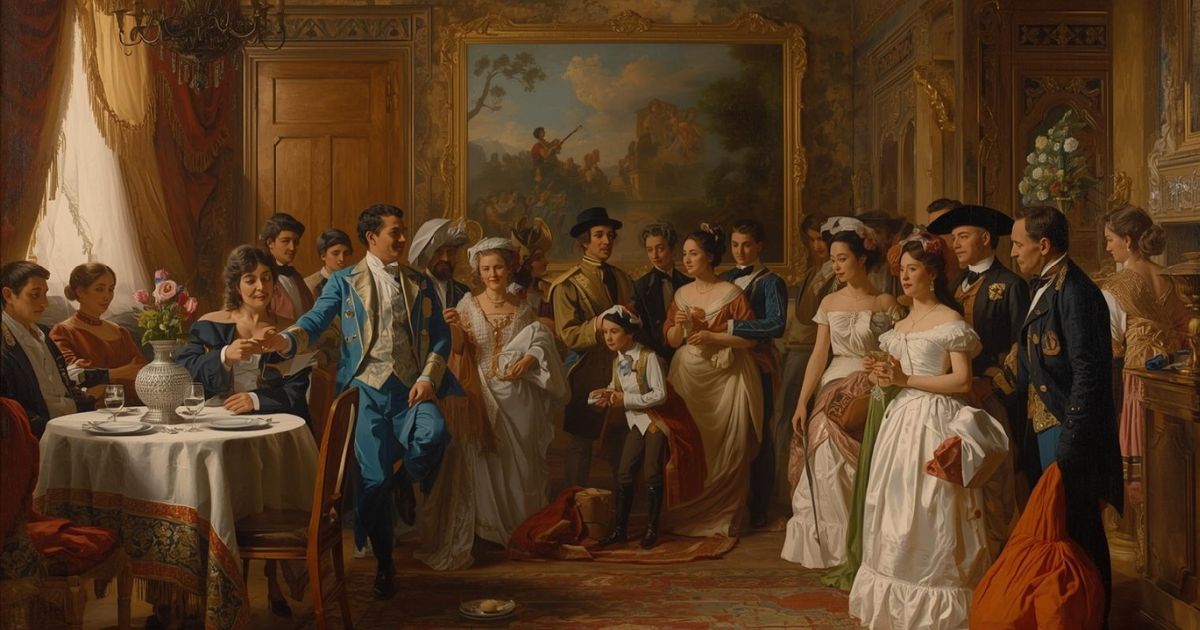
An excerpt from the original text.(complete · 4284 words)
ishing
The stars still glittered in the sapphire arch of heaven and the birds
were still sleeping among the branches when a merry party, lighted
by torches of resin, commonly called huepes, made its way through
the streets toward the lake. There were five girls, who walked along
rapidly with hands clasped or arms encircling one another's waists,
followed by some old women and by servants who were carrying gracefully
on their heads baskets of food and dishes. Looking upon the laughing
and hopeful countenances of the young women and watching the wind blow
about their abundant black hair and the wide folds of their garments,
we might have taken them for goddesses of the night fleeing from the
day, did we not know that they were Maria Clara and her four friends,
the merry Sinang, the grave Victoria, the beautiful Iday, and the
thoughtful Neneng of modest and timid beauty. They were conversing
in a lively manner, laughing and pinching one another, whispering in
one another's ears and then breaking out into loud laughter.
"You'll wake up the people who are still asleep," Aunt Isabel
scolded. "When we were young, we didn't make so much disturbance."
"Neither would you get up so early nor would the old folks have been
such sleepy-heads," retorted little Sinang.
They were silent for a short time, then tried to talk in low tones,
but soon forgot themselves and again filled the street with their
fresh young voices.
"Behave as if you were displeased and don't talk to him," Sinang was
advising Maria Clara. "Scold him so he won't get into bad habits."
"Don't be so exacting," objected Iday.
"Be exacting! Don't be foolish! He must be made to obey while he's
only engaged, for after he's your husband he'll do as he pleases,"
counseled little Sinang.
"What do you know about that, child?" her cousin Victoria corrected
her.
"Sst! Keep quiet, for here they come!"
A group of young men, lighting their way with large bamboo torches,
now came up, marching gravely along to the sound of a guitar.
"It sounds like a beggar's guitar," laughed Sinang. When the two
parties met it was the women who maintained a serious and formal
attitude, just as if they had never known how to laugh, while on the
other hand the men talked and laughed, asking six questions to get
half an answer.
"Is the lake calm? Do you think we'll have good weather?" asked
the mothers.
"Don't be alarmed, ladies, I know how to swim well," answered a tall,
thin, emaciated youth.
"We ought to have heard mass first," sighed Aunt Isabel, clasping
her hands.
"There's yet time, ma'am. Albino has been a theological student in
his day and can say it in the boat," remarked another youth, pointing
to the tall, thin one who had first spoken. The latter, who had a
clownish countenance, threw himself into an attitude of contrition,
caricaturing Padre Salvi. Ibarra, though he maintained his serious
demeanor, also joined in the merriment.
When they arrived at the beach, there involuntarily escaped from
the women exclamations of surprise and pleasure at the sight of
two large bankas fastened together and picturesquely adorned with
garlands of flowers, leaves, and ruined cotton of many colors. Little
paper lanterns hung from an improvised canopy amid flowers and
fruits. Comfortable seats with rugs and cushions for the women had
been provided by Ibarra. Even the paddles and oars were decorated,
while in the more profusely decorated banka were a harp, guitars,
accordions, and a trumpet made from a carabao horn. In the other banka
fires burned on the clay kalanes for preparing refreshments of tea,
coffee, and salabat.
"In this boat here the women, and in the other there the men," ordered
the mothers upon embarking. "Keep quiet! Don't move about so or we'll
be upset."
"Cross yourself first," advised Aunt Isabel, setting the example.
"Are we to be here all alone?" asked Sinang with a grimace. "Ourselves
alone?" This question was opportunely answered by a pinch from
her mother.
As the boats moved slowly away from the shore, the light of the
lanterns was reflected in the calm waters of the lake, while in the
eastern sky the first tints of dawn were just beginning to appear. A
deep silence reigned over the party after the division established
by the mothers, for the young people seemed to have given themselves
up to meditation.
"Take care," said Albino, the ex-theological student, in a loud tone
to another youth. "Keep your foot tight on the plug under you."
"What?"
"It might come out and let the water in. This banka has a lot of
holes in it."
"Oh, we're going to sink!" cried the frightened women.
"Don't be alarmed, ladies," the ex-theological student reassured them
to calm their fears. "The banka you are in is safe. It has only five
holes in it and they aren't large."
"Five holes! Jesús! Do you want to drown us?" exclaimed the
horrified women.
"Not more than five, ladies, and only about so large," the
ex-theological student assured them, indicating the circle formed
with his index finger and thumb. "Press hard on the plugs so that
they won't come out."
"María Santísima! The water's coming in," cried an old woman who
felt herself already getting wet.
There now arose a small tumult; some screamed, while others thought
of jumping into the water.
"Press hard on the plugs there!" repeated Albino, pointing toward
the place where the girls were.
"Where, where? Diós! We don't know how! For pity's sake come here,
for we don't know how!" begged the frightened women.
It was accordingly necessary for five of the young men to get over
into the other banka to calm the terrified mothers. But by some
strange chance it seemed that there w, as danger by the side of each
of the dalagas; all the old ladies together did not have a single
dangerous hole near them! Still more strange it was that Ibarra had
to be seated by the side of Maria Clara, Albino beside Victoria,
and so on. Quiet was restored among the solicitous mothers but not
in the circle of the young people.
As the water was perfectly still, the fish-corrals not far away,
and the hour yet early, it was decided to abandon the oars so that
all might partake of some refreshment. Dawn had now come, so the
lanterns were extinguished.
"There's nothing to compare with salabat, drunk in the morning before
going to mass," said Capitana Tika, mother of the merry Sinang. "Drink
some salabat and eat a rice-cake, Albino, and you'll see that even
you will want to pray."
"That's what I'm doing," answered the youth addressed. "I'm thinking
of confessing myself."
"No," said Sinang, "drink some coffee to bring merry thoughts."
"I will, at once, because I feel a trifle sad."
"Don't do that," advised Aunt Isabel. "Drink some tea and eat a few
crackers. They say that tea calms one's thoughts."
"I'll also take some tea and crackers," answered the complaisant youth,
"since fortunately none of these drinks is Catholicism."
"But, can you--" Victoria began.
"Drink some chocolate also? Well, I guess so, since breakfast is
not so far off."
The morning was beautiful. The water began to gleam with the light
reflected from the sky with such clearness that every object stood
revealed without producing a shadow, a bright, fresh clearness
permeated with color, such as we get a hint of in some marine
paintings. All were now merry as they breathed in the light breeze that
began to arise. Even the mothers, so full of cautions and warnings,
now laughed and joked among themselves.
"Do you remember," one old woman was saying to Capitana Tika,
"do you remember the time we went to bathe in the river, before we
were married? In little boats made from banana-stalks there drifted
down with the current fruits of many kinds and fragrant flowers. The
little boats had banners on them and each of us could see her name
on one of them."
"And when we were on our way back home?" added another, without
letting her go on. "We found the bamboo bridges destroyed and so we
had to wade the brooks. The rascals!"
"Yes, I know that I chose rather to let the borders of my skirt get
wet than to uncover my feet," said Capitana Tika, "for I knew that
in the thickets on the bank there were eyes watching us."
Some of the girls who heard these reminiscences winked and smiled,
while the others were so occupied with their own conversations that
they took no notice.
One man alone, he who performed the duty of pilot, remained silent and
removed from all the merriment. He was a youth of athletic build and
striking features, with large, sad eyes and compressed lips. His black
hair, long and unkempt, fell over a stout neck. A dark striped shirt
afforded a suggestion through its folds of the powerful muscles that
enabled the vigorous arms to handle as if it were a pen the wide and
unwieldy paddle which' served as a rudder for steering the two bankas.
Maria Clara had more than once caught him looking at her, but on such
occasions he had quickly turned his gaze toward the distant mountain
or the shore. The young woman was moved with pity at his loneliness
and offered him some crackers. The pilot gave her a surprised stare,
which, however, lasted for only a second. He took a cracker and
thanked her briefly in a scarcely audible voice. After this no one
paid any more attention to him. The sallies and merry laughter of the
young folks caused not the slightest movement in the muscles of his
face. Even the merry Sinang did not make him smile when she received
pinchings that caused her to wrinkle up her eyebrows for an instant,
only to return to her former merry mood.
The lunch over, they proceeded on their way toward the fish-corrals,
of which there were two situated near each other, both belonging
to Capitan Tiago. From afar were to be seen some herons perched
in contemplative attitude on the tops of the bamboo posts, while
a number of white birds, which the Tagalogs call kalaway, flew
about in different directions, skimming the water with their wings
and filling the air with shrill cries. At the approach of the bankas
the herons took to flight, and Maria Clara followed them with her
gaze as they flew in the direction of the neighboring mountain.
"Do those birds build their nests on the mountain?" she asked the
pilot, not so much from a desire to know as for the purpose of making
him talk.
"Probably they do, señora," he answered, "but no one up to this time
has ever seen their nests."
"Don't they have nests?"
"I suppose they must have them, otherwise they would be very
unfortunate."
Maria Clara did not notice the tone of sadness with which he uttered
these words. "Then--"
"It is said, señora," answered the strange youth, "that the nests of
those birds are invisible and that they have the power of rendering
invisible any one who possesses one of them. Just as the soul can
only be seen in the pure mirror of the eyes, so also in the mirror
of the water alone can their nests be looked upon."
Maria Clara became sad and thoughtful. Meanwhile, they had reached
the first fish-corral and an aged boatman tied the craft to a post.
"Wait!" called Aunt Isabel to the son of the fisherman, who was getting
ready to climb upon the platform of the corral with his panalok,
or fish-net fastened on the end of a stout bamboo pole. "We must get
the sinigang ready so that the fish may pass at once from the water
into the soup."
"Kind Aunt Isabel!" exclaimed the ex-theological student. "She doesn't
want the fish to miss the water for an instant!"
Andeng, Maria Clara's foster-sister, in spite of her carefree and happy
face, enjoyed the reputation of being an excellent cook, so she set
about preparing a soup of rice and vegetables, helped and hindered by
some of the young men, eager perhaps to win her favor. The other young
women all busied themselves in cutting up and washing the vegetables.
In order to divert the impatience of those who were waiting to see the
fishes taken alive and wriggling from their prison, the beautiful Iday
got out the harp, for Iday not only played well on that instrument,
but, besides, she had very pretty fingers. The young people applauded
and Maria Clara kissed her, for the harp is the most popular instrument
in that province, and was especially suited to this occasion.
"Sing the hymn about marriage," begged the old women. The men protested
and Victoria, who had a fine voice, complained of hoarseness. The "Hymn
of Marriage" is a beautiful Tagalog chant in which are set forth the
cares and sorrows of the married state, yet not passing over its joys.
They then asked Maria Clara to sing, but she protested that all her
songs were sad ones. This protest, however, was overruled so she held
back no longer. Taking the harp, she played a short prelude and then
sang in a harmonious and vibrating voice full of feeling:
Sweet are the hours in one's native land,
Where all is dear the sunbeams bless;
Life-giving breezes sweep the strand,
And death is soften'd by love's caress.
Warm kisses play on mother's lips,
On her fond, tender breast awaking;
When round her neck the soft arm slips,
And bright eyes smile, all love partaking.
Sweet is death for one's native land,
Where all is dear the sunbeams bless;
Dead is the breeze that sweeps the strand,
Without a mother, home, or love's caress.
The song ceased, the voice died away, the harp became silent, and they
still listened; no one applauded. The young women felt their eyes
fill with tears, and Ibarra seemed to be unpleasantly affected. The
youthful pilot stared motionless into the distance.
Suddenly a thundering roar was heard, such that the women screamed and
covered their ears; it was the ex-theological student blowing with all
the strength of his lungs on the tambuli, or carabao horn. Laughter
and cheerfulness returned while tear-dimmed eyes brightened. "Are
you trying to deafen us, you heretic?" cried Aunt Isabel.
"Madam," replied the offender gravely, "I once heard of a poor
trumpeter on the banks of the Rhine who, by playing on his trumpet,
won in marriage a rich and noble maiden."
"That's right, the trumpeter of Sackingen!" exclaimed Ibarra, unable
to resist taking part in the renewed merriment.
"Do you hear that?" went on Albino. "Now I want to see if I can't
have the same luck." So saying, he began to blow with even more force
into the resounding horn, holding it close to the ears of the girls
who looked saddest. As might be expected, a small tumult arose and
the mothers finally reduced him to silence by beating him with their
slippers [71] and pinching him.
"My, oh my!" he complained as he felt of his smarting arms, "what
a distance there is between the Philippines and the banks of the
Rhine! O tempora! O mores! Some are given honors and others
sanbenitos!"
All laughed at this, even the grave Victoria, while Sinang, she of
the smiling eyes, whispered to Maria Clara, "Happy girl! I, too,
would sing if I could!"
Andeng at length announced that the soup was ready to receive its
guests, so the young fisherman climbed up into the pen placed at
the narrower end of the corral, over which might be written for the
fishes, were they able to read and understand Italian, "Lasciate ogni
speranza voi ch' entrante," [72] for no fish that gets in there is
ever released except by death. This division of the corral encloses
a circular space so arranged that a man can stand on a platform in
the upper part and draw the fish out with a small net.
"I shouldn't get tired fishing there with a pole and line," commented
Sinang, trembling with pleasant anticipation.
All were now watching and some even began to believe that they saw
the fishes wriggling about in the net and showing their glittering
scales. But when the youth lowered his net not a fish leaped up.
"It must be full," whispered Albino, "for it has been over five days
now since it was visited."
The fisherman drew in his net, but not even a single little fish
adorned it. The water as it fell back in glittering drops reflecting
the sunlight seemed to mock his efforts with a silvery smile. An
exclamation of surprise, displeasure, and disappointment escaped from
the lips of all. Again the youth repeated the operation, but with no
better result.
"You don't understand your business," said Albino, climbing up into
the pen of the corral and taking the net from the youth's hands. "Now
you'll see! Andeng, get the pot ready!"
But apparently Albino did not understand the business either, for
the net again came up empty. All broke out into laughter at him.
"Don't make so much noise that the fish can hear and so not let
themselves be caught. This net must be torn." But on examination all
the meshes of the net appeared to be intact.
"Give it to me," said Leon, Iday's sweetheart. He assured himself
that the fence was in good condition, examined the net and being
satisfied with it, asked, "Are you sure that it hasn't been visited
for five days?"
"Very sure! The last time was on the eve of All Saints."
"Well then, either the lake is enchanted or I'll draw up something."
Leon then dropped the pole into the water and instantly astonishment
was pictured on his countenance. Silently he looked off toward the
mountain and moved the pole about in the water, then without raising
it murmured in a low voice:
"A cayman!"
"A cayman!" repeated everyone, as the word ran from mouth to mouth
in the midst of fright and general surprise.
"What did you say?" they asked him.
"I say that we're caught a cayman," Leon assured them, and as he
dropped the heavy end of the pole into the water, he continued:
"Don't you hear that sound? That's not sand, but a tough hide, the
back of a cayman. Don't you see how the posts shake? He's pushing
against them even though he is all rolled up. Wait, he's a big one,
his body is almost a foot or more across."
"What shall we do?" was the question.
"Catch him!" prompted some one.
"Heavens! And who'll catch him?"
No one offered to go down into the trap, for the water was deep.
"We ought to tie him to our banka and drag him along in triumph,"
suggested Sinang. "The idea of his eating the fish that we were going
to eat!"
"I have never yet seen a live cayman," murmured Maria Clara.
The pilot arose, picked up a long rope, and climbed nimbly up on the
platform, where Leon made room for him. With the exception of Maria
Clara, no one had taken any notice of him, but now all admired his
shapely figure. To the great surprise of all and in spite of their
cries, he leaped down into the enclosure.
"Take this knife!" called Crisostomo to him, holding out a wide Toledo
blade, but already the water was splashing up in a thousand jets and
the depths closed mysteriously.
"Jesús, María, y José!" exclaimed the old women. "We're going to
have an accident!"
"Don't be uneasy, ladies," said the old boatman, "for if there is
any one in the province who can do it, he's the man."
"What's his name?" they asked.
"We call him 'The Pilot' and he's the best I've ever seen, only he
doesn't like the business."
The water became disturbed, then broke into ripples, the fence shook;
a struggle seemed to be going on in the depths. All were silent
and hardly breathed. Ibarra grasped the handle of the sharp knife
convulsively.
Now the struggle seemed to be at an end and the head of the youth
appeared, to be greeted with joyful cries. The eyes of the old women
filled with tears. The pilot climbed up with one end of the rope in
his hand and once on the platform began to pull on it. The monster
soon appeared above the water with the rope tied in a double band
around its neck and underneath its front legs. It was a large one,
as Leon had said, speckled, and on its back grew the green moss which
is to the caymans what gray hairs are to men. Roaring like a bull and
beating its tail against or catching hold of the sides of the corral,
it opened its huge jaws and showed its long, sharp teeth. The pilot
was hoisting it alone, for no one had thought to assist him.
Once out of the water and resting on the platform, he placed his
foot upon it and with his strong hands forced its huge jaws together
and tried to tie its snout with stout knots. With a last effort the
reptile arched its body, struck the floor with its powerful tail,
and jerking free, hurled itself with one leap into the water outside
the corral, dragging its captor along with it. A cry of horror broke
from the lips of all. But like a flash of lightning another body shot
into the water so quickly that there was hardly time to realize that
it was Ibarra. Maria Clara did not swoon only for the reason that
the Filipino women do not yet know how to do so.
The anxious watchers saw the water become colored and dyed with
blood. The young fisherman jumped down with his bolo in his hand and
was followed by his father, but they had scarcely disappeared when
Crisostomo and the pilot reappeared clinging to the dead body of the
reptile, which had the whole length of its white belly slit open and
the knife still sticking in its throat.
To describe the joy were impossible, as a dozen arms reached out to
drag the young men from the water. The old women were beside themselves
between laughter and prayers. Andeng forgot that her sinigang
had boiled over three times, spilling the soup and putting out the
fire. The only one who could say nothing was Maria Clara.
Ibarra was uninjured, while the pilot had only a slight scratch on
his arm. "I owe my life to you," said the latter to Ibarra, who was
wrapping himself up in blankets and cloths. The pilot's voice seemed
to have a note of sadness in it.
"You are too daring," answered Ibarra. "Don't tempt fate again."
"If you had not come up again--" murmured the still pale and trembling
Maria Clara.
"If I had not come up and you had followed me," replied Ibarra,
completing the thought in his own way, "in the bottom of the lake,
I should still have been with my family!" He had not forgotten that
there lay the bones of his father.
The old women did not want to visit the other corral but wished to
return, saying that the day had begun inauspiciously and that many more
accidents might occur. "All because we didn't hear mass," sighed one.
"But what accident has befallen us, ladies?" asked Ibarra. "The cayman
seems to have been the only unlucky one."
"All of which proves," concluded the ex-student of theology, "that
in all its sinful life this unfortunate reptile has never attended
mass--at least, I've never seen him among the many other caymans that
frequent the church."
So the boats were turned in the direction of the other corral and
Andeng had to get her sinigang ready again. The day was now well
advanced, with a fresh breeze blowing. The waves curled up behind the
body of the cayman, raising "mountains of foam whereon the smooth,
rich sunlight glitters," as the poet says. The music again resounded;
Iday played on the harp, while the men handled the accordions and
guitars with greater or less skill. The prize-winner was Albino, who
actually scratched the instruments, getting out of tune and losing
the time every moment or else forgetting it and changing to another
tune entirely different.
The second corral was visited with some misgivings, as many expected to
find there the mate of the dead cayman, but nature is ever a jester,
and the nets came up full at each haul. Aunt Isabel superintended
the sorting of the fish and ordered that some be left in the trap for
decoys. "It's not lucky to empty the corral completely," she concluded.
Then they made their way toward the shore near the forest of old trees
that belonged to Ibarra. There in the shade by the clear waters of the
brook, among the flowers, they ate their breakfast under improvised
canopies. The space was filled with music while the smoke from the
fires curled up in slender wreaths. The water bubbled cheerfully in
the hot dishes as though uttering sounds of consolation, or perchance
of sarcasm and irony, to the dead fishes. The body of the cayman
writhed about, sometimes showing its torn white belly and again its
speckled greenish back, while man, Nature's favorite, went on his
way undisturbed by what the Brahmins and vegetarians would call so
many cases of fratricide.
Master this chapter. Complete your experience
Purchase the complete book to access all chapters and support classic literature
As an Amazon Associate, we earn a small commission from qualifying purchases at no additional cost to you.
Available in paperback, hardcover, and e-book formats
Let's Analyse the Pattern
Dangerous or high-pressure situations strip away social pretenses and reveal people's true character and priorities.
Why This Matters
Connect literature to life
This chapter teaches how crisis moments strip away social performance and reveal who people really are underneath.
Practice This Today
This week, notice when small crises hit your workplace or family - watch who steps forward to help and who finds reasons to step back, then adjust your trust accordingly.
Now let's explore the literary elements.
Key Quotes & Analysis
"When we were young, we didn't make so much disturbance."
Context: Scolding the girls for being too loud and boisterous on their way to the lake
Shows the generational tension between propriety and natural youthful energy. Aunt Isabel represents the older generation's need to control and contain, while the girls represent life breaking through social constraints.
In Today's Words:
Back in my day, we knew how to behave ourselves.
"Neither would you get up so early nor would the old folks have been such sleepy-heads."
Context: Her quick retort to Aunt Isabel's criticism about making noise
Demonstrates Sinang's wit and the younger generation's refusal to be shamed. She turns the criticism back on the adults, suggesting they lack the energy and spirit of youth.
In Today's Words:
Yeah, well, at least we're not too old and tired to have fun.
"Looking upon the laughing and hopeful countenances of the young women and watching the wind blow about their abundant black hair and the wide folds of their garments, we might have taken them for goddesses of the night fleeing from the day."
Context: Describing the girls as they walk through the pre-dawn streets
Elevates these ordinary young women to mythical status, suggesting their beauty and vitality connect them to something larger than their social circumstances. The imagery emphasizes their freedom and natural grace.
In Today's Words:
They looked so beautiful and alive in the early morning light, you'd think they were something magical.
Thematic Threads
Class
In This Chapter
Social barriers dissolve when the pilot and Ibarra work together against the cayman, showing how crisis can temporarily erase class distinctions
Development
Evolved from earlier chapters showing rigid class separation to moments where shared danger creates temporary equality
In Your Life:
You might notice how workplace emergencies reveal who actually helps versus who maintains hierarchy even in crisis
Identity
In This Chapter
The mysterious pilot's true capabilities emerge through action rather than social position or reputation
Development
Builds on themes of hidden identity and the gap between public persona and private reality
In Your Life:
You might recognize how crisis situations allow you to show abilities that normal social roles don't reveal
Social Expectations
In This Chapter
The careful separation of men and women breaks down completely when real danger threatens, showing how artificial many social rules are
Development
Continues the pattern of social conventions being maintained until they become impractical
In Your Life:
You might see how emergency situations make normal workplace or family protocols seem suddenly irrelevant
Personal Growth
In This Chapter
Ibarra proves his character through action, moving beyond the cautious reformer to someone willing to risk everything for others
Development
Shows Ibarra's evolution from careful social navigation to authentic moral action
In Your Life:
You might find that stepping up in crisis moments teaches you more about your own capabilities than years of routine
Human Relationships
In This Chapter
Maria Clara's fear for Ibarra reveals her true feelings despite social pressure to remain composed and distant
Development
Shows how genuine emotion breaks through the careful courtship rituals established earlier
In Your Life:
You might notice how crisis reveals which relationships are based on genuine care versus social convenience
You now have the context. Time to form your own thoughts.
Discussion Questions
- 1
What changed about how people saw the pilot and Ibarra after the cayman incident?
analysis • surface - 2
Why did the social rules and careful manners disappear when real danger appeared?
analysis • medium - 3
Think of a crisis at your workplace or in your family - who stepped up and who stepped back?
application • medium - 4
How do you prepare yourself to be someone who shows up when others need help, even when it's risky?
application • deep - 5
What does this fishing trip teach us about the difference between who people appear to be and who they really are?
reflection • deep
Critical Thinking Exercise
Crisis Character Map
Think of three people in your life - family, friends, or coworkers. Based on how they've handled past emergencies or stressful situations, predict how each would respond if you had a real crisis tomorrow. Write down their name and your honest prediction of their likely response.
Consider:
- •Look at their past actions, not their words or promises
- •Consider both big emergencies and small everyday problems
- •Think about whether they protect themselves first or help others first
Journaling Prompt
Write about a time when someone surprised you during a difficult moment - either by stepping up when you didn't expect it, or by disappearing when you thought they'd help. What did that teach you about reading people's true character?
Coming Up Next...
Chapter 24: Secrets in the Forest
The group moves to the forest for their meal, where the natural setting and recent excitement create new opportunities for private conversations and deeper revelations among the young people.



