
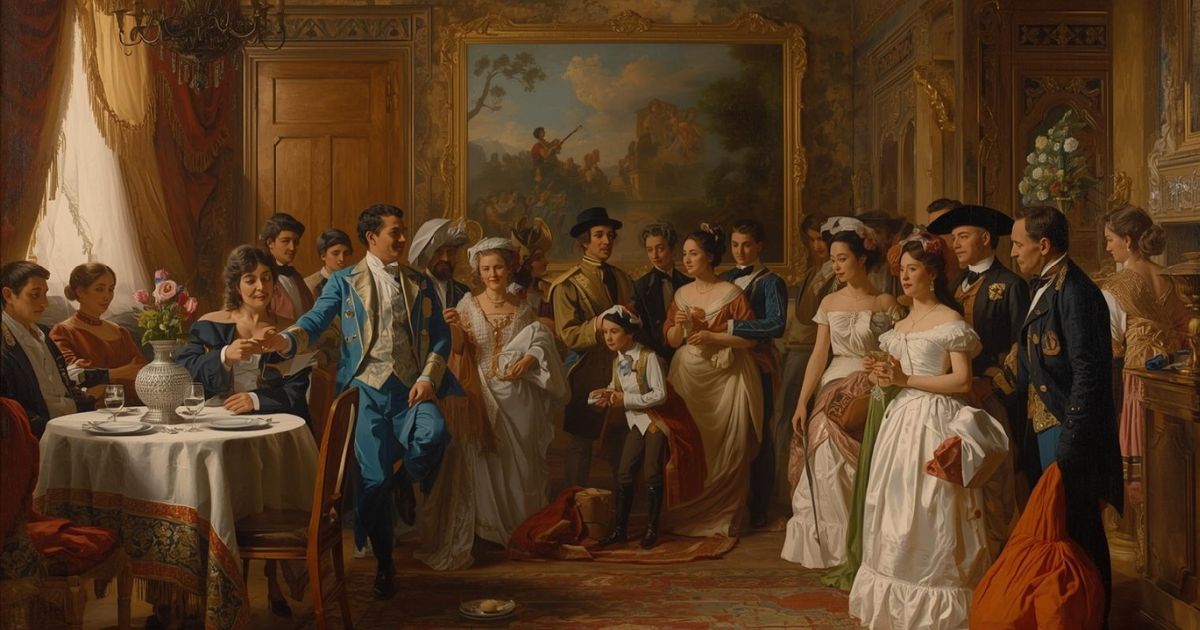
An excerpt from the original text.(complete · 1153 words)
ights and Shadows
Three days have passed since the events narrated, three days which
the town of San Diego has devoted to making preparations for the
fiesta, commenting and murmuring at the same time. While all were
enjoying the prospect of the pleasures to come, some spoke ill of the
gobernadorcillo, others of the teniente-mayor, others of the young men,
and there were not lacking those who blamed everybody for everything.
There was a great deal of comment on the arrival of Maria Clara,
accompanied by her Aunt Isabel. All rejoiced over it because they loved
her and admired her beauty, while at the same time they wondered at the
change that had come over Padre Salvi. "He often becomes inattentive
during the holy services, nor does he talk much with us, and he is
thinner and more taciturn than usual," commented his penitents. The
cook noticed him getting thinner and thinner by minutes and complained
of the little honor that was done to his dishes. But that which caused
the most comment among the people was the fact that in the convento
were to be seen more than two lights burning during the evening while
Padre Salvi was on a visit to a private dwelling--the home of Maria
Clara! The pious women crossed themselves but continued their comments.
Ibarra had telegraphed from the capital of the province welcoming Aunt
Isabel and her niece, but had failed to explain the reason for his
absence. Many thought him a prisoner on account of his treatment of
Padre Salvi on the afternoon of All Saints, but the comments reached
a climax when, on the evening of the third day, they saw him alight
before the home of his fiancée and extend a polite greeting to the
priest, who was just entering the same house.
Sisa and her sons were forgotten by all.
If we should now go into the home of Maria Clara, a beautiful nest
set among trees of orange and ilang-ilang, we should surprise the two
young people at a window overlooking the lake, shadowed by flowers
and climbing vines which exhaled a delicate perfume. Their lips
murmured words softer than the rustling of the leaves and sweeter
than the aromatic odors that floated through the garden. It was the
hour when the sirens of the lake take advantage of the fast falling
twilight to show their merry heads above the waves to gaze upon the
setting sun and sing it to rest. It is said that their eyes and hair
are blue, and that they are crowned with white and red water plants;
that at times the foam reveals their shapely forms, whiter than
the foam itself, and that when night descends completely they begin
their divine sports, playing mysterious airs like those of Æolian
harps. But let us turn to our young people and listen to the end of
their conversation. Ibarra was speaking to Maria Clara.
"Tomorrow before daybreak your wish shall be fulfilled. I'll arrange
everything tonight so that nothing will be lacking."
"Then I'll write to my girl friends to come. But arrange it so that
the curate won't be there."
"Why?"
"Because he seems to be watching me. His deep, gloomy eyes trouble
me, and when he fixes them on me I'm afraid. When he talks to me, his
voice--oh, he speaks of such odd, such strange, such incomprehensible
things! He asked me once if I have ever dreamed of letters from my
mother. I really believe that he is half-crazy. My friend Sinang and
my foster-sister, Andeng, say that he is somewhat touched, because
he neither eats nor bathes and lives in darkness. See to it that he
does not come!"
"We can't do otherwise than invite him," answered Ibarra
thoughtfully. "The customs of the country require it. He is in your
house and, besides, he has conducted himself nobly toward me. When
the alcalde consulted him about the business of which I've told you,
he had only praises for me and didn't try to put the least obstacle
in the way. But I see that you're serious about it, so cease worrying,
for he won't go in the same boat with us."
Light footsteps were heard. It was the curate, who approached with a
forced smile on his lips. "The wind is chilly," he said, "and when
one catches cold one generally doesn't get rid of it until the hot
weather. Aren't you afraid of catching cold?" His voice trembled
and his eyes were turned toward the distant horizon, away from the
young people.
"No, we rather find the night pleasant and the breeze delicious,"
answered Ibarra. "During these months we have our autumn and our
spring. Some leaves fall, but the flowers are always in bloom."
Fray Salvi sighed.
"I think the union of these two seasons beautiful, with no cold winter
intervening," continued Ibarra. "In February the buds on the trees
will burst open and in March we'll have the ripe fruit. When the hot
month's come we shall go elsewhere."
Fray Salvi smiled and began to talk of commonplace things, of the
weather, of the town, and of the fiesta. Maria Clara slipped away on
some pretext.
"Since we are talking of fiestas, allow me to invite you to the one
that we are going to celebrate tomorrow. It is to be a picnic in the
woods, which we and our friends are going to hold together."
"Where will it be held?"
"The young women wish to hold it by the brook in the neighboring wood,
near to the old balete, so we shall rise early to avoid the sun."
The priest thought a moment and then answered: "The invitation is
very tempting and I accept it to prove to you that I hold no rancor
against you. But I shall have to go late, after I've attended to my
duties. Happy are you who are free, entirely free."
A few moments later Ibarra left in order to look after the arrangements
for the picnic on the next day. The night was dark and in the street
some one approached and saluted him respectfully.
"Who are you?" asked Ibarra.
"Sir, you don't know my name," answered the unknown, "but I've been
waiting for you two days."
"For what purpose?"
"Because nowhere has any pity been shown me and they say that I'm an
outlaw, sir. But I've lost my two sons, my wife is insane, and every
one says that I deserve what has happened to me."
Ibarra looked at the man critically as he asked, "What do you want
now?"
"To beg for your pity upon my wife and sons."
"I can't stop now," replied Ibarra. "If you wish to come, you can
tell me as we go along what has happened to you."
The man thanked him, and the two quickly disappeared in the shadows
along the dimly lighted street.
Master this chapter. Complete your experience
Purchase the complete book to access all chapters and support classic literature
As an Amazon Associate, we earn a small commission from qualifying purchases at no additional cost to you.
Available in paperback, hardcover, and e-book formats
Let's Analyse the Pattern
A recurring theme explored in this chapter.
Why This Matters
Connect literature to life
This chapter teaches how communities unconsciously decide whose problems matter and whose can be ignored.
Practice This Today
This week, notice when workplace gossip focuses on entertaining drama while real struggles go unmentioned - then deliberately ask about the quiet person.
Now let's explore the literary elements.
Key Quotes & Analysis
"He often becomes inattentive during the holy services, nor does he talk much with us, and he is thinner and more taciturn than usual."
Context: The townspeople discussing Padre Salvi's strange behavior since Maria Clara's arrival
This shows how a community notices when someone in authority starts acting differently. The priest's obsession is affecting his professional duties, but people don't yet understand the disturbing reason behind his distraction.
In Today's Words:
He's been acting weird lately - distracted at work, not talking to anyone, and he looks like he's losing weight.
"The pious women crossed themselves but continued their comments."
Context: Describing the townswomen's reaction to gossip about the priest's nighttime visits
This perfectly captures how people react to scandalous behavior from authority figures - they're shocked enough to make religious gestures, but not shocked enough to stop gossiping about it.
In Today's Words:
They acted all shocked and scandalized, but they kept right on talking about it anyway.
"I have lost my sons, my wife has gone mad, and everyone blames me for my misfortunes."
Context: The man approaching Ibarra in the street, revealing his tragic situation
This reveals how communities often blame victims for their own tragedies. When terrible things happen to people, others distance themselves by deciding the victims must have done something to deserve it.
In Today's Words:
My life has completely fallen apart, and instead of helping me, everyone acts like it's all my fault.
Thematic Threads
Social Invisibility
In This Chapter
Sisa and her sons are completely forgotten while the town gossips about others
Development
Builds on earlier class divisions, showing how communities actively choose to ignore certain people
In Your Life:
Notice who gets overlooked in your workplace, family gatherings, or community discussions
Abuse of Authority
In This Chapter
Padre Salvi uses his religious position to inappropriately pursue Maria Clara
Development
Escalates from earlier hints of clerical corruption to direct personal exploitation
In Your Life:
Watch for supervisors, doctors, or leaders who exploit their position for personal gain
Community Gossip
In This Chapter
The town buzzes with speculation about Padre Salvi's behavior and Ibarra's return
Development
Shows how gossip serves as social control and entertainment in small communities
In Your Life:
Consider what your workplace or neighborhood gossip reveals about shared values and fears
Protective Instincts
In This Chapter
Maria Clara feels uncomfortable with Padre Salvi and asks Ibarra to keep them separated
Development
Introduces theme of women recognizing and trying to protect themselves from predatory behavior
In Your Life:
Trust your instincts when someone in authority makes you uncomfortable, even if you can't name why
You now have the context. Time to form your own thoughts.
Discussion Questions
- 1
Why does the whole town notice and gossip about Padre Salvi's strange behavior, but completely forget about Sisa and her missing sons?
analysis • surface - 2
What makes Maria Clara uncomfortable about Padre Salvi's attention, and why does she insist he not join their picnic?
analysis • medium - 3
Where do you see this pattern of selective attention in your workplace, school, or community - focusing on entertaining drama while ignoring real suffering?
application • medium - 4
If you were in Ibarra's position and noticed how the community treats different people's problems, what would you do to address this unfairness?
application • deep - 5
What does this chapter reveal about how communities decide whose voices matter and whose can be safely ignored?
reflection • deep
Critical Thinking Exercise
Map Your Community's Invisible People
Think about your workplace, neighborhood, or social circle. List three people whose problems get lots of attention and discussion, then list three people whose struggles are rarely mentioned or acknowledged. Consider what makes the difference between visible and invisible suffering in your environment.
Consider:
- •Notice who has social power or entertainment value versus who doesn't
- •Consider whether helping visible problems feels easier or more rewarding
- •Think about your own role in maintaining these patterns of attention
Journaling Prompt
Write about a time when you felt invisible or ignored when you needed support. What would have made the difference? How can you use that experience to notice and reach out to others who might be overlooked?
Coming Up Next...
Chapter 23: The Fishing Trip
The picnic begins with friends gathering by the brook near an ancient balete tree, but this seemingly innocent outing will reveal hidden tensions and set dangerous events in motion.



