
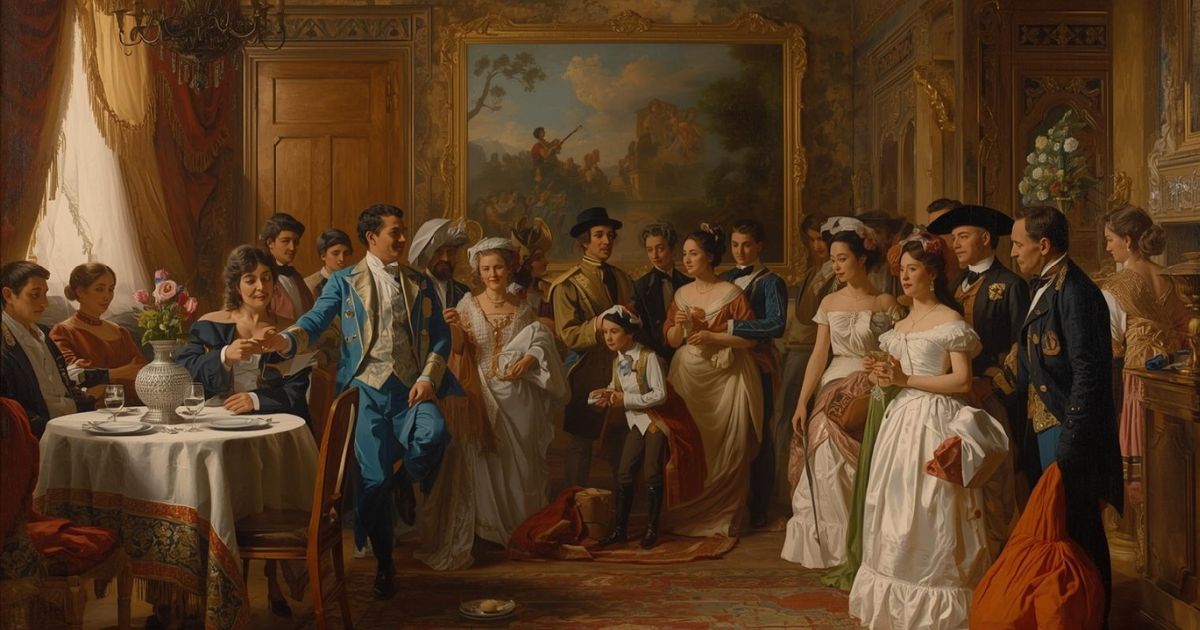
An excerpt from the original text.(complete · 2420 words)
orrespondence
Cada uno habla de la feria como le va en ella. [82]
As nothing of importance to our characters happened during the
first two days, we should gladly pass on to the third and last,
were it not that perhaps some foreign reader may wish to know how the
Filipinos celebrate their fiestas. For this reason we shall faithfully
reproduce in this chapter several letters, one of them being that
of the correspondent of a noted Manila newspaper, respected for its
grave tone and deep seriousness. Our readers will correct some natural
and trifling slips of the pen. Thus the worthy correspondent of the
respectable newspaper wrote:
"TO THE EDITOR, MY DISTINGUISHED FRIEND,--Never did I witness,
nor had I ever expected to see in the provinces, a religious
fiesta so solemn, so splendid, and so impressive as that
now being celebrated in this town by the Most Reverend and
virtuous Franciscan Fathers.
"Great crowds are in attendance. I have here had the pleasure
of greeting nearly all the Spaniards who reside in this
province, three Reverend Augustinian Fathers from the province
of Batangas, and two Reverend Dominican Fathers. One of the
latter is the Very Reverend Fray Hernando Sibyla, who has come
to honor this town with his presence, a distinction which its
worthy inhabitants should never forget. I have also seen a
great number of the best people of Cavite and Pampanga, many
wealthy persons from Manila, and many bands of music,--among
these the very artistic one of Pagsanhan belonging to
the escribano, Don Miguel Guevara,--swarms of Chinamen and
Indians, who, with the curiosity of the former and the piety
of the latter, awaited anxiously the day on which was to be
celebrated the comic-mimic-lyric-lightning-change-dramatic
spectacle, for which a large and spacious theater had been
erected in the middle of the plaza.
"At nine on the night of the 10th, the eve of the fiesta,
after a succulent dinner set before us by the hermano mayor,
the attention of all the Spaniards and friars in the convento
was attracted by strains of music from a surging multitude
which, with the noise of bombs and rockets, preceded by
the leading citizens of the town, came to the convento to
escort us to the place prepared and arranged for us that we
might witness the spectacle. Such a courteous offer we had to
accept, although I should have preferred to rest in the arms
of Morpheus and repose my weary limbs, which were aching,
thanks to the joltings of the vehicle furnished us by the
gobernadorcillo of B----.
"Accordingly we joined them and proceeded to look for our
companions, who were dining in the house, owned here by the
pious and wealthy Don Santiago de los Santos. The curate of
the town, the Very Reverend Fray Bernardo Salvi, and the Very
Reverend Fray Damaso Verdolagas, who is now by the special
favor of Heaven recovered from the suffering caused him by
an impious hand, in company with the Very Reverend Fray
Hernando Sibyla and the virtuous curate of Tanawan, with
other Spaniards, were guests in the house of the Filipino
Croesus. There we had the good fortune of admiring not only
the luxury and good taste of the host, which are not usual
among the natives, but also the beauty of the charming
and wealthy heiress, who showed herself to be a polished
disciple of St. Cecelia by playing on her elegant piano,
with a mastery that recalled Galvez to me, the best German
and Italian compositions. It is a matter of regret that such
a charming young lady should be so excessively modest as to
hide her talents from a society which has only admiration
for her. Nor should I leave unwritten that in the house
of our host there were set before us champagne and fine
liqueurs with the profusion and splendor that characterize
the well-known capitalist.
"We attended the spectacle. You already know our artists,
Ratia, Carvajal, and Fernandez, whose cleverness was
comprehended by us alone, since the uncultured crowd did
not understand a jot of it. Chananay and Balbino were very
good, though a little hoarse; the latter made one break,
but together, and as regards earnest effort, they were
admirable. The Indians were greatly pleased with the Tagalog
drama, especially the gobernadorcillo, who rubbed his hands
and informed us that it was a pity that they had not made the
princess join in combat with the giant who had stolen her
away, which in his opinion would have been more marvelous,
especially if the giant had been represented as vulnerable
only in the navel, like a certain Ferragus of whom the stories
of the Paladins tell. The Very Reverend Fray Damaso, in his
customary goodness of heart, concurred in this opinion, and
added that in such case the princess should be made to discover
the giant's weak spot and give him the coup de grace.
"Needless to tell you that during the show the affability
of the Filipino Rothschild allowed nothing to be lacking:
ice-cream, lemonade, wines, and refreshments of all kinds
circulated profusely among us. A matter of reasonable and
special note was the absence of the well-known and cultured
youth, Don Juan Crisostomo Ibarra, who, as you know, will
tomorrow preside at the laying of the corner-stone for the
great edifice which he is so philanthropically erecting. This
worthy descendant of the Pelayos and Elcanos (for I have
learned that one of his paternal ancestors was from our heroic
and noble northern provinces, perhaps one of the companions
of Magellan or Legazpi) did not show himself during the
entire day, owing to a slight indisposition. His name runs
from mouth to mouth, being uttered with praises that can only
reflect glory upon Spain and true Spaniards like ourselves,
who never deny our blood, however mixed it may be.
"Today, at eleven o'clock in the morning, we attended a
deeply-moving spectacle. Today, as is generally known, is
the fiesta of the Virgin of Peace and is being observed by
the Brethren of the Holy Rosary. Tomorrow will occur the
fiesta of the patron, San Diego, and it will be observed
principally by the Venerable Tertiary Order. Between these
two societies there exists a pious rivalry in serving God,
which piety has reached the extreme of holy quarrels among
them, as has just happened in the dispute over the preacher of
acknowledged fame, the oft-mentioned Very Reverend Fray Damaso,
who tomorrow will occupy the pulpit of the Holy Ghost with
a sermon, which, according to general expectation, will be
a literary and religious event.
"So, as we were saying, we attended a highly edifying
and moving spectacle. Six pious youths, three to recite the
mass and three for acolytes, marched out of the sacristy and
prostrated themselves before the altar, while the officiating
priest, the Very Reverend Fray Hernando Sibyla, chanted the
Surge Domine--the signal for commencing the procession
around the church--with the magnificent voice and religious
unction that all recognize and that make him so worthy of
general admiration. When the Surge Domine was concluded,
the gobernadorcillo, in a frock coat, carrying the standard
and followed by four acolytes with incense-burners, headed
the procession. Behind them came the tall silver candelabra,
the municipal corporation, the precious images dressed in satin
and gold, representing St. Dominic and the Virgin of Peace in a
magnificent blue robe trimmed with gilded silver, the gift of
the pious ex-gobernadorcillo, the so-worthy-of-being-imitated
and never-sufficiently-praised Don Santiago de los Santos. All
these images were borne on silver cars. Behind the Mother of
God came the Spaniards and the rest of the clergy, while the
officiating priest was protected by a canopy carried by the
cabezas de barangay, and the procession was closed by a squad
of the worthy Civil Guard. I believe it unnecessary to state
that a multitude of Indians, carrying lighted candles with
great devotion, formed the two lines of the procession. The
musicians played religious marches, while bombs and pinwheels
furnished repeated salutes. It causes admiration to see the
modesty and the fervor which these ceremonies inspire in the
hearts of the true believers, the grand, pure faith professed
for the Virgin of Peace, the solemnity and fervent devotion
with which such ceremonies are performed by those of us who
have had the good fortune to be born under the sacrosanct
and immaculate banner of Spain.
"The procession concluded, there began the mass rendered by
the orchestra and the theatrical artists. After the reading
of the Gospel, the Very Reverend Fray Manuel Martin, an
Augustinian from the province of Batangas, ascended the
pulpit and kept the whole audience enraptured and hanging
on his words, especially the Spaniards, during the exordium
in Castilian, as he spoke with vigor and in such flowing
and well-rounded periods that our hearts were filled with
fervor and enthusiasm. This indeed is the term that should
be used for what is felt, or what we feel, when the Virgin
of our beloved Spain is considered, and above all when there
can be intercalated in the text, if the subject permits,
the ideas of a prince of the Church, the Señor Monescillo,
[83] which are surely those of all Spaniards.
"At the conclusion of the services all of us went up into
the convento with the leading citizens of the town and other
persons of note. There we were especially honored by the
refinement, attention, and prodigality that characterize the
Very Reverend Fray Salvi, there being set before us cigars
and an abundant lunch which the hermano mayor had prepared
under the convento for all who might feel the necessity for
appeasing the cravings of their stomachs.
"During the day nothing has been lacking to make the fiesta
joyous and to preserve the animation so characteristic of
Spaniards, and which it is impossible to restrain on such
occasions as this, showing itself sometimes in singing and
dancing, at other times in simple and merry diversions of
so strong and noble a nature that all sorrow is driven away,
and it is enough for three Spaniards to be gathered together
in one place in order that sadness and ill-humor be banished
thence. Then homage was paid to Terpsichore in many homes,
but especially in that of the cultured Filipino millionaire,
where we were all invited to dine. Needless to say, the
banquet, which was sumptuous and elegantly served, was a
second edition of the wedding-feast in Cana, or of Camacho,
[84] corrected and enlarged. While we were enjoying the meal,
which was directed by a cook from 'La Campana,' an orchestra
played harmonious melodies. The beautiful young lady of the
house, in a mestiza gown [85] and a cascade of diamonds,
was as ever the queen of the feast.. All of us deplored from
the bottom of our hearts a light sprain in her shapely foot
that deprived her of the pleasures of the dance, for if we
have to judge by her other conspicuous perfections, the young
lady must dance like a sylph.
"The alcalde of the province arrived this afternoon for
the purpose of honoring with his presence the ceremony of
tomorrow. He has expressed regret over the poor health of the
distinguished landlord, Señor Ibarra, who in God's mercy is
now, according to report, somewhat recovered.
"Tonight there was a solemn procession, but of that I will
speak in my letter tomorrow, because in addition to the
explosions that have bewildered me and made me somewhat deaf
I am tired and falling over with sleep. While, therefore,
I recover my strength in the arms of Morpheus--or rather on
a cot in the convento--I desire for you, my distinguished
friend, a pleasant night and take leave of you until tomorrow,
which will be the great day.
Your affectionate friend,
SAN DIEGO, November 11.
THE CORRESPONDENT."
Thus wrote the worthy correspondent. Now let us see what Capitan
Martin wrote to his friend, Luis Chiquito:
"DEAR CHOY,--Come a-running if you can, for there's something
doing at the fiesta. Just imagine, Capitan Joaquin is almost
broke. Capitan Tiago has doubled up on him three times and
won at the first turn of the cards each time, so that Capitan
Manuel, the owner of the house, is growing smaller every
minute from sheer joy. Padre Damaso smashed a lamp with his
fist because up to now he hasn't won on a single card. The
Consul has lost on his cocks and in the bank all that he won
from us at the fiesta of Biñan and at that of the Virgin of
the Pillar in Santa Cruz.
"We expected Capitan Tiago to bring us his future son-in-law,
the rich heir of Don Rafael, but it seems that he wishes to
imitate his father, for he does not even show himself. It's
a pity, for it seems he never will be any use to us.
"Carlos the Chinaman is making a big fortune with the
liam-pó. I suspect that he carries something hidden,
probably a charm, for he complains constantly of headaches and
keeps his head bandaged, and when the wheel of the liam-pó
is slowing down he leans over, almost touching it, as if he
were looking at it closely. I am shocked, because I know more
stories of the same kind.
"Good-by, Choy. My birds are well and my wife is happy and
having a good time.
Your friend,
MARTIN ARISTORENAS."
Ibarra had received a perfumed note which Andeng, Maria Clara's
foster-sister, delivered to him on the evening of the first day of
the fiesta. This note said:
"CRISOSTOMO,--It has been over a day since you have shown
yourself. I have heard that you are ill and have prayed for
you and lighted two candles, although papa says that you are
not seriously ill. Last night and today I've been bored by
requests to play on the piano and by invitations to dance. I
didn't know before that there are so many tiresome people
in the world! If it were not for Padre Damaso, who tries to
entertain me by talking to me and telling me many things, I
would have shut myself up in my room and gone to sleep. Write
me what the matter is with you and I'll tell papa to visit
you. For the present I send Andeng to make you some tea,
as she knows how to prepare it well, probably better than
your servants do.
MARIA CLARA."
"P.S. If you don't come tomorrow, I won't go to the
ceremony. Vale!"
Master this chapter. Complete your experience
Purchase the complete book to access all chapters and support classic literature
As an Amazon Associate, we earn a small commission from qualifying purchases at no additional cost to you.
Available in paperback, hardcover, and e-book formats
Let's Analyse the Pattern
The same event generates different 'truths' depending on the narrator's role, audience, and agenda.
Why This Matters
Connect literature to life
This chapter teaches how the same event gets told differently depending on the teller's agenda and audience.
Practice This Today
This week, notice when official announcements at work don't match what people say privately—then look for the personal stories underneath both versions.
Now let's explore the literary elements.
Key Quotes & Analysis
"Never did I witness, nor had I ever expected to see in the provinces, a religious fiesta so solemn, so splendid, and so impressive"
Context: Opening his propaganda-filled report about the festival
The exaggerated praise serves colonial interests by presenting Spanish religious influence as civilizing and beneficial. The condescending surprise at finding 'splendor' in the provinces reveals colonial attitudes about Filipino inferiority.
In Today's Words:
I never thought these backward people could pull off something this impressive - clearly it's because of proper Spanish guidance.
"I have also seen a great number of the best people of Cavite and Pampanga, many wealthy persons from Manila"
Context: Describing the festival's distinguished attendees
The emphasis on wealth and status reveals what the correspondent considers important - not faith or community, but social hierarchy and colonial connections. 'Best people' means those most integrated into Spanish colonial society.
In Today's Words:
All the right people with money and connections showed up, so you know this event matters.
"The Filipinos, as usual, have shown themselves to be very curious and very pious"
Context: Commenting on Filipino participation in the festival
This patronizing observation reduces Filipinos to simple, childlike qualities while claiming to praise them. It's classic colonial discourse that appears complimentary while reinforcing stereotypes of intellectual inferiority.
In Today's Words:
The locals were cute and well-behaved, like you'd expect from simple people.
Thematic Threads
Class
In This Chapter
Each letter writer represents a different social position—colonial mouthpiece, Filipino elite insider, and sheltered young woman—showing how class shapes perspective
Development
Continues from earlier chapters but now shows how class creates entirely different versions of reality
In Your Life:
Your experience of workplace changes differs dramatically from management's version or your coworkers' private complaints
Performance
In This Chapter
The festival itself is performance, but each letter is also a performance for its intended audience—formal, casual, or intimate
Development
Builds on earlier themes of social masks by showing how the same person performs differently for different audiences
In Your Life:
You present different versions of yourself to your boss, your family, and your closest friends
Truth
In This Chapter
Three letters about the same event reveal that 'truth' depends entirely on perspective and purpose, with no single complete version
Development
Introduced here as a central mechanism for understanding colonial society
In Your Life:
Family gatherings look perfect on social media while private conversations reveal ongoing tensions and concerns
Power
In This Chapter
The correspondent serves colonial power by writing propaganda, while Martin and Maria Clara exercise smaller forms of power through selective information sharing
Development
Continues from earlier chapters but shows how power shapes narrative control
In Your Life:
Hospital administration controls official messaging while floor staff share the real situation through informal channels
Connection
In This Chapter
Maria Clara's genuine emotion cuts through the artificiality of both the correspondent's propaganda and Martin's cynical observations
Development
Evolves from earlier romantic themes to show how authentic feeling persists despite social performance
In Your Life:
Real relationships require moving beyond public presentations to share what you actually think and feel
You now have the context. Time to form your own thoughts.
Discussion Questions
- 1
How does the same religious festival look completely different in the three letters we read?
analysis • surface - 2
Why does each letter writer focus on totally different aspects of the same event?
analysis • medium - 3
Think about a recent workplace meeting, family gathering, or community event you attended. How might different people describe that same event based on their role or relationship to it?
application • medium - 4
When you need to understand what really happened in a situation, what sources would you check beyond the official story?
application • deep - 5
What does this chapter reveal about how power shapes the stories we're allowed to tell publicly versus what we share privately?
reflection • deep
Critical Thinking Exercise
Write the Missing Letter
Choose a recent event from your workplace, family, or community. Write three different 2-3 sentence descriptions of that same event: one for your boss or authority figure, one for a close friend who wasn't there, and one for someone you're romantically interested in. Notice how your focus, tone, and details shift based on your audience.
Consider:
- •What details do you emphasize or skip for each audience?
- •How does your relationship with each person change what you consider important to share?
- •Which version feels most 'honest' and why might that be?
Journaling Prompt
Write about a time when you discovered that the official version of events was very different from what people were saying privately. How did that change your understanding of the situation or the people involved?
Coming Up Next...
Chapter 29: The Festival's Last Day
The morning of the great ceremony arrives, and all the careful social performances of the festival will be put to their ultimate test. What happens when public ritual meets private reality?



