
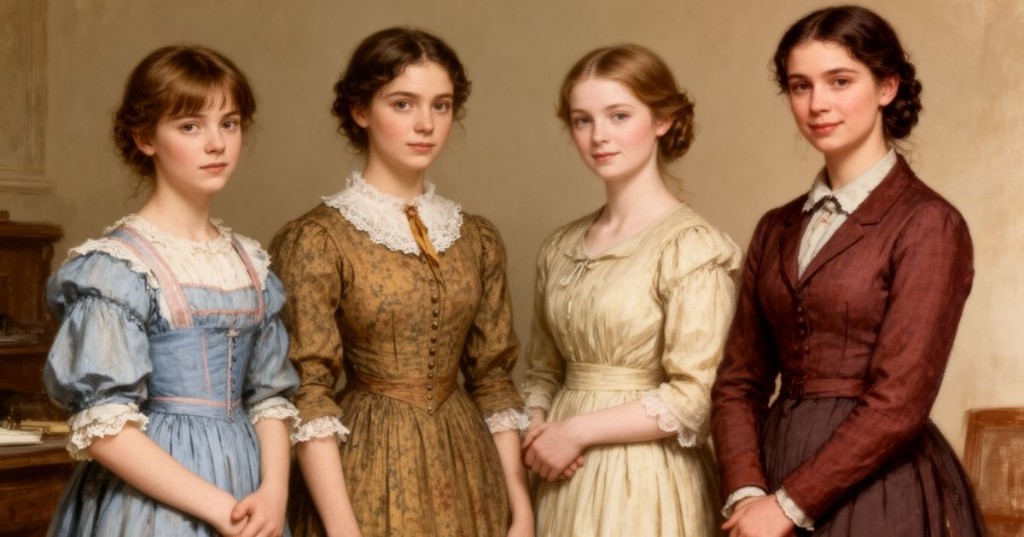
An excerpt from the original text.(complete · 2503 words)
CHAPTER TWENTY-TWO PLEASANT MEADOWS
Like sunshine after a storm were the peaceful weeks which followed. The
invalids improved rapidly, and Mr. March began to talk of returning
early in the new year. Beth was soon able to lie on the study sofa all
day, amusing herself with the well-beloved cats at first, and in time
with doll’s sewing, which had fallen sadly behind-hand. Her once active
limbs were so stiff and feeble that Jo took her for a daily airing
about the house in her strong arms. Meg cheerfully blackened and burned
her white hands cooking delicate messes for ‘the dear’, while Amy, a
loyal slave of the ring, celebrated her return by giving away as many
of her treasures as she could prevail on her sisters to accept.
As Christmas approached, the usual mysteries began to haunt the house,
and Jo frequently convulsed the family by proposing utterly impossible
or magnificently absurd ceremonies, in honor of this unusually merry
Christmas. Laurie was equally impracticable, and would have had
bonfires, skyrockets, and triumphal arches, if he had had his own way.
After many skirmishes and snubbings, the ambitious pair were considered
effectually quenched and went about with forlorn faces, which were
rather belied by explosions of laughter when the two got together.
Several days of unusually mild weather fitly ushered in a splendid
Christmas Day. Hannah ‘felt in her bones’ that it was going to be an
unusually fine day, and she proved herself a true prophetess, for
everybody and everything seemed bound to produce a grand success. To
begin with, Mr. March wrote that he should soon be with them, then Beth
felt uncommonly well that morning, and, being dressed in her mother’s
gift, a soft crimson merino wrapper, was borne in high triumph to the
window to behold the offering of Jo and Laurie. The Unquenchables had
done their best to be worthy of the name, for like elves they had
worked by night and conjured up a comical surprise. Out in the garden
stood a stately snow maiden, crowned with holly, bearing a basket of
fruit and flowers in one hand, a great roll of music in the other, a
perfect rainbow of an Afghan round her chilly shoulders, and a
Christmas carol issuing from her lips on a pink paper streamer.
THE JUNGFRAU TO BETH
God bless you, dear Queen Bess!
May nothing you dismay,
But health and peace and happiness
Be yours, this Christmas day.
Here’s fruit to feed our busy bee,
And flowers for her nose.
Here’s music for her pianee,
An afghan for her toes,
A portrait of Joanna, see,
By Raphael No. 2,
Who laboured with great industry
To make it fair and true.
Accept a ribbon red, I beg,
For Madam Purrer’s tail,
And ice cream made by lovely Peg,
A Mont Blanc in a pail.
Their dearest love my makers laid
Within my breast of snow.
Accept it, and the Alpine maid,
From Laurie and from Jo.
How Beth laughed when she saw it, how Laurie ran up and down to bring
in the gifts, and what ridiculous speeches Jo made as she presented
them.
“I’m so full of happiness, that if Father was only here, I couldn’t
hold one drop more,” said Beth, quite sighing with contentment as Jo
carried her off to the study to rest after the excitement, and to
refresh herself with some of the delicious grapes the ‘Jungfrau’ had
sent her.
“So am I,” added Jo, slapping the pocket wherein reposed the
long-desired Undine and Sintram.
“I’m sure I am,” echoed Amy, poring over the engraved copy of the
Madonna and Child, which her mother had given her in a pretty frame.
“Of course I am!” cried Meg, smoothing the silvery folds of her first
silk dress, for Mr. Laurence had insisted on giving it. “How can I be
otherwise?” said Mrs. March gratefully, as her eyes went from her
husband’s letter to Beth’s smiling face, and her hand caressed the
brooch made of gray and golden, chestnut and dark brown hair, which the
girls had just fastened on her breast.
Now and then, in this workaday world, things do happen in the
delightful storybook fashion, and what a comfort it is. Half an hour
after everyone had said they were so happy they could only hold one
drop more, the drop came. Laurie opened the parlor door and popped his
head in very quietly. He might just as well have turned a somersault
and uttered an Indian war whoop, for his face was so full of suppressed
excitement and his voice so treacherously joyful that everyone jumped
up, though he only said, in a queer, breathless voice, “Here’s another
Christmas present for the March family.”
Before the words were well out of his mouth, he was whisked away
somehow, and in his place appeared a tall man, muffled up to the eyes,
leaning on the arm of another tall man, who tried to say something and
couldn’t. Of course there was a general stampede, and for several
minutes everybody seemed to lose their wits, for the strangest things
were done, and no one said a word.
Mr. March became invisible in the embrace of four pairs of loving arms.
Jo disgraced herself by nearly fainting away, and had to be doctored by
Laurie in the china closet. Mr. Brooke kissed Meg entirely by mistake,
as he somewhat incoherently explained. And Amy, the dignified, tumbled
over a stool, and never stopping to get up, hugged and cried over her
father’s boots in the most touching manner. Mrs. March was the first to
recover herself, and held up her hand with a warning, “Hush! Remember
Beth.”
But it was too late. The study door flew open, the little red wrapper
appeared on the threshold, joy put strength into the feeble limbs, and
Beth ran straight into her father’s arms. Never mind what happened just
after that, for the full hearts overflowed, washing away the bitterness
of the past and leaving only the sweetness of the present.
It was not at all romantic, but a hearty laugh set everybody straight
again, for Hannah was discovered behind the door, sobbing over the fat
turkey, which she had forgotten to put down when she rushed up from the
kitchen. As the laugh subsided, Mrs. March began to thank Mr. Brooke
for his faithful care of her husband, at which Mr. Brooke suddenly
remembered that Mr. March needed rest, and seizing Laurie, he
precipitately retired. Then the two invalids were ordered to repose,
which they did, by both sitting in one big chair and talking hard.
Mr. March told how he had longed to surprise them, and how, when the
fine weather came, he had been allowed by his doctor to take advantage
of it, how devoted Brooke had been, and how he was altogether a most
estimable and upright young man. Why Mr. March paused a minute just
there, and after a glance at Meg, who was violently poking the fire,
looked at his wife with an inquiring lift of the eyebrows, I leave you
to imagine. Also why Mrs. March gently nodded her head and asked,
rather abruptly, if he wouldn’t like to have something to eat. Jo saw
and understood the look, and she stalked grimly away to get wine and
beef tea, muttering to herself as she slammed the door, “I hate
estimable young men with brown eyes!”
There never was such a Christmas dinner as they had that day. The fat
turkey was a sight to behold, when Hannah sent him up, stuffed,
browned, and decorated. So was the plum pudding, which melted in one’s
mouth, likewise the jellies, in which Amy reveled like a fly in a
honeypot. Everything turned out well, which was a mercy, Hannah said,
“For my mind was that flustered, Mum, that it’s a merrycle I didn’t
roast the pudding, and stuff the turkey with raisins, let alone bilin’
of it in a cloth.”
Mr. Laurence and his grandson dined with them, also Mr. Brooke, at whom
Jo glowered darkly, to Laurie’s infinite amusement. Two easy chairs
stood side by side at the head of the table, in which sat Beth and her
father, feasting modestly on chicken and a little fruit. They drank
healths, told stories, sang songs, ‘reminisced’, as the old folks say,
and had a thoroughly good time. A sleigh ride had been planned, but the
girls would not leave their father, so the guests departed early, and
as twilight gathered, the happy family sat together round the fire.
“Just a year ago we were groaning over the dismal Christmas we expected
to have. Do you remember?” asked Jo, breaking a short pause which had
followed a long conversation about many things.
“Rather a pleasant year on the whole!” said Meg, smiling at the fire,
and congratulating herself on having treated Mr. Brooke with dignity.
“I think it’s been a pretty hard one,” observed Amy, watching the light
shine on her ring with thoughtful eyes.
“I’m glad it’s over, because we’ve got you back,” whispered Beth, who
sat on her father’s knee.
“Rather a rough road for you to travel, my little pilgrims, especially
the latter part of it. But you have got on bravely, and I think the
burdens are in a fair way to tumble off very soon,” said Mr. March,
looking with fatherly satisfaction at the four young faces gathered
round him.
“How do you know? Did Mother tell you?” asked Jo.
“Not much. Straws show which way the wind blows, and I’ve made several
discoveries today.”
“Oh, tell us what they are!” cried Meg, who sat beside him.
“Here is one.” And taking up the hand which lay on the arm of his
chair, he pointed to the roughened forefinger, a burn on the back, and
two or three little hard spots on the palm. “I remember a time when
this hand was white and smooth, and your first care was to keep it so.
It was very pretty then, but to me it is much prettier now, for in this
seeming blemishes I read a little history. A burnt offering has been
made to vanity, this hardened palm has earned something better than
blisters, and I’m sure the sewing done by these pricked fingers will
last a long time, so much good will went into the stitches. Meg, my
dear, I value the womanly skill which keeps home happy more than white
hands or fashionable accomplishments. I’m proud to shake this good,
industrious little hand, and hope I shall not soon be asked to give it
away.”
If Meg had wanted a reward for hours of patient labor, she received it
in the hearty pressure of her father’s hand and the approving smile he
gave her.
“What about Jo? Please say something nice, for she has tried so hard
and been so very, very good to me,” said Beth in her father’s ear.
He laughed and looked across at the tall girl who sat opposite, with an
unusually mild expression in her face.
“In spite of the curly crop, I don’t see the ‘son Jo’ whom I left a
year ago,” said Mr. March. “I see a young lady who pins her collar
straight, laces her boots neatly, and neither whistles, talks slang,
nor lies on the rug as she used to do. Her face is rather thin and pale
just now, with watching and anxiety, but I like to look at it, for it
has grown gentler, and her voice is lower. She doesn’t bounce, but
moves quietly, and takes care of a certain little person in a motherly
way which delights me. I rather miss my wild girl, but if I get a
strong, helpful, tenderhearted woman in her place, I shall feel quite
satisfied. I don’t know whether the shearing sobered our black sheep,
but I do know that in all Washington I couldn’t find anything beautiful
enough to be bought with the five-and-twenty dollars my good girl sent
me.”
Jo’s keen eyes were rather dim for a minute, and her thin face grew
rosy in the firelight as she received her father’s praise, feeling that
she did deserve a portion of it.
“Now, Beth,” said Amy, longing for her turn, but ready to wait.
“There’s so little of her, I’m afraid to say much, for fear she will
slip away altogether, though she is not so shy as she used to be,”
began their father cheerfully. But recollecting how nearly he had lost
her, he held her close, saying tenderly, with her cheek against his
own, “I’ve got you safe, my Beth, and I’ll keep you so, please God.”
After a minute’s silence, he looked down at Amy, who sat on the cricket
at his feet, and said, with a caress of the shining hair...
“I observed that Amy took drumsticks at dinner, ran errands for her
mother all the afternoon, gave Meg her place tonight, and has waited on
every one with patience and good humor. I also observe that she does
not fret much nor look in the glass, and has not even mentioned a very
pretty ring which she wears, so I conclude that she has learned to
think of other people more and of herself less, and has decided to try
and mold her character as carefully as she molds her little clay
figures. I am glad of this, for though I should be very proud of a
graceful statue made by her, I shall be infinitely prouder of a lovable
daughter with a talent for making life beautiful to herself and
others.”
“What are you thinking of, Beth?” asked Jo, when Amy had thanked her
father and told about her ring.
“I read in Pilgrim’s Progress today how, after many troubles,
Christian and Hopeful came to a pleasant green meadow where lilies
bloomed all year round, and there they rested happily, as we do now,
before they went on to their journey’s end,” answered Beth, adding, as
she slipped out of her father’s arms and went to the instrument, “It’s
singing time now, and I want to be in my old place. I’ll try to sing
the song of the shepherd boy which the Pilgrims heard. I made the music
for Father, because he likes the verses.”
So, sitting at the dear little piano, Beth softly touched the keys, and
in the sweet voice they had never thought to hear again, sang to her
own accompaniment the quaint hymn, which was a singularly fitting song
for her.
He that is down need fear no fall,
He that is low no pride.
He that is humble ever shall
Have God to be his guide.
I am content with what I have,
Little be it, or much.
And, Lord! Contentment still I crave,
Because Thou savest such.
Fulness to them a burden is,
That go on pilgrimage.
Here little, and hereafter bliss,
Is best from age to age!
Master this chapter. Complete your experience
Purchase the complete book to access all chapters and support classic literature
As an Amazon Associate, we earn a small commission from qualifying purchases at no additional cost to you.
Available in paperback, hardcover, and e-book formats
Let's Analyse the Pattern
True satisfaction comes from growing through challenges, not from avoiding them.
Why This Matters
Connect literature to life
This chapter teaches how to identify the positive changes that happen inside us during difficult times.
Practice This Today
This week, notice when challenges force you to develop new skills or strength—document these small victories like Mr. March celebrating each daughter's growth.
Now let's explore the literary elements.
Key Quotes & Analysis
"Like sunshine after a storm were the peaceful weeks which followed."
Context: Opening the chapter as the family recovers from Beth's illness
This metaphor captures how relief and joy feel more intense after you've been through real fear and pain. The storm wasn't just Beth's illness but the family's terror of losing her.
In Today's Words:
After going through hell, even normal life feels like a blessing.
"Hannah 'felt in her bones' that it was going to be an unusually fine day."
Context: Describing Hannah's prediction about Christmas Day weather
This shows how intuition and folk wisdom often prove right, especially about things that matter to us emotionally. Hannah's connection to the family makes her sensitive to good omens.
In Today's Words:
Hannah had that feeling that something really good was about to happen.
"Her once active limbs were so stiff and feeble that Jo took her for a daily airing about the house in her strong arms."
Context: Describing how Jo cares for Beth during her recovery
This reversal of roles - the strong sister literally carrying the gentle one - shows how crisis changes family dynamics. Jo's physical strength now serves love instead of just adventure.
In Today's Words:
Beth was so weak that Jo had to carry her around every day just to get her out of bed.
Thematic Threads
Growth
In This Chapter
Each sister has visibly developed through the year's trials, with Mr. March recognizing their individual transformations
Development
Culmination of character development shown throughout the book
In Your Life:
You might notice how your toughest periods often coincide with your biggest personal breakthroughs.
Recognition
In This Chapter
Mr. March sees and celebrates each daughter's specific growth, making their development feel valued and real
Development
Builds on themes of being seen and understood from earlier chapters
In Your Life:
You might crave acknowledgment when you've grown through difficulty, needing someone to notice your progress.
Family
In This Chapter
The reunion shows how shared struggle has strengthened rather than weakened family bonds
Development
Evolution from early chapters where family felt more like obligation than choice
In Your Life:
You might find that families who weather storms together develop deeper connections than those who avoid conflict.
Contentment
In This Chapter
Beth's hymn about finding peace in what you have rather than wanting what you lack
Development
Contrast to Amy's earlier materialism and Jo's restless ambition
In Your Life:
You might discover that happiness comes from appreciating your current life rather than constantly chasing the next thing.
Work
In This Chapter
Mr. March sees Meg's work-worn hands as beautiful because they represent dedication and sacrifice
Development
Builds on earlier themes about the dignity of honest labor despite social expectations
In Your Life:
You might feel pride in the visible signs of your hard work, even when society doesn't always value what you do.
You now have the context. Time to form your own thoughts.
Discussion Questions
- 1
What specific changes does Mr. March notice in each of his daughters when he returns home?
analysis • surface - 2
Why does Mr. March see Meg's work-roughened hands as beautiful rather than damaged?
analysis • medium - 3
Think about someone you know who's grown stronger through difficult times. What 'marks' of that growth can you see in them?
application • medium - 4
When you're facing a tough situation, how could you shift from asking 'Why me?' to 'What is this building in me?'
application • deep - 5
What does this chapter suggest about the difference between happiness that comes from avoiding problems versus joy that comes from growing through them?
reflection • deep
Critical Thinking Exercise
Track Your Growth Markers
Think of a challenging period you've been through in the past year or two. Like Mr. March examining his daughters, look for the specific ways that challenge changed you for the better. What new strengths did you develop? What skills did you gain? What perspectives shifted? Write down at least three concrete 'growth markers' that came from that difficult time.
Consider:
- •Focus on internal changes, not just external outcomes
- •Look for skills you use now that you didn't have before
- •Consider how others might notice these changes in you
Journaling Prompt
Write about a current challenge you're facing. Based on this pattern from Little Women, what growth markers might emerge from your current situation? What kind of person could this struggle be building you into?
Coming Up Next...
Chapter 23: When Opposition Backfires Spectacularly
But family harmony faces a new test when romance enters the picture. Aunt March has strong opinions about suitable matches, and her interference threatens to disrupt the peaceful meadow the March family has found.



