
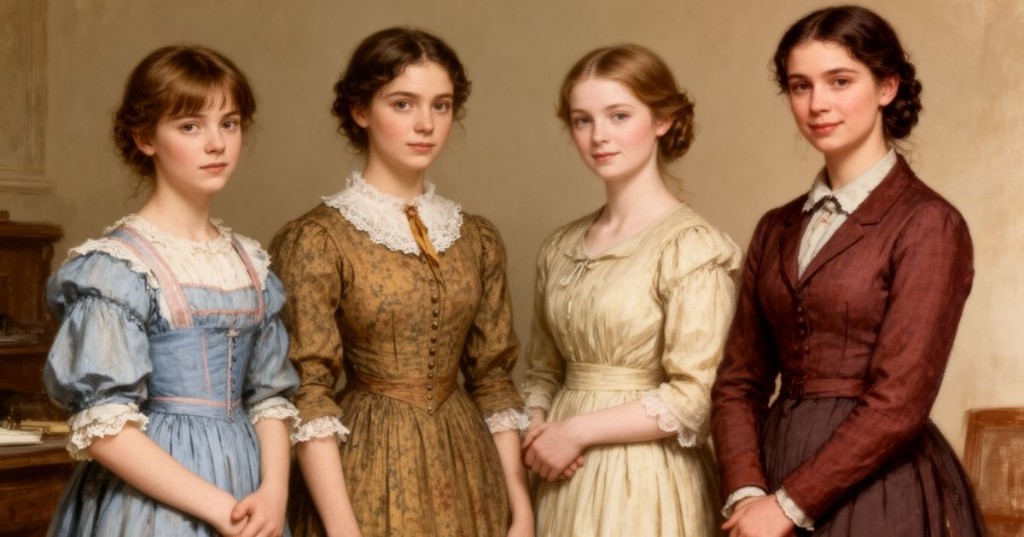
An excerpt from the original text.(complete · 4323 words)
CHAPTER TWENTY-THREE AUNT MARCH SETTLES THE QUESTION
Like bees swarming after their queen, mother and daughters hovered
about Mr. March the next day, neglecting everything to look at, wait
upon, and listen to the new invalid, who was in a fair way to be killed
by kindness. As he sat propped up in a big chair by Beth’s sofa, with
the other three close by, and Hannah popping in her head now and then
‘to peek at the dear man’, nothing seemed needed to complete their
happiness. But something was needed, and the elder ones felt it, though
none confessed the fact. Mr. and Mrs. March looked at one another with
an anxious expression, as their eyes followed Meg. Jo had sudden fits
of sobriety, and was seen to shake her fist at Mr. Brooke’s umbrella,
which had been left in the hall. Meg was absent-minded, shy, and
silent, started when the bell rang, and colored when John’s name was
mentioned. Amy said, “Everyone seemed waiting for something, and
couldn’t settle down, which was queer, since Father was safe at home,”
and Beth innocently wondered why their neighbors didn’t run over as
usual.
Laurie went by in the afternoon, and seeing Meg at the window, seemed
suddenly possessed with a melodramatic fit, for he fell down on one
knee in the snow, beat his breast, tore his hair, and clasped his hands
imploringly, as if begging some boon. And when Meg told him to behave
himself and go away, he wrung imaginary tears out of his handkerchief,
and staggered round the corner as if in utter despair.
“What does the goose mean?” said Meg, laughing and trying to look
unconscious.
“He’s showing you how your John will go on by-and-by. Touching, isn’t
it?” answered Jo scornfully.
“Don’t say my John, it isn’t proper or true,” but Meg’s voice lingered
over the words as if they sounded pleasant to her. “Please don’t plague
me, Jo, I’ve told you I don’t care much about him, and there isn’t to
be anything said, but we are all to be friendly, and go on as before.”
“We can’t, for something has been said, and Laurie’s mischief has
spoiled you for me. I see it, and so does Mother. You are not like your
old self a bit, and seem ever so far away from me. I don’t mean to
plague you and will bear it like a man, but I do wish it was all
settled. I hate to wait, so if you mean ever to do it, make haste and
have it over quickly,” said Jo pettishly.
“I can’t say anything till he speaks, and he won’t, because Father said
I was too young,” began Meg, bending over her work with a queer little
smile, which suggested that she did not quite agree with her father on
that point.
“If he did speak, you wouldn’t know what to say, but would cry or
blush, or let him have his own way, instead of giving a good, decided
no.”
“I’m not so silly and weak as you think. I know just what I should say,
for I’ve planned it all, so I needn’t be taken unawares. There’s no
knowing what may happen, and I wished to be prepared.”
Jo couldn’t help smiling at the important air which Meg had
unconsciously assumed and which was as becoming as the pretty color
varying in her cheeks.
“Would you mind telling me what you’d say?” asked Jo more respectfully.
“Not at all. You are sixteen now, quite old enough to be my confidant,
and my experience will be useful to you by-and-by, perhaps, in your own
affairs of this sort.”
“Don’t mean to have any. It’s fun to watch other people philander, but
I should feel like a fool doing it myself,” said Jo, looking alarmed at
the thought.
“I think not, if you liked anyone very much, and he liked you.” Meg
spoke as if to herself, and glanced out at the lane where she had often
seen lovers walking together in the summer twilight.
“I thought you were going to tell your speech to that man,” said Jo,
rudely shortening her sister’s little reverie.
“Oh, I should merely say, quite calmly and decidedly, ‘Thank you, Mr.
Brooke, you are very kind, but I agree with Father that I am too young
to enter into any engagement at present, so please say no more, but let
us be friends as we were.’”
“Hum, that’s stiff and cool enough! I don’t believe you’ll ever say it,
and I know he won’t be satisfied if you do. If he goes on like the
rejected lovers in books, you’ll give in, rather than hurt his
feelings.”
“No, I won’t. I shall tell him I’ve made up my mind, and shall walk out
of the room with dignity.”
Meg rose as she spoke, and was just going to rehearse the dignified
exit, when a step in the hall made her fly into her seat and begin to
sew as fast as if her life depended on finishing that particular seam
in a given time. Jo smothered a laugh at the sudden change, and when
someone gave a modest tap, opened the door with a grim aspect which was
anything but hospitable.
“Good afternoon. I came to get my umbrella, that is, to see how your
father finds himself today,” said Mr. Brooke, getting a trifle confused
as his eyes went from one telltale face to the other.
“It’s very well, he’s in the rack. I’ll get him, and tell it you are
here.” And having jumbled her father and the umbrella well together in
her reply, Jo slipped out of the room to give Meg a chance to make her
speech and air her dignity. But the instant she vanished, Meg began to
sidle toward the door, murmuring...
“Mother will like to see you. Pray sit down, I’ll call her.”
“Don’t go. Are you afraid of me, Margaret?” and Mr. Brooke looked so
hurt that Meg thought she must have done something very rude. She
blushed up to the little curls on her forehead, for he had never called
her Margaret before, and she was surprised to find how natural and
sweet it seemed to hear him say it. Anxious to appear friendly and at
her ease, she put out her hand with a confiding gesture, and said
gratefully...
“How can I be afraid when you have been so kind to Father? I only wish
I could thank you for it.”
“Shall I tell you how?” asked Mr. Brooke, holding the small hand fast
in both his own, and looking down at Meg with so much love in the brown
eyes that her heart began to flutter, and she both longed to run away
and to stop and listen.
“Oh no, please don’t, I’d rather not,” she said, trying to withdraw her
hand, and looking frightened in spite of her denial.
“I won’t trouble you. I only want to know if you care for me a little,
Meg. I love you so much, dear,” added Mr. Brooke tenderly.
This was the moment for the calm, proper speech, but Meg didn’t make
it. She forgot every word of it, hung her head, and answered, “I don’t
know,” so softly that John had to stoop down to catch the foolish
little reply.
He seemed to think it was worth the trouble, for he smiled to himself
as if quite satisfied, pressed the plump hand gratefully, and said in
his most persuasive tone, “Will you try and find out? I want to know so
much, for I can’t go to work with any heart until I learn whether I am
to have my reward in the end or not.”
“I’m too young,” faltered Meg, wondering why she was so fluttered, yet
rather enjoying it.
“I’ll wait, and in the meantime, you could be learning to like me.
Would it be a very hard lesson, dear?”
“Not if I chose to learn it, but. . .”
“Please choose to learn, Meg. I love to teach, and this is easier than
German,” broke in John, getting possession of the other hand, so that
she had no way of hiding her face as he bent to look into it.
His tone was properly beseeching, but stealing a shy look at him, Meg
saw that his eyes were merry as well as tender, and that he wore the
satisfied smile of one who had no doubt of his success. This nettled
her. Annie Moffat’s foolish lessons in coquetry came into her mind, and
the love of power, which sleeps in the bosoms of the best of little
women, woke up all of a sudden and took possession of her. She felt
excited and strange, and not knowing what else to do, followed a
capricious impulse, and, withdrawing her hands, said petulantly, “I
don’t choose. Please go away and let me be!”
Poor Mr. Brooke looked as if his lovely castle in the air was tumbling
about his ears, for he had never seen Meg in such a mood before, and it
rather bewildered him.
“Do you really mean that?” he asked anxiously, following her as she
walked away.
“Yes, I do. I don’t want to be worried about such things. Father says I
needn’t, it’s too soon and I’d rather not.”
“Mayn’t I hope you’ll change your mind by-and-by? I’ll wait and say
nothing till you have had more time. Don’t play with me, Meg. I didn’t
think that of you.”
“Don’t think of me at all. I’d rather you wouldn’t,” said Meg, taking a
naughty satisfaction in trying her lover’s patience and her own power.
He was grave and pale now, and looked decidedly more like the novel
heroes whom she admired, but he neither slapped his forehead nor
tramped about the room as they did. He just stood looking at her so
wistfully, so tenderly, that she found her heart relenting in spite of
herself. What would have happened next I cannot say, if Aunt March had
not come hobbling in at this interesting minute.
The old lady couldn’t resist her longing to see her nephew, for she had
met Laurie as she took her airing, and hearing of Mr. March’s arrival,
drove straight out to see him. The family were all busy in the back
part of the house, and she had made her way quietly in, hoping to
surprise them. She did surprise two of them so much that Meg started as
if she had seen a ghost, and Mr. Brooke vanished into the study.
“Bless me, what’s all this?” cried the old lady with a rap of her cane
as she glanced from the pale young gentleman to the scarlet young lady.
“It’s Father’s friend. I’m so surprised to see you!” stammered Meg,
feeling that she was in for a lecture now.
“That’s evident,” returned Aunt March, sitting down. “But what is
Father’s friend saying to make you look like a peony? There’s mischief
going on, and I insist upon knowing what it is,” with another rap.
“We were only talking. Mr. Brooke came for his umbrella,” began Meg,
wishing that Mr. Brooke and the umbrella were safely out of the house.
“Brooke? That boy’s tutor? Ah! I understand now. I know all about it.
Jo blundered into a wrong message in one of your Father’s letters, and
I made her tell me. You haven’t gone and accepted him, child?” cried
Aunt March, looking scandalized.
“Hush! He’ll hear. Shan’t I call Mother?” said Meg, much troubled.
“Not yet. I’ve something to say to you, and I must free my mind at
once. Tell me, do you mean to marry this Cook? If you do, not one penny
of my money ever goes to you. Remember that, and be a sensible girl,”
said the old lady impressively.
Now Aunt March possessed in perfection the art of rousing the spirit of
opposition in the gentlest people, and enjoyed doing it. The best of us
have a spice of perversity in us, especially when we are young and in
love. If Aunt March had begged Meg to accept John Brooke, she would
probably have declared she couldn’t think of it, but as she was
preemptorily ordered not to like him, she immediately made up her mind
that she would. Inclination as well as perversity made the decision
easy, and being already much excited, Meg opposed the old lady with
unusual spirit.
“I shall marry whom I please, Aunt March, and you can leave your money
to anyone you like,” she said, nodding her head with a resolute air.
“Highty-tighty! Is that the way you take my advice, Miss? You’ll be
sorry for it by-and-by, when you’ve tried love in a cottage and found
it a failure.”
“It can’t be a worse one than some people find in big houses,” retorted
Meg.
Aunt March put on her glasses and took a look at the girl, for she did
not know her in this new mood. Meg hardly knew herself, she felt so
brave and independent, so glad to defend John and assert her right to
love him, if she liked. Aunt March saw that she had begun wrong, and
after a little pause, made a fresh start, saying as mildly as she
could, “Now, Meg, my dear, be reasonable and take my advice. I mean it
kindly, and don’t want you to spoil your whole life by making a mistake
at the beginning. You ought to marry well and help your family. It’s
your duty to make a rich match and it ought to be impressed upon you.”
“Father and Mother don’t think so. They like John though he is poor.”
“Your parents, my dear, have no more worldly wisdom than a pair of
babies.”
“I’m glad of it,” cried Meg stoutly.
Aunt March took no notice, but went on with her lecture. “This Rook is
poor and hasn’t got any rich relations, has he?”
“No, but he has many warm friends.”
“You can’t live on friends, try it and see how cool they’ll grow. He
hasn’t any business, has he?”
“Not yet. Mr. Laurence is going to help him.”
“That won’t last long. James Laurence is a crotchety old fellow and not
to be depended on. So you intend to marry a man without money,
position, or business, and go on working harder than you do now, when
you might be comfortable all your days by minding me and doing better?
I thought you had more sense, Meg.”
“I couldn’t do better if I waited half my life! John is good and wise,
he’s got heaps of talent, he’s willing to work and sure to get on, he’s
so energetic and brave. Everyone likes and respects him, and I’m proud
to think he cares for me, though I’m so poor and young and silly,” said
Meg, looking prettier than ever in her earnestness.
“He knows you have got rich relations, child. That’s the secret of his
liking, I suspect.”
“Aunt March, how dare you say such a thing? John is above such
meanness, and I won’t listen to you a minute if you talk so,” cried Meg
indignantly, forgetting everything but the injustice of the old lady’s
suspicions. “My John wouldn’t marry for money, any more than I would.
We are willing to work and we mean to wait. I’m not afraid of being
poor, for I’ve been happy so far, and I know I shall be with him
because he loves me, and I...”
Meg stopped there, remembering all of a sudden that she hadn’t made up
her mind, that she had told ‘her John’ to go away, and that he might be
overhearing her inconsistent remarks.
Aunt March was very angry, for she had set her heart on having her
pretty niece make a fine match, and something in the girl’s happy young
face made the lonely old woman feel both sad and sour.
“Well, I wash my hands of the whole affair! You are a willful child,
and you’ve lost more than you know by this piece of folly. No, I won’t
stop. I’m disappointed in you, and haven’t spirits to see your father
now. Don’t expect anything from me when you are married. Your Mr.
Brooke’s friends must take care of you. I’m done with you forever.”
And slamming the door in Meg’s face, Aunt March drove off in high
dudgeon. She seemed to take all the girl’s courage with her, for when
left alone, Meg stood for a moment, undecided whether to laugh or cry.
Before she could make up her mind, she was taken possession of by Mr.
Brooke, who said all in one breath, “I couldn’t help hearing, Meg.
Thank you for defending me, and Aunt March for proving that you do care
for me a little bit.”
“I didn’t know how much till she abused you,” began Meg.
“And I needn’t go away, but may stay and be happy, may I, dear?”
Here was another fine chance to make the crushing speech and the
stately exit, but Meg never thought of doing either, and disgraced
herself forever in Jo’s eyes by meekly whispering, “Yes, John,” and
hiding her face on Mr. Brooke’s waistcoat.
Fifteen minutes after Aunt March’s departure, Jo came softly
downstairs, paused an instant at the parlor door, and hearing no sound
within, nodded and smiled with a satisfied expression, saying to
herself, “She has seen him away as we planned, and that affair is
settled. I’ll go and hear the fun, and have a good laugh over it.”
But poor Jo never got her laugh, for she was transfixed upon the
threshold by a spectacle which held her there, staring with her mouth
nearly as wide open as her eyes. Going in to exult over a fallen enemy
and to praise a strong-minded sister for the banishment of an
objectionable lover, it certainly was a shock to behold the aforesaid
enemy serenely sitting on the sofa, with the strongminded sister
enthroned upon his knee and wearing an expression of the most abject
submission. Jo gave a sort of gasp, as if a cold shower bath had
suddenly fallen upon her, for such an unexpected turning of the tables
actually took her breath away. At the odd sound the lovers turned and
saw her. Meg jumped up, looking both proud and shy, but ‘that man’, as
Jo called him, actually laughed and said coolly, as he kissed the
astonished newcomer, “Sister Jo, congratulate us!”
That was adding insult to injury, it was altogether too much, and
making some wild demonstration with her hands, Jo vanished without a
word. Rushing upstairs, she startled the invalids by exclaiming
tragically as she burst into the room, “Oh, do somebody go down quick!
John Brooke is acting dreadfully, and Meg likes it!”
Mr. and Mrs. March left the room with speed, and casting herself upon
the bed, Jo cried and scolded tempestuously as she told the awful news
to Beth and Amy. The little girls, however, considered it a most
agreeable and interesting event, and Jo got little comfort from them,
so she went up to her refuge in the garret, and confided her troubles
to the rats.
Nobody ever knew what went on in the parlor that afternoon, but a great
deal of talking was done, and quiet Mr. Brooke astonished his friends
by the eloquence and spirit with which he pleaded his suit, told his
plans, and persuaded them to arrange everything just as he wanted it.
The tea bell rang before he had finished describing the paradise which
he meant to earn for Meg, and he proudly took her in to supper, both
looking so happy that Jo hadn’t the heart to be jealous or dismal. Amy
was very much impressed by John’s devotion and Meg’s dignity, Beth
beamed at them from a distance, while Mr. and Mrs. March surveyed the
young couple with such tender satisfaction that it was perfectly
evident Aunt March was right in calling them as ‘unworldly as a pair of
babies’. No one ate much, but everyone looked very happy, and the old
room seemed to brighten up amazingly when the first romance of the
family began there.
“You can’t say nothing pleasant ever happens now, can you, Meg?” said
Amy, trying to decide how she would group the lovers in a sketch she
was planning to make.
“No, I’m sure I can’t. How much has happened since I said that! It
seems a year ago,” answered Meg, who was in a blissful dream lifted far
above such common things as bread and butter.
“The joys come close upon the sorrows this time, and I rather think the
changes have begun,” said Mrs. March. “In most families there comes,
now and then, a year full of events. This has been such a one, but it
ends well, after all.”
“Hope the next will end better,” muttered Jo, who found it very hard to
see Meg absorbed in a stranger before her face, for Jo loved a few
persons very dearly and dreaded to have their affection lost or
lessened in any way.
“I hope the third year from this will end better. I mean it shall, if I
live to work out my plans,” said Mr. Brooke, smiling at Meg, as if
everything had become possible to him now.
“Doesn’t it seem very long to wait?” asked Amy, who was in a hurry for
the wedding.
“I’ve got so much to learn before I shall be ready, it seems a short
time to me,” answered Meg, with a sweet gravity in her face never seen
there before.
“You have only to wait, I am to do the work,” said John beginning his
labors by picking up Meg’s napkin, with an expression which caused Jo
to shake her head, and then say to herself with an air of relief as the
front door banged, “Here comes Laurie. Now we shall have some sensible
conversation.”
But Jo was mistaken, for Laurie came prancing in, overflowing with good
spirits, bearing a great bridal-looking bouquet for ‘Mrs. John Brooke’,
and evidently laboring under the delusion that the whole affair had
been brought about by his excellent management.
“I knew Brooke would have it all his own way, he always does, for when
he makes up his mind to accomplish anything, it’s done though the sky
falls,” said Laurie, when he had presented his offering and his
congratulations.
“Much obliged for that recommendation. I take it as a good omen for the
future and invite you to my wedding on the spot,” answered Mr. Brooke,
who felt at peace with all mankind, even his mischievous pupil.
“I’ll come if I’m at the ends of the earth, for the sight of Jo’s face
alone on that occasion would be worth a long journey. You don’t look
festive, ma’am, what’s the matter?” asked Laurie, following her into a
corner of the parlor, whither all had adjourned to greet Mr. Laurence.
“I don’t approve of the match, but I’ve made up my mind to bear it, and
shall not say a word against it,” said Jo solemnly. “You can’t know how
hard it is for me to give up Meg,” she continued with a little quiver
in her voice.
“You don’t give her up. You only go halves,” said Laurie consolingly.
“It can never be the same again. I’ve lost my dearest friend,” sighed
Jo.
“You’ve got me, anyhow. I’m not good for much, I know, but I’ll stand
by you, Jo, all the days of my life. Upon my word I will!” and Laurie
meant what he said.
“I know you will, and I’m ever so much obliged. You are always a great
comfort to me, Teddy,” returned Jo, gratefully shaking hands.
“Well, now, don’t be dismal, there’s a good fellow. It’s all right you
see. Meg is happy, Brooke will fly round and get settled immediately,
Grandpa will attend to him, and it will be very jolly to see Meg in her
own little house. We’ll have capital times after she is gone, for I
shall be through college before long, and then we’ll go abroad on some
nice trip or other. Wouldn’t that console you?”
“I rather think it would, but there’s no knowing what may happen in
three years,” said Jo thoughtfully.
“That’s true. Don’t you wish you could take a look forward and see
where we shall all be then? I do,” returned Laurie.
“I think not, for I might see something sad, and everyone looks so
happy now, I don’t believe they could be much improved.” And Jo’s eyes
went slowly round the room, brightening as they looked, for the
prospect was a pleasant one.
Father and Mother sat together, quietly reliving the first chapter of
the romance which for them began some twenty years ago. Amy was drawing
the lovers, who sat apart in a beautiful world of their own, the light
of which touched their faces with a grace the little artist could not
copy. Beth lay on her sofa, talking cheerily with her old friend, who
held her little hand as if he felt that it possessed the power to lead
him along the peaceful way she walked. Jo lounged in her favorite low
seat, with the grave quiet look which best became her, and Laurie,
leaning on the back of her chair, his chin on a level with her curly
head, smiled with his friendliest aspect, and nodded at her in the long
glass which reflected them both.
So the curtain falls upon Meg, Jo, Beth, and Amy. Whether it ever rises
again, depends upon the reception given the first act of the domestic
drama called Little Women.
PART 2
In order that we may start afresh and go to Meg’s wedding...
Master this chapter. Complete your experience
Purchase the complete book to access all chapters and support classic literature
As an Amazon Associate, we earn a small commission from qualifying purchases at no additional cost to you.
Available in paperback, hardcover, and e-book formats
Let's Analyse the Pattern
Heavy-handed attempts to control or forbid something often create the exact outcome they're trying to prevent.
Why This Matters
Connect literature to life
This chapter teaches how to recognize when someone's heavy-handed attempts to control your choices are actually revealing their own agenda rather than protecting your interests.
Practice This Today
This week, notice when someone's objections to your choices seem more about their control than your wellbeing - pause and ask yourself what you actually want versus what you're being told to want.
Now let's explore the literary elements.
Key Quotes & Analysis
"I shall marry whom I please, Aunt March, and you can leave your money to anyone you like!"
Context: When Aunt March threatens to disinherit her for considering John
This is Meg's declaration of independence. For the first time, she chooses love over money and stands up to family pressure. It's the moment she becomes an adult.
In Today's Words:
I'll date whoever I want, and you can keep your money if it comes with strings attached!
"Yes, John"
Context: Her whispered acceptance after John asks if she truly meant her defense of him
After all her careful planning to reject him properly, Meg's actual answer is simple and from the heart. Sometimes the biggest decisions require the fewest words.
In Today's Words:
Yes, I choose you.
"You ought to be ashamed of yourself! What would your poor mother say to such stuff?"
Context: Scolding Meg for considering marrying for love instead of money
Aunt March reveals her values - that practical advantage matters more than happiness. She can't understand why anyone would choose differently.
In Today's Words:
Your mother would be horrified that you're not gold-digging like a smart girl should!
Thematic Threads
Class
In This Chapter
Aunt March's snobbery about John being 'just a tutor' reveals rigid class expectations
Development
Deepens from earlier hints about family's reduced circumstances and social position
In Your Life:
You might face judgment about your choices based on others' ideas of what's 'appropriate' for your background
Power
In This Chapter
Aunt March wields financial threats to control Meg's romantic choices
Development
Builds on earlier scenes of adult authority over the girls' decisions
In Your Life:
Someone in your life might use money, job security, or family pressure to control your personal decisions
Identity
In This Chapter
Meg discovers her true feelings only when forced to defend them against opposition
Development
Continues Meg's journey from dutiful daughter to independent woman
In Your Life:
You might not know what you really want until someone tries to take that choice away from you
Love
In This Chapter
John and Meg's relationship solidifies through external pressure rather than despite it
Development
First major romantic resolution in the story, showing love's power over social convention
In Your Life:
Your relationships might grow stronger when you have to defend them against outside criticism
Family
In This Chapter
The March parents' acceptance contrasts sharply with Aunt March's interference
Development
Shows the difference between supportive and controlling family dynamics
In Your Life:
You might need to choose between pleasing extended family and following your own path
You now have the context. Time to form your own thoughts.
Discussion Questions
- 1
What was Meg's original plan when John arrived, and how did it completely fall apart?
analysis • surface - 2
Why did Aunt March's threats and lectures backfire so spectacularly - what psychological principle was at work?
analysis • medium - 3
Where have you seen this pattern in your own life - someone's opposition making you more determined to do the opposite?
application • medium - 4
If you were John, would you have stayed hidden during Aunt March's lecture, or would you have intervened? What are the risks and benefits of each choice?
application • deep - 5
What does this chapter reveal about the difference between making choices from authentic desire versus making them as rebellion against control?
reflection • deep
Critical Thinking Exercise
Rewrite the Intervention
Imagine you're Aunt March, but you genuinely want what's best for Meg. Rewrite her conversation to express concerns without triggering rebellion. Then compare your approach to what actually happened in the chapter.
Consider:
- •How do you express concerns without sounding controlling or condescending?
- •What tone and word choices might have opened dialogue instead of shutting it down?
- •How could Aunt March have honored Meg's agency while still sharing her perspective?
Journaling Prompt
Write about a time when someone's opposition made you more determined to do something. Looking back, were you choosing from authentic desire or just rebelling? How can you tell the difference in future situations?
Coming Up Next...
Chapter 24: Family Updates and Wedding Preparations
Three years pass in a blink, and it's time for Meg's wedding. But married life brings new challenges no one prepared her for, and the March sisters must navigate their first major separation.



