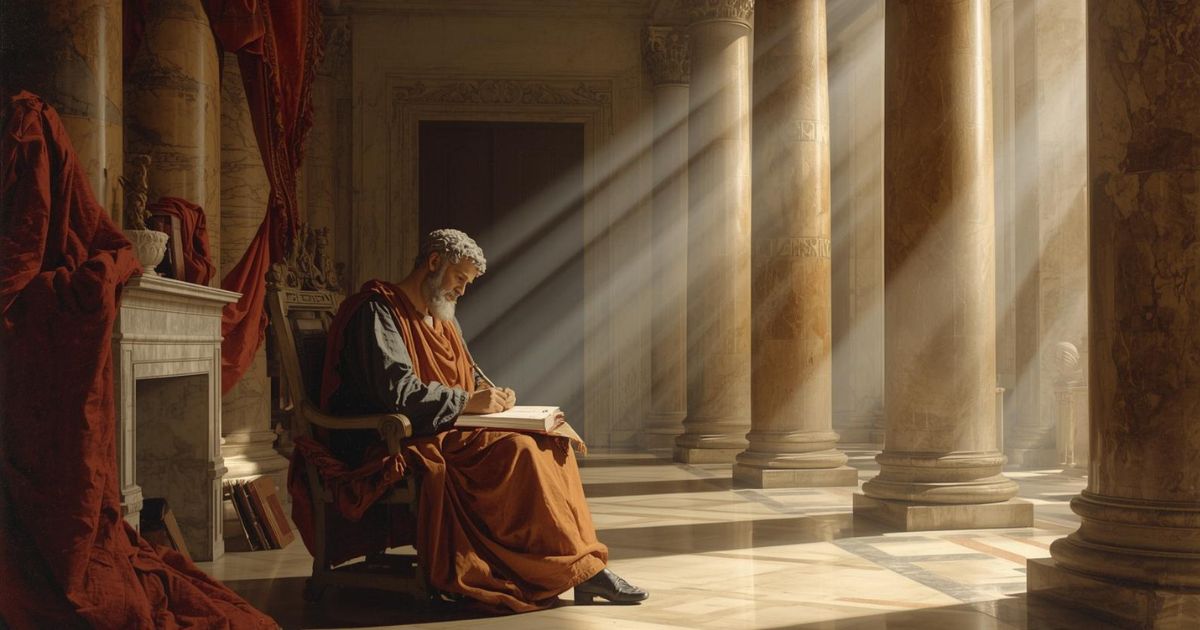
An excerpt from the original text.(complete · 3941 words)
←etter 73. On philosophers and kingsMoral letters to Luciliusby Seneca, translated by Richard Mott GummereLetter 74. On virtue as a refuge from worldly distractionsLetter 75. On the diseases of the soul→483217Moral letters to Lucilius — Letter 74. On virtue as a refuge from worldly distractionsRichard Mott GummereSeneca LXXIV. ON VIRTUE AS A REFUGE FROM WORLDLY DISTRACTIONS 1. Your letter has given me pleasure, and has roused me from sluggishness. It has also prompted my memory, which has been for some time slack and nerveless. You are right, of course, my dear Lucilius, in deeming the chief means of attaining the happy life to consist in the belief that the only good lies in that which is honourable.[1] For anyone who deems other things to be good, puts himself in the power of Fortune, and goes under the control of another; but he who has in every case defined the good by the honourable, is happy with an inward happiness. 2. One man is saddened when his children die; another is anxious when they become ill; a third is embittered when they do something disgraceful, or suffer a taint in their reputation. One man, you will observe, is tortured by passion for his neighbour’s wife, another by passion for his own. You will find men who are completely upset by failure to win an election, and others who are actually plagued by the offices which they have won. 3. But the largest throng of unhappy men among the host of mortals are those whom the expectation of death, which threatens them on every hand, drives to despair. For there is no quarter from which death may not approach. Hence, like soldiers scouting in the enemy’s country, they must look about in all directions, and turn their heads at every sound; unless the breast be rid of this fear, one lives with a palpitating heart. 4. You will readily recall those who have been driven into exile and dispossessed of their property. You will also recall (and this is the most serious kind of destitution) those who are poor in the midst of their riches.[2] You will recall men who have suffered shipwreck, or those whose sufferings resemble shipwreck; for they were untroubled and at ease, when the anger or perhaps the envy of the populace,—a missile most deadly to those in high places,[3]—dismantled them like a storm which is wont to rise when one is most confident of continued calm, or like a sudden stroke of lightning which even causes the region round about it to tremble. For just as anyone who stands near the bolt is stunned and resembles one who is struck, so in these sudden and violent mishaps, although but one person is overwhelmed by the disaster, the rest are overwhelmed by fear, and the possibility that they may suffer makes them as downcast as the actual sufferer. 5. Every man is troubled in spirit by evils that come suddenly upon his neighbour. Like birds, who cower even at the whirr of an empty sling, we are distracted by mere sounds as well as by blows. No man therefore can be happy if he yields himself up to such foolish fancies. For nothing brings happiness unless it also brings calm; it is a bad sort of existence that is spent in apprehension. 6. Whoever has largely surrendered himself to the power of Fortune has made for himself a huge web of disquietude, from which he cannot get free; if one would win a way to safety, there is but one road,—to despise externals and to be contented with that which is honourable. For those who regard anything as better than virtue, or believe that there is any good except virtue, are spreading their arms to gather in that which Fortune tosses abroad, and are anxiously awaiting her favours. 7. Picture now to yourself that Fortune is holding a festival, and is showering down honours, riches, and influence upon this mob of mortals; some of these gifts have already been torn to pieces in the hands of those who try to snatch them, others have been divided up by treacherous partnerships, and still others have been seized to the great detriment of those into whose possession they have come. Certain of these favours have fallen to men while they were absent-minded;[4] others have been lost to their seekers because they were snatching too eagerly for them, and, just because they are greedily seized upon, have been knocked from their hands. There is not a man among them all, however,—even he who has been lucky in the booty which has fallen to him,—whose joy in his spoil has lasted until the morrow. The most sensible man, therefore, as soon as he sees the dole being brought in,[5] runs from the theatre; for he knows that one pays a high price for small favours. No one will grapple with him on the way out, or strike him as he departs; the quarrelling takes place where the prizes are. 8. Similarly with the gifts which Fortune tosses down to us; wretches that we are, we become excited, we are torn asunder, we wish that we had many hands, we look back now in this direction and now in that. All too slowly, as it seems, are the gifts thrown in our direction; they merely excite our cravings, since they can reach but few and are awaited by all. 9. We are keen to intercept them as they fall down. We rejoice if we have laid hold of anything; and some have been mocked by the idle hope of laying hold; we have either paid a high price for worthless plunder with some disadvantage to ourselves, or else have been defrauded and are left in the lurch. Let us therefore withdraw from a game like this, and give way to the greedy rabble; let them gaze after such “goods,” which hang suspended above them, and be themselves still more in suspense.[6] 10. Whoever makes up his mind to be happy should conclude that the good consists only in that which is honourable. For if he regards anything else as good, he is, in the first place, passing an unfavourable judgment upon Providence because of the fact that upright men often suffer misfortunes,[7] and that the time which is allotted to us is but short and scanty, if you compare it with the eternity which is allotted to the universe. 11. It is a result of complaints like these that we are unappreciative in our comments upon the gifts of heaven; we complain because they are not always granted to us, because they are few and unsure and fleeting. Hence we have not the will either to live or to die; we are possessed by hatred of life, by fear of death. Our plans are all at sea, and no amount of prosperity can satisfy us. And the reason for all this is that we have not yet attained to that good which is immeasurable and unsurpassable, in which all wishing on our part must cease, because there is no place beyond the highest. 12. Do you ask why virtue needs nothing? Because it is pleased with what it has, and does not lust after that which it has not. Whatever is enough is abundant in the eyes of virtue. Dissent from this judgment, and duty and loyalty will not abide. For one who desires to exhibit these two qualities must endure much that the world calls evil; we must sacrifice many things to which we are addicted, thinking them to be goods. 13. Gone is courage, which should be continually testing itself; gone is greatness of soul, which cannot stand out clearly unless it has learned to scorn as trivial everything that the crowd covets as supremely important; and gone is kindness and the repaying of kindness, if we fear toil, if we have acknowledged anything to be more precious than loyalty, if our eyes are fixed upon anything except the best. 14. But to pass these questions by: either these so-called goods are not goods, or else man is more fortunate than God, because God has no enjoyment of the things which are given to us.[8] For lust pertains not to God, nor do elegant banquets, nor wealth, nor any of the things that allure mankind and lead him on through the influence of degrading pleasure. Therefore, it is, either not incredible that there are goods which God does not possess, or else the very fact that God does not possess them is in itself a proof that these things are not goods. 15. Besides, many things which are wont to be regarded as goods are granted to animals in fuller measure than to men. Animals eat their food with better appetite, are not in the same degree weakened by sexual indulgence, and have a greater and more uniform constancy in their strength. Consequently, they are much more fortunate than man. For there is no wickedness, no injury to themselves, in their way of living. They enjoy their pleasures and they take them more often and more easily, without any of the fear that results from shame or regret. 16. This being so, you should consider whether one has a right to call anything good in which God is outdone by man. Let us limit the Supreme Good to the soul; it loses its meaning if it is taken from the best part of us and applied to the worst, that is, if it is transferred to the senses; for the senses are more active in dumb beasts. The sum total of our happiness must not be placed in the flesh; the true goods are those which reason bestows, substantial and eternal; they cannot fall away, neither can they grow less or be diminished. 17. Other things are goods according to opinion, and though they are called by the same name as the true goods, the essence of goodness is not in them. Let us therefore call them “advantages,” and, to use our technical term, “preferred” things.[9] Let us, however, recognize that they are our chattels, not parts of ourselves; and let us have them in our possession, but take heed to remember that they are outside ourselves. Even though they are in our possession, they are to be reckoned as things subordinate and poor, the possession of which gives no man a right to plume himself. For what is more foolish than being self-complacent about something which one has not accomplished by one’s own efforts? 18. Let everything of this nature be added to us, and not stick fast to us, so that, if it is withdrawn, it may come away without tearing off any part of us. Let us use these things, but not boast of them, and let us use them sparingly, as if they were given for safe-keeping and will be withdrawn. Anyone who does not employ reason in his possession of them never keeps them long; for prosperity of itself, if uncontrolled by reason, overwhelms itself. If anyone has put his trust in goods that are most fleeting, he is soon bereft of them, and, to avoid being bereft, he suffers distress. Few men have been permitted to lay aside prosperity gently. The rest all fall, together with the things amid which they have come into eminence, and they are weighted down by the very things which had before exalted them. 19. For this reason foresight must be brought into play, to insist upon a limit or upon frugality in the use of these things, since licence overthrows and destroys its own abundance. That which has no limit has never endured, unless reason, which sets limits, has held it in check. The fate of many cities will prove the truth of this; their sway has ceased at the very prime because they were given to luxury, and excess has ruined all that had been won by virtue. We should fortify ourselves against such calamities. But no wall can be erected against Fortune which she cannot take by storm; let us strengthen our inner defences. If the inner part be safe, man can be attacked, but never captured. Do you wish to know what this weapon of defence is? 20. It is the ability to refrain from chafing over whatever happens to one, of knowing that the very agencies which seem to bring harm are working for the preservation of the world, and are a part of the scheme for bringing to fulfilment the order of the universe and its functions. Let man be pleased with whatever has pleased God; let him marvel at himself and his own resources for this very reason, that he cannot be overcome, that he has the very powers of evil subject to his control, and that he brings into subjection chance and pain and wrong by means of that strongest of powers—reason. 21. Love reason! The love of reason will arm you against the greatest hardships. Wild beasts dash against the hunter’s spear through love of their young, and it is their wildness and their unpremeditated onrush that keep them from being tamed; often a desire for glory has stirred the mind of youth to despise both sword and stake; the mere vision and semblance of virtue impel certain men to a self-imposed death. In proportion as reason is stouter and steadier than any of these emotions, so much the more forcefully will she make her way through the midst of utter terrors and dangers. 22. Men say to us: “You are mistaken if you maintain that nothing is a good except that which is honourable; a defence like this will not make you safe from Fortune and free from her assaults. For you maintain that dutiful children, and a well-governed country, and good parents, are to be reckoned as goods; but you cannot see these dear objects in danger and be yourself at ease. Your calm will be disturbed by a siege conducted against your country, by the death of your children, or by the enslaving of your parents.” 23. I will first state what we Stoics usually reply[10] to these objectors, and then will add what additional answer should, in my opinion, be given. The situation is entirely different in the case of goods whose loss entails some hardship substituted in their place; for example, when good health is impaired there is a change to ill-health; when the eye is put out, we are visited with blindness; we not only lose our speed when our leg-muscles are cut, but infirmity takes the place of speed. But no such danger is involved in the case of the goods to which we referred a moment ago. And why? If I have lost a good friend, I have no false friend whom I must endure in his place; nor if I have buried a dutiful son, must I face in exchange unfilial conduct. 24. In the second place, this does not mean to me the taking-off of a friend or of a child; it is the mere taking-off of their bodies. But a good can be lost in only one way, by changing into what is bad; and this is impossible according to the law of nature, because every virtue, and every work of virtue, abides uncorrupted. Again, even if friends have perished, or children of approved goodness who fulfil their father’s prayers for them, there is something that can fill their place. Do you ask what this is? It is that which had made them good in the first place, namely, virtue. 25. Virtue suffers no space in us to be unoccupied; it takes possession of the whole soul and removes all sense of loss. It alone is sufficient; for the strength and beginnings of all goods exist in virtue herself. What does it matter if running water is cut off and flows away, as long as the fountain from which it has flowed is unharmed? You will not maintain that a man’s life is more just if his children are unharmed than if they have passed away, nor yet better appointed, nor more intelligent, nor more honourable; therefore, no better, either. The addition of friends does not make one wiser, nor does their taking away make one more foolish; therefore, not happier or more wretched, either. As long as your virtue is unharmed, you will not feel the loss of anything that has been withdrawn from you. 26. You may say: “Come now; is not a man happier when girt about with a large company of friends and children?” Why should this be so? For the Supreme Good is neither impaired nor increased thereby; it abides within its own limits, no matter how Fortune has conducted herself. Whether a long old age falls to one’s lot, or whether the end comes on this side of old age—the measure of the Supreme Good is unvaried, in spite of the difference in years. 27. Whether you draw a larger or a smaller circle, its size affects its area, not its shape. One circle may remain as it is for a long time while you may contract the other forthwith, or even merge it completely with the sand in which it was drawn;[11] yet each circle has had the same shape. That which is straight is not judged by its size, or by its number, or by its duration; it can no more be made longer than it can be made shorter. Scale down the honourable life as much as you like from the full hundred years, and reduce it to a single day; it is equally honourable.[12] 28. Sometimes virtue is widespread, governing kingdoms, cities, and provinces, creating laws, developing friendships, and regulating the duties that hold good between relatives and children; at other times it is limited by the narrow bounds of poverty, exile, or bereavement. But it is no smaller when it is reduced from prouder heights to a private station, from a royal palace to a humble dwelling, or when from a general and broad jurisdiction it is gathered into the narrow limits of a private house or a tiny corner. 29. Virtue is just as great, even when it has retreated within itself and is shut in on all sides. For its spirit is no less great and upright, its sagacity no less complete, its justice no less inflexible. It is, therefore, equally happy. For happiness has its abode in one place only, namely, in the mind itself, and is noble, steadfast, and calm; and this state cannot be attained without a knowledge of things divine and human. 30. The other answer, which I promised[13] to make to your objection, follows from this reasoning. The wise man is not distressed by the loss of children or of friends. For he endures their death in the same spirit in which he awaits his own. And he fears the one as little as he grieves for the other. For the underlying principle of virtue is conformity;[14] all the works of virtue are in harmony and agreement with virtue itself. But this harmony is lost if the soul, which ought to be uplifted, is cast down by grief or a sense of loss. It is ever a dishonour for a man to be troubled and fretted, to be numbed when there is any call for activity. For that which is honourable is free from care and untrammelled, is unafraid, and stands girt for action. 31. “What,” you ask, “will the wise man experience no emotion like disturbance of spirit? Will not his features change colour,[15] his countenance be agitated, and his limbs grow cold? And there are other things which we do, not under the influence of the will, but unconsciously and as the result of a sort of natural impulse.” I admit that this is true; but the sage will retain the firm belief that none of these things is evil, or important enough to make a healthy mind break down. 32. Whatever shall remain to be done virtue can do with courage and readiness. For anyone would admit that it is a mark of folly to do in a slothful and rebellious spirit whatever one has to do, or to direct the body in one direction and the mind in another, and thus to be torn between utterly conflicting emotions. For folly is despised precisely because of the things for which she vaunts and admires herself, and she does not do gladly even those things in which she prides herself. But if folly fears some evil, she is burdened by it in the very moment of awaiting it, just as if it had actually come,—already suffering in apprehension whatever she fears she may suffer. 33. Just as in the body symptoms of latent ill-health precede the disease—there is, for example, a certain weak sluggishness,[16] a lassitude which is not the result of any work, a trembling, and a shivering that pervades the limbs,—so the feeble spirit is shaken by its ills a long time before it is overcome by them. It anticipates them, and totters before its time. But what is greater madness than to be tortured by the future and not to save your strength for the actual suffering, but to invite and bring on wretchedness? If you cannot be rid of it, you ought at least to postpone it. 34. Will you not understand that no man should be tormented by the future? The man who has been told that he will have to endure torture fifty years from now is not disturbed thereby, unless he has leaped over the intervening years, and has projected himself into the trouble that is destined to arrive a generation later. In the same way, souls that enjoy being sick and that seize upon excuses for sorrow are saddened by events long past and effaced from the records. Past and future are both absent; we feel neither of them. But there can be no pain except as the result of what you feel. Farewell. ↑ A doctrine often expressed in the letters; cf., for example, lxxi. 4. ↑ Cf. Horace, Carm. iii. 16. 28 magnas inter opes inops. ↑ For the same thought cf. Ep. iv. 7 Neminem eo fortuna provexit, ut non tantum illi minaretur, quantum permiserat. Noli huic tranquillitati confidere; momento mare evertitur. Eodem die ubi luserunt navigia, sorbentur. ↑ i.e., engaged upon something else. Cf. Ep. i. 1. ↑ A distribution of coins, etc., at the public games. Food was also doled out to the populace on similar occasions. ↑ This figure of the dole as applied to Fortune is sustained to an extent which is unusual in Seneca. ↑ This phrase recalls the title of one of Seneca’s philosophical essays: De Providentia, or Quare Bonis Viris Mala Accidant cum sit Providentia. ↑ Cf. Ep. lxxiii. § 14 Iuppiter uti illis non potest. ↑ Producta is a translation of the Stoic term προηγμένα. For a clear exposition of this topic see Cicero, De Fin. iii. 52 ff. ↑ See Ep. lxvi. 6. The Stoics, unlike the Academics and the Peripatetics, maintained that the good must have “an unconditional value” (Zeller). ↑ Cf. Itane in geometriae pulvere haerebo?, Ep. lxxxviii. 39 and note. ↑ See the argument in Ep. xii. 6 f., and often elsewhere. ↑ See § 23. ↑ Called by the early Stoics ὁμολογία; the idea of “conformity with nature” is a fundamental doctrine of the school. See Rackham on Cicero, De Fin. iii. 21. ↑ Cf. Epp. xi. 6 and lxxi. 29. ↑ Perhaps a sort of malaria.
Master this chapter. Complete your experience
Purchase the complete book to access all chapters and support classic literature
As an Amazon Associate, we earn a small commission from qualifying purchases at no additional cost to you.
Available in paperback, hardcover, and e-book formats
Let's Analyse the Pattern
Tying your peace and worth to outcomes you cannot control, creating constant anxiety and powerlessness.
Why This Matters
Connect literature to life
This chapter teaches the crucial skill of identifying what's actually within your power versus what only feels like it should be.
Practice This Today
This week, notice when you feel anxious and ask: 'What part of this situation can I actually influence?' Then redirect your energy there.
Now let's explore the literary elements.
Key Quotes & Analysis
"He who has in every case defined the good by the honourable, is happy with an inward happiness."
Context: Explaining why virtue-based living creates unshakeable peace
This captures the core Stoic insight that happiness comes from within, based on our character and choices rather than external circumstances. When we ground our worth in doing the right thing, no one can take that away from us.
In Today's Words:
When you base your happiness on being a good person instead of getting good things, you'll have peace no matter what happens.
"Anyone who deems other things to be good, puts himself in the power of Fortune, and goes under the control of another."
Context: Warning about the danger of depending on external things for happiness
This reveals how chasing external goods makes us vulnerable and dependent. When our peace depends on things outside our control, we become slaves to circumstances and other people's decisions.
In Today's Words:
If you need things to go your way to be happy, you've handed control of your life to forces you can't control.
"The largest throng of unhappy men among the host of mortals are those who are kept in constant worry by their possessions."
Context: Describing how wealth often increases rather than decreases anxiety
Seneca observes that having more stuff often means more to worry about losing. This challenges the common assumption that wealth automatically brings security and happiness.
In Today's Words:
Most miserable people are those who spend all their time worrying about protecting what they have.
Thematic Threads
Control
In This Chapter
Seneca distinguishes between what we can and cannot control, arguing that peace comes from focusing only on our responses
Development
Introduced here as core Stoic principle
In Your Life:
You might recognize this when you lose sleep over things completely outside your influence.
Security
In This Chapter
True security comes from inner virtue, not external possessions or circumstances that can be lost
Development
Introduced here as foundation for peace
In Your Life:
You might see this in how financial anxiety persists regardless of your actual bank balance.
Identity
In This Chapter
Our worth should be based on our character and responses, not on external validation or outcomes
Development
Introduced here as key to unshakeable self-worth
In Your Life:
You might notice this when your mood depends entirely on other people's opinions of you.
Resilience
In This Chapter
The wise person feels natural human emotions but doesn't let them control their judgment or actions
Development
Introduced here as balanced approach to hardship
In Your Life:
You might recognize this in how you handle criticism or setbacks at work or home.
You now have the context. Time to form your own thoughts.
Discussion Questions
- 1
According to Seneca, what's the difference between scrambling for Fortune's prizes and building your fortress on virtue?
analysis • surface - 2
Why does Seneca say that depending on external things for happiness is like being a prisoner of circumstance?
analysis • medium - 3
Where do you see people today exhausting themselves trying to control things they can't actually influence?
application • medium - 4
How would you apply Seneca's fortress strategy to a current stress in your life - what's actually in your control versus what isn't?
application • deep - 5
What does this chapter reveal about why humans naturally tie their peace to external outcomes, and how we might break that pattern?
reflection • deep
Critical Thinking Exercise
Draw Your Control Map
Think of a current situation causing you stress or anxiety. Draw two columns: 'My Territory' (what you can actually control) and 'Not My Territory' (what you can't control). Be brutally honest about which column each worry belongs in. Then identify one concrete action you can take in your territory today.
Consider:
- •Your feelings and initial reactions might not be controllable, but your responses and actions usually are
- •Other people's choices, opinions, and behaviors almost always belong in the 'not your territory' column
- •Focus on influence rather than control - you can influence outcomes through your choices without controlling them
Journaling Prompt
Write about a time when you wasted energy trying to control something outside your territory. What would you do differently now, knowing Seneca's fortress strategy?
Coming Up Next...
Chapter 75: Authentic Communication and Stages of Growth
In the next letter, Seneca shifts focus to examine the diseases that can infect our souls and minds. He'll explore how poor thinking habits create their own forms of sickness, and what we can do to maintain mental health in a chaotic world.