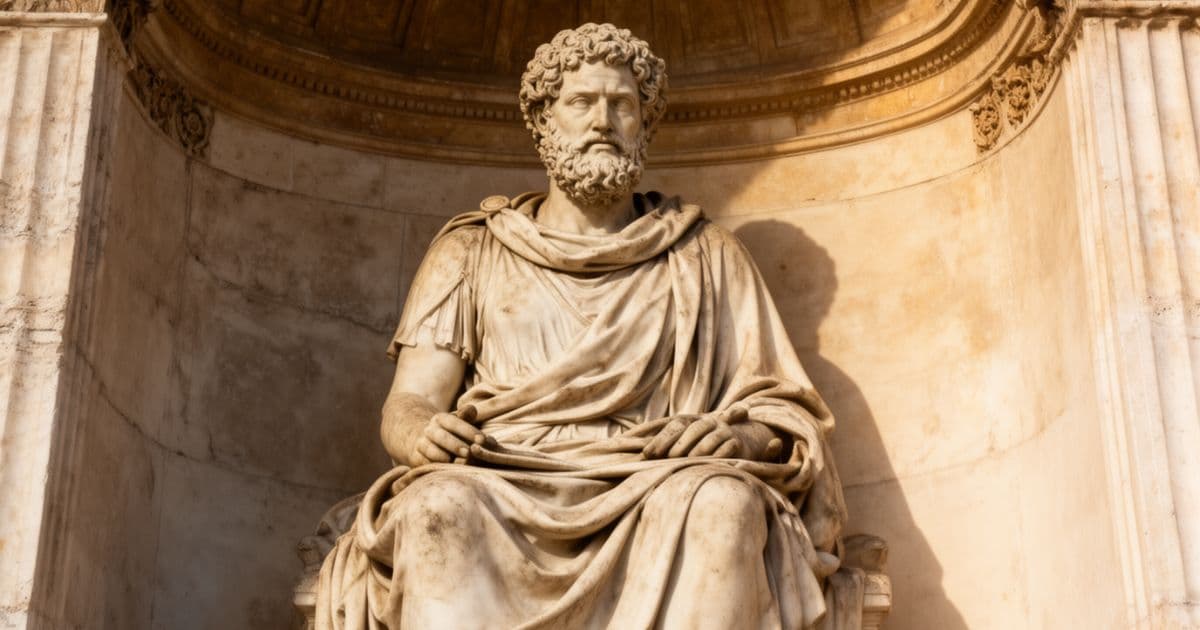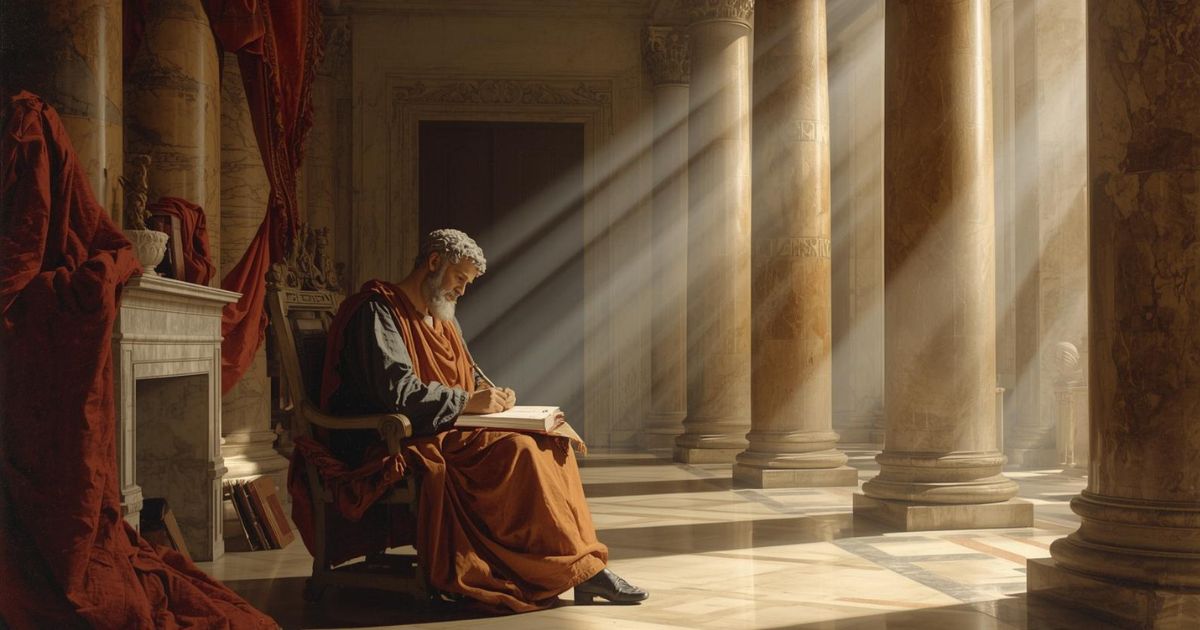
An excerpt from the original text.(complete · 5568 words)
←etter 65. On the first causeMoral letters to Luciliusby Seneca, translated by Richard Mott GummereLetter 66. On various aspects of virtueLetter 67. On ill-health and endurance of suffering→483085Moral letters to Lucilius — Letter 66. On various aspects of virtueRichard Mott GummereSeneca THE EPISTLES OF SENECA LXVI. ON VARIOUS ASPECTS OF VIRTUE 1. I have just seen my former school-mate Claranus for the first time in many years. You need not wait for me to add that he is an old man; but I assure you that I found him hale in spirit and sturdy, although he is wrestling with a frail and feeble body. For Nature acted unfairly when she gave him a poor domicile for so rare a soul; or perhaps it was because she wished to prove to us that an absolutely strong and happy mind can lie hidden under any exterior. Be that as it may, Claranus overcomes all these hindrances, and by despising his own body has arrived at a stage where he can despise other things also. 2. The poet who sang Worth shows more pleasing in a form that’s fair,[1] is, in my opinion, mistaken. For virtue needs nothing to set it off; it is its own great glory, and it hallows the body in which it dwells. At any rate, I have begun to regard Claranus in a different light; he seems to me handsome, and as well-set-up in body as in mind. 3. A great man can spring from a hovel; so can a beautiful and great soul from an ugly and insignificant body. For this reason Nature seems to me to breed certain men of this stamp with the idea of proving that virtue springs into birth in any place whatever. Had it been possible for her to produce souls by themselves and naked, she would have done so; as it is, Nature does a still greater thing, for she produces certain men who, though hampered in their bodies, none the less break through the obstruction. 4. I think Claranus has been produced as a pattern, that we might be enabled to understand that the soul is not disfigured by the ugliness of the body, but rather the opposite, that the body is beautified by the comeliness of the soul. Now, though Claranus and I have spent very few days together, we have nevertheless had many conversations, which I will at once pour forth and pass on to you. 5. The first day we investigated this problem: how can goods be equal if they are of three kinds?[2] For certain of them, according to our philosophical tenets, are primary, such as joy, peace, and the welfare of one’s country. Others are of the second order, moulded in an unhappy material, such as the endurance of suffering, and self-control during severe illness. We shall pray outright for the goods of the first class; for the second class we shall pray only if the need shall arise. There is still a third variety, as, for example, a modest gait, a calm and honest countenance, and a bearing that suits the man of wisdom. 6. Now how can these things be equal when we compare them, if you grant that we ought to pray for the one and avoid the other? If we would make distinctions among them, we had better return to the First Good, and consider what its nature is: the soul that gazes upon truth, that is skilled in what should be sought and what should be avoided, establishing standards of value not according to opinion, but according to nature,—the soul that penetrates the whole world and directs its contemplating gaze upon all its phenomena, paying strict attention to thoughts and actions, equally great and forceful, superior alike to hardships and blandishments, yielding itself to neither extreme of fortune, rising above all blessings and tribulations, absolutely beautiful, perfectly equipped with grace as well as with strength, healthy and sinewy,[3] unruffled, undismayed, one which no violence can shatter, one which acts of chance can neither exalt nor depress,—a soul like this is virtue itself. 7. There you have its outward appearance, if it should ever come under a single view and show itself once in all its completeness. But there are many aspects of it. They unfold themselves according as life varies and as actions differ; but virtue itself does not become less or greater.[4] For the Supreme Good cannot diminish, nor may virtue retrograde; rather is it transformed, now into one quality and now into another, shaping itself according to the part which it is to play. 8. Whatever it has touched it brings into likeness with itself, and dyes with its own colour. It adorns our actions, our friendships, and sometimes entire households which it has entered and set in order. Whatever it has handled it forthwith makes lovable, notable, admirable. Therefore the power and the greatness of virtue cannot rise to greater heights, because increase is denied to that which is superlatively great. You will find nothing straighter than the straight, nothing truer than the truth, and nothing more temperate than that which is temperate. 9. Every virtue is limitless; for limits depend upon definite measurements. Constancy cannot advance further, any more than fidelity, or truthfulness, or loyalty. What can be added to that which is perfect? Nothing otherwise that was not perfect to which something has been added. Nor can anything be added to virtue, either, for if anything can be added thereto, it must have contained a defect. Honour, also, permits of no addition; for it is honourable because of the very qualities which I have mentioned.[5] What then? Do you think that propriety, justice, lawfulness, do not also belong to the same type, and that they are kept within fixed limits? The ability to increase is proof that a thing is still imperfect. 10. The good, in every instance, is subject to these same laws. The advantage of the state and that of the individual are yoked together; indeed it is as impossible to separate them as to separate the commendable from the desirable. Therefore, virtues are mutually equal; and so are the works of virtue, and all men who are so fortunate as to possess these virtues. 11. But, since the virtues of plants and of animals are perishable, they are also frail and fleeting and uncertain. They spring up, and they sink down again, and for this reason they are not rated at the same value; but to human virtues only one rule applies. For right reason is single and of but one kind. Nothing is more divine than the divine, or more heavenly than the heavenly. 12. Mortal things decay, fall, are worn out, grow up, are exhausted, and replenished. Hence, in their case, in view of the uncertainty of their lot, there is inequality; but of things divine the nature is one. Reason, however, is nothing else than a portion of the divine spirit set in a human body.[6] If reason is divine, and the good in no case lacks reason, then the good in every case is divine. And furthermore, there is no distinction between things divine; hence there is none between goods, either. Therefore it follows that joy and a brave unyielding endurance of torture are equal goods; for in both there is the same greatness of soul relaxed and cheerful in the one case, in the other combative and braced for action. 13. What? Do you not think that the virtue of him who bravely storms the enemy’s stronghold is equal to that of him who endures a siege with the utmost patience? Great is Scipio when he invests Numantia,[7] and constrains and compels the hands of an enemy, whom he could not conquer, to resort to their own destruction. Great also are the souls of the defenders—men who know that, as long as the path to death lies open, the blockade is not complete, men who breathe their last in the arms of liberty. In like manner, the other virtues are also equal as compared with one another: tranquillity, simplicity, generosity, constancy, equanimity, endurance. For underlying them all is a single virtue—that which renders the soul straight and unswerving. 14. “What then,” you say; “is there no difference between joy and unyielding endurance of pain?” None at all, as regards the virtues themselves; very great, however, in the circumstances in which either of these two virtues is displayed. In the one case, there is a natural relaxation and loosening of the soul; in the other there is an unnatural pain. Hence these circumstances, between which a great distinction can be drawn, belong to the category of indifferent things,[8] but the virtue shown in each case is equal. 15. Virtue is not changed by the matter with which it deals; if the matter is hard and stubborn, it does not make the virtue worse; if pleasant and joyous, it does not make it better. Therefore, virtue necessarily remains equal. For, in each case, what is done is done with equal uprightness, with equal wisdom, and with equal honour. Hence the states of goodness involved are equal, and it is impossible for a man to transcend these states of goodness by conducting himself better, either the one man in his joy, or the other amid his suffering. And two goods, neither of which can possibly be better, are equal. 16. For if things which are extrinsic to virtue can either diminish or increase virtue, then that which is honourable[9] ceases to be the only good. If you grant this, honour has wholly perished. And why? Let me tell you: it is because no act is honourable that is done by an unwilling agent, that is compulsory. Every honourable act is voluntary. Alloy it with reluctance, complaints, cowardice, or fear, and it loses its best characteristic—self-approval. That which is not free cannot be honourable; for fear means slavery. 17. The honourable is wholly free from anxiety and is calm; if it ever objects, laments, or regards anything as an evil, it becomes subject to disturbance and begins to flounder about amid great confusion. For on one side the semblance of right calls to it, on the other the suspicion of evil drags it back. Therefore, when a man is about to do something honourable, he should not regard any obstacles as evils, even though he regard them as inconvenient, but he should will to do the deed, and do it willingly. For every honourable act is done without commands or compulsion; it is unalloyed and contains no admixture of evil. 18. I know what you may reply to me at this point: “Are you trying to make us believe that it does not matter whether a man feels joy, or whether he lies upon the rack and tires out his torturer?” I might say in answer: “Epicurus also maintains that the wise man, though he is being burned in the bull of Phalaris,[10] will cry out: ‘’Tis pleasant, and concerns me not at all.’” Why need you wonder, if I maintain that he who reclines at a banquet and the victim who stoutly withstands torture possess equal goods, when Epicurus maintains a thing that is harder to believe, namely, that it is pleasant to be roasted in this way? 19. But the reply which I do make, is that there is great difference between joy and pain; if I am asked to choose, I shall seek the former and avoid the latter. The former is according to nature, the latter contrary to it. So long as they are rated by this standard, there is a great gulf between; but when it comes to a question of the virtue involved, the virtue in each case is the same, whether it comes through joy or through sorrow. 20. Vexation and pain and other inconveniences are of no consequence, for they are overcome by virtue. Just as the brightness of the sun dims all lesser lights, so virtue, by its own greatness, shatters and overwhelms all pains, annoyances, and wrongs; and wherever its radiance reaches, all lights which shine without the help of virtue are extinguished; and inconveniences, when they come in contact with virtue, play no more important a part than does a storm-cloud at sea. 21. This can be proved to you by the fact that the good man will hasten unhesitatingly to any noble deed; even though he be confronted by the hangman, the torturer, and the stake, he will persist, regarding not what he must suffer, but what he must do; and he will entrust himself as readily to an honourable deed as he would to a good man; he will consider it advantageous to himself, safe, propitious. And he will hold the same view concerning an honourable deed, even though it be fraught with sorrow and hardship, as concerning a good man who is poor or wasting away in exile. 22. Come now, contrast a good man who is rolling in wealth with a man who has nothing, except that in himself he has all things; they will be equally good, though they experience unequal fortune. This same standard, as I have remarked, is to be applied to things as well as to men; virtue is just as praiseworthy if it dwells in a sound and free body, as in one which is sickly or in bondage. 23. Therefore, as regards your own virtue also, you will not praise it any more, if fortune has favoured it by granting you a sound body, than if fortune has endowed you with a body that is crippled in some member, since that would mean rating a master low because he is dressed like a slave. For all those things over which Chance holds sway are chattels,—money, person, position; they are weak, shifting, prone to perish, and of uncertain tenure. On the other hand, the works of virtue are free and unsubdued, neither more worthy to be sought when fortune treats them kindly, nor less worthy when any adversity weighs upon them. 24. Now friendship in the case of men corresponds to desirability in the case of things. You would not, I fancy, love a good man if he were rich any more than if he were poor, nor would you love a strong and muscular person more than one who was slender and of delicate constitution. Accordingly, neither will you seek or love a good thing that is mirthful and tranquil more than one that is full of perplexity and toil. 25. Or, if you do this, you will, in the case of two equally good men, care more for him who is neat and well-groomed than for him who is dirty and unkempt. You would next go so far as to care more for a good man who is sound in all his limbs and without blemish, than for one who is weak or purblind; and gradually your fastidiousness would reach such a point that, of two equally just and prudent men, you would choose him who has long curling hair! Whenever the virtue in each one is equal, the inequality in their other attributes is not apparent. For all other things are not parts, but merely accessories. 26. Would any man judge his children so unfairly as to care more for a healthy son than for one who was sickly, or for a tall child of unusual stature more than for one who was short or of middling height? Wild beasts show no favouritism among their offspring; they lie down in order to suckle all alike; birds make fair distribution of their food. Ulysses hastens back to the rocks of his Ithaca as eagerly as Agamemnon speeds to the kingly walls of Mycenae. For no man loves his native land because it is great; he loves it because it is his own.[11] 27. And what is the purpose of all this? That you may know that virtue regards all her works in the same light, as if they were her children, showing equal kindness to all, and still deeper kindness to those which encounter hardships; for even parents lean with more affection towards those of their offspring for whom they feel pity. Virtue, too, does not necessarily love more deeply those of her works which she beholds in trouble and under heavy burdens, but, like good parents, she gives them more of her fostering care. 28. Why is no good greater than any other good? It is because nothing can be more fitting than that which is fitting, and nothing more level than that which is level. You cannot say that one thing is more equal to a given object than another thing; hence also nothing is more honourable than that which is honourable. 29. Accordingly, if all the virtues are by nature equal, the three varieties[12] of goods are equal. This is what I mean: there is an equality between feeling joy with self-control and suffering pain with self-control. The joy in the one case does not surpass in the other the steadfastness of soul that gulps down the groan when the victim is in the clutches of the torturer; goods of the first kind are desirable, while those of the second are worthy of admiration; and in each case they are none the less equal, because whatever inconvenience attaches to the latter is compensated by the qualities of the good, which is so much greater. 30. Any man who believes them to be unequal is turning his gaze away from the virtues themselves and is surveying mere externals; true goods have the same weight and the same width.[13] The spurious sort contain much emptiness; hence, when they are weighed in the balance, they are found wanting, although they look imposing and grand to the gaze. 31. Yes, my dear Lucilius, the good which true reason approves is solid and everlasting; it strengthens the spirit and exalts it, so that it will always be on the heights; but those things which are thoughtlessly praised, and are goods in the opinion of the mob merely puff us up with empty joy. And again, those things which are feared as if they were evils merely inspire trepidation in men’s minds, for the mind is disturbed by the semblance of danger, just as animals are disturbed. 32. Hence it is without reason that both these things distract and sting the spirit; the one is not worthy of joy, nor the other of fear. It is reason alone that is unchangeable, that holds fast to its decisions. For reason is not a slave to the senses, but a ruler over them. Reason is equal to reason, as one straight line to another; therefore virtue also is equal to virtue. Virtue is nothing else than right reason. All virtues are reasons. Reasons are reasons, if they are right reasons. If they are right, they are also equal. 33. As reason is, so also are actions; therefore all actions are equal. For since they resemble reason, they also resemble each other. Moreover, I hold that actions are equal to each other in so far as they are honourable and right actions. There will be, of course, great differences according as the material varies, as it becomes now broader and now narrower, now glorious and now base, now manifold in scope and now limited. However, that which is best in all these cases is equal; they are all honourable. 34. In the same way, all good men, in so far as they are good, are equal. There are, indeed, differences of age,—one is older, another younger; of body,—one is comely, another is ugly; of fortune,—this man is rich, that man poor, this one is influential, powerful, and well-known to cities and peoples, that man is unknown to most, and is obscure. But all, in respect of that wherein they are good, are equal. 35. The senses[14] do not decide upon things good and evil; they do not know what is useful and what is not useful. They cannot record their opinion unless they are brought face to face with a fact; they can neither see into the future nor recollect the past; and they do not know what results from what. But it is from such knowledge that a sequence and succession of actions is woven, and a unity of life is created,—a unity which will proceed in a straight course. Reason, therefore, is the judge of good and evil; that which is foreign and external she regards as dross, and that which is neither good nor evil she judges as merely accessory, insignificant and trivial. For all her good resides in the soul. 36. But there are certain goods which reason regards as primary, to which she addresses herself purposely; these are, for example, victory, good children, and the welfare of one’s country. Certain others she regards as secondary; these become manifest only in adversity,—for example, equanimity in enduring severe illness or exile. Certain goods are indifferent; these are no more according to nature than contrary to nature, as, for example, a discreet gait and a sedate posture in a chair. For sitting is an act that is not less according to nature than standing or walking. 37. The two kinds of goods which are of a higher order are different; the primary are according to nature,—such as deriving joy from the dutiful behaviour of one’s children and from the well-being of one’s country. The secondary are contrary to nature,—such as fortitude in resisting torture or in enduring thirst when illness makes the vitals feverish. 38. “What then,” you say; “can anything that is contrary to nature be a good?” Of course not; but that in which this good takes its rise is sometimes contrary to nature. For being wounded, wasting away over a fire, being afflicted with bad health,—such things are contrary to nature; but it is in accordance with nature for a man to preserve an indomitable soul amid such distresses. 39. To explain my thought briefly, the material with which a good is concerned is sometimes contrary to nature, but a good itself never is contrary, since no good is without reason, and reason is in accordance with nature. “What, then,” you ask, “is reason?” It is copying nature.[15] “And what,” you say, “is the greatest good that man can possess?” It is to conduct oneself according to what nature wills. 40. “There is no doubt,” says the objector, “that peace affords more happiness when it has not been assailed than when it has been recovered at the cost of great slaughter.” “There is no doubt also,” he continues, “that health which has not been impaired affords more happiness than health which has been restored to soundness by means of force, as it were, and by endurance of suffering, after serious illnesses that threaten life itself. And similarly there will be no doubt that joy is a greater good than a soul’s struggle to endure to the bitter end the torments of wounds or burning at the stake.” 41. By no means. For things that result from hazard admit of wide distinctions, since they are rated according to their usefulness in the eyes of those who experience them, but with regard to goods, the only point to be considered is that they are in agreement with nature; and this is equal in the case of all goods. When at a meeting of the Senate we vote in favour of someone’s motion, it cannot be said, “A. is more in accord with the motion than B.” All alike vote for the same motion. I make the same statement with regard to virtues,—they are all in accord with nature; and I make it with regard to goods also,—they are all in accord with nature. 42. One man dies young, another in old age, and still another in infancy, having enjoyed nothing more than a mere glimpse out into life. They have all been equally subject to death, even though death has permitted the one to proceed farther along the pathway of life, has cut off the life of the second in his flower, and has broken off the life of the third at its very beginning. 43. Some get their release at the dinner-table. Others extend their sleep into the sleep of death. Some are blotted out during dissipation. Now contrast with these persons individuals who have been pierced by the sword, or bitten to death by snakes, or crushed in ruins, or tortured piecemeal out of existence by the prolonged twisting of their sinews. Some of these departures may be regarded as better, some as worse; but the act of dying is equal in all. The methods of ending life are different; but the end is one and the same. Death has no degrees of greater or less; for it has the same limit in all instances,—the finishing of life. 44. The same thing holds true, I assure you, concerning goods; you will find one amid circumstances of pure pleasure, another amid sorrow and bitterness. The one controls the favours of fortune; the other overcomes her onslaughts. Each is equally a good, although the one travels a level and easy road, and the other a rough road. And the end of them all is the same: they are goods, they are worthy of praise, they accompany virtue and reason. Virtue makes all the things that it acknowledges equal to one another. 45. You need not wonder that this is one of our principles; we find mentioned in the works of Epicurus[16] two goods, of which his Supreme Good, or blessedness, is composed, namely, a body free from pain and a soul free from disturbance. These goods, if they are complete, do not increase; for how can that which is complete increase? The body is, let us suppose, free from pain; what increase can there be to this absence of pain? The soul is composed and calm; what increase can there be to this tranquillity? 46. Just as fair weather, purified into the purest brilliancy, does not admit of a still greater degree of clearness; so, when a man takes care of his body and of his soul, weaving the texture of his good from both, his condition is perfect, and he has found the consummation of his prayers, if there is no commotion in his soul or pain in his body. Whatever delights fall to his lot over and above these two things do not increase his Supreme Good; they merely season it, so to speak, and add spice to it. For the absolute good of man’s nature is satisfied with peace in the body and peace in the soul. 47. I can show you at this moment in the writings of Epicurus[17] a graded list of goods just like that of our own school. For there are some things, he declares, which he prefers should fall to his lot, such as bodily rest free from all inconvenience, and relaxation of the soul as it takes delight in the contemplation of its own goods. And there are other things which, though he would prefer that they did not happen, he nevertheless praises and approves,—for example, the kind of resignation, in times of ill-health and serious suffering, to which I alluded a moment ago, and which Epicurus displayed on that last and most blessed day of his life. For he tells us[18] that he had to endure excruciating agony from a diseased bladder and from an ulcerated stomach,—so acute that it permitted no increase of pain; “and yet,” he says, “that day was none the less happy.” And no man can spend such a day in happiness unless he possesses the Supreme Good. 48. We therefore find mentioned, even by Epicurus,[19] those goods which one would prefer not to experience; which, however, because circumstances have decided thus, must be welcomed and approved and placed on a level with the highest goods. We cannot say that the good which has rounded out[20] a happy life, the good for which Epicurus rendered thanks in the last words he uttered, is not equal to the greatest. 49. Allow me, excellent Lucilius, to utter a still bolder word: if any goods could be greater than others, I should prefer those which seem harsh to those which are mild and alluring, and should pronounce them greater. For it is more of an accomplishment to break one’s way through difficulties than to keep joy within bounds. 50. It requires the same use of reason, I am fully aware, for a man to endure prosperity well and also to endure misfortune bravely. That man may be just as brave who sleeps in front of the ramparts without fear of danger when no enemy attacks the camp, as the man who, when the tendons of his legs have been severed, holds himself up on his knees and does not let fall his weapons; but it is to the blood-stained soldier returning from the front that men cry: “Well done, thou hero!”[21] And therefore I should bestow greater praise upon those goods that have stood trial, and show courage, and have fought it out with fortune. 51. Should I hesitate whether to give greater praise to the maimed and shrivelled hand of Mucius[22] than to the uninjured hand of the bravest man in the world? There stood Mucius, despising the enemy and despising the fire, and watched his hand as it dripped blood over the fire on his enemy’s altar, until Porsenna, envying the fame of the hero whose punishment he was advocating, ordered the fire to be removed against the will of the victim. 52. Why should I not reckon this good among the primary goods, and deem it in so far greater than those other goods which are unattended by danger and have made no trial of fortune, as it is a rarer thing to have overcome a foe with a hand lost than with a hand armed? “What then?"” you say; “shall you desire this good for yourself?” Of course I shall. For this is a thing that a man cannot achieve unless he can also desire it. 53. Should I desire, instead, to be allowed to stretch out my limbs for my slaves to massage,[23] or to have a woman, or a man changed into the likeness of a woman, pull my finger-joints? I cannot help believing that Mucius was all the more lucky because he manipulated the flames as calmly as if he were holding out his hand to the manipulator. He had wiped out all his previous mistakes; he finished the war unarmed and maimed; and with that stump of a hand he conquered two kings.[24] Farewell. ↑ Vergil, Aeneid, v. 344. ↑ Seneca is not speaking here of the three generic virtues (physical, ethical, logical), nor of the three kinds of goods (based on bodily advantage) which were classified by the Peripatetic school; he is only speaking of three sorts of circumstances under which the good can manifest itself. And in §§ 36 ff. he shows that he regards only the first two classes as real goods. See Zeller, Stoics, p. 230, n. 3. ↑ Siccus (not in the sense of Ep. xviii. 4) here means “vigorous,” “healthy,” “dry”; i.e., free from dropsy, catarrh, etc. ↑ Cf., from among many passages, Ep. lxxi. 20 f. and xcii. 16 ff. ↑ i.e., constancy, fidelity, etc. ↑ Ratio (λόγος) is also defined as God, as Absolute Truth, Destiny, etc. The same idea is evident in the definition of sapientia (the object of philosophy) as rerum divinarum et humanarum . . . scientia (Cic. Off. ii. 2. 5, etc.), and nosse divina et humana et horum causas, etc. ↑ A Spanish city, reduced and razed to the ground in 133 B.C. by Scipio Africanus, the conqueror of Carthage. ↑ Cf. Ep. xxxi. 4 and footnote (Vol. I.). ↑ Cf. Cicero, De Fin. ii. 14 f. Rackham translates as “moral worth,”—a reminiscence of τὸ καλόν. ↑ One of the stock bits of heroism attributed to the ideal wise man. Cf. Epicurus (Frag. 601 Usener), Cicero, Tusc. ii. 7. 17, etc. ↑ A slight variation of the idea in Cicero, De Orat. i. 196 si nos . . . nostra patria delectat, cuius rei tanta est vis ac tanta natura, ut Ithacam illam in asperrimis saxulis tamquam nidulum adfixam sapientissimus vir immortalitati anteponeret. ↑ i.e., of the soul, of the body, and of external goods. ↑ Buecheler thinks that this alliterative phrase of Seneca’s is an echo of some popular proverb or line taken from a play. ↑ Here Seneca is reminding Lucillius, as he so often does in the earlier letters, that the evidence of the senses is only a stepping-stone to higher ideas—an Epicurean tenet. ↑ Another definition, developing further the thought expressed in § 12. ↑ Frag. 434 Usener. ↑ Frag. 449 Usener. ↑ Frag. 138 Usener. ↑ See above, § 47. ↑ Clausula has, among other meanings, that of “a period” (Quintil. viii. 5), and “the rhythmic close of a period” (Cic. De Orat. iii. 192). ↑ For a full discussion of this phrase see Conington, Excursus to Vergil’s Aeneid, ix. 641. ↑ For the story see Livy, ii. 12 ff. ↑ A rare word—sometimes spelled malacisso,—used by Plautus (Bacch. 73) and Laberius, but not in a technical sense. ↑ Porsenna and Tarquin.
Master this chapter. Complete your experience
Purchase the complete book to access all chapters and support classic literature
As an Amazon Associate, we earn a small commission from qualifying purchases at no additional cost to you.
Available in paperback, hardcover, and e-book formats
Let's Analyse the Pattern
The tendency to judge people's worth by their external circumstances rather than their character and choices.
Why This Matters
Connect literature to life
This chapter teaches how to judge character by response to situations rather than the situations themselves.
Practice This Today
This week, notice when you judge someone by their job title, appearance, or luck rather than how they actually behave under pressure.
Now let's explore the literary elements.
Key Quotes & Analysis
"Virtue needs nothing to set it off; it is its own great glory, and it hallows the body in which it dwells."
Context: Explaining why his friend Claranus appears beautiful despite his frail body
This reveals that virtue transforms how we see people. Good character makes someone attractive regardless of physical appearance. Virtue doesn't need external decoration or perfect circumstances to shine.
In Today's Words:
Good character makes anyone beautiful—it lights them up from the inside and you can't help but notice it.
"A great man can spring from a hovel; so can a beautiful and great soul from an ugly and insignificant body."
Context: Continuing his reflection on how virtue transcends physical limitations
This challenges social prejudices about worth being tied to appearance or background. Seneca argues that greatness comes from character, not circumstances of birth or physical attributes.
In Today's Words:
Amazing people can come from anywhere and look like anything—don't write someone off because of where they're from or how they look.
"All goods are equal, and all virtuous acts are equal."
Context: Arguing that virtue has the same value regardless of the situation where it appears
This is the chapter's central philosophical point. Whether someone shows courage in war or patience in illness, the moral worth is identical. This prevents us from ranking people's struggles or achievements.
In Today's Words:
Being good is being good, period—whether you're dealing with big drama or small daily challenges, doing the right thing counts the same.
Thematic Threads
Identity
In This Chapter
Claranus's identity isn't defined by his physical appearance but by his brilliant mind and character
Development
Builds on earlier themes about not letting external judgments define who we are
In Your Life:
You might struggle with feeling judged by your job title, income, or appearance rather than your actual qualities
Class
In This Chapter
Virtue exists equally across all social and economic levels—a poor person's integrity equals a rich person's
Development
Reinforces ongoing theme that moral worth transcends economic circumstances
In Your Life:
You might feel inferior to wealthier people or superior to those with less, missing their true character
Social Expectations
In This Chapter
Society expects us to judge by appearances and circumstances, but wisdom looks deeper
Development
Continues challenge to conventional social hierarchies based on external factors
In Your Life:
You might feel pressure to present a perfect image rather than being authentic about your struggles
Personal Growth
In This Chapter
Growth means learning to see virtue wherever it appears, regardless of packaging
Development
Expands on theme that wisdom involves seeing beyond surface appearances
In Your Life:
You might miss opportunities to learn from people you initially dismiss based on first impressions
Human Relationships
In This Chapter
True friendship values character over circumstances, as Seneca does with Claranus
Development
Deepens exploration of what makes relationships meaningful and lasting
In Your Life:
You might need to examine whether you choose friends based on what they can do for you or who they truly are
You now have the context. Time to form your own thoughts.
Discussion Questions
- 1
Why was Seneca surprised by his reunion with Claranus, and what did this teach him about how we judge people?
analysis • surface - 2
According to Seneca, why are all virtuous acts equal regardless of whether they bring joy or suffering? What makes the torture victim equal to the person celebrating?
analysis • medium - 3
Where do you see people being judged by their circumstances rather than their character in your workplace, community, or family life?
application • medium - 4
Think of someone you initially misjudged based on their appearance, job, or situation. How would you approach that relationship differently now?
application • deep - 5
If virtue makes all circumstances equal, how does this change the way you view your own struggles and successes?
reflection • deep
Critical Thinking Exercise
Character Detective Challenge
Choose three people you interact with regularly but have made quick judgments about based on their circumstances (wealth, appearance, job, living situation). For each person, list what you initially assumed about their character, then identify three actual character clues you've observed through their actions or words. Finally, write what you might have missed by focusing on circumstances instead of character.
Consider:
- •Look for how people treat others when they think no one is watching
- •Notice how they handle stress, disappointment, or unexpected challenges
- •Pay attention to whether their actions match their words over time
Journaling Prompt
Write about a time when someone misjudged you based on your circumstances. How did it feel, and what did you wish they had seen instead? How can this experience guide how you judge others?
Coming Up Next...
Chapter 67: When Life Hurts: Finding Strength in Suffering
As spring arrives, Seneca turns to a more personal struggle—dealing with illness and physical suffering. He'll explore how philosophy actually works when your body is failing and pain clouds your thinking.