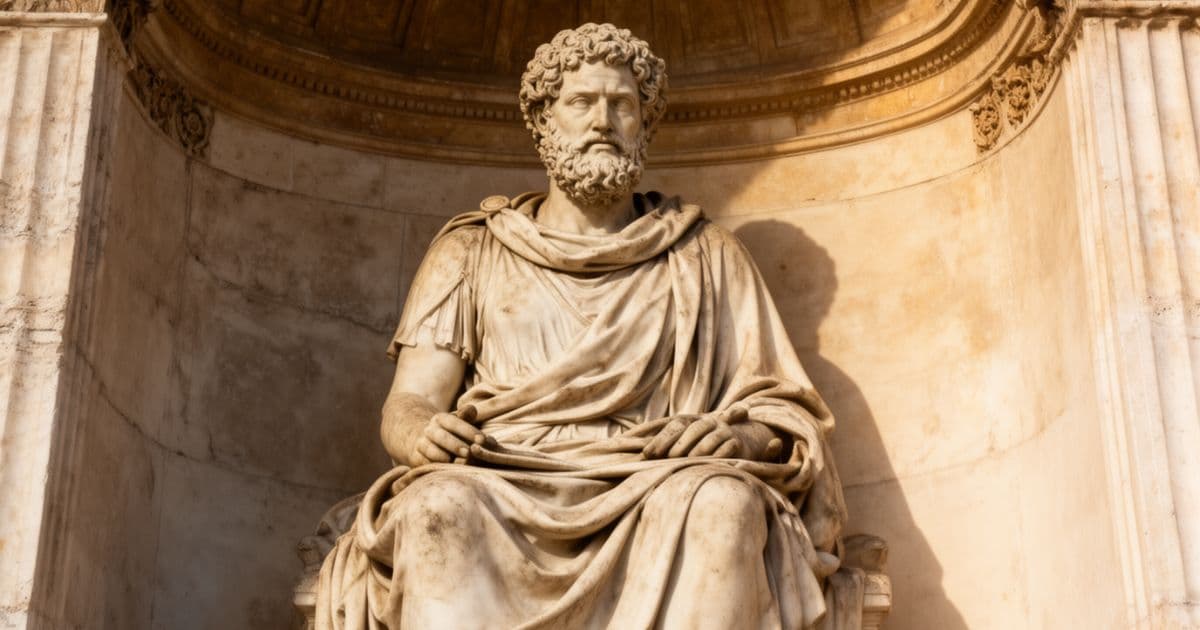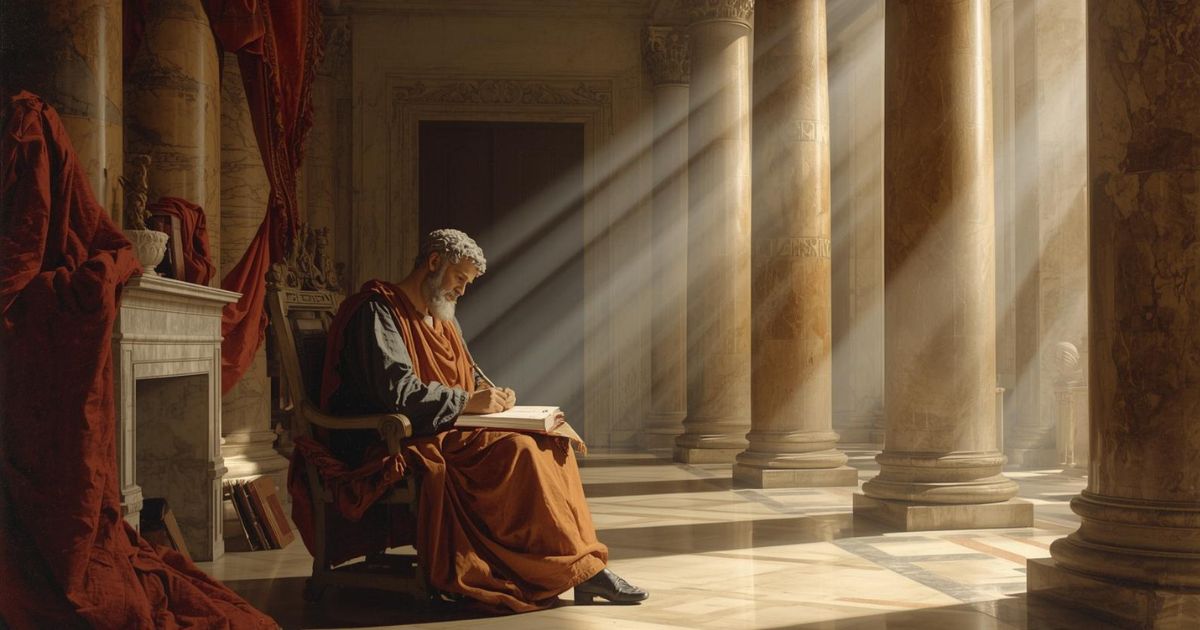
An excerpt from the original text.(complete · 2851 words)
←etter 64. On the philosopher's taskMoral letters to Luciliusby Seneca, translated by Richard Mott GummereLetter 65. On the first causeLetter 66. On various aspects of virtue→483042Moral letters to Lucilius — Letter 65. On the first causeRichard Mott GummereSeneca LXV. ON THE FIRST CAUSE 1. I shared my time yesterday with ill health;[1] it claimed for itself all the period before noon; in the afternoon, however, it yielded to me. And so I first tested my spirit by reading; then, when reading was found to be possible, I dared to make more demands upon the spirit, or perhaps I should say, to make more concessions to it. I wrote a little, and indeed with more concentration than usual, for I am struggling with a difficult subject and do not wish to be downed. In the midst of this, some friends visited me, with the purpose of employing force and of restraining me, as if I were a sick man indulging in some excess. 2. So conversation was substituted for writing; and from this conversation I shall communicate to you the topic which is still the subject of debate; for we have appointed you referee.[2] You have more of a task on your hands than you suppose, for the argument is threefold. Our Stoic philosophers, as you know, declare that there are two things in the universe which are the source of everything,—namely, cause and matter.[3] Matter lies sluggish, a substance ready for any use, but sure to remain unemployed if no one sets it in motion. Cause, however, by which we mean reason, moulds matter and turns it in whatever direction it will, producing thereby various concrete results. Accordingly, there must be, in the case of each thing, that from which it is made, and, next, an agent by which it is made. The former is its material, the latter its cause. 3. All art is but imitation of nature; therefore, let me apply these statements of general principles to the things which have to be made by man. A statue, for example, has afforded matter which was to undergo treatment at the hands of the artist, and has had an artist who was to give form to the matter. Hence, in the case of the statue, the material was bronze, the cause was the workman. And so it goes with all things,—they consist of that which is made, and of the maker. 4. The Stoics believe in one cause only,—the maker; but Aristotle thinks that the word “cause” can be used in three ways: “The first cause,” he says, “is the actual matter, without which nothing can be created. The second is the workman. The third is the form, which is impressed upon every work,—a statue, for example.” This last is what Aristotle calls the idos.[4] “There is, too,” says he, “a fourth,—the purpose of the work as a whole.” 5. Now I shall show you what this last means. Bronze is the “first cause” of the statue, for it could never have been made unless there had been something from which it could be cast and moulded. The “second cause” is the artist; for without the skilled hands of a workman that bronze could not have been shaped to the outlines of the statue. The “third cause” is the form, inasmuch as our statue could never be called The Lance-Bearer or The Boy Binding his Hair,[5] had not this special shape been stamped upon it. The “fourth cause” is the purpose of the work. For if this purpose had not existed, the statue would not have been made. 6. Now what is this purpose? It is that which attracted the artist, which he followed when he made the statue. It may have been money, if he has made it for sale; or renown, if he has worked for reputation; or religion, if he has wrought it as a gift for a temple. Therefore this also is a cause contributing towards the making of the statue; or do you think that we should avoid including, among the causes of a thing which has been made, that element without which the thing in question would not have been made? 7. To these four Plato adds a fifth cause,—the pattern which he himself calls the “idea"; for it is this that the artist gazed upon[6] when he created the work which he had decided to carry out. Now it makes no difference whether he has his pattern outside himself, that he may direct his glance to it, or within himself, conceived and placed there by himself. God has within himself these patterns of all things, and his mind comprehends the harmonies and the measures of the whole totality of things which are to be carried out; he is filled with these shapes which Plato calls the “ideas,”—imperishable, unchangeable, not subject to decay. And therefore, though men die, humanity itself, or the idea of man, according to which man is moulded, lasts on, and though men toil and perish, it suffers no change. 8. Accordingly, there are five causes, as Plato says:[7] the material, the agent, the make-up, the model, and the end in view. Last comes the result of all these. Just as in the case of the statue,—to go back to the figure with which we began,—the material is the bronze, the agent is the artist, the make-up is the form which is adapted to the material, the model is the pattern imitated by the agent, the end in view is the purpose in the maker’s mind, and, finally, the result of all these is the statue itself. 9. The universe also, in Plato’s opinion, possesses all these elements. The agent is God; the source, matter; the form, the shape and the arrangement of the visible world. The pattern is doubtless the model according to which God has made this great and most beautiful creation. 10. The purpose is his object in so doing. Do you ask what God’s purpose is? It is goodness. Plato, at any rate, says: “What was God’s reason for creating the world? God is good, and no good person is grudging of anything that is good. Therefore, God made it the best world possible.” Hand down your opinion, then, O judge; state who seems to you to say what is truest, and not who says what is absolutely true. For to do that is as far beyond our ken as truth itself. 11. This throng of causes, defined by Aristotle and by Plato, embraces either too much or too little.[8] For if they regard as “causes” of an object that is to be made everything without which the object cannot be made, they have named too few. Time must be included among the causes; for nothing can be made without time. They must also include place; for if there be no place where a thing can be made, it will not be made. And motion too; nothing is either made or destroyed without motion. There is no art without motion, no change of any kind. 12. Now, however, I am searching for the first, the general cause; this must be simple, inasmuch as matter, too, is simple. Do we ask what cause is? It is surely Creative Reason,[9]—in other words, God. For those elements to which you referred are not a great series of independent causes; they all hinge on one alone, and that will be the creative cause. 13. Do you maintain that form is a cause? This is only what the artist stamps upon his work; it is part of a cause, but not the cause. Neither is the pattern a cause, but an indispensable tool of the cause. His pattern is as indispensable to the artist as the chisel or the file; without these, art can make no progress. But for all that, these things are neither parts of the art, nor causes of it. 14. “Then,” perhaps you will say, “the purpose of the artist, that which leads him to undertake to create something, is the cause.” It may be a cause; it is not, however, the efficient cause, but only an accessory cause. But there are countless accessory causes; what we are discussing is the general cause. Now the statement of Plato and Aristotle is not in accord with their usual penetration, when they maintain that the whole universe, the perfectly wrought work, is a cause. For there is a great difference between a work and the cause of a work. 15. Either give your opinion, or, as is easier in cases of this kind, declare that the matter is not clear and call for another hearing.[10] But you will reply: “What pleasure do you get from wasting your time on these problems, which relieve you of none of your emotions, rout none of your desires?” So far as I am concerned, I treat and discuss them as matters which contribute greatly toward calming the spirit, and I search myself first, and then the world about me. 16. And not even now am I, as you think, wasting my time. For all these questions, provided that they be not chopped up and torn apart into such unprofitable refinements, elevate and lighten the soul, which is weighted down by a heavy burden and desires to be freed and to return to the elements of which it was once a part. For this body of ours is a weight upon the soul and its penance; as the load presses down the soul is crushed and is in bondage, unless philosophy has come to its assistance and has bid it take fresh courage by contemplating the universe, and has turned it from things earthly to things divine. There it has its liberty, there it can roam abroad;[11] meantime it escapes the custody in which it is bound, and renews its life in heaven. 17. Just as skilled workmen, who have been engaged upon some delicate piece of work which wearies their eyes with straining, if the light which they have is niggardly or uncertain, go forth into the open air and in some park devoted to the people’s recreation delight their eyes in the generous light of day; so the soul, imprisoned as it has been in this gloomy and darkened house, seeks the open sky whenever it can, and in the contemplation of the universe finds rest. 18. The wise man, the seeker after wisdom, is bound closely, indeed, to his body, but he is an absentee so far as his better self is concerned, and he concentrates his thoughts upon lofty things. Bound, so to speak, to his oath of allegiance, he regards the period of life as his term of service. He is so trained that he neither loves nor hates life; he endures a mortal lot, although he knows that an ampler lot is in store for him. 19. Do you forbid me to contemplate the universe? Do you compel me to withdraw from the whole and restrict me to a part? May I not ask what are the beginnings of all things, who moulded the universe, who took the confused and conglomerate mass of sluggish matter, and separated it into its parts? May I not inquire who is the Master-Builder of this universe, how the mighty bulk was brought under the control of law and order, who gathered together the scattered atoms, who separated the disordered elements and assigned an outward form to elements that lay in one vast shapelessness? Or whence came all the expanse of light? And whether is it fire, or something even brighter than fire?[12] 20. Am I not to ask these questions? Must I be ignorant of the heights whence I have descended? Whether I am to see this world but once, or to be born many times? What is my destination afterwards? What abode awaits my soul on its release from the laws of slavery among men? Do you forbid me to have a share in heaven? In other words, do you bid me live with my head bowed down? 21. No, I am above such an existence; I was born to a greater destiny than to be a mere chattel of my body, and I regard this body as nothing but a chain[13] which manacles my freedom. Therefore, I offer it as a sort of buffer to fortune, and shall allow no wound to penetrate through to my soul. For my body is the only part of me which can suffer injury. In this dwelling, which is exposed to peril, my soul lives free. 22. Never shall this flesh drive me to feel fear, or to assume any pretence that is unworthy of a good man. Never shall I lie in order to honour this petty body. When it seems proper, I shall sever my connexion with it. And at present, while we are bound together, our alliance shall nevertheless not be one of equality; the soul shall bring all quarrels before its own tribunal. To despise our bodies is sure freedom. 23. To return to our subject; this freedom will be greatly helped by the contemplation of which we were just speaking. All things are made up of matter and of God;[14] God controls matter, which encompasses him and follows him as its guide and leader. And that which creates, in other words, God, is more powerful and precious than matter, which is acted upon by God. 24. God’s place in the universe corresponds to the soul’s relation to man. World-matter corresponds to our mortal body; therefore let the lower serve the higher. Let us be brave in the face of hazards. Let us not fear wrongs, or wounds, or bonds, or poverty. And what is death? It is either the end, or a process of change. I have no fear of ceasing to exist; it is the same as not having begun. Nor do I shrink from changing into another state, because I shall, under no conditions, be as cramped as I am now. Farewell. ↑ For Seneca’s troubles in this regard see also Epp. liv. and civ. ↑ The arbiter was a judge appointed to try a case according to bona fides (equity), as contrasted with the iudex proper, whose duty was defined by the magistrate. ↑ See Zeller’s Stoics (translated by Reichel), pp. 139 ff. ↑ The statue figure is a frequent one in philosophy; cf. Ep. ix. 5. The “form” of Aristotle goes back to the “idea” of Plato. These four causes are the causes of Aristotle, matter (ὕλη), form (εἶδος), force (τὸ κινοῦν), and the end (τὸ τέλος); when they all concur, we pass from possibility to fact. Aristotle gives eight categories in Phys. 225 b 5; and ten in Categ. 1 b 25,—substance, quantity, quality, relation, place, time, situation, possession, action, passion. For a definition of εἶδος see Aristotle, Phys 190 b 20 γίγνεται πᾶν ἔκ τε τοῦ ὑποκειμένου καὶ τῆς μορφῆς (i.e. τοῦ εἴδους). ↑ Well-known works of Polyclitus, fifth century B.C. ↑ Explaining the derivation of the Greek word,—ιδεῖν, “to behold.” For a discussion of Plato’s “ideas,” those “independent, separate, self-existing, perfect, and eternal essences” (Republic vi. and vii.) see Adam, The Republic of Plato, ii. 168-179. According to Adam, Plato owes his theory of ideas to Socrates, the Eleatics, and the study of geometry; but his debt is not so great as his discovery. ↑ i.e., the four categories as established by Aristotle, plus the “idea” of Plato. ↑ The Stoic view (see § 2 of this letter), besides making the four categories of “substance,” “form,” “variety,” and “variety of relation,” regarded material things as the only things which possessed being. The Stoics thus differ from Aristotle and Plato in holding that nothing is real except matter; besides, they relate everything to one ultimate cause, the acting force or efficient cause. ↑ i.e., the λόγος σπερματικός, the creative force in nature, that is, Providence, or the will of Zeus. ↑ i.e., restate the question and hear the evidence again. ↑ According to the Stoics the soul, which consisted of fire or breath and was a part of the divine essence, rose at death into the ether and became one with the stars. Seneca elsewhere (Consolatio ad Marciam) states that the soul went through a sort of purifying process,—a view which may have had some influence on Christian thought. The souls of the good, the Stoics maintained, were destined to last until the end of the world, the souls of the bad to be extinguished before that time. ↑ The sequence of elements from the earth outwards and upwards was earth, water, air, and fire. The upper fire was ether. Zeno (quoted by Cicero, Acad. i. 11. 39) refused to acknowledge a fifth essence: statuebat enim ignem esse ipsam naturam, quae quaeque gigneret, et mentem et sensus. ↑ The “prison of the body” is a frequent figure in Stoic as in all philosophy. See, for example, § 16 of this letter, “the soul in bondage.” ↑ A restatement of the previous remark made in this letter; see note on § 11.
Master this chapter. Complete your experience
Purchase the complete book to access all chapters and support classic literature
As an Amazon Associate, we earn a small commission from qualifying purchases at no additional cost to you.
Available in paperback, hardcover, and e-book formats
Let's Analyse the Pattern
Understanding deeper forces and bigger pictures provides mental freedom that circumstances cannot touch.
Why This Matters
Connect literature to life
This chapter teaches how to identify deeper systems and forces at work when immediate circumstances feel chaotic or overwhelming.
Practice This Today
This week, when facing any stressful situation, pause and ask 'What pattern is really playing out here?' before reacting emotionally to surface events.
Now let's explore the literary elements.
Key Quotes & Analysis
"Matter lies sluggish, a substance ready for any use, but sure to remain unemployed if no one sets it in motion."
Context: Explaining the Stoic view of how the universe works
This reveals how Stoics saw potential everywhere, but recognized that potential needs an active force to become reality. It's about the relationship between raw materials and the intelligence that shapes them.
In Today's Words:
Everything has potential, but nothing happens without someone or something to make it happen.
"You have more of a task on your hands than you suppose, for the argument is threefold."
Context: Warning Lucilius that judging this philosophical debate won't be simple
Seneca acknowledges that big questions rarely have easy answers. He's preparing his student for the complexity of real thinking, not just accepting simple solutions.
In Today's Words:
This is going to be more complicated than you think - there are multiple sides to consider.
"The soul is freed by contemplating these higher truths, even when the body is confined."
Context: Explaining how philosophical thinking liberates us from physical limitations
This captures the core Stoic promise - that mental freedom is always available regardless of external circumstances. Your thoughts can transcend any prison, including illness, poverty, or other constraints.
In Today's Words:
Your mind can go anywhere, even when your body can't.
Thematic Threads
Mental Freedom
In This Chapter
Seneca demonstrates how philosophical thinking liberates the mind from physical and circumstantial limitations
Development
Introduced here as core Stoic practice
In Your Life:
You might find this when studying something complex helps you feel less trapped by your current situation
Root Causes
In This Chapter
The debate over what truly causes things to exist—material, maker, form, purpose, or divine reason
Development
Introduced here as framework for understanding
In Your Life:
You might see this when trying to understand why problems keep recurring in your workplace or relationships
Perspective
In This Chapter
Physical illness becomes secondary when the mind engages with larger philosophical questions
Development
Introduced here as coping mechanism
In Your Life:
You might experience this when learning something new makes your daily stresses feel more manageable
Knowledge as Power
In This Chapter
Understanding fundamental forces gives strength that circumstances cannot diminish
Development
Introduced here as Stoic principle
In Your Life:
You might notice this when understanding your rights at work makes you feel less vulnerable to unfair treatment
Mind-Body Split
In This Chapter
The soul can roam free through contemplation even when the body is constrained by illness
Development
Introduced here as liberation technique
In Your Life:
You might find this when reading or learning helps you mentally escape physical discomfort or boring situations
You now have the context. Time to form your own thoughts.
Discussion Questions
- 1
When Seneca was sick in bed, what did he choose to think about instead of his physical discomfort?
analysis • surface - 2
Why does Seneca believe that understanding 'big picture' forces helps us handle daily problems better?
analysis • medium - 3
Think about someone you know who stays calm during crises. What deeper knowledge or perspective might they have that others don't?
application • medium - 4
When you're overwhelmed by immediate problems, how could you use Seneca's approach of 'stepping back to see the bigger system' in your own life?
application • deep - 5
What does this chapter reveal about the relationship between knowledge and emotional resilience?
reflection • deep
Critical Thinking Exercise
Map Your Stress to Its Root System
Think of a current stressor in your life - money troubles, difficult relationships, work pressure, health concerns. Instead of focusing on how it makes you feel, spend time identifying the deeper forces at work. What systems, patterns, or root causes are creating this situation? Draw or write out the connections you discover, like mapping a family tree of your problem.
Consider:
- •Look for patterns that repeat across different areas of your life
- •Consider what forces are outside your control versus what you can influence
- •Ask yourself what knowledge or perspective might change how you approach this situation
Journaling Prompt
Write about a time when understanding the 'why' behind a difficult situation changed how you handled it. What knowledge gave you that shift in perspective, and how did it affect your emotional response?
Coming Up Next...
Chapter 66: Why All Good Things Are Equal
Seneca reunites with an old school friend after many years apart, leading to reflections on how people change over time and what it means to truly know someone. The encounter reveals surprising truths about virtue and character development.