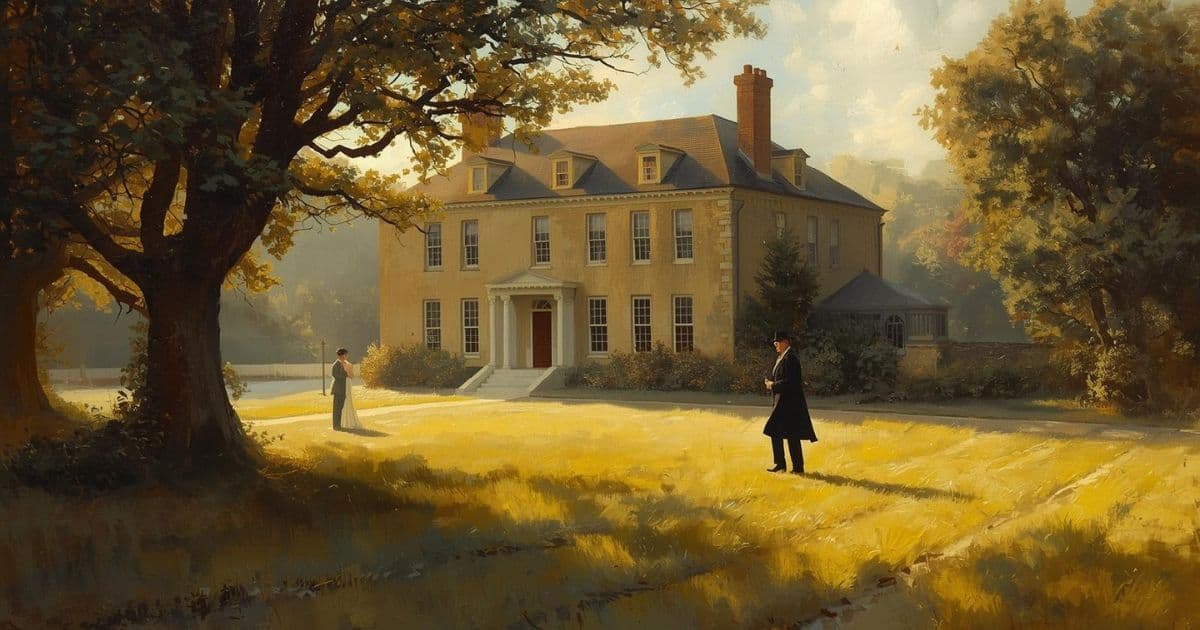
An excerpt from the original text.(complete · 2931 words)
entley Drummle, who was so sulky a fellow that he even took up a book
as if its writer had done him an injury, did not take up an
acquaintance in a more agreeable spirit. Heavy in figure, movement, and
comprehension,—in the sluggish complexion of his face, and in the
large, awkward tongue that seemed to loll about in his mouth as he
himself lolled about in a room,—he was idle, proud, niggardly,
reserved, and suspicious. He came of rich people down in Somersetshire,
who had nursed this combination of qualities until they made the
discovery that it was just of age and a blockhead. Thus, Bentley
Drummle had come to Mr. Pocket when he was a head taller than that
gentleman, and half a dozen heads thicker than most gentlemen.
Startop had been spoilt by a weak mother and kept at home when he ought
to have been at school, but he was devotedly attached to her, and
admired her beyond measure. He had a woman’s delicacy of feature, and
was—“as you may see, though you never saw her,” said Herbert to
me—“exactly like his mother.” It was but natural that I should take to
him much more kindly than to Drummle, and that, even in the earliest
evenings of our boating, he and I should pull homeward abreast of one
another, conversing from boat to boat, while Bentley Drummle came up in
our wake alone, under the overhanging banks and among the rushes. He
would always creep in-shore like some uncomfortable amphibious
creature, even when the tide would have sent him fast upon his way; and
I always think of him as coming after us in the dark or by the
back-water, when our own two boats were breaking the sunset or the
moonlight in mid-stream.
Herbert was my intimate companion and friend. I presented him with a
half-share in my boat, which was the occasion of his often coming down
to Hammersmith; and my possession of a half-share in his chambers often
took me up to London. We used to walk between the two places at all
hours. I have an affection for the road yet (though it is not so
pleasant a road as it was then), formed in the impressibility of
untried youth and hope.
When I had been in Mr. Pocket’s family a month or two, Mr. and Mrs.
Camilla turned up. Camilla was Mr. Pocket’s sister. Georgiana, whom I
had seen at Miss Havisham’s on the same occasion, also turned up. She
was a cousin,—an indigestive single woman, who called her rigidity
religion, and her liver love. These people hated me with the hatred of
cupidity and disappointment. As a matter of course, they fawned upon me
in my prosperity with the basest meanness. Towards Mr. Pocket, as a
grown-up infant with no notion of his own interests, they showed the
complacent forbearance I had heard them express. Mrs. Pocket they held
in contempt; but they allowed the poor soul to have been heavily
disappointed in life, because that shed a feeble reflected light upon
themselves.
These were the surroundings among which I settled down, and applied
myself to my education. I soon contracted expensive habits, and began
to spend an amount of money that within a few short months I should
have thought almost fabulous; but through good and evil I stuck to my
books. There was no other merit in this, than my having sense enough to
feel my deficiencies. Between Mr. Pocket and Herbert I got on fast;
and, with one or the other always at my elbow to give me the start I
wanted, and clear obstructions out of my road, I must have been as
great a dolt as Drummle if I had done less.
I had not seen Mr. Wemmick for some weeks, when I thought I would write
him a note and propose to go home with him on a certain evening. He
replied that it would give him much pleasure, and that he would expect
me at the office at six o’clock. Thither I went, and there I found him,
putting the key of his safe down his back as the clock struck.
“Did you think of walking down to Walworth?” said he.
“Certainly,” said I, “if you approve.”
“Very much,” was Wemmick’s reply, “for I have had my legs under the
desk all day, and shall be glad to stretch them. Now, I’ll tell you
what I have got for supper, Mr. Pip. I have got a stewed steak,—which
is of home preparation,—and a cold roast fowl,—which is from the
cook’s-shop. I think it’s tender, because the master of the shop was a
Juryman in some cases of ours the other day, and we let him down easy.
I reminded him of it when I bought the fowl, and I said, “Pick us out a
good one, old Briton, because if we had chosen to keep you in the box
another day or two, we could easily have done it.” He said to that,
“Let me make you a present of the best fowl in the shop.” I let him, of
course. As far as it goes, it’s property and portable. You don’t object
to an aged parent, I hope?”
I really thought he was still speaking of the fowl, until he added,
“Because I have got an aged parent at my place.” I then said what
politeness required.
“So, you haven’t dined with Mr. Jaggers yet?” he pursued, as we walked
along.
“Not yet.”
“He told me so this afternoon when he heard you were coming. I expect
you’ll have an invitation to-morrow. He’s going to ask your pals, too.
Three of ’em; ain’t there?”
Although I was not in the habit of counting Drummle as one of my
intimate associates, I answered, “Yes.”
“Well, he’s going to ask the whole gang,”—I hardly felt complimented by
the word,—“and whatever he gives you, he’ll give you good. Don’t look
forward to variety, but you’ll have excellence. And there’s another rum
thing in his house,” proceeded Wemmick, after a moment’s pause, as if
the remark followed on the housekeeper understood; “he never lets a
door or window be fastened at night.”
“Is he never robbed?”
“That’s it!” returned Wemmick. “He says, and gives it out publicly, “I
want to see the man who’ll rob me.” Lord bless you, I have heard him,
a hundred times, if I have heard him once, say to regular cracksmen in
our front office, “You know where I live; now, no bolt is ever drawn
there; why don’t you do a stroke of business with me? Come; can’t I
tempt you?” Not a man of them, sir, would be bold enough to try it on,
for love or money.”
“They dread him so much?” said I.
“Dread him,” said Wemmick. “I believe you they dread him. Not but what
he’s artful, even in his defiance of them. No silver, sir. Britannia
metal, every spoon.”
“So they wouldn’t have much,” I observed, “even if they—”
“Ah! But he would have much,” said Wemmick, cutting me short, “and
they know it. He’d have their lives, and the lives of scores of ’em.
He’d have all he could get. And it’s impossible to say what he couldn’t
get, if he gave his mind to it.”
I was falling into meditation on my guardian’s greatness, when Wemmick
remarked:—
“As to the absence of plate, that’s only his natural depth, you know. A
river’s its natural depth, and he’s his natural depth. Look at his
watch-chain. That’s real enough.”
“It’s very massive,” said I.
“Massive?” repeated Wemmick. “I think so. And his watch is a gold
repeater, and worth a hundred pound if it’s worth a penny. Mr. Pip,
there are about seven hundred thieves in this town who know all about
that watch; there’s not a man, a woman, or a child, among them, who
wouldn’t identify the smallest link in that chain, and drop it as if it
was red hot, if inveigled into touching it.”
At first with such discourse, and afterwards with conversation of a
more general nature, did Mr. Wemmick and I beguile the time and the
road, until he gave me to understand that we had arrived in the
district of Walworth.
It appeared to be a collection of back lanes, ditches, and little
gardens, and to present the aspect of a rather dull retirement.
Wemmick’s house was a little wooden cottage in the midst of plots of
garden, and the top of it was cut out and painted like a battery
mounted with guns.
“My own doing,” said Wemmick. “Looks pretty; don’t it?”
I highly commended it, I think it was the smallest house I ever saw;
with the queerest gothic windows (by far the greater part of them
sham), and a gothic door almost too small to get in at.
“That’s a real flagstaff, you see,” said Wemmick, “and on Sundays I run
up a real flag. Then look here. After I have crossed this bridge, I
hoist it up—so—and cut off the communication.”
The bridge was a plank, and it crossed a chasm about four feet wide and
two deep. But it was very pleasant to see the pride with which he
hoisted it up and made it fast; smiling as he did so, with a relish and
not merely mechanically.
“At nine o’clock every night, Greenwich time,” said Wemmick, “the gun
fires. There he is, you see! And when you hear him go, I think you’ll
say he’s a Stinger.”
The piece of ordnance referred to, was mounted in a separate fortress,
constructed of lattice-work. It was protected from the weather by an
ingenious little tarpaulin contrivance in the nature of an umbrella.
“Then, at the back,” said Wemmick, “out of sight, so as not to impede
the idea of fortifications,—for it’s a principle with me, if you have
an idea, carry it out and keep it up,—I don’t know whether that’s your
opinion—”
I said, decidedly.
“—At the back, there’s a pig, and there are fowls and rabbits; then, I
knock together my own little frame, you see, and grow cucumbers; and
you’ll judge at supper what sort of a salad I can raise. So, sir,” said
Wemmick, smiling again, but seriously too, as he shook his head, “if
you can suppose the little place besieged, it would hold out a devil of
a time in point of provisions.”
Then, he conducted me to a bower about a dozen yards off, but which was
approached by such ingenious twists of path that it took quite a long
time to get at; and in this retreat our glasses were already set forth.
Our punch was cooling in an ornamental lake, on whose margin the bower
was raised. This piece of water (with an island in the middle which
might have been the salad for supper) was of a circular form, and he
had constructed a fountain in it, which, when you set a little mill
going and took a cork out of a pipe, played to that powerful extent
that it made the back of your hand quite wet.
“I am my own engineer, and my own carpenter, and my own plumber, and my
own gardener, and my own Jack of all Trades,” said Wemmick, in
acknowledging my compliments. “Well; it’s a good thing, you know. It
brushes the Newgate cobwebs away, and pleases the Aged. You wouldn’t
mind being at once introduced to the Aged, would you? It wouldn’t put
you out?”
I expressed the readiness I felt, and we went into the castle. There we
found, sitting by a fire, a very old man in a flannel coat: clean,
cheerful, comfortable, and well cared for, but intensely deaf.
“Well aged parent,” said Wemmick, shaking hands with him in a cordial
and jocose way, “how am you?”
“All right, John; all right!” replied the old man.
“Here’s Mr. Pip, aged parent,” said Wemmick, “and I wish you could hear
his name. Nod away at him, Mr. Pip; that’s what he likes. Nod away at
him, if you please, like winking!”
“This is a fine place of my son’s, sir,” cried the old man, while I
nodded as hard as I possibly could. “This is a pretty pleasure-ground,
sir. This spot and these beautiful works upon it ought to be kept
together by the Nation, after my son’s time, for the people’s
enjoyment.”
“You’re as proud of it as Punch; ain’t you, Aged?” said Wemmick,
contemplating the old man, with his hard face really softened;
“there’s a nod for you;” giving him a tremendous one; “there’s
another for you;” giving him a still more tremendous one; “you like
that, don’t you? If you’re not tired, Mr. Pip—though I know it’s tiring
to strangers—will you tip him one more? You can’t think how it pleases
him.”
I tipped him several more, and he was in great spirits. We left him
bestirring himself to feed the fowls, and we sat down to our punch in
the arbour; where Wemmick told me, as he smoked a pipe, that it had
taken him a good many years to bring the property up to its present
pitch of perfection.
“Is it your own, Mr. Wemmick?”
“O yes,” said Wemmick, “I have got hold of it, a bit at a time. It’s a
freehold, by George!”
“Is it indeed? I hope Mr. Jaggers admires it?”
“Never seen it,” said Wemmick. “Never heard of it. Never seen the Aged.
Never heard of him. No; the office is one thing, and private life is
another. When I go into the office, I leave the Castle behind me, and
when I come into the Castle, I leave the office behind me. If it’s not
in any way disagreeable to you, you’ll oblige me by doing the same. I
don’t wish it professionally spoken about.”
Of course I felt my good faith involved in the observance of his
request. The punch being very nice, we sat there drinking it and
talking, until it was almost nine o’clock. “Getting near gun-fire,”
said Wemmick then, as he laid down his pipe; “it’s the Aged’s treat.”
Proceeding into the Castle again, we found the Aged heating the poker,
with expectant eyes, as a preliminary to the performance of this great
nightly ceremony. Wemmick stood with his watch in his hand until the
moment was come for him to take the red-hot poker from the Aged, and
repair to the battery. He took it, and went out, and presently the
Stinger went off with a Bang that shook the crazy little box of a
cottage as if it must fall to pieces, and made every glass and teacup
in it ring. Upon this, the Aged—who I believe would have been blown out
of his arm-chair but for holding on by the elbows—cried out exultingly,
“He’s fired! I heerd him!” and I nodded at the old gentleman until it
is no figure of speech to declare that I absolutely could not see him.
The interval between that time and supper Wemmick devoted to showing me
his collection of curiosities. They were mostly of a felonious
character; comprising the pen with which a celebrated forgery had been
committed, a distinguished razor or two, some locks of hair, and
several manuscript confessions written under condemnation,—upon which
Mr. Wemmick set particular value as being, to use his own words, “every
one of ’em Lies, sir.” These were agreeably dispersed among small
specimens of china and glass, various neat trifles made by the
proprietor of the museum, and some tobacco-stoppers carved by the Aged.
They were all displayed in that chamber of the Castle into which I had
been first inducted, and which served, not only as the general
sitting-room but as the kitchen too, if I might judge from a saucepan
on the hob, and a brazen bijou over the fireplace designed for the
suspension of a roasting-jack.
There was a neat little girl in attendance, who looked after the Aged
in the day. When she had laid the supper-cloth, the bridge was lowered
to give her means of egress, and she withdrew for the night. The supper
was excellent; and though the Castle was rather subject to dry-rot
insomuch that it tasted like a bad nut, and though the pig might have
been farther off, I was heartily pleased with my whole entertainment.
Nor was there any drawback on my little turret bedroom, beyond there
being such a very thin ceiling between me and the flagstaff, that when
I lay down on my back in bed, it seemed as if I had to balance that
pole on my forehead all night.
Wemmick was up early in the morning, and I am afraid I heard him
cleaning my boots. After that, he fell to gardening, and I saw him from
my gothic window pretending to employ the Aged, and nodding at him in a
most devoted manner. Our breakfast was as good as the supper, and at
half-past eight precisely we started for Little Britain. By degrees,
Wemmick got dryer and harder as we went along, and his mouth tightened
into a post-office again. At last, when we got to his place of business
and he pulled out his key from his coat-collar, he looked as
unconscious of his Walworth property as if the Castle and the
drawbridge and the arbour and the lake and the fountain and the Aged,
had all been blown into space together by the last discharge of the
Stinger.
Master this chapter. Complete your experience
Purchase the complete book to access all chapters and support classic literature
As an Amazon Associate, we earn a small commission from qualifying purchases at no additional cost to you.
Available in paperback, hardcover, and e-book formats
Let's Analyse the Pattern
People create separate identities for different environments to protect their authentic selves from hostile or demanding situations.
Why This Matters
Connect literature to life
This chapter teaches how to separate different aspects of your life to preserve what matters most.
Practice This Today
This week, notice when you bring work stress home or personal problems to work—then practice leaving each world at its proper door.
Now let's explore the literary elements.
Key Quotes & Analysis
"Office is one thing, private life is another."
Context: Wemmick explains to Pip why he's so different at home versus at work
This reveals the survival strategy of compartmentalization - keeping your authentic self separate from what your job requires. Wemmick has learned that mixing the two worlds would destroy both his effectiveness at work and his happiness at home.
In Today's Words:
Work me and home me are two completely different people, and that's how it has to be.
"When I go into the office, I leave the Castle behind me, and when I come into the Castle, I leave the office behind me."
Context: Describing his philosophy of keeping work and personal life separate
This shows the deliberate mental discipline required to maintain boundaries. Wemmick doesn't just accidentally become different - he consciously chooses which version of himself fits each environment.
In Today's Words:
I don't bring work stress home, and I don't bring personal stuff to work - it's a choice I make every day.
"Bentley Drummle, who was so sulky a fellow that he even took up a book as if its writer had done him an injury."
Context: Introducing Drummle's unpleasant character
This perfectly captures how some people approach everything with resentment and hostility. Drummle can't even read without being angry about it, showing how negative attitudes poison every experience.
In Today's Words:
Bentley was the kind of guy who got mad at books just for existing.
Thematic Threads
Identity
In This Chapter
Wemmick shows two completely different personalities—mechanical at work, warm at home
Development
Builds on Pip's own identity confusion, showing that multiple selves can be intentional rather than lost
In Your Life:
You might recognize having a 'work self' and 'home self' that feel like different people entirely.
Class
In This Chapter
Wemmick's castle represents working-class creativity and pride despite his modest clerk position
Development
Contrasts with Pip's shame about his origins, showing dignity can exist at any social level
In Your Life:
You might find yourself apologizing for your background instead of taking pride in what you've built.
Family
In This Chapter
Wemmick's tender care for his deaf father shows authentic love and responsibility
Development
First genuine family relationship shown in the novel, contrasting with Pip's abandonment of Joe
In Your Life:
You might recognize the quiet satisfaction of caring for aging parents or family members who need you.
Authenticity
In This Chapter
Wemmick's home represents his true self—creative, caring, and proud of his achievements
Development
Shows what genuine authenticity looks like versus Pip's performative gentility
In Your Life:
You might have a space or activity where you feel most like your real self.
Survival
In This Chapter
Wemmick's compartmentalization is a conscious strategy to preserve his humanity in harsh work environment
Development
Introduces the idea that adaptation can be wise rather than weak
In Your Life:
You might recognize putting on different masks not from deception, but from self-protection.
You now have the context. Time to form your own thoughts.
Discussion Questions
- 1
Why does Wemmick act completely differently at work versus at home?
analysis • surface - 2
What does Wemmick's castle represent, and why does he keep his two worlds so separate?
analysis • medium - 3
Where do you see people in your life switching between different versions of themselves depending on their environment?
application • medium - 4
When might compartmentalizing your life be healthy versus harmful? How do you decide what to share where?
application • deep - 5
What does Wemmick's relationship with his father teach us about protecting the people and things we love most?
reflection • deep
Critical Thinking Exercise
Map Your Own Compartments
Draw or list the different 'versions' of yourself that you use in different environments—work, family, friends, online. For each version, note what you protect, what you reveal, and what you hide. Consider why you've developed these different personas and whether they serve you well.
Consider:
- •Think about which environments feel safe for your authentic self
- •Notice where you feel you have to perform or protect yourself
- •Consider whether your boundaries are helping or isolating you
Journaling Prompt
Write about a time when you brought the wrong version of yourself to a situation. What happened, and what did you learn about when to share your full self versus when to maintain protective boundaries?
Coming Up Next...
Chapter 26: Dinner with the Spider
Pip receives an invitation to dine at his mysterious guardian Jaggers' house, where he'll discover more secrets about the man who controls his fortune. The dinner promises to reveal new dimensions of Jaggers' character and perhaps shed light on the source of Pip's expectations.