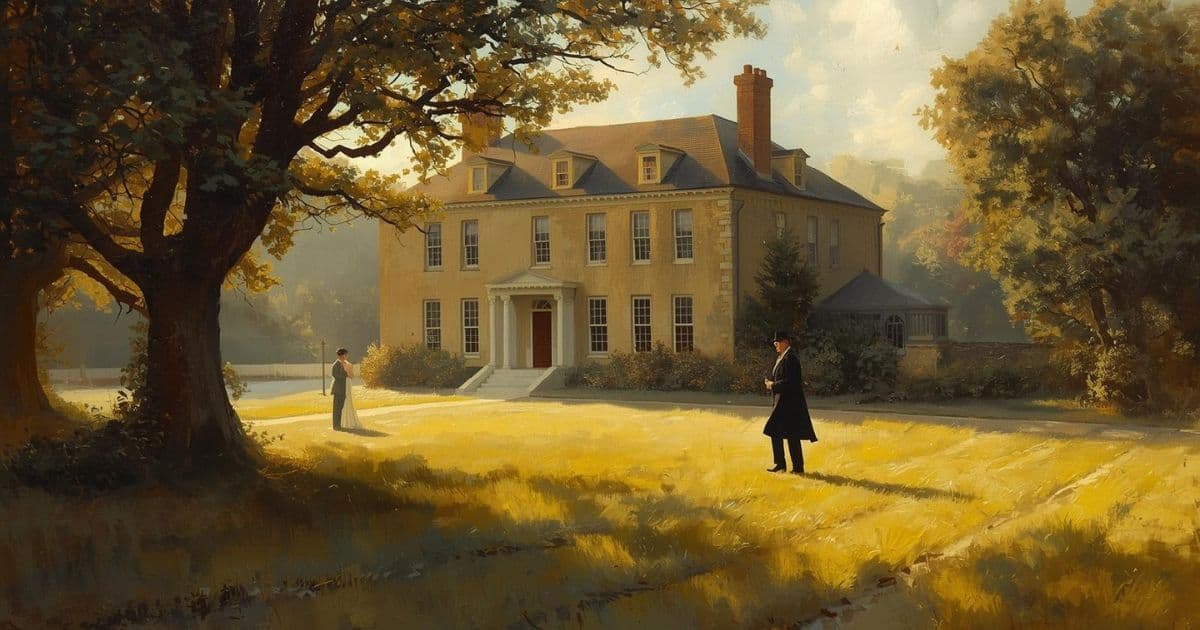
An excerpt from the original text.(complete · 2831 words)
fell out as Wemmick had told me it would, that I had an early
opportunity of comparing my guardian’s establishment with that of his
cashier and clerk. My guardian was in his room, washing his hands with
his scented soap, when I went into the office from Walworth; and he
called me to him, and gave me the invitation for myself and friends
which Wemmick had prepared me to receive. “No ceremony,” he stipulated,
“and no dinner dress, and say to-morrow.” I asked him where we should
come to (for I had no idea where he lived), and I believe it was in his
general objection to make anything like an admission, that he replied,
“Come here, and I’ll take you home with me.” I embrace this opportunity
of remarking that he washed his clients off, as if he were a surgeon or
a dentist. He had a closet in his room, fitted up for the purpose,
which smelt of the scented soap like a perfumer’s shop. It had an
unusually large jack-towel on a roller inside the door, and he would
wash his hands, and wipe them and dry them all over this towel,
whenever he came in from a police court or dismissed a client from his
room. When I and my friends repaired to him at six o’clock next day, he
seemed to have been engaged on a case of a darker complexion than
usual, for we found him with his head butted into this closet, not only
washing his hands, but laving his face and gargling his throat. And
even when he had done all that, and had gone all round the jack-towel,
he took out his penknife and scraped the case out of his nails before
he put his coat on.
There were some people slinking about as usual when we passed out into
the street, who were evidently anxious to speak with him; but there was
something so conclusive in the halo of scented soap which encircled his
presence, that they gave it up for that day. As we walked along
westward, he was recognised ever and again by some face in the crowd of
the streets, and whenever that happened he talked louder to me; but he
never otherwise recognised anybody, or took notice that anybody
recognised him.
He conducted us to Gerrard Street, Soho, to a house on the south side
of that street. Rather a stately house of its kind, but dolefully in
want of painting, and with dirty windows. He took out his key and
opened the door, and we all went into a stone hall, bare, gloomy, and
little used. So, up a dark brown staircase into a series of three dark
brown rooms on the first floor. There were carved garlands on the
panelled walls, and as he stood among them giving us welcome, I know
what kind of loops I thought they looked like.
Dinner was laid in the best of these rooms; the second was his
dressing-room; the third, his bedroom. He told us that he held the
whole house, but rarely used more of it than we saw. The table was
comfortably laid—no silver in the service, of course—and at the side of
his chair was a capacious dumb-waiter, with a variety of bottles and
decanters on it, and four dishes of fruit for dessert. I noticed
throughout, that he kept everything under his own hand, and distributed
everything himself.
There was a bookcase in the room; I saw from the backs of the books,
that they were about evidence, criminal law, criminal biography,
trials, acts of Parliament, and such things. The furniture was all very
solid and good, like his watch-chain. It had an official look, however,
and there was nothing merely ornamental to be seen. In a corner was a
little table of papers with a shaded lamp: so that he seemed to bring
the office home with him in that respect too, and to wheel it out of an
evening and fall to work.
As he had scarcely seen my three companions until now,—for he and I had
walked together,—he stood on the hearth-rug, after ringing the bell,
and took a searching look at them. To my surprise, he seemed at once to
be principally if not solely interested in Drummle.
“Pip,” said he, putting his large hand on my shoulder and moving me to
the window, “I don’t know one from the other. Who’s the Spider?”
“The spider?” said I.
“The blotchy, sprawly, sulky fellow.”
“That’s Bentley Drummle,” I replied; “the one with the delicate face is
Startop.”
Not making the least account of “the one with the delicate face,” he
returned, “Bentley Drummle is his name, is it? I like the look of that
fellow.”
He immediately began to talk to Drummle: not at all deterred by his
replying in his heavy reticent way, but apparently led on by it to
screw discourse out of him. I was looking at the two, when there came
between me and them the housekeeper, with the first dish for the table.
She was a woman of about forty, I supposed,—but I may have thought her
younger than she was. Rather tall, of a lithe nimble figure, extremely
pale, with large faded eyes, and a quantity of streaming hair. I cannot
say whether any diseased affection of the heart caused her lips to be
parted as if she were panting, and her face to bear a curious
expression of suddenness and flutter; but I know that I had been to see
Macbeth at the theatre, a night or two before, and that her face looked
to me as if it were all disturbed by fiery air, like the faces I had
seen rise out of the Witches’ caldron.
She set the dish on, touched my guardian quietly on the arm with a
finger to notify that dinner was ready, and vanished. We took our seats
at the round table, and my guardian kept Drummle on one side of him,
while Startop sat on the other. It was a noble dish of fish that the
housekeeper had put on table, and we had a joint of equally choice
mutton afterwards, and then an equally choice bird. Sauces, wines, all
the accessories we wanted, and all of the best, were given out by our
host from his dumb-waiter; and when they had made the circuit of the
table, he always put them back again. Similarly, he dealt us clean
plates and knives and forks, for each course, and dropped those just
disused into two baskets on the ground by his chair. No other attendant
than the housekeeper appeared. She set on every dish; and I always saw
in her face, a face rising out of the caldron. Years afterwards, I made
a dreadful likeness of that woman, by causing a face that had no other
natural resemblance to it than it derived from flowing hair to pass
behind a bowl of flaming spirits in a dark room.
Induced to take particular notice of the housekeeper, both by her own
striking appearance and by Wemmick’s preparation, I observed that
whenever she was in the room she kept her eyes attentively on my
guardian, and that she would remove her hands from any dish she put
before him, hesitatingly, as if she dreaded his calling her back, and
wanted him to speak when she was nigh, if he had anything to say. I
fancied that I could detect in his manner a consciousness of this, and
a purpose of always holding her in suspense.
Dinner went off gayly, and although my guardian seemed to follow rather
than originate subjects, I knew that he wrenched the weakest part of
our dispositions out of us. For myself, I found that I was expressing
my tendency to lavish expenditure, and to patronise Herbert, and to
boast of my great prospects, before I quite knew that I had opened my
lips. It was so with all of us, but with no one more than Drummle: the
development of whose inclination to gird in a grudging and suspicious
way at the rest, was screwed out of him before the fish was taken off.
It was not then, but when we had got to the cheese, that our
conversation turned upon our rowing feats, and that Drummle was rallied
for coming up behind of a night in that slow amphibious way of his.
Drummle upon this, informed our host that he much preferred our room to
our company, and that as to skill he was more than our master, and that
as to strength he could scatter us like chaff. By some invisible
agency, my guardian wound him up to a pitch little short of ferocity
about this trifle; and he fell to baring and spanning his arm to show
how muscular it was, and we all fell to baring and spanning our arms in
a ridiculous manner.
Now the housekeeper was at that time clearing the table; my guardian,
taking no heed of her, but with the side of his face turned from her,
was leaning back in his chair biting the side of his forefinger and
showing an interest in Drummle, that, to me, was quite inexplicable.
Suddenly, he clapped his large hand on the housekeeper’s, like a trap,
as she stretched it across the table. So suddenly and smartly did he do
this, that we all stopped in our foolish contention.
“If you talk of strength,” said Mr. Jaggers, “I’ll show you a wrist.
Molly, let them see your wrist.”
Her entrapped hand was on the table, but she had already put her other
hand behind her waist. “Master,” she said, in a low voice, with her
eyes attentively and entreatingly fixed upon him. “Don’t.”
“I’ll show you a wrist,” repeated Mr. Jaggers, with an immovable
determination to show it. “Molly, let them see your wrist.”
“Master,” she again murmured. “Please!”
“Molly,” said Mr. Jaggers, not looking at her, but obstinately looking
at the opposite side of the room, “let them see both your wrists.
Show them. Come!”
He took his hand from hers, and turned that wrist up on the table. She
brought her other hand from behind her, and held the two out side by
side. The last wrist was much disfigured,—deeply scarred and scarred
across and across. When she held her hands out she took her eyes from
Mr. Jaggers, and turned them watchfully on every one of the rest of us
in succession.
“There’s power here,” said Mr. Jaggers, coolly tracing out the sinews
with his forefinger. “Very few men have the power of wrist that this
woman has. It’s remarkable what mere force of grip there is in these
hands. I have had occasion to notice many hands; but I never saw
stronger in that respect, man’s or woman’s, than these.”
While he said these words in a leisurely, critical style, she continued
to look at every one of us in regular succession as we sat. The moment
he ceased, she looked at him again. “That’ll do, Molly,” said Mr.
Jaggers, giving her a slight nod; “you have been admired, and can go.”
She withdrew her hands and went out of the room, and Mr. Jaggers,
putting the decanters on from his dumb-waiter, filled his glass and
passed round the wine.
“At half-past nine, gentlemen,” said he, “we must break up. Pray make
the best use of your time. I am glad to see you all. Mr. Drummle, I
drink to you.”
If his object in singling out Drummle were to bring him out still more,
it perfectly succeeded. In a sulky triumph, Drummle showed his morose
depreciation of the rest of us, in a more and more offensive degree,
until he became downright intolerable. Through all his stages, Mr.
Jaggers followed him with the same strange interest. He actually seemed
to serve as a zest to Mr. Jaggers’s wine.
In our boyish want of discretion I dare say we took too much to drink,
and I know we talked too much. We became particularly hot upon some
boorish sneer of Drummle’s, to the effect that we were too free with
our money. It led to my remarking, with more zeal than discretion, that
it came with a bad grace from him, to whom Startop had lent money in my
presence but a week or so before.
“Well,” retorted Drummle; “he’ll be paid.”
“I don’t mean to imply that he won’t,” said I, “but it might make you
hold your tongue about us and our money, I should think.”
“You should think!” retorted Drummle. “Oh Lord!”
“I dare say,” I went on, meaning to be very severe, “that you wouldn’t
lend money to any of us if we wanted it.”
“You are right,” said Drummle. “I wouldn’t lend one of you a sixpence.
I wouldn’t lend anybody a sixpence.”
“Rather mean to borrow under those circumstances, I should say.”
“You should say,” repeated Drummle. “Oh Lord!”
This was so very aggravating—the more especially as I found myself
making no way against his surly obtuseness—that I said, disregarding
Herbert’s efforts to check me,—
“Come, Mr. Drummle, since we are on the subject, I’ll tell you what
passed between Herbert here and me, when you borrowed that money.”
“I don’t want to know what passed between Herbert there and you,”
growled Drummle. And I think he added in a lower growl, that we might
both go to the devil and shake ourselves.
“I’ll tell you, however,” said I, “whether you want to know or not. We
said that as you put it in your pocket very glad to get it, you seemed
to be immensely amused at his being so weak as to lend it.”
Drummle laughed outright, and sat laughing in our faces, with his hands
in his pockets and his round shoulders raised; plainly signifying that
it was quite true, and that he despised us as asses all.
Hereupon Startop took him in hand, though with a much better grace than
I had shown, and exhorted him to be a little more agreeable. Startop,
being a lively, bright young fellow, and Drummle being the exact
opposite, the latter was always disposed to resent him as a direct
personal affront. He now retorted in a coarse, lumpish way, and Startop
tried to turn the discussion aside with some small pleasantry that made
us all laugh. Resenting this little success more than anything,
Drummle, without any threat or warning, pulled his hands out of his
pockets, dropped his round shoulders, swore, took up a large glass, and
would have flung it at his adversary’s head, but for our entertainer’s
dexterously seizing it at the instant when it was raised for that
purpose.
“Gentlemen,” said Mr. Jaggers, deliberately putting down the glass, and
hauling out his gold repeater by its massive chain, “I am exceedingly
sorry to announce that it’s half past nine.”
On this hint we all rose to depart. Before we got to the street door,
Startop was cheerily calling Drummle “old boy,” as if nothing had
happened. But the old boy was so far from responding, that he would not
even walk to Hammersmith on the same side of the way; so Herbert and I,
who remained in town, saw them going down the street on opposite sides;
Startop leading, and Drummle lagging behind in the shadow of the
houses, much as he was wont to follow in his boat.
As the door was not yet shut, I thought I would leave Herbert there for
a moment, and run upstairs again to say a word to my guardian. I found
him in his dressing-room surrounded by his stock of boots, already hard
at it, washing his hands of us.
I told him I had come up again to say how sorry I was that anything
disagreeable should have occurred, and that I hoped he would not blame
me much.
“Pooh!” said he, sluicing his face, and speaking through the
water-drops; “it’s nothing, Pip. I like that Spider though.”
He had turned towards me now, and was shaking his head, and blowing,
and towelling himself.
“I am glad you like him, sir,” said I—“but I don’t.”
“No, no,” my guardian assented; “don’t have too much to do with him.
Keep as clear of him as you can. But I like the fellow, Pip; he is one
of the true sort. Why, if I was a fortune-teller—”
Looking out of the towel, he caught my eye.
“But I am not a fortune-teller,” he said, letting his head drop into a
festoon of towel, and towelling away at his two ears. “You know what I
am, don’t you? Good night, Pip.”
“Good night, sir.”
In about a month after that, the Spider’s time with Mr. Pocket was up
for good, and, to the great relief of all the house but Mrs. Pocket, he
went home to the family hole.
Master this chapter. Complete your experience
Purchase the complete book to access all chapters and support classic literature
As an Amazon Associate, we earn a small commission from qualifying purchases at no additional cost to you.
Available in paperback, hardcover, and e-book formats
Let's Analyse the Pattern
People in power often prefer difficult, manipulable individuals over decent ones because dysfunction is more predictable and controllable than integrity.
Why This Matters
Connect literature to life
This chapter teaches how to identify when authority figures deliberately choose dysfunction over competence because toxic people are easier to control.
Practice This Today
This week, notice when managers, family members, or leaders seem more engaged with problematic people than steady performers—ask yourself what they gain from that chaos.
Now let's explore the literary elements.
Key Quotes & Analysis
"He washed his clients off, as if he were a surgeon or a dentist."
Context: Pip observes Jaggers' ritual of washing his hands after every client interaction
This reveals Jaggers' need to maintain psychological distance from the criminal world he profits from. The comparison to medical professionals suggests he sees his clients as diseased or contaminated.
In Today's Words:
He treated his clients like they were contagious and needed to scrub them off his hands afterward.
"I like that Spider though."
Context: Jaggers expresses his admiration for Drummle's unpleasant character
Shows that Jaggers values nastiness over goodness because difficult people are more predictable and useful to him. It reveals his cynical view of human nature.
In Today's Words:
I actually prefer dealing with jerks because at least I know what I'm getting.
"Show them your wrist."
Context: Jaggers commands Molly to display her scarred wrists to the dinner guests
Demonstrates Jaggers' complete dominance over Molly and his willingness to humiliate her for his guests' entertainment. It shows how power corrupts relationships.
In Today's Words:
Look what I can make her do - she has no choice but to obey me.
Thematic Threads
Power Dynamics
In This Chapter
Jaggers demonstrates psychological dominance through calculated manipulation, forcing his housekeeper to display her scars and deliberately provoking tension among his guests
Development
Builds on earlier glimpses of Jaggers' control, now showing the disturbing pleasure he takes in wielding power over others
In Your Life:
You might see this in supervisors who seem to enjoy creating workplace drama or family members who stir up conflict for attention.
Social Performance
In This Chapter
The dinner party becomes theater where Jaggers orchestrates roles for each guest, with Drummle as the unwitting star performer of nastiness
Development
Continues Pip's education in how the upper classes use social situations as power plays rather than genuine connection
In Your Life:
You might recognize this in social gatherings where someone seems to be pulling strings to create specific reactions from others.
Moral Corruption
In This Chapter
Jaggers finds Drummle's aggression entertaining rather than concerning, showing how power can warp moral judgment
Development
Deepens the theme of how wealth and position can corrupt basic human decency, building on earlier hints about Jaggers' character
In Your Life:
You might see this when people in authority positions excuse bad behavior because it serves their purposes or amuses them.
Hidden Suffering
In This Chapter
Molly's scarred wrists and nervous behavior hint at past trauma that Jaggers exploits for his guests' curiosity
Development
Introduces the theme of how victims become props in powerful people's games, expanding the book's examination of exploitation
In Your Life:
You might recognize this when someone's personal struggles become entertainment or teaching tools for others without their real consent.
False Mentorship
In This Chapter
Jaggers warns Pip about Drummle while simultaneously encouraging the very behavior he warns against, giving contradictory guidance
Development
Continues the pattern of Pip receiving mixed messages from authority figures who claim to help while serving their own interests
In Your Life:
You might experience this with mentors or advisors who give you conflicting advice that serves their agenda more than your growth.
You now have the context. Time to form your own thoughts.
Discussion Questions
- 1
Why does Jaggers seem more interested in Drummle than in Pip's other friends, even though Drummle is clearly the most unpleasant person at dinner?
analysis • surface - 2
What does Jaggers' ritual of washing his hands after dealing with clients reveal about how he views his relationship with people?
analysis • medium - 3
Think about workplaces or families you know—where have you seen someone in authority pay more attention to the troublemakers than to the reliable people?
application • medium - 4
If you were Startop (the decent friend being overlooked), how would you handle being in a situation where toxic behavior gets rewarded with attention?
application • deep - 5
What does this dinner party teach us about why some people in power positions seem drawn to chaos rather than peace?
reflection • deep
Critical Thinking Exercise
Map the Power Dynamic
Draw or describe the power relationships at this dinner party. Who has control? Who's seeking approval? Who's being manipulated? Then think of a similar situation from your own life—a workplace, family gathering, or social group where someone in charge seemed to prefer dealing with difficult people over easy-going ones.
Consider:
- •Notice how Jaggers controls the evening's mood and direction
- •Consider why toxic people might be more 'useful' to manipulators than good people
- •Think about what this means for how you present yourself in power-imbalanced situations
Journaling Prompt
Write about a time when you watched someone in authority give more attention to a troublemaker than to reliable people. What did you learn about power from that experience? How did it change how you navigate similar situations?
Coming Up Next...
Chapter 27: When Old Friends Don't Fit
A mysterious letter arrives for Pip, promising new developments that will shift the direction of his expectations. The formal tone and unexpected timing suggest important news about his future.