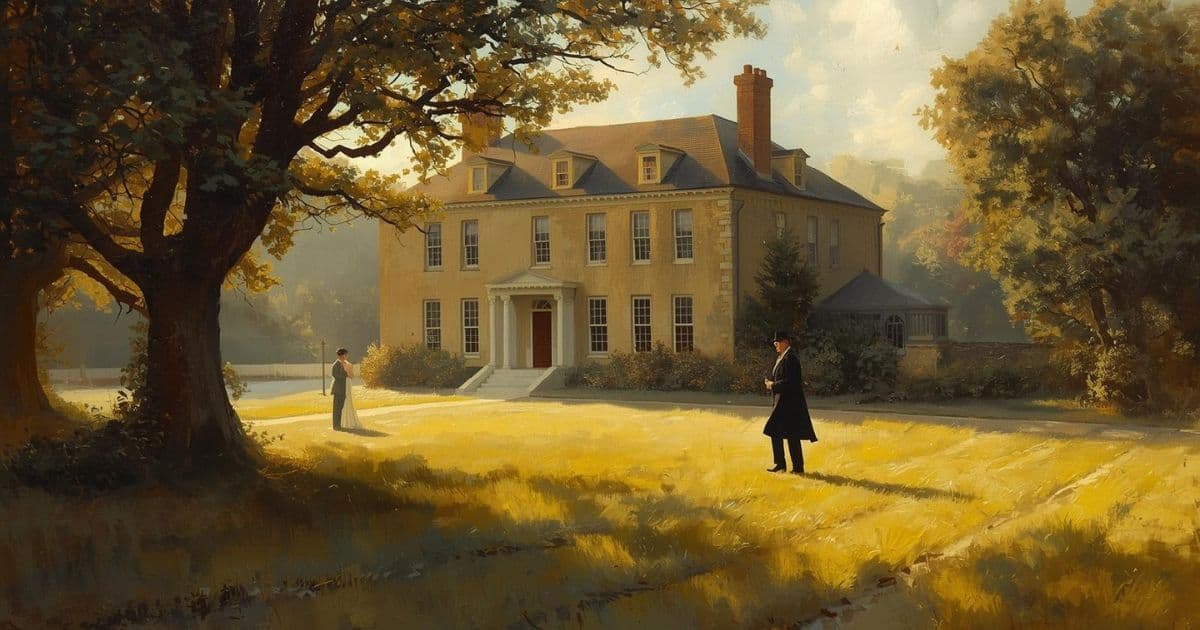
An excerpt from the original text.(complete · 5299 words)
t the appointed time I returned to Miss Havisham’s, and my hesitating
ring at the gate brought out Estella. She locked it after admitting me,
as she had done before, and again preceded me into the dark passage
where her candle stood. She took no notice of me until she had the
candle in her hand, when she looked over her shoulder, superciliously
saying, “You are to come this way to-day,” and took me to quite another
part of the house.
The passage was a long one, and seemed to pervade the whole square
basement of the Manor House. We traversed but one side of the square,
however, and at the end of it she stopped, and put her candle down and
opened a door. Here, the daylight reappeared, and I found myself in a
small paved courtyard, the opposite side of which was formed by a
detached dwelling-house, that looked as if it had once belonged to the
manager or head clerk of the extinct brewery. There was a clock in the
outer wall of this house. Like the clock in Miss Havisham’s room, and
like Miss Havisham’s watch, it had stopped at twenty minutes to nine.
We went in at the door, which stood open, and into a gloomy room with a
low ceiling, on the ground-floor at the back. There was some company in
the room, and Estella said to me as she joined it, “You are to go and
stand there boy, till you are wanted.” “There”, being the window, I
crossed to it, and stood “there,” in a very uncomfortable state of
mind, looking out.
It opened to the ground, and looked into a most miserable corner of the
neglected garden, upon a rank ruin of cabbage-stalks, and one box-tree
that had been clipped round long ago, like a pudding, and had a new
growth at the top of it, out of shape and of a different colour, as if
that part of the pudding had stuck to the saucepan and got burnt. This
was my homely thought, as I contemplated the box-tree. There had been
some light snow, overnight, and it lay nowhere else to my knowledge;
but, it had not quite melted from the cold shadow of this bit of
garden, and the wind caught it up in little eddies and threw it at the
window, as if it pelted me for coming there.
I divined that my coming had stopped conversation in the room, and that
its other occupants were looking at me. I could see nothing of the room
except the shining of the fire in the window-glass, but I stiffened in
all my joints with the consciousness that I was under close inspection.
There were three ladies in the room and one gentleman. Before I had
been standing at the window five minutes, they somehow conveyed to me
that they were all toadies and humbugs, but that each of them pretended
not to know that the others were toadies and humbugs: because the
admission that he or she did know it, would have made him or her out to
be a toady and humbug.
They all had a listless and dreary air of waiting somebody’s pleasure,
and the most talkative of the ladies had to speak quite rigidly to
repress a yawn. This lady, whose name was Camilla, very much reminded
me of my sister, with the difference that she was older, and (as I
found when I caught sight of her) of a blunter cast of features.
Indeed, when I knew her better I began to think it was a Mercy she had
any features at all, so very blank and high was the dead wall of her
face.
“Poor dear soul!” said this lady, with an abruptness of manner quite my
sister’s. “Nobody’s enemy but his own!”
“It would be much more commendable to be somebody else’s enemy,” said
the gentleman; “far more natural.”
“Cousin Raymond,” observed another lady, “we are to love our
neighbour.”
“Sarah Pocket,” returned Cousin Raymond, “if a man is not his own
neighbour, who is?”
Miss Pocket laughed, and Camilla laughed and said (checking a yawn),
“The idea!” But I thought they seemed to think it rather a good idea
too. The other lady, who had not spoken yet, said gravely and
emphatically, “Very true!”
“Poor soul!” Camilla presently went on (I knew they had all been
looking at me in the mean time), “he is so very strange! Would anyone
believe that when Tom’s wife died, he actually could not be induced to
see the importance of the children’s having the deepest of trimmings to
their mourning? ‘Good Lord!’ says he, ‘Camilla, what can it signify so
long as the poor bereaved little things are in black?’ So like Matthew!
The idea!”
“Good points in him, good points in him,” said Cousin Raymond; “Heaven
forbid I should deny good points in him; but he never had, and he never
will have, any sense of the proprieties.”
“You know I was obliged,” said Camilla,—“I was obliged to be firm. I
said, ‘It WILL NOT DO, for the credit of the family.’ I told him that,
without deep trimmings, the family was disgraced. I cried about it from
breakfast till dinner. I injured my digestion. And at last he flung out
in his violent way, and said, with a D, ‘Then do as you like.’ Thank
Goodness it will always be a consolation to me to know that I instantly
went out in a pouring rain and bought the things.”
“He paid for them, did he not?” asked Estella.
“It’s not the question, my dear child, who paid for them,” returned
Camilla. “I bought them. And I shall often think of that with peace,
when I wake up in the night.”
The ringing of a distant bell, combined with the echoing of some cry or
call along the passage by which I had come, interrupted the
conversation and caused Estella to say to me, “Now, boy!” On my turning
round, they all looked at me with the utmost contempt, and, as I went
out, I heard Sarah Pocket say, “Well I am sure! What next!” and Camilla
add, with indignation, “Was there ever such a fancy! The i-de-a!”
As we were going with our candle along the dark passage, Estella
stopped all of a sudden, and, facing round, said in her taunting
manner, with her face quite close to mine,—
“Well?”
“Well, miss?” I answered, almost falling over her and checking myself.
She stood looking at me, and, of course, I stood looking at her.
“Am I pretty?”
“Yes; I think you are very pretty.”
“Am I insulting?”
“Not so much so as you were last time,” said I.
“Not so much so?”
“No.”
She fired when she asked the last question, and she slapped my face
with such force as she had, when I answered it.
“Now?” said she. “You little coarse monster, what do you think of me
now?”
“I shall not tell you.”
“Because you are going to tell upstairs. Is that it?”
“No,” said I, “that’s not it.”
“Why don’t you cry again, you little wretch?”
“Because I’ll never cry for you again,” said I. Which was, I suppose,
as false a declaration as ever was made; for I was inwardly crying for
her then, and I know what I know of the pain she cost me afterwards.
We went on our way upstairs after this episode; and, as we were going
up, we met a gentleman groping his way down.
“Whom have we here?” asked the gentleman, stopping and looking at me.
“A boy,” said Estella.
He was a burly man of an exceedingly dark complexion, with an
exceedingly large head, and a corresponding large hand. He took my chin
in his large hand and turned up my face to have a look at me by the
light of the candle. He was prematurely bald on the top of his head,
and had bushy black eyebrows that wouldn’t lie down but stood up
bristling. His eyes were set very deep in his head, and were
disagreeably sharp and suspicious. He had a large watch-chain, and
strong black dots where his beard and whiskers would have been if he
had let them. He was nothing to me, and I could have had no foresight
then, that he ever would be anything to me, but it happened that I had
this opportunity of observing him well.
“Boy of the neighbourhood? Hey?” said he.
“Yes, sir,” said I.
“How do you come here?”
“Miss Havisham sent for me, sir,” I explained.
“Well! Behave yourself. I have a pretty large experience of boys, and
you’re a bad set of fellows. Now mind!” said he, biting the side of his
great forefinger as he frowned at me, “you behave yourself!”
With those words, he released me—which I was glad of, for his hand
smelt of scented soap—and went his way downstairs. I wondered whether
he could be a doctor; but no, I thought; he couldn’t be a doctor, or he
would have a quieter and more persuasive manner. There was not much
time to consider the subject, for we were soon in Miss Havisham’s room,
where she and everything else were just as I had left them. Estella
left me standing near the door, and I stood there until Miss Havisham
cast her eyes upon me from the dressing-table.
“So!” she said, without being startled or surprised: “the days have
worn away, have they?”
“Yes, ma’am. To-day is—”
“There, there, there!” with the impatient movement of her fingers. “I
don’t want to know. Are you ready to play?”
I was obliged to answer in some confusion, “I don’t think I am, ma’am.”
“Not at cards again?” she demanded, with a searching look.
“Yes, ma’am; I could do that, if I was wanted.”
“Since this house strikes you old and grave, boy,” said Miss Havisham,
impatiently, “and you are unwilling to play, are you willing to work?”
I could answer this inquiry with a better heart than I had been able to
find for the other question, and I said I was quite willing.
“Then go into that opposite room,” said she, pointing at the door
behind me with her withered hand, “and wait there till I come.”
I crossed the staircase landing, and entered the room she indicated.
From that room, too, the daylight was completely excluded, and it had
an airless smell that was oppressive. A fire had been lately kindled in
the damp old-fashioned grate, and it was more disposed to go out than
to burn up, and the reluctant smoke which hung in the room seemed
colder than the clearer air,—like our own marsh mist. Certain wintry
branches of candles on the high chimney-piece faintly lighted the
chamber; or it would be more expressive to say, faintly troubled its
darkness. It was spacious, and I dare say had once been handsome, but
every discernible thing in it was covered with dust and mould, and
dropping to pieces. The most prominent object was a long table with a
tablecloth spread on it, as if a feast had been in preparation when the
house and the clocks all stopped together. An epergne or centre-piece
of some kind was in the middle of this cloth; it was so heavily
overhung with cobwebs that its form was quite undistinguishable; and,
as I looked along the yellow expanse out of which I remember its
seeming to grow, like a black fungus, I saw speckle-legged spiders with
blotchy bodies running home to it, and running out from it, as if some
circumstances of the greatest public importance had just transpired in
the spider community.
I heard the mice too, rattling behind the panels, as if the same
occurrence were important to their interests. But the black beetles
took no notice of the agitation, and groped about the hearth in a
ponderous elderly way, as if they were short-sighted and hard of
hearing, and not on terms with one another.
These crawling things had fascinated my attention, and I was watching
them from a distance, when Miss Havisham laid a hand upon my shoulder.
In her other hand she had a crutch-headed stick on which she leaned,
and she looked like the Witch of the place.
“This,” said she, pointing to the long table with her stick, “is where
I will be laid when I am dead. They shall come and look at me here.”
With some vague misgiving that she might get upon the table then and
there and die at once, the complete realisation of the ghastly waxwork
at the Fair, I shrank under her touch.
“What do you think that is?” she asked me, again pointing with her
stick; “that, where those cobwebs are?”
“I can’t guess what it is, ma’am.”
“It’s a great cake. A bride-cake. Mine!”
She looked all round the room in a glaring manner, and then said,
leaning on me while her hand twitched my shoulder, “Come, come, come!
Walk me, walk me!”
I made out from this, that the work I had to do, was to walk Miss
Havisham round and round the room. Accordingly, I started at once, and
she leaned upon my shoulder, and we went away at a pace that might have
been an imitation (founded on my first impulse under that roof) of Mr.
Pumblechook’s chaise-cart.
She was not physically strong, and after a little time said, “Slower!”
Still, we went at an impatient fitful speed, and as we went, she
twitched the hand upon my shoulder, and worked her mouth, and led me to
believe that we were going fast because her thoughts went fast. After a
while she said, “Call Estella!” so I went out on the landing and roared
that name as I had done on the previous occasion. When her light
appeared, I returned to Miss Havisham, and we started away again round
and round the room.
If only Estella had come to be a spectator of our proceedings, I should
have felt sufficiently discontented; but as she brought with her the
three ladies and the gentleman whom I had seen below, I didn’t know
what to do. In my politeness, I would have stopped; but Miss Havisham
twitched my shoulder, and we posted on,—with a shame-faced
consciousness on my part that they would think it was all my doing.
“Dear Miss Havisham,” said Miss Sarah Pocket. “How well you look!”
“I do not,” returned Miss Havisham. “I am yellow skin and bone.”
Camilla brightened when Miss Pocket met with this rebuff; and she
murmured, as she plaintively contemplated Miss Havisham, “Poor dear
soul! Certainly not to be expected to look well, poor thing. The idea!”
“And how are you?” said Miss Havisham to Camilla. As we were close to
Camilla then, I would have stopped as a matter of course, only Miss
Havisham wouldn’t stop. We swept on, and I felt that I was highly
obnoxious to Camilla.
“Thank you, Miss Havisham,” she returned, “I am as well as can be
expected.”
“Why, what’s the matter with you?” asked Miss Havisham, with exceeding
sharpness.
“Nothing worth mentioning,” replied Camilla. “I don’t wish to make a
display of my feelings, but I have habitually thought of you more in
the night than I am quite equal to.”
“Then don’t think of me,” retorted Miss Havisham.
“Very easily said!” remarked Camilla, amiably repressing a sob, while a
hitch came into her upper lip, and her tears overflowed. “Raymond is a
witness what ginger and sal volatile I am obliged to take in the night.
Raymond is a witness what nervous jerkings I have in my legs. Chokings
and nervous jerkings, however, are nothing new to me when I think with
anxiety of those I love. If I could be less affectionate and sensitive,
I should have a better digestion and an iron set of nerves. I am sure I
wish it could be so. But as to not thinking of you in the night—The
idea!” Here, a burst of tears.
The Raymond referred to, I understood to be the gentleman present, and
him I understood to be Mr. Camilla. He came to the rescue at this
point, and said in a consolatory and complimentary voice, “Camilla, my
dear, it is well known that your family feelings are gradually
undermining you to the extent of making one of your legs shorter than
the other.”
“I am not aware,” observed the grave lady whose voice I had heard but
once, “that to think of any person is to make a great claim upon that
person, my dear.”
Miss Sarah Pocket, whom I now saw to be a little dry, brown, corrugated
old woman, with a small face that might have been made of
walnut-shells, and a large mouth like a cat’s without the whiskers,
supported this position by saying, “No, indeed, my dear. Hem!”
“Thinking is easy enough,” said the grave lady.
“What is easier, you know?” assented Miss Sarah Pocket.
“Oh, yes, yes!” cried Camilla, whose fermenting feelings appeared to
rise from her legs to her bosom. “It’s all very true! It’s a weakness
to be so affectionate, but I can’t help it. No doubt my health would be
much better if it was otherwise, still I wouldn’t change my disposition
if I could. It’s the cause of much suffering, but it’s a consolation to
know I possess it, when I wake up in the night.” Here another burst of
feeling.
Miss Havisham and I had never stopped all this time, but kept going
round and round the room; now brushing against the skirts of the
visitors, now giving them the whole length of the dismal chamber.
“There’s Matthew!” said Camilla. “Never mixing with any natural ties,
never coming here to see how Miss Havisham is! I have taken to the sofa
with my staylace cut, and have lain there hours insensible, with my
head over the side, and my hair all down, and my feet I don’t know
where—”
(“Much higher than your head, my love,” said Mr. Camilla.)
“I have gone off into that state, hours and hours, on account of
Matthew’s strange and inexplicable conduct, and nobody has thanked me.”
“Really I must say I should think not!” interposed the grave lady.
“You see, my dear,” added Miss Sarah Pocket (a blandly vicious
personage), “the question to put to yourself is, who did you expect to
thank you, my love?”
“Without expecting any thanks, or anything of the sort,” resumed
Camilla, “I have remained in that state, hours and hours, and Raymond
is a witness of the extent to which I have choked, and what the total
inefficacy of ginger has been, and I have been heard at the piano-forte
tuner’s across the street, where the poor mistaken children have even
supposed it to be pigeons cooing at a distance,—and now to be told—”
Here Camilla put her hand to her throat, and began to be quite chemical
as to the formation of new combinations there.
When this same Matthew was mentioned, Miss Havisham stopped me and
herself, and stood looking at the speaker. This change had a great
influence in bringing Camilla’s chemistry to a sudden end.
“Matthew will come and see me at last,” said Miss Havisham, sternly,
“when I am laid on that table. That will be his place,—there,” striking
the table with her stick, “at my head! And yours will be there! And
your husband’s there! And Sarah Pocket’s there! And Georgiana’s there!
Now you all know where to take your stations when you come to feast
upon me. And now go!”
At the mention of each name, she had struck the table with her stick in
a new place. She now said, “Walk me, walk me!” and we went on again.
“I suppose there’s nothing to be done,” exclaimed Camilla, “but comply
and depart. It’s something to have seen the object of one’s love and
duty for even so short a time. I shall think of it with a melancholy
satisfaction when I wake up in the night. I wish Matthew could have
that comfort, but he sets it at defiance. I am determined not to make a
display of my feelings, but it’s very hard to be told one wants to
feast on one’s relations,—as if one was a Giant,—and to be told to go.
The bare idea!”
Mr. Camilla interposing, as Mrs. Camilla laid her hand upon her heaving
bosom, that lady assumed an unnatural fortitude of manner which I
supposed to be expressive of an intention to drop and choke when out of
view, and kissing her hand to Miss Havisham, was escorted forth. Sarah
Pocket and Georgiana contended who should remain last; but Sarah was
too knowing to be outdone, and ambled round Georgiana with that artful
slipperiness that the latter was obliged to take precedence. Sarah
Pocket then made her separate effect of departing with, “Bless you,
Miss Havisham dear!” and with a smile of forgiving pity on her
walnut-shell countenance for the weaknesses of the rest.
While Estella was away lighting them down, Miss Havisham still walked
with her hand on my shoulder, but more and more slowly. At last she
stopped before the fire, and said, after muttering and looking at it
some seconds,—
“This is my birthday, Pip.”
I was going to wish her many happy returns, when she lifted her stick.
“I don’t suffer it to be spoken of. I don’t suffer those who were here
just now, or any one to speak of it. They come here on the day, but
they dare not refer to it.”
Of course I made no further effort to refer to it.
“On this day of the year, long before you were born, this heap of
decay,” stabbing with her crutched stick at the pile of cobwebs on the
table, but not touching it, “was brought here. It and I have worn away
together. The mice have gnawed at it, and sharper teeth than teeth of
mice have gnawed at me.”
She held the head of her stick against her heart as she stood looking
at the table; she in her once white dress, all yellow and withered; the
once white cloth all yellow and withered; everything around in a state
to crumble under a touch.
“When the ruin is complete,” said she, with a ghastly look, “and when
they lay me dead, in my bride’s dress on the bride’s table,—which shall
be done, and which will be the finished curse upon him,—so much the
better if it is done on this day!”
She stood looking at the table as if she stood looking at her own
figure lying there. I remained quiet. Estella returned, and she too
remained quiet. It seemed to me that we continued thus for a long time.
In the heavy air of the room, and the heavy darkness that brooded in
its remoter corners, I even had an alarming fancy that Estella and I
might presently begin to decay.
At length, not coming out of her distraught state by degrees, but in an
instant, Miss Havisham said, “Let me see you two play cards; why have
you not begun?” With that, we returned to her room, and sat down as
before; I was beggared, as before; and again, as before, Miss Havisham
watched us all the time, directed my attention to Estella’s beauty, and
made me notice it the more by trying her jewels on Estella’s breast and
hair.
Estella, for her part, likewise treated me as before, except that she
did not condescend to speak. When we had played some half-dozen games,
a day was appointed for my return, and I was taken down into the yard
to be fed in the former dog-like manner. There, too, I was again left
to wander about as I liked.
It is not much to the purpose whether a gate in that garden wall which
I had scrambled up to peep over on the last occasion was, on that last
occasion, open or shut. Enough that I saw no gate then, and that I saw
one now. As it stood open, and as I knew that Estella had let the
visitors out,—for she had returned with the keys in her hand,—I
strolled into the garden, and strolled all over it. It was quite a
wilderness, and there were old melon-frames and cucumber-frames in it,
which seemed in their decline to have produced a spontaneous growth of
weak attempts at pieces of old hats and boots, with now and then a
weedy offshoot into the likeness of a battered saucepan.
When I had exhausted the garden and a greenhouse with nothing in it but
a fallen-down grape-vine and some bottles, I found myself in the dismal
corner upon which I had looked out of the window. Never questioning for
a moment that the house was now empty, I looked in at another window,
and found myself, to my great surprise, exchanging a broad stare with a
pale young gentleman with red eyelids and light hair.
This pale young gentleman quickly disappeared, and reappeared beside
me. He had been at his books when I had found myself staring at him,
and I now saw that he was inky.
“Halloa!” said he, “young fellow!”
Halloa being a general observation which I had usually observed to be
best answered by itself, I said, “Halloa!” politely omitting young
fellow.
“Who let you in?” said he.
“Miss Estella.”
“Who gave you leave to prowl about?”
“Miss Estella.”
“Come and fight,” said the pale young gentleman.
What could I do but follow him? I have often asked myself the question
since; but what else could I do? His manner was so final, and I was so
astonished, that I followed where he led, as if I had been under a
spell.
“Stop a minute, though,” he said, wheeling round before we had gone
many paces. “I ought to give you a reason for fighting, too. There it
is!” In a most irritating manner he instantly slapped his hands against
one another, daintily flung one of his legs up behind him, pulled my
hair, slapped his hands again, dipped his head, and butted it into my
stomach.
The bull-like proceeding last mentioned, besides that it was
unquestionably to be regarded in the light of a liberty, was
particularly disagreeable just after bread and meat. I therefore hit
out at him and was going to hit out again, when he said, “Aha! Would
you?” and began dancing backwards and forwards in a manner quite
unparalleled within my limited experience.
“Laws of the game!” said he. Here, he skipped from his left leg on to
his right. “Regular rules!” Here, he skipped from his right leg on to
his left. “Come to the ground, and go through the preliminaries!” Here,
he dodged backwards and forwards, and did all sorts of things while I
looked helplessly at him.
I was secretly afraid of him when I saw him so dexterous; but I felt
morally and physically convinced that his light head of hair could have
had no business in the pit of my stomach, and that I had a right to
consider it irrelevant when so obtruded on my attention. Therefore, I
followed him without a word, to a retired nook of the garden, formed by
the junction of two walls and screened by some rubbish. On his asking
me if I was satisfied with the ground, and on my replying Yes, he
begged my leave to absent himself for a moment, and quickly returned
with a bottle of water and a sponge dipped in vinegar. “Available for
both,” he said, placing these against the wall. And then fell to
pulling off, not only his jacket and waistcoat, but his shirt too, in a
manner at once light-hearted, business-like, and bloodthirsty.
Although he did not look very healthy,—having pimples on his face, and
a breaking out at his mouth,—these dreadful preparations quite appalled
me. I judged him to be about my own age, but he was much taller, and he
had a way of spinning himself about that was full of appearance. For
the rest, he was a young gentleman in a grey suit (when not denuded for
battle), with his elbows, knees, wrists, and heels considerably in
advance of the rest of him as to development.
My heart failed me when I saw him squaring at me with every
demonstration of mechanical nicety, and eyeing my anatomy as if he were
minutely choosing his bone. I never have been so surprised in my life,
as I was when I let out the first blow, and saw him lying on his back,
looking up at me with a bloody nose and his face exceedingly
fore-shortened.
But, he was on his feet directly, and after sponging himself with a
great show of dexterity began squaring again. The second greatest
surprise I have ever had in my life was seeing him on his back again,
looking up at me out of a black eye.
His spirit inspired me with great respect. He seemed to have no
strength, and he never once hit me hard, and he was always knocked
down; but he would be up again in a moment, sponging himself or
drinking out of the water-bottle, with the greatest satisfaction in
seconding himself according to form, and then came at me with an air
and a show that made me believe he really was going to do for me at
last. He got heavily bruised, for I am sorry to record that the more I
hit him, the harder I hit him; but he came up again and again and
again, until at last he got a bad fall with the back of his head
against the wall. Even after that crisis in our affairs, he got up and
turned round and round confusedly a few times, not knowing where I was;
but finally went on his knees to his sponge and threw it up: at the
same time panting out, “That means you have won.”
He seemed so brave and innocent, that although I had not proposed the
contest, I felt but a gloomy satisfaction in my victory. Indeed, I go
so far as to hope that I regarded myself while dressing as a species of
savage young wolf or other wild beast. However, I got dressed, darkly
wiping my sanguinary face at intervals, and I said, “Can I help you?”
and he said “No thankee,” and I said “Good afternoon,” and he said
“Same to you.”
When I got into the courtyard, I found Estella waiting with the keys.
But she neither asked me where I had been, nor why I had kept her
waiting; and there was a bright flush upon her face, as though
something had happened to delight her. Instead of going straight to the
gate, too, she stepped back into the passage, and beckoned me.
“Come here! You may kiss me, if you like.”
I kissed her cheek as she turned it to me. I think I would have gone
through a great deal to kiss her cheek. But I felt that the kiss was
given to the coarse common boy as a piece of money might have been, and
that it was worth nothing.
What with the birthday visitors, and what with the cards, and what with
the fight, my stay had lasted so long, that when I neared home the
light on the spit of sand off the point on the marshes was gleaming
against a black night-sky, and Joe’s furnace was flinging a path of
fire across the road.
Master this chapter. Complete your experience
Purchase the complete book to access all chapters and support classic literature
As an Amazon Associate, we earn a small commission from qualifying purchases at no additional cost to you.
Available in paperback, hardcover, and e-book formats
Let's Analyse the Pattern
The Performance Trap - When Suffering Becomes Currency
When people turn genuine emotions into competitive displays to gain advantage, corrupting both the emotion and the relationship.
Why This Matters
Connect literature to life
This chapter teaches how to spot when people turn genuine emotions into competitive performances for personal gain.
Practice This Today
This week, notice when someone's concern feels like a performance—do they escalate when others show care, or do they help quietly without an audience?
Now let's explore the literary elements.
Key Quotes & Analysis
"You are to go and stand there boy, till you are wanted"
Context: Estella dismisses Pip when they enter the room with Miss Havisham's relatives
This shows how casually Estella treats Pip like a servant, not even a person worth introducing. It reveals the automatic cruelty that comes from class differences.
In Today's Words:
Go stand over there and wait until someone needs you for something
"When I am laid on that table, that will be the finished picture"
Context: She's talking about her own death to her relatives who hope to inherit from her
Miss Havisham sees her whole life as a tableau of betrayal and revenge. She knows her relatives are waiting for her to die and cruelly reminds them of it.
In Today's Words:
When I'm dead on that table, that'll complete the whole sad picture of my life
"I felt that the kiss was given to the coarse common boy as a piece of money might have been"
Context: After Pip defeats the pale young gentleman, Estella rewards him with a kiss
Pip realizes the kiss isn't affection but payment for services rendered. It shows how the wealthy turn even intimacy into a transaction.
In Today's Words:
I could tell she was kissing me like she was tipping the help, not because she actually liked me
Thematic Threads
Class Competition
In This Chapter
The pale young gentleman challenges Pip to a proper boxing match, representing how class differences play out through ritualized conflict
Development
Builds on earlier class tensions, now showing how the upper class uses formal rules and rituals to maintain hierarchy
In Your Life:
You might see this when wealthier people use 'proper procedures' or formal processes to maintain advantage over working-class people.
Emotional Currency
In This Chapter
Estella's kiss is given 'as a piece of money might have been,' showing how the wealthy use affection as transactional reward
Development
Develops the theme of love being commodified, first seen in Estella's cold training
In Your Life:
You might recognize this when someone gives you attention or affection only after you've done something useful for them.
Performed Grief
In This Chapter
Miss Havisham's relatives compete dramatically over who suffers most on her behalf while clearly angling for inheritance
Development
Introduced here as a new manifestation of how people manipulate emotions for gain
In Your Life:
You might see this during family crises when relatives suddenly appear and compete over who cares most about an aging parent.
Hollow Victory
In This Chapter
Pip defeats the gentleman easily but feels no satisfaction, sensing something artificial about the whole encounter
Development
Builds on earlier themes of achievement feeling empty when gained through an unfair system
In Your Life:
You might experience this when you 'win' an argument or competition but realize the playing field was uneven from the start.
Frozen Time
In This Chapter
The decaying wedding cake and stopped clocks reveal how trauma can freeze a person's entire world in one moment
Development
Deepens our understanding of Miss Havisham's psychological state and its physical manifestations
In Your Life:
You might recognize this in people who can't move past a major betrayal or loss, keeping their environment exactly as it was.
You now have the context. Time to form your own thoughts.
Discussion Questions
- 1
Why do Miss Havisham's relatives compete over who suffers most dramatically on her behalf?
analysis • surface - 2
What does Miss Havisham's cruel comment about them 'feasting upon' her corpse reveal about her understanding of their motives?
analysis • medium - 3
Where do you see people today performing exaggerated concern or suffering to gain advantage with someone who has power over them?
application • medium - 4
How can you tell the difference between genuine care and performed care in your own relationships?
application • deep - 5
What does this chapter suggest about how power dynamics corrupt even family relationships?
reflection • deep
Critical Thinking Exercise
Spot the Performance Trap
Think of a situation where multiple people compete for attention or favor from someone with power (a boss, wealthy relative, or authority figure). Write down three signs that would tell you someone is performing concern rather than feeling it genuinely. Then identify one person in your life whose care shows up consistently without fanfare.
Consider:
- •Notice who escalates their displays when others are watching versus who stays consistent
- •Pay attention to whether the 'concern' comes with strings attached or expectations
- •Consider how the performance affects the person receiving all this 'care'
Journaling Prompt
Write about a time when you felt pressured to perform emotions or concern to fit in or gain advantage. How did it feel, and what did you learn about authentic versus strategic relationships?
Coming Up Next...
Chapter 12: Living with Guilt and Expectations
Pip's victory over the pale young gentleman weighs heavily on his conscience. He becomes convinced that serious consequences await him—perhaps even legal trouble. His anxiety about the fight reveals how deeply he's internalized his sense of inferiority, expecting punishment for daring to best his social superior.