
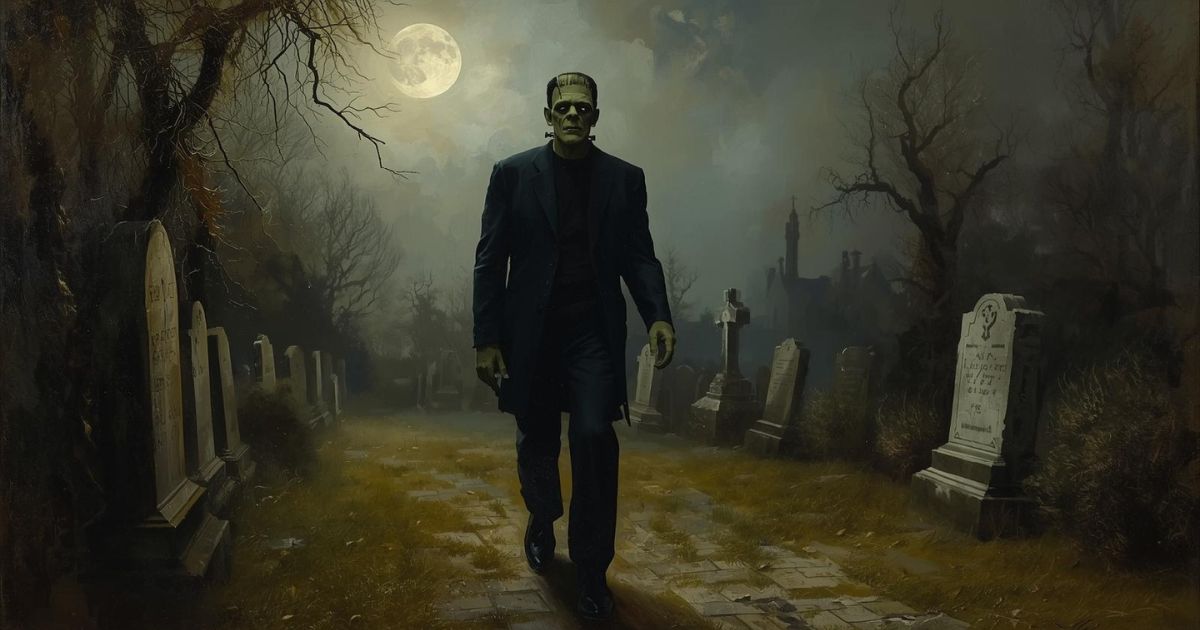
An excerpt from the original text.(complete · 1761 words)
t was on a dreary night of November that I beheld the accomplishment of my toils. With an anxiety that almost amounted to agony, I collected the instruments of life around me, that I might infuse a spark of being into the lifeless thing that lay at my feet. It was already one in the morning; the rain pattered dismally against the panes, and my candle was nearly burnt out, when, by the glimmer of the half-extinguished light, I saw the dull yellow eye of the creature open; it breathed hard, and a convulsive motion agitated its limbs.
How can I describe my emotions at this catastrophe, or how delineate the wretch whom with such infinite pains and care I had endeavoured to form? His limbs were in proportion, and I had selected his features as beautiful. Beautiful! Great God! His yellow skin scarcely covered the work of muscles and arteries beneath; his hair was of a lustrous black, and flowing; his teeth of a pearly whiteness; but these luxuriances only formed a more horrid contrast with his watery eyes, that seemed almost of the same colour as the dun-white sockets in which they were set, his shrivelled complexion and straight black lips.
The different accidents of life are not so changeable as the feelings of human nature. I had worked hard for nearly two years, for the sole purpose of infusing life into an inanimate body. For this I had deprived myself of rest and health. I had desired it with an ardour that far exceeded moderation; but now that I had finished, the beauty of the dream vanished, and breathless horror and disgust filled my heart. Unable to endure the aspect of the being I had created, I rushed out of the room and continued a long time traversing my bed-chamber, unable to compose my mind to sleep. At length lassitude succeeded to the tumult I had before endured, and I threw myself on the bed in my clothes, endeavouring to seek a few moments of forgetfulness. But it was in vain; I slept, indeed, but I was disturbed by the wildest dreams. I thought I saw Elizabeth, in the bloom of health, walking in the streets of Ingolstadt. Delighted and surprised, I embraced her, but as I imprinted the first kiss on her lips, they became livid with the hue of death; her features appeared to change, and I thought that I held the corpse of my dead mother in my arms; a shroud enveloped her form, and I saw the grave-worms crawling in the folds of the flannel. I started from my sleep with horror; a cold dew covered my forehead, my teeth chattered, and every limb became convulsed; when, by the dim and yellow light of the moon, as it forced its way through the window shutters, I beheld the wretch—the miserable monster whom I had created. He held up the curtain of the bed; and his eyes, if eyes they may be called, were fixed on me. His jaws opened, and he muttered some inarticulate sounds, while a grin wrinkled his cheeks. He might have spoken, but I did not hear; one hand was stretched out, seemingly to detain me, but I escaped and rushed downstairs. I took refuge in the courtyard belonging to the house which I inhabited, where I remained during the rest of the night, walking up and down in the greatest agitation, listening attentively, catching and fearing each sound as if it were to announce the approach of the demoniacal corpse to which I had so miserably given life.
Oh! No mortal could support the horror of that countenance. A mummy again endued with animation could not be so hideous as that wretch. I had gazed on him while unfinished; he was ugly then, but when those muscles and joints were rendered capable of motion, it became a thing such as even Dante could not have conceived.
I passed the night wretchedly. Sometimes my pulse beat so quickly and hardly that I felt the palpitation of every artery; at others, I nearly sank to the ground through languor and extreme weakness. Mingled with this horror, I felt the bitterness of disappointment; dreams that had been my food and pleasant rest for so long a space were now become a hell to me; and the change was so rapid, the overthrow so complete!
Morning, dismal and wet, at length dawned and discovered to my sleepless and aching eyes the church of Ingolstadt, its white steeple and clock, which indicated the sixth hour. The porter opened the gates of the court, which had that night been my asylum, and I issued into the streets, pacing them with quick steps, as if I sought to avoid the wretch whom I feared every turning of the street would present to my view. I did not dare return to the apartment which I inhabited, but felt impelled to hurry on, although drenched by the rain which poured from a black and comfortless sky.
I continued walking in this manner for some time, endeavouring by bodily exercise to ease the load that weighed upon my mind. I traversed the streets without any clear conception of where I was or what I was doing. My heart palpitated in the sickness of fear, and I hurried on with irregular steps, not daring to look about me:
Like one who, on a lonesome road,
Doth walk in fear and dread,
And, having once turned round, walks on,
And turns no more his head;
Because he knows a frightful fiend
Doth close behind him tread.
Continuing thus, I came at length opposite to the inn at which the various diligences and carriages usually stopped. Here I paused, I knew not why; but I remained some minutes with my eyes fixed on a coach that was coming towards me from the other end of the street. As it drew nearer I observed that it was the Swiss diligence; it stopped just where I was standing, and on the door being opened, I perceived Henry Clerval, who, on seeing me, instantly sprung out. "My dear Frankenstein," exclaimed he, "how glad I am to see you! How fortunate that you should be here at the very moment of my alighting!"
Nothing could equal my delight on seeing Clerval; his presence brought back to my thoughts my father, Elizabeth, and all those scenes of home so dear to my recollection. I grasped his hand, and in a moment forgot my horror and misfortune; I felt suddenly, and for the first time during many months, calm and serene joy. I welcomed my friend, therefore, in the most cordial manner, and we walked towards my college. Clerval continued talking for some time about our mutual friends and his own good fortune in being permitted to come to Ingolstadt. "You may easily believe," said he, "how great was the difficulty to persuade my father that all necessary knowledge was not comprised in the noble art of book-keeping; and, indeed, I believe I left him incredulous to the last, for his constant answer to my unwearied entreaties was the same as that of the Dutch schoolmaster in The Vicar of Wakefield: 'I have ten thousand florins a year without Greek, I eat heartily without Greek.' But his affection for me at length overcame his dislike of learning, and he has permitted me to undertake a voyage of discovery to the land of knowledge."
"It gives me the greatest delight to see you; but tell me how you left my father, brothers, and Elizabeth."
"Very well, and very happy, only a little uneasy that they hear from you so seldom. By the by, I mean to lecture you a little upon their account myself. But, my dear Frankenstein," continued he, stopping short and gazing full in my face, "I did not before remark how very ill you appear; so thin and pale; you look as if you had been watching for several nights."
"You have guessed right; I have lately been so deeply engaged in one occupation that I have not allowed myself sufficient rest, as you see; but I hope, I sincerely hope, that all these employments are now at an end and that I am at length free."
I trembled excessively; I could not endure to think of, and far less to allude to, the occurrences of the preceding night. I walked with a quick pace, and we soon arrived at my college. I then reflected, and the thought made me shiver, that the creature whom I had left in my apartment might still be there, alive and walking about. I dreaded to behold this monster, but I feared still more that Henry should see him. Entreating him, therefore, to remain a few minutes at the bottom of the stairs, I darted up towards my own room. My hand was already on the lock of the door before I recollected myself. I then paused, and a cold shivering came over me. I threw the door forcibly open, as children are accustomed to do when they expect a spectre to stand in waiting for them on the other side; but nothing appeared. I stepped fearfully in: the apartment was empty, and my bedroom was also freed from its hideous guest. I could hardly believe that so great a good fortune could have befallen me, but when I became assured that my enemy had indeed fled, I clapped my hands for joy and ran down to Clerval.
We ascended into my room, and the servant presently brought breakfast; but I was unable to contain myself. It was not joy only that possessed me; I felt my flesh tingle with excess of sensitiveness, and my pulse beat rapidly. I was unable to remain for a single instant in the same place; I jumped over the chairs, ran out of the room, and came back again. "Dear Clerval," exclaimed I, "what a miracle it is that you should be here; and not in the company, but delighted by the sight of a friend, whom I have not seen for so long, and whom I really love."
I continued pacing up and down, talking incoherently, and my voice becoming shriller and more agitated, until I became so exhausted that I could no longer endure the vehemence of my feelings and threw myself on the bed, feverish and fainting. In a few minutes I was overcome by a violent fever. During which I was nursed by Henry, who became my closest friend and companion.
Master this chapter. Complete your experience
Purchase the complete book to access all chapters and support classic literature
As an Amazon Associate, we earn a small commission from qualifying purchases at no additional cost to you.
Available in paperback, hardcover, and e-book formats
Let's Analyse the Pattern
The Pattern of Abandoning What We Create
Bringing things into existence for ego gratification, then abandoning them when reality doesn't match fantasy.
Why This Matters
Connect literature to life
This chapter teaches how to spot when someone (including yourself) is fleeing from the consequences of their own actions.
Practice This Today
This week, notice when you or others suddenly get 'busy' or 'overwhelmed' right after something goes wrong—that's often avoidance disguised as legitimate stress.
Now let's explore the literary elements.
Key Quotes & Analysis
"It was on a dreary night of November that I beheld the accomplishment of my toils."
Context: The famous opening line of the creature's animation
One of literature's most famous opening lines. The word 'dreary' immediately signals this isn't a triumphant moment. Victor frames his success as something ominous, revealing he already knows this is catastrophe, not achievement.
In Today's Words:
It was a miserable November night when I finally finished what I'd been working on.
"How can I describe my emotions at this catastrophe, or how delineate the wretch whom with such infinite pains and care I had endeavoured to form?"
Context: Victor's immediate reaction upon seeing his creation come to life
He calls his life's work a 'catastrophe' and his creation a 'wretch' within seconds of success. This reveals how completely unprepared Victor was for the reality of what he was doing. All those months of work, and he never once considered what would happen when it actually worked.
In Today's Words:
How can I even explain how horrified I was, or describe the disgusting thing I'd spent so much time and effort creating?
"Unable to endure the aspect of the being I had created, I rushed out of the room."
Context: Victor's abandonment of the creature moments after it awakens
This is the original sin of the novel—the moment Victor abandons his newborn creation. 'Unable to endure' shows he's acting on revulsion rather than reason. A responsible creator would stay and deal with the consequences. Victor runs.
In Today's Words:
I couldn't stand to look at what I'd made, so I just ran out of the room.
"I beheld the wretch—the miserable monster whom I had created. He held up the curtain of the bed; and his eyes, if eyes they may be called, were fixed on me... one hand was stretched out, seemingly to detain me, but I escaped."
Context: The creature reaching out to Victor, who flees in terror
This scene is heartbreaking when read carefully. The creature is reaching out—possibly for help, connection, or understanding. Victor interprets it as threat and runs. The creature's first experience of consciousness is rejection and abandonment by the only being who should have cared for it.
In Today's Words:
I saw the horrible monster I'd made standing by my bed. He reached out toward me, but I ran away.
Thematic Threads
Abandonment
In This Chapter
Victor creates life then immediately flees, leaving a conscious being alone and confused
Development
The central act that creates all future tragedy
In Your Life:
You might recognize this when you start something important then bail when it gets difficult
Fantasy vs Reality
In This Chapter
Victor imagined beautiful creation worshipping him; reality is ugly being reaching out for help
Development
The moment where Victor's delusions crash into consequences
In Your Life:
You might pursue something for the fantasy version while being unprepared for the actual reality
Revulsion as Rejection
In This Chapter
Victor's physical disgust at the creature's appearance justifies (in his mind) complete abandonment
Development
Shows how we use aesthetic judgments to avoid moral responsibilities
In Your Life:
You might reject people or situations based on surface judgments while avoiding deeper obligations
Friendship as Salvation
In This Chapter
Clerval's arrival saves Victor from complete breakdown, showing the power of genuine human connection
Development
Contrasts isolation's destruction with connection's healing power
In Your Life:
You might be saved from your worst self by someone who shows up with simple presence and care
Physical Manifestation of Guilt
In This Chapter
Victor's fever, nightmares, and manic behavior reveal his subconscious knows what he's done is wrong
Development
Body and mind rebel against Victor's conscious rationalizations
In Your Life:
Your body often shows the cost of your choices before your mind admits the guilt
You now have the context. Time to form your own thoughts.
Discussion Questions
- 1
What exactly happens the moment Victor brings his creature to life, and how does he react?
analysis • surface - 2
Why do you think Victor immediately abandons his creation instead of trying to communicate with it or teach it?
analysis • medium - 3
Where have you seen this pattern of someone getting what they thought they wanted, then running away when reality hits?
application • medium - 4
If you were Victor's friend and saw him obsessing over this project for months, what questions would you have asked him to prepare him for this moment?
application • deep - 5
What does Victor's reaction reveal about the difference between wanting achievement and being ready for responsibility?
reflection • deep
Critical Thinking Exercise
Reality-Check Your Goals
Think of something you're currently working toward or really want to achieve. Write down not just the moment of success, but what the day-to-day reality would actually look like six months after you get it. Include the boring parts, the problems you'd need to solve, and the responsibilities that would come with it.
Consider:
- •What would you need to give up or sacrifice to maintain this achievement?
- •What skills or emotional capacity would you need to develop that you don't currently have?
- •Who else would be affected by your success, and what would they need from you?
Journaling Prompt
Write about a time when you got something you thought you wanted but weren't prepared for the reality of having it. What did that teach you about the difference between fantasy and readiness?
Coming Up Next...
Chapter 10: Elizabeth's Letter and the Poison of Science
Victor tries to return to normal life, but you can't outrun what you've created. A letter from home brings news that will force him to confront the wider world beyond his obsessions.



