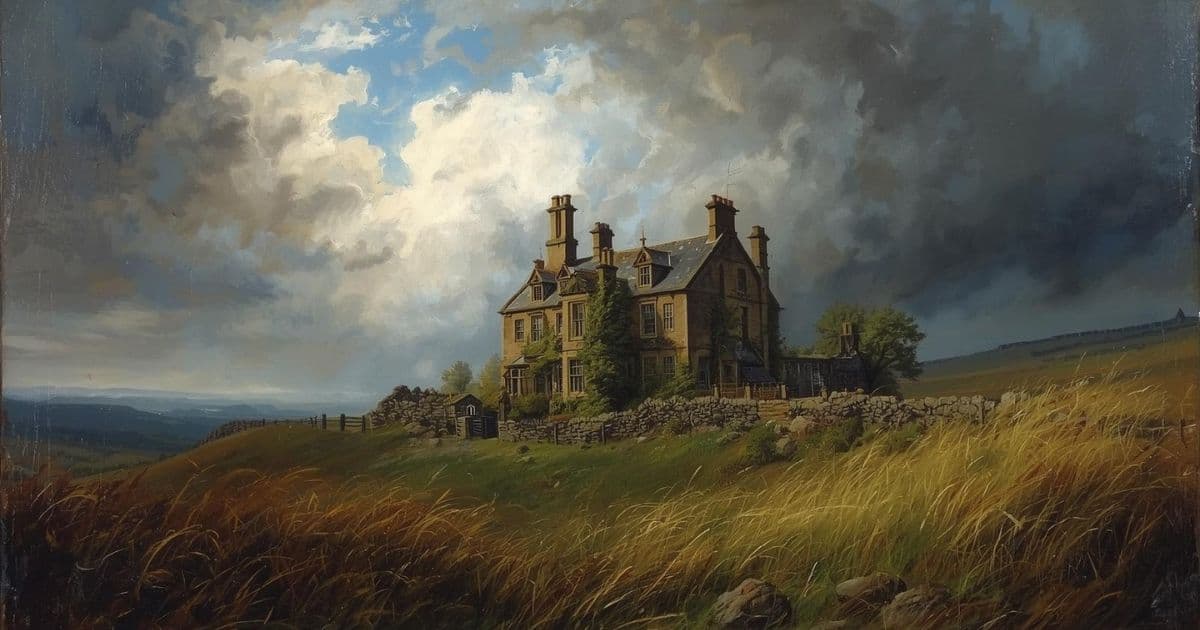
An excerpt from the original text.(complete · 2205 words)
e were brought up together; there was not quite a year difference in our ages. I need not say that we were strangers to any species of disunion or dispute. Harmony was the soul of our companionship, and the diversity and contrast that subsisted between our characters drew us nearer together. Elizabeth was of a calmer and more concentrated disposition; but, with all my ardour, I was capable of a more intense application and was more deeply smitten with the thirst for knowledge. She busied herself with following the aerial creations of the poets; and in the majestic and wondrous scenes which surrounded our Swiss home—the sublime shapes of the mountains, the changes of the seasons, tempest and calm, the silence of winter, and the life and turbulence of our Alpine summers—she found ample scope for admiration and delight. While my companion contemplated with a serious and satisfied spirit the magnificent appearances of things, I delighted in investigating their causes. The world was to me a secret which I desired to divine. Curiosity, earnest research to learn the hidden laws of nature, gladness akin to rapture, as they were unfolded to me, are among the earliest sensations I can remember.
On the birth of a second son, my junior by seven years, my parents gave up entirely their wandering life and fixed themselves in their native country. We possessed a house in Geneva, and a campagne on Belrive, the eastern shore of the lake, at the distance of rather more than a league from the city. We resided principally in the latter, and the lives of my parents were passed in considerable seclusion. It was my temper to avoid a crowd and to attach myself fervently to a few. I was indifferent, therefore, to my school-fellows in general; but I united myself in the bonds of the closest friendship to one among them. Henry Clerval was the son of a merchant of Geneva. He was a boy of singular talent and fancy. He loved enterprise, hardship, and even danger for its own sake. He was deeply read in books of chivalry and romance. He composed heroic songs and began to write many a tale of enchantment and knightly adventure. He tried to make us act plays and to enter into masquerades, in which the characters were drawn from the heroes of Roncesvalles, of the Round Table of King Arthur, and the chivalrous train who shed their blood to redeem the holy sepulchre from the hands of the infidels.
No human being could have passed a happier childhood than myself. My parents were possessed by the very spirit of kindness and indulgence. We felt that they were not the tyrants to rule our lot according to their caprice, but the agents and creators of all the many delights which we enjoyed. When I mingled with other families I distinctly discerned how peculiarly fortunate my lot was, and gratitude assisted the development of filial love.
My temper was sometimes violent, and my passions vehement; but by some law in my temperature they were turned not towards childish pursuits but to an eager desire to learn, and not to learn all things indiscriminately. I confess that neither the structure of languages, nor the code of governments, nor the politics of various states possessed attractions for me. It was the secrets of heaven and earth that I desired to learn; and whether it was the outward substance of things or the inner spirit of nature and the mysterious soul of man that occupied me, still my inquiries were directed to the metaphysical, or in its highest sense, the physical secrets of the world.
Meanwhile Clerval occupied himself, so to speak, with the moral relations of things. The busy stage of life, the virtues of heroes, and the actions of men were his theme; and his hope and his dream was to become one among those whose names are recorded in story as the gallant and adventurous benefactors of our species. The saintly soul of Elizabeth shone like a shrine-dedicated lamp in our peaceful home. Her sympathy was ours; her smile, her soft voice, the sweet glance of her celestial eyes, were ever there to bless and animate us. She was the living spirit of love to soften and attract; I might have become sullen in my study, rough through the ardour of my nature, but that she was there to subdue me to a semblance of her own gentleness. And Clerval—could aught ill entrench on the noble spirit of Clerval? Yet he might not have been so perfectly humane, so thoughtful in his generosity, so full of kindness and tenderness amidst his passion for adventurous exploit, had she not unfolded to him the real loveliness of beneficence and made the doing good the end and aim of his soaring ambition.
I feel exquisite pleasure in dwelling on the recollections of childhood, before misfortune had tainted my mind and changed its bright visions of extensive usefulness into gloomy and narrow reflections upon self. Besides, in drawing the picture of my early days, I also record those events which led, by insensible steps, to my after tale of misery, for when I would account to myself for the birth of that passion which afterwards ruled my destiny I find it arise, like a mountain river, from ignoble and almost forgotten sources; but, swelling as it proceeded, it became the torrent which, in its course, has swept away all my hopes and joys.
Natural philosophy is the genius that has regulated my fate; I desire, therefore, in this narration, to state those facts which led to my predilection for that science. When I was thirteen years of age we all went on a party of pleasure to the baths near Thonon; the inclemency of the weather obliged us to remain a day confined to the inn. In this house I chanced to find a volume of the works of Cornelius Agrippa. I opened it with apathy; the theory which he attempts to demonstrate and the wonderful facts which he relates soon changed my feelings from indifference to enthusiasm. A new light seemed to dawn upon my mind, and bounding with joy, I communicated my discovery to my father. My father looked carelessly at the title page of my book and said, "Ah! Cornelius Agrippa! My dear Victor, do not waste your time upon this; it is sad trash."
If, instead of this remark, my father had taken the pains to explain to me that the principles of Agrippa had been entirely exploded and that a modern system of science had been introduced which possessed much greater powers than the ancient, because the powers of the latter were chimerical, while those of the former were real and practical, under such circumstances I should certainly have thrown Agrippa aside and have contented my imagination, warmed as it was, by returning with greater ardour to my former studies. It is even possible that the train of my ideas would never have received the fatal impulse that led to my ruin. But the cursory glance my father had taken of my volume by no means assured me that he was acquainted with its contents, and I continued to read with the greatest avidity.
When I returned home my first care was to procure the whole works of this author, and afterwards of Paracelsus and Albertus Magnus. I read and studied the wild fancies of these writers with delight; they appeared to me treasures known to few besides myself. I have described myself as always having been imbued with a fervent longing to penetrate the secrets of nature. In spite of the intense labour and wonderful discoveries of modern philosophers, I always came from my studies discontented and unsatisfied. Sir Isaac Newton is said to have avowed that he felt like a child picking up shells beside the great and unexplored ocean of truth. Those of his successors in each branch of natural philosophy with whom I was acquainted appeared even to my boy's apprehensions as tyros engaged in the same pursuit.
The untaught peasant beheld the elements around him and was acquainted with their practical uses. The most learned philosopher knew little more. He had partially unveiled the face of Nature, but her immortal lineaments were still a wonder and a mystery. He might dissect, anatomise, and give names; but, not to speak of a final cause, causes in their secondary and tertiary grades were utterly unknown to him. I had gazed upon the fortifications and impediments that seemed to keep human beings from entering the citadel of nature, and rashly and ignorantly I had repined.
But here were books, and here were men who had penetrated deeper and knew more. I took their word for all that they averred, and I became their disciple. It may appear strange that such should arise in the eighteenth century; but while I followed the routine of education in the schools of Geneva, I was, to a great degree, self-taught with regard to my favourite studies. My father was not scientific, and I was left to struggle with a child's blindness, added to a student's thirst for knowledge. Under the guidance of my new preceptors I entered with the greatest diligence into the search of the philosopher's stone and the elixir of life; but the latter soon obtained my undivided attention. Wealth was an inferior object, but what glory would attend the discovery if I could banish disease from the human frame and render man invulnerable to any but a violent death!
Nor were these my only visions. The raising of ghosts or devils was a promise liberally accorded by my favourite authors, the fulfilment of which I most eagerly sought; and if my incantations were always unsuccessful, I attributed the failure rather to my own inexperience and mistake than to a want of skill or fidelity in my instructors. And thus for a time I was occupied by exploded systems, mingling, like an unadept, a thousand contradictory theories and floundering desperately in a very slough of multifarious knowledge, guided by an ardent imagination and childish reasoning, till an accident again changed the current of my ideas.
When I was about fifteen years old we had retired to our house near Belrive, when we witnessed a most violent and terrible thunderstorm. It advanced from behind the mountains of Jura, and the thunder burst at once with frightful loudness from various quarters of the heavens. I remained, while the storm lasted, watching its progress with curiosity and delight. As I stood at the door, on a sudden I beheld a stream of fire issue from an old and beautiful oak which stood about twenty yards from our house; and so soon as the dazzling light vanished, the oak had disappeared, and nothing remained but a blasted stump. When we visited it the next morning, we found the tree shattered in a singular manner. It was not splintered by the shock, but entirely reduced to thin ribbons of wood. I never beheld anything so utterly destroyed.
Before this I was not unacquainted with the more obvious laws of electricity. On this occasion a man of great research in natural philosophy was with us, and excited by this catastrophe, he entered on the explanation of a theory which he had formed on the subject of electricity and galvanism, which was at once new and astonishing to me. All that he said threw greatly into the shade Cornelius Agrippa, Albertus Magnus, and Paracelsus, the lords of my imagination; but by some fatality the overthrow of these men disinclined me to pursue my accustomed studies. It seemed to me as if nothing would or could ever be known. All that had so long engaged my attention suddenly grew despicable. By one of those caprices of the mind which we are perhaps most subject to in early youth, I at once gave up my former occupations, set down natural history and all its progeny as a deformed and abortive creation, and entertained the greatest disdain for a would-be science which could never even step within the threshold of real knowledge. In this mood of mind I betook myself to the mathematics and the branches of study appertaining to that science as being built upon secure foundations, and so worthy of my consideration.
Thus strangely are our souls constructed, and by such slight ligaments are we bound to prosperity or ruin. When I look back, it seems to me as if this almost miraculous change of inclination and will was the immediate suggestion of the guardian angel of my life—the last effort made by the spirit of preservation to avert the storm that was even then hanging in the stars and ready to envelop me. Her victory was announced by an unusual tranquillity and gladness of soul which followed the relinquishing of my ancient and latterly tormenting studies. It was thus that I was to be taught to associate evil with their prosecution, happiness with their disregard.
It was a strong effort of the spirit of good, but it was ineffectual. Destiny was too potent, and her immutable laws had decreed my utter and terrible destruction.
Master this chapter. Complete your experience
Purchase the complete book to access all chapters and support classic literature
As an Amazon Associate, we earn a small commission from qualifying purchases at no additional cost to you.
Available in paperback, hardcover, and e-book formats
Let's Analyse the Pattern
The Pattern of Dismissal Creating Obsession
When authority figures dismiss passionate interests without explanation, they drive those interests underground where they become dangerous obsessions.
Why This Matters
Connect literature to life
This chapter teaches how privilege and protection can create dangerous gaps in empathy and self-awareness.
Practice This Today
This week, notice when someone's 'perfect' background might be hiding their inability to handle conflict or criticism—including yourself.
Now let's explore the literary elements.
Key Quotes & Analysis
"Ah! Cornelius Agrippa! My dear Victor, do not waste your time upon this; it is sad trash."
Context: Victor's father dismissively responding when young Victor shows him the alchemist's book he discovered
This single sentence changes everything. Instead of explaining why Agrippa's theories were disproven, Alphonse just dismisses it as 'sad trash.' This lazy parenting drives Victor's interest underground where it becomes obsession. If he'd taken five minutes to explain, Victor might have pursued legitimate science. Instead, dismissal creates defiance.
In Today's Words:
That's garbage. Don't waste your time on it.
"If, instead of this remark, my father had taken the pains to explain to me that the principles of Agrippa had been entirely exploded... I should certainly have thrown Agrippa aside."
Context: Victor reflecting on how his father's dismissal shaped his path
Victor explicitly identifies the moment his fate was sealed. He admits he would have abandoned alchemy if his father had engaged with his curiosity instead of dismissing it. This is Victor partially blaming his father while revealing his own tendency to blame external factors for his choices.
In Today's Words:
If Dad had actually explained why this was wrong instead of just shutting me down, I would have listened and moved on.
"It was the secrets of heaven and earth that I desired to learn; and whether it was the outward substance of things or the inner spirit of nature and the mysterious soul of man that occupied me, still my inquiries were directed to the metaphysical, or in its highest sense, the physical secrets of the world."
Context: Victor describing the scope of his childhood ambitions
This reveals Victor's grandiose thinking from an early age. He doesn't want to understand some things—he wants the ultimate secrets of existence itself. The messianic language shows dangerous arrogance disguised as intellectual curiosity.
In Today's Words:
I wanted to figure out everything—how life works, what makes people tick, the fundamental laws of the universe.
"Elizabeth was of a calmer and more concentrated disposition; but, with all my ardour, I was capable of a more intense application and was more deeply smitten with the thirst for knowledge."
Context: Victor comparing himself to Elizabeth
Victor frames his obsessive nature as superiority—he's more 'intense' and 'ardent' than calm Elizabeth. This reveals how he romanticizes his own dangerous tendencies, seeing extremism as passion rather than dysfunction.
In Today's Words:
Elizabeth was steady and balanced, but I was way more passionate and driven to learn.
Thematic Threads
Parental Failure
In This Chapter
Alphonse's casual dismissal of Victor's interests instead of proper guidance plants the seeds of disaster
Development
The critical moment where loving but lazy parenting creates tragedy
In Your Life:
You might do this when you shut down someone's idea without explanation, creating defiance instead of understanding
All-or-Nothing Thinking
In This Chapter
Victor either worships alchemists completely or rejects them with total disdain—no middle ground
Development
Introduced as Victor's fundamental character flaw
In Your Life:
You might swing between total commitment and complete rejection without ever finding balance
Underground Obsession
In This Chapter
After dismissal, Victor pursues alchemy in secret, believing he's found 'treasures known to few besides myself'
Development
Shows how dismissal creates isolation and grandiosity
In Your Life:
You might hide interests from people who 'wouldn't understand,' making yourself vulnerable to extremism
Turning Points
In This Chapter
The thunderstorm that destroys the oak tree temporarily shifts Victor away from alchemy toward mathematics
Development
First major turning point that seems like salvation but is only temporary
In Your Life:
You might mistake temporary course corrections for permanent change
Foreshadowing
In This Chapter
Victor notes that abandoning alchemy felt like divine intervention, but 'Destiny was too potent'—doom is inevitable
Development
Literary device showing Victor's fate is sealed despite apparent redemption
In Your Life:
Sometimes early success at avoiding a problem just delays the inevitable reckoning
You now have the context. Time to form your own thoughts.
Discussion Questions
- 1
What kind of childhood did Victor have, and how did his parents treat him and Elizabeth?
analysis • surface - 2
Why might Victor's 'perfect' upbringing actually be setting him up for problems later?
analysis • medium - 3
Where do you see Golden Cage Syndrome today - people who got everything they wanted as kids but struggle with limits as adults?
application • medium - 4
If you were Victor's parent, what would you do differently to prepare him for real-world challenges?
application • deep - 5
What does Victor's story teach us about the difference between loving someone and preparing them for life?
reflection • deep
Critical Thinking Exercise
Rewrite Elizabeth's Story
Victor describes Elizabeth as his perfect companion, but we never hear her voice or perspective. Write a paragraph from Elizabeth's point of view about being 'given' to Victor as a child. What might she really think about being treated like a living gift rather than a person with her own dreams and desires?
Consider:
- •How might it feel to be constantly described as someone else's property or destiny?
- •What dreams or ambitions might Elizabeth have that Victor never mentions?
- •How does being the 'perfect' girl limit someone's ability to be fully human?
Journaling Prompt
Write about a time when someone treated you like you existed mainly to serve their needs rather than as a complete person with your own inner life. How did it feel, and how did you handle it?
Coming Up Next...
Chapter 7: Death, Departure, and Destiny
Victor's protected world begins to crack as tragedy strikes his family, setting him on the path toward his fateful experiments. His response to loss will reveal the true nature of his character.