An excerpt from the original text.(complete · 3558 words)
n my return, I found the following letter from my father:
"My dear Victor,
"You have probably waited impatiently for a letter to fix the date of your return to us; and I was at first tempted to write only a few lines, merely mentioning the day on which I should expect you. But that would be a cruel kindness, and I dare not do it. What would be your surprise, my son, when you expected a happy and glad welcome, to behold, on the contrary, tears and wretchedness? And how, Victor, can I relate our misfortune? Absence cannot have rendered you callous to our joys and griefs; and how shall I inflict pain on my long absent son? I wish to prepare you for the woeful news, but I know it is impossible; even now your eye skims over the page to seek the words which are to convey to you the horrible tidings.
"William is dead!—that sweet child, whose smiles delighted and warmed my heart, who was so gentle, yet so gay! Victor, he is murdered!
"I will not attempt to console you; but will simply relate the circumstances of the transaction.
"Last Thursday (May 7th), I, my niece, and your two brothers, went to walk in Plainpalais. The evening was warm and serene, and we prolonged our walk farther than usual. It was already dusk before we thought of returning; and then we discovered that William and Ernest, who had gone on before, were not to be found. We accordingly rested on a seat until they should return. Presently Ernest came, and enquired if we had seen his brother; he said, that he had been playing with him, that William had run away to hide himself, and that he vainly sought for him, and afterwards waited for a long time, but that he did not return.
"This account rather alarmed us, and we continued to search for him until night fell, when Elizabeth conjectured that he might have returned to the house. He was not there. We returned again, with torches; for I could not rest, when I thought that my sweet boy had lost himself, and was exposed to all the damps and dews of night; Elizabeth also suffered extreme anguish. About five in the morning I discovered my lovely boy, whom the night before I had seen blooming and active in health, stretched on the grass livid and motionless; the print of the murder's finger was on his neck.
"He was conveyed home, and the anguish that was visible in my countenance betrayed the secret to Elizabeth. She was very earnest to see the corpse. At first I attempted to prevent her but she persisted, and entering the room where it lay, hastily examined the neck of the victim, and clasping her hands exclaimed, 'O God! I have murdered my sweet child!'
"She fainted, and was restored with extreme difficulty. When she again lived, it was only to weep and sigh. She told me, that that same evening William had teased her to let him wear a very valuable miniature that she possessed of your mother. This picture is gone, and was doubtless the temptation which urged the murderer to the deed. We have no trace of him at present, although our exertions to discover him are unremitted; but they will not restore my beloved William!
"Come, dearest Victor; you alone can console Elizabeth. She weeps continually, and accuses herself unjustly as the cause of his death; her words pierce my heart. We are all unhappy; but will not that be an additional motive for you, my son, to return and be our comforter? Your dear mother! Alas, Victor! I now say, Thank God she did not live to witness the cruel, miserable death of her youngest darling!
"Come, Victor; not brooding thoughts of vengeance against the assassin, but with feelings of peace and gentleness, that will heal, instead of festering, the wounds of our minds. Enter the house of mourning, my friend, but with kindness and affection for those who love you, and not with hatred for your enemies.
"Your affectionate and afflicted father,
"Alphonse Frankenstein.
"Geneva, May 12th, 17—."
Clerval, who had watched my countenance as I read this letter, was surprised to observe the despair that succeeded the joy I at first expressed on receiving new from my friends. I threw the letter on the table, and covered my face with my hands.
"My dear Frankenstein," exclaimed Henry, when he perceived me weep with bitterness, "are you always to be unhappy? My dear friend, what has happened?"
I motioned him to take up the letter, while I walked up and down the room in the extremest agitation. Tears also gushed from the eyes of Clerval, as he read the account of my misfortune.
"I can offer you no consolation, my friend," said he; "your disaster is irreparable. What do you intend to do?"
"To go instantly to Geneva: come with me, Henry, to order the horses."
During our walk, Clerval endeavoured to say a few words of consolation; he could only express his heartfelt sympathy. "Poor William!" said he, "dear lovely child, he now sleeps with his angel mother! Who that had seen him bright and joyous in his young beauty, but must weep over his untimely loss! To die so miserably; to feel the murderer's grasp! How much more a murdered that could destroy radiant innocence! Poor little fellow! one only consolation have we; his friends mourn and weep, but he is at rest. The pang is over, his sufferings are at an end for ever. A sod covers his gentle form, and he knows no pain. He can no longer be a subject for pity; we must reserve that for his miserable survivors."
Clerval spoke thus as we hurried through the streets; the words impressed themselves on my mind and I remembered them afterwards in solitude. But now, as soon as the horses arrived, I hurried into a cabriolet, and bade farewell to my friend.
My journey was very melancholy. At first I wished to hurry on, for I longed to console and sympathise with my loved and sorrowing friends; but when I drew near my native town, I slackened my progress. I could hardly sustain the multitude of feelings that crowded into my mind. I passed through scenes familiar to my youth, but which I had not seen for nearly six years. How altered every thing might be during that time! One sudden and desolating change had taken place; but a thousand little circumstances might have by degrees worked other alterations, which, although they were done more tranquilly, might not be the less decisive. Fear overcame me; I dared not advance, dreading a thousand nameless evils that made me tremble, although I was unable to define them.
I remained two days at Lausanne, in this painful state of mind. I contemplated the lake: the waters were placid; all around was calm; and the snowy mountains, "the palaces of nature," were not changed. By degrees the calm and heavenly scene restored me, and I continued my journey towards Geneva.
The road ran by the side of the lake, which became narrower as I approached my native town. I discovered more distinctly the black sides of Jura, and the bright summit of Mont Blanc. I wept like a child. "Dear mountains! my own beautiful lake! how do you welcome your wanderer? Your summits are clear; the sky and lake are blue and placid. Is this to prognosticate peace, or to mock at my unhappiness?"
I fear, my friend, that I shall render myself tedious by dwelling on these preliminary circumstances; but they were days of comparative happiness, and I think of them with pleasure. My country, my beloved country! who but a native can tell the delight I took in again beholding thy streams, thy mountains, and, more than all, thy lovely lake!
Yet, as I drew nearer home, grief and fear again overcame me. Night also closed around; and when I could hardly see the dark mountains, I felt still more gloomily. The picture appeared a vast and dim scene of evil, and I foresaw obscurely that I was destined to become the most wretched of human beings. Alas! I prophesied truly, and failed only in one single circumstance, that in all the misery I imagined and dreaded, I did not conceive the hundredth part of the anguish I was destined to endure.
It was completely dark when I arrived in the environs of Geneva; the gates of the town were already shut; and I was obliged to pass the night at Secheron, a village at the distance of half a league from the city. The sky was serene; and, as I was unable to rest, I resolved to visit the spot where my poor William had been murdered. As I could not pass through the town, I was obliged to cross the lake in a boat to arrive at Plainpalais. During this short voyage I saw the lightning playing on the summit of Mont Blanc in the most beautiful figures. The storm appeared to approach rapidly, and, on landing, I ascended a low hill, that I might observe its progress. It advanced; the heavens were clouded, and I soon felt the rain coming slowly in large drops, but its violence quickly increased.
I quitted my seat, and walked on, although the darkness and storm increased every minute, and the thunder burst with a terrific crash over my head. It was echoed from Salêve, the Juras, and the Alps of Savoy; vivid flashes of lightning dazzled my eyes, illuminating the lake, making it appear like a vast sheet of fire; then for an instant every thing seemed of a pitchy darkness, until the eye recovered itself from the preceding flash. The storm, as is often the case in Switzerland, appeared at once in various parts of the heavens. The most violent storm hung exactly north of the town, over the part of the lake which lies between the promontory of Belrive and the village of Copêt. Another storm enlightened Jura with faint flashes; and another darkened and sometimes disclosed the Môle, a peaked mountain to the east of the lake.
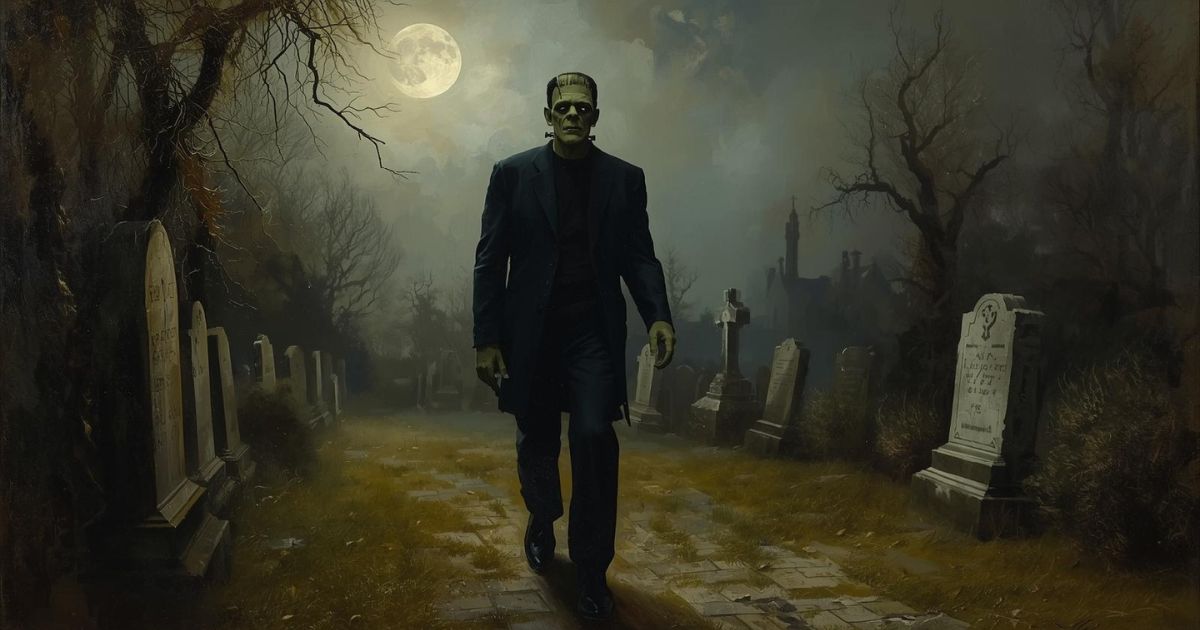
While I watched the tempest, so beautiful yet terrific, I wandered on with a hasty step. This noble war in the sky elevated my spirits; I clasped my hands, and exclaimed aloud, "William, dear angel! this is thy funeral, this thy dirge!" As I said these words, I perceived in the gloom a figure which stole from behind a clump of trees near me; I stood fixed, gazing intently: I could not be mistaken. A flash of lightning illuminated the object, and discovered its shape plainly to me; its gigantic stature, and the deformity of its aspect more hideous than belongs to humanity, instantly informed me that it was the wretch, the filthy daemon, to whom I had given life. What did he there? Could he be (I shuddered at the conception) the murderer of my brother? No sooner did that idea cross my imagination, than I became convinced of its truth; my teeth chattered, and I was forced to lean against a tree for support. The figure passed me quickly, and I lost it in the gloom.
Nothing in human shape could have destroyed that fair child. He was the murderer! I could not doubt it. The mere presence of the idea was an irresistible proof of the fact. I thought of pursuing the devil; but it would have been in vain, for another flash discovered him to me hanging among the rocks of the nearly perpendicular ascent of Mont Salêve, a hill that bounds Plainpalais on the south. He soon reached the summit, and disappeared.
I remained motionless. The thunder ceased; but the rain still continued, and the scene was enveloped in an impenetrable darkness. I revolved in my mind the events which I had until now sought to forget: the whole train of my progress toward the creation; the appearance of the works of my own hands at my bedside; its departure. Two years had now nearly elapsed since the night on which he first received life; and was this his first crime? Alas! I had turned loose into the world a depraved wretch, whose delight was in carnage and misery; had he not murdered my brother?
No one can conceive the anguish I suffered during the remainder of the night, which I spent, cold and wet, in the open air. But I did not feel the inconvenience of the weather; my imagination was busy in scenes of evil and despair. I considered the being whom I had cast among mankind, and endowed with the will and power to effect purposes of horror, such as the deed which he had now done, nearly in the light of my own vampire, my own spirit let loose from the grave, and forced to destroy all that was dear to me.
Day dawned; and I directed my steps towards the town. The gates were open, and I hastened to my father's house. My first thought was to discover what I knew of the murderer, and cause instant pursuit to be made. But I paused when I reflected on the story that I had to tell. A being whom I myself had formed, and endued with life, had met me at midnight among the precipices of an inaccessible mountain. I remembered also the nervous fever with which I had been seized just at the time that I dated my creation, and which would give an air of delirium to a tale otherwise so utterly improbable. I well knew that if any other had communicated such a relation to me, I should have looked upon it as the ravings of insanity. Besides, the strange nature of the animal would elude all pursuit, even if I were so far credited as to persuade my relatives to commence it. And then of what use would be pursuit? Who could arrest a creature capable of scaling the overhanging sides of Mont Salêve? These reflections determined me, and I resolved to remain silent.
It was about five in the morning when I entered my father's house. I told the servants not to disturb the family, and went into the library to attend their usual hour of rising.
Six years had elapsed, passed in a dream but for one indelible trace, and I stood in the same place where I had last embraced my father before my departure for Ingolstadt. Beloved and venerable parent! He still remained to me. I gazed on the picture of my mother, which stood over the mantel-piece. It was an historical subject, painted at my father's desire, and represented Caroline Beaufort in an agony of despair, kneeling by the coffin of her dead father. Her garb was rustic, and her cheek pale; but there was an air of dignity and beauty, that hardly permitted the sentiment of pity. Below this picture was a miniature of William; and my tears flowed when I looked upon it. While I was thus engaged, Ernest entered: he had heard me arrive, and hastened to welcome me. "Welcome, my dearest Victor," said he. "Ah! I wish you had come three months ago, and then you would have found us all joyous and delighted. You come to us now to share a misery which nothing can alleviate; yet your presence will, I hope, revive our father, who seems sinking under his misfortune; and your persuasions will induce poor Elizabeth to cease her vain and tormenting self-accusations.—Poor William! he was our darling and our pride!"
Tears, unrestrained, fell from my brother's eyes; a sense of mortal agony crept over my frame. Before, I had only imagined the wretchedness of my desolated home; the reality came on me as a new, and a not less terrible, disaster. I tried to calm Ernest; I enquired more minutely concerning my father, and here I named my cousin.
"She most of all," said Ernest, "requires consolation; she accused herself of having caused the death of my brother, and that made her very wretched. But since the murderer has been discovered—"
"The murderer discovered! Good God! how can that be? who could attempt to pursue him? It is impossible; one might as well try to overtake the winds, or confine a mountain-stream with a straw. I saw him too; he was free last night!"
"I do not know what you mean," replied my brother, in accents of wonder, "but to us the discovery we have made completes our misery. No one would believe it at first; and even now Elizabeth will not be convinced, notwithstanding all the evidence. Indeed, who would credit that Justine Moritz, who was so amiable, and fond of all the family, could suddenly become so capable of so frightful, so appalling a crime?"
"Justine Moritz! Poor, poor girl, is she the accused? But it is wrongfully; every one knows that; no one believes it, surely, Ernest?"
"No one did at first; but several circumstances came out, that have almost forced conviction upon us; and her own behaviour has been so confused, as to add to the evidence of facts a weight that, I fear, leaves no hope for doubt. But she will be tried today, and you will then hear all."
He then related that, the morning on which the murder of poor William had been discovered, Justine had been taken ill, and confined to her bed for several days. During this interval, one of the servants, happening to examine the apparel she had worn on the night of the murder, had discovered in her pocket the picture of my mother, which had been judged to be the temptation of the murderer. The servant instantly showed it to one of the others, who, without saying a word to any of the family, went to a magistrate; and, upon their deposition, Justine was apprehended. On being charged with the fact, the poor girl confirmed the suspicion in a great measure by her extreme confusion of manner.
This was a strange tale, but it did not shake my faith; and I replied earnestly, "You are all mistaken; I know the murderer. Justine, poor, good Justine, is innocent."
At that instant my father entered. I saw unhappiness deeply impressed on his countenance, but he endeavoured to welcome me cheerfully; and, after we had exchanged our mournful greeting, would have introduced some other topic than that of our disaster, had not Ernest exclaimed, "Good God, papa! Victor says that he knows who was the murderer of poor William."
"We do also, unfortunately," replied my father, "for indeed I had rather have been for ever ignorant than have discovered so much depravity and ungratitude in one I valued so highly."
"My dear father, you are mistaken; Justine is innocent."
"If she is, God forbid that she should suffer as guilty. She is to be tried today, and I hope, I sincerely hope, that she will be acquitted."
This speech calmed me. I was firmly convinced in my own mind that Justine, and indeed every human being, was guiltless of this murder. I had no fear, therefore, that any circumstantial evidence could be brought forward strong enough to convict her. My tale was not one to announce publicly; its astounding horror would be looked upon as madness by the vulgar. Did any one indeed exist, except I, the creator, who would believe, unless his senses convinced him, in the existence of the living monument of presumption and rash ignorance which I had let loose upon the world?
We were soon joined by Elizabeth. Time had altered her since I last beheld her; it had endowed her with loveliness surpassing the beauty of her childish years. There was the same candour, the same vivacity, but it was allied to an expression more full of sensibility and intellect. She welcomed me with the greatest affection. "Your arrival, my dear cousin," said she, "fills me with hope. You perhaps will find some means to justify my poor guiltless Justine. Alas! who is safe, if she be convicted of crime? I rely on her innocence as certainly as I do upon my own. Our misfortune is doubly hard to us; we have not only lost that lovely darling boy, but this poor girl, whom I sincerely love, is to be torn away by even a worse fate. If she is condemned, I never shall know joy more. But she will not, I am sure she will not; and then I shall be happy again, even after the sad death of my little William."
"She is innocent, my Elizabeth," said I, "and that shall be proved; fear nothing, but let your spirits be cheered by the assurance of her acquittal."
"How kind and generous you are! every one else believes in her guilt, and that made me wretched, for I knew that it was impossible: and to see every one else prejudiced in so deadly a manner rendered me hopeless and despairing." She wept.
"Dearest niece," said my father, "dry your tears. If she is, as you believe, innocent, rely on the justice of our laws, and the activity with which I shall prevent the slightest shadow of partiality.
Master this chapter. Complete your experience
Purchase the complete book to access all chapters and support classic literature
As an Amazon Associate, we earn a small commission from qualifying purchases at no additional cost to you.
Available in paperback, hardcover, and e-book formats
Let's Analyse the Pattern
The Pattern of Cascading Abandonment
One act of abandonment creates a chain of destruction where each failure to take responsibility compounds the damage.
Why This Matters
Connect literature to life
This chapter teaches how to recognize when institutions sacrifice individuals to protect themselves from systemic problems.
Practice This Today
This week, notice when workplace problems get blamed on the newest or most vulnerable employee—ask yourself what systemic issue is being hidden.
Now let's explore the literary elements.
Key Quotes & Analysis
"William is dead!—that sweet child, whose smiles delighted and warmed my heart, who was so gentle, yet so gay! Victor, he is murdered!"
Context: Victor's father breaking the devastating news in his letter
The exclamation points and dashes show Alphonse's barely contained anguish. His description of William's gentleness and joy makes the murder even more horrific—this wasn't just any child, but one who brought happiness to everyone around him.
In Today's Words:
William is dead! That sweet, happy little boy who made everyone smile—someone murdered him!
"He was the murderer! I could not doubt it. The mere presence of the idea was an irresistible proof of the fact."
Context: Victor seeing the creature during the thunderstorm near the murder scene
Victor knows instantly and completely that his creature killed William. His certainty reveals both the truth and his guilt—he created something capable of murdering children, then abandoned it to roam free. The 'irresistible proof' is his conscience confirming what he already feared.
In Today's Words:
It was him—I knew it beyond any doubt. Just seeing him there was all the proof I needed.
"I had turned loose into the world a depraved wretch, whose delight was in carnage and misery."
Context: Victor realizing the full implications of his creation and abandonment
Victor characterizes the creature as inherently evil ('depraved,' 'delight in carnage') rather than taking responsibility for creating and then abandoning a being that had no guidance or love. He's already constructing a narrative where the creature is the villain and he's the victim.
In Today's Words:
I unleashed a monster into the world who loves violence and causing pain.
"My tale was not one to announce publicly; its astounding horror would be looked upon as madness by the vulgar."
Context: Victor rationalizing why he won't reveal the truth that could save Justine
Victor convinces himself that telling the truth is impossible, but this is self-serving rationalization. He's more concerned with being thought mad than with saving an innocent life. He chooses his reputation over Justine's survival.
In Today's Words:
I couldn't tell anyone the truth—they'd think I was crazy.
Thematic Threads
Consequences of Creation
In This Chapter
Victor's abandoned creature murders his innocent brother and frames a servant—showing how abandonment breeds destruction
Development
Direct result of Victor's flight in Chapter 5—abandoned being becomes destroyer
In Your Life:
What you abandon doesn't disappear—it often comes back worse
Silence as Complicity
In This Chapter
Victor knows Justine is innocent but stays silent, making him morally responsible for her upcoming execution
Development
Second major abandonment—first the creature, now Justine
In Your Life:
Not speaking up when you have crucial information makes you part of the injustice
Class Injustice
In This Chapter
Justine's servant status makes her a convenient scapegoat—the system assumes guilt based on social position
Development
Introduced as systemic problem that enables the creature's manipulation
In Your Life:
Power structures often sacrifice the vulnerable to protect the comfortable
Recognition and Denial
In This Chapter
Victor instantly recognizes the creature as murderer but won't acknowledge his own role in creating this situation
Development
Victor sees the creature as purely evil rather than his own abandoned responsibility
In Your Life:
You might recognize problems you caused but frame yourself as victim rather than originator
The Innocent Suffering
In This Chapter
William and Justine, both innocent and good, pay for Victor's choices with their lives
Development
Establishes pattern where Victor's actions destroy bystanders
In Your Life:
Your mistakes often hurt people who had nothing to do with your original choices
You now have the context. Time to form your own thoughts.
Discussion Questions
- 1
Why does Victor convince himself he can't save Justine, even though he knows she's innocent?
analysis • surface - 2
How does Justine's social status as a servant affect her treatment in court, and what does this reveal about the justice system?
analysis • medium - 3
Where do you see people today staying silent when they have information that could help someone in trouble?
application • medium - 4
What would you do if you had crucial information that could save someone, but speaking up might make you look crazy or ruin your reputation?
application • deep - 5
What does Victor's paralysis teach us about the difference between being powerless and choosing powerlessness?
reflection • deep
Critical Thinking Exercise
Map Your Moral Emergency Plan
Think of a situation where you might witness injustice but feel scared to speak up. Create a step-by-step action plan: Who would you tell first? What evidence would you gather? What allies could you find? Write out your personal protocol for breaking through moral paralysis when it matters most.
Consider:
- •Consider starting with the safest person who might listen and take action
- •Think about documentation - what proof could you gather before speaking up?
- •Remember that doing something imperfect is often better than doing nothing perfectly
Journaling Prompt
Write about a time when you stayed silent about something wrong because you were afraid of the consequences. What would you do differently now, knowing what you know about moral paralysis?
Coming Up Next...
Chapter 12: Justine's Trial and Execution
Justine's trial begins, and Victor must watch as an innocent woman faces execution for his creature's crime. His silence becomes a choice that will haunt him forever.