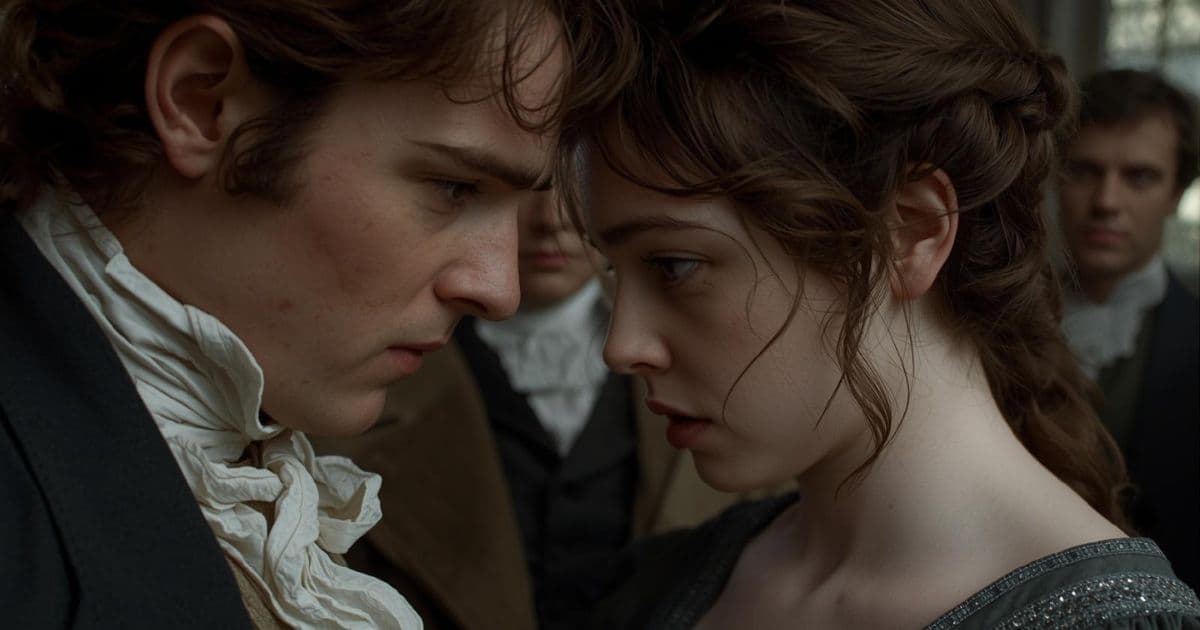
An excerpt from the original text.(complete · 1970 words)
“ do not know what your opinion may be, Mrs. Weston,” said Mr.
Knightley, “of this great intimacy between Emma and Harriet Smith, but
I think it a bad thing.”
“A bad thing! Do you really think it a bad thing?—why so?”
“I think they will neither of them do the other any good.”
“You surprize me! Emma must do Harriet good: and by supplying her with
a new object of interest, Harriet may be said to do Emma good. I have
been seeing their intimacy with the greatest pleasure. How very
differently we feel!—Not think they will do each other any good! This
will certainly be the beginning of one of our quarrels about Emma, Mr.
Knightley.”
“Perhaps you think I am come on purpose to quarrel with you, knowing
Weston to be out, and that you must still fight your own battle.”
“Mr. Weston would undoubtedly support me, if he were here, for he
thinks exactly as I do on the subject. We were speaking of it only
yesterday, and agreeing how fortunate it was for Emma, that there
should be such a girl in Highbury for her to associate with. Mr.
Knightley, I shall not allow you to be a fair judge in this case. You
are so much used to live alone, that you do not know the value of a
companion; and, perhaps no man can be a good judge of the comfort a
woman feels in the society of one of her own sex, after being used to
it all her life. I can imagine your objection to Harriet Smith. She is
not the superior young woman which Emma’s friend ought to be. But on
the other hand, as Emma wants to see her better informed, it will be an
inducement to her to read more herself. They will read together. She
means it, I know.”
“Emma has been meaning to read more ever since she was twelve years
old. I have seen a great many lists of her drawing-up at various times
of books that she meant to read regularly through—and very good lists
they were—very well chosen, and very neatly arranged—sometimes
alphabetically, and sometimes by some other rule. The list she drew up
when only fourteen—I remember thinking it did her judgment so much
credit, that I preserved it some time; and I dare say she may have made
out a very good list now. But I have done with expecting any course of
steady reading from Emma. She will never submit to any thing requiring
industry and patience, and a subjection of the fancy to the
understanding. Where Miss Taylor failed to stimulate, I may safely
affirm that Harriet Smith will do nothing.—You never could persuade her
to read half so much as you wished.—You know you could not.”
“I dare say,” replied Mrs. Weston, smiling, “that I thought so
then;—but since we have parted, I can never remember Emma’s omitting
to do any thing I wished.”
“There is hardly any desiring to refresh such a memory as that,”—said
Mr. Knightley, feelingly; and for a moment or two he had done. “But I,”
he soon added, “who have had no such charm thrown over my senses, must
still see, hear, and remember. Emma is spoiled by being the cleverest
of her family. At ten years old, she had the misfortune of being able
to answer questions which puzzled her sister at seventeen. She was
always quick and assured: Isabella slow and diffident. And ever since
she was twelve, Emma has been mistress of the house and of you all. In
her mother she lost the only person able to cope with her. She inherits
her mother’s talents, and must have been under subjection to her.”
“I should have been sorry, Mr. Knightley, to be dependent on your
recommendation, had I quitted Mr. Woodhouse’s family and wanted another
situation; I do not think you would have spoken a good word for me to
any body. I am sure you always thought me unfit for the office I held.”
“Yes,” said he, smiling. “You are better placed here; very fit for a
wife, but not at all for a governess. But you were preparing yourself
to be an excellent wife all the time you were at Hartfield. You might
not give Emma such a complete education as your powers would seem to
promise; but you were receiving a very good education from her, on
the very material matrimonial point of submitting your own will, and
doing as you were bid; and if Weston had asked me to recommend him a
wife, I should certainly have named Miss Taylor.”
“Thank you. There will be very little merit in making a good wife to
such a man as Mr. Weston.”
“Why, to own the truth, I am afraid you are rather thrown away, and
that with every disposition to bear, there will be nothing to be borne.
We will not despair, however. Weston may grow cross from the wantonness
of comfort, or his son may plague him.”
“I hope not that.—It is not likely. No, Mr. Knightley, do not
foretell vexation from that quarter.”
“Not I, indeed. I only name possibilities. I do not pretend to Emma’s
genius for foretelling and guessing. I hope, with all my heart, the
young man may be a Weston in merit, and a Churchill in fortune.—But
Harriet Smith—I have not half done about Harriet Smith. I think her the
very worst sort of companion that Emma could possibly have. She knows
nothing herself, and looks upon Emma as knowing every thing. She is a
flatterer in all her ways; and so much the worse, because undesigned.
Her ignorance is hourly flattery. How can Emma imagine she has any
thing to learn herself, while Harriet is presenting such a delightful
inferiority? And as for Harriet, I will venture to say that she
cannot gain by the acquaintance. Hartfield will only put her out of
conceit with all the other places she belongs to. She will grow just
refined enough to be uncomfortable with those among whom birth and
circumstances have placed her home. I am much mistaken if Emma’s
doctrines give any strength of mind, or tend at all to make a girl
adapt herself rationally to the varieties of her situation in
life.—They only give a little polish.”
“I either depend more upon Emma’s good sense than you do, or am more
anxious for her present comfort; for I cannot lament the acquaintance.
How well she looked last night!”
“Oh! you would rather talk of her person than her mind, would you? Very
well; I shall not attempt to deny Emma’s being pretty.”
“Pretty! say beautiful rather. Can you imagine any thing nearer perfect
beauty than Emma altogether—face and figure?”
“I do not know what I could imagine, but I confess that I have seldom
seen a face or figure more pleasing to me than hers. But I am a partial
old friend.”
“Such an eye!—the true hazle eye—and so brilliant! regular features,
open countenance, with a complexion! oh! what a bloom of full health,
and such a pretty height and size; such a firm and upright figure!
There is health, not merely in her bloom, but in her air, her head, her
glance. One hears sometimes of a child being ‘the picture of health;’
now, Emma always gives me the idea of being the complete picture of
grown-up health. She is loveliness itself. Mr. Knightley, is not she?”
“I have not a fault to find with her person,” he replied. “I think her
all you describe. I love to look at her; and I will add this praise,
that I do not think her personally vain. Considering how very handsome
she is, she appears to be little occupied with it; her vanity lies
another way. Mrs. Weston, I am not to be talked out of my dislike of
Harriet Smith, or my dread of its doing them both harm.”
“And I, Mr. Knightley, am equally stout in my confidence of its not
doing them any harm. With all dear Emma’s little faults, she is an
excellent creature. Where shall we see a better daughter, or a kinder
sister, or a truer friend? No, no; she has qualities which may be
trusted; she will never lead any one really wrong; she will make no
lasting blunder; where Emma errs once, she is in the right a hundred
times.”
“Very well; I will not plague you any more. Emma shall be an angel, and
I will keep my spleen to myself till Christmas brings John and
Isabella. John loves Emma with a reasonable and therefore not a blind
affection, and Isabella always thinks as he does; except when he is not
quite frightened enough about the children. I am sure of having their
opinions with me.”
“I know that you all love her really too well to be unjust or unkind;
but excuse me, Mr. Knightley, if I take the liberty (I consider myself,
you know, as having somewhat of the privilege of speech that Emma’s
mother might have had) the liberty of hinting that I do not think any
possible good can arise from Harriet Smith’s intimacy being made a
matter of much discussion among you. Pray excuse me; but supposing any
little inconvenience may be apprehended from the intimacy, it cannot be
expected that Emma, accountable to nobody but her father, who perfectly
approves the acquaintance, should put an end to it, so long as it is a
source of pleasure to herself. It has been so many years my province to
give advice, that you cannot be surprized, Mr. Knightley, at this
little remains of office.”
“Not at all,” cried he; “I am much obliged to you for it. It is very
good advice, and it shall have a better fate than your advice has often
found; for it shall be attended to.”
“Mrs. John Knightley is easily alarmed, and might be made unhappy about
her sister.”
“Be satisfied,” said he, “I will not raise any outcry. I will keep my
ill-humour to myself. I have a very sincere interest in Emma. Isabella
does not seem more my sister; has never excited a greater interest;
perhaps hardly so great. There is an anxiety, a curiosity in what one
feels for Emma. I wonder what will become of her!”
“So do I,” said Mrs. Weston gently, “very much.”
“She always declares she will never marry, which, of course, means just
nothing at all. But I have no idea that she has yet ever seen a man she
cared for. It would not be a bad thing for her to be very much in love
with a proper object. I should like to see Emma in love, and in some
doubt of a return; it would do her good. But there is nobody hereabouts
to attach her; and she goes so seldom from home.”
“There does, indeed, seem as little to tempt her to break her
resolution at present,” said Mrs. Weston, “as can well be; and while
she is so happy at Hartfield, I cannot wish her to be forming any
attachment which would be creating such difficulties on poor Mr.
Woodhouse’s account. I do not recommend matrimony at present to Emma,
though I mean no slight to the state, I assure you.”
Part of her meaning was to conceal some favourite thoughts of her own
and Mr. Weston’s on the subject, as much as possible. There were wishes
at Randalls respecting Emma’s destiny, but it was not desirable to have
them suspected; and the quiet transition which Mr. Knightley soon
afterwards made to “What does Weston think of the weather; shall we
have rain?” convinced her that he had nothing more to say or surmise
about Hartfield.
Master this chapter. Complete your experience
Purchase the complete book to access all chapters and support classic literature
As an Amazon Associate, we earn a small commission from qualifying purchases at no additional cost to you.
Available in paperback, hardcover, and e-book formats
Let's Analyse the Pattern
The tension between confronting someone you care about with hard truths versus supporting them unconditionally through their mistakes.
Why This Matters
Connect literature to life
This chapter teaches how to distinguish between friends who support you and friends who challenge you—and why you need both.
Practice This Today
This week, notice when friends agree with everything you say versus when they push back—both responses reveal something important about the relationship and your choices.
Now let's explore the literary elements.
Key Quotes & Analysis
"I think they will neither of them do the other any good."
Context: His opening argument against Emma and Harriet's friendship
This sets up the central conflict - Knightley sees potential harm where Mrs. Weston sees potential good. It shows his willingness to voice unpopular opinions when he thinks someone he cares about is making a mistake.
In Today's Words:
This friendship is going to be bad for both of them.
"You are so much used to live alone, that you do not know the value of a companion."
Context: Her defense when Knightley criticizes the friendship
She's suggesting his perspective is limited by his experience as a single man. This reveals how much women's social needs were understood differently, and how friendship was seen as essential for women's wellbeing.
In Today's Words:
You're such a loner that you don't get how much women need their girlfriends.
"Perhaps no man can be a good judge of the comfort a woman feels in the society of one of her own sex."
Context: Continuing her argument that Knightley can't understand women's friendships
This highlights the gender divide in understanding relationships and emotional needs. Mrs. Weston is claiming that female friendship has benefits that men simply cannot comprehend.
In Today's Words:
Maybe guys just don't understand what women get out of having close female friends.
Thematic Threads
Class
In This Chapter
Knightley worries that Emma's friendship with Harriet will give both women false ideas about their social positions—Emma feeling superior, Harriet feeling entitled to more than her birth allows
Development
Deepening from earlier hints about social boundaries to explicit concern about cross-class friendships disrupting natural order
In Your Life:
You might see this when workplace friendships cross hierarchical lines and create tension about boundaries and expectations
Personal Growth
In This Chapter
Knightley identifies Emma's core problem: she's never faced real difficulty or had anyone challenge her, leaving her unprepared for life's realities
Development
Building on previous chapters' hints about Emma's sheltered existence to reveal the deeper consequences of unchallenged privilege
In Your Life:
You recognize this in yourself or others who've been protected from consequences and struggle when reality finally hits
Human Relationships
In This Chapter
The disagreement between Knightley and Mrs. Weston shows two different ways of loving someone—through confrontation versus through support
Development
Introduced here as a new dimension of how people who care about the same person can have completely different approaches
In Your Life:
You see this in how different family members or friends handle your problems—some challenge you, others enable you
Identity
In This Chapter
Emma's sense of self is built on constant admiration and lack of challenge, making her identity fragile and untested
Development
Evolving from earlier suggestions that Emma might be overconfident to revealing the psychological foundation of her self-image
In Your Life:
You might recognize this in yourself or others whose confidence crumbles when faced with real criticism or failure
You now have the context. Time to form your own thoughts.
Discussion Questions
- 1
What specific concerns does Mr. Knightley raise about Emma's friendship with Harriet Smith?
analysis • surface - 2
Why do you think Mrs. Weston defends Emma's choices even though she might have private doubts?
analysis • medium - 3
Think about your own relationships - do you have friends who challenge you like Knightley, or friends who support you like Mrs. Weston? Which type do you find yourself being more often?
application • medium - 4
When someone you care about is making choices you think are harmful, how do you decide whether to speak up or stay quiet?
application • deep - 5
What does this chapter suggest about the difference between loving someone and enabling them?
reflection • deep
Critical Thinking Exercise
Map Your Support Network
Draw or list the people in your life who fill different roles: who tells you hard truths (your Knightleys), who offers unconditional support (your Mrs. Westons), and who just agrees with everything you say. Then think about which type of friend you are to others. Are there gaps in your network or patterns in how you show up for people?
Consider:
- •Notice if you're missing either truth-tellers or supporters - both are necessary
- •Consider whether you avoid people who challenge you or only seek out those who agree
- •Think about whether you default to being supportive or challenging - and when each is most helpful
Journaling Prompt
Write about a time when someone loved you enough to tell you something you didn't want to hear. How did you react in the moment, and how do you feel about it now? What did you learn about yourself from that experience?
Coming Up Next...
Chapter 6: The Portrait Project Begins
Emma continues her project of 'improving' Harriet, but her matchmaking ambitions are about to create complications that even she hasn't anticipated.