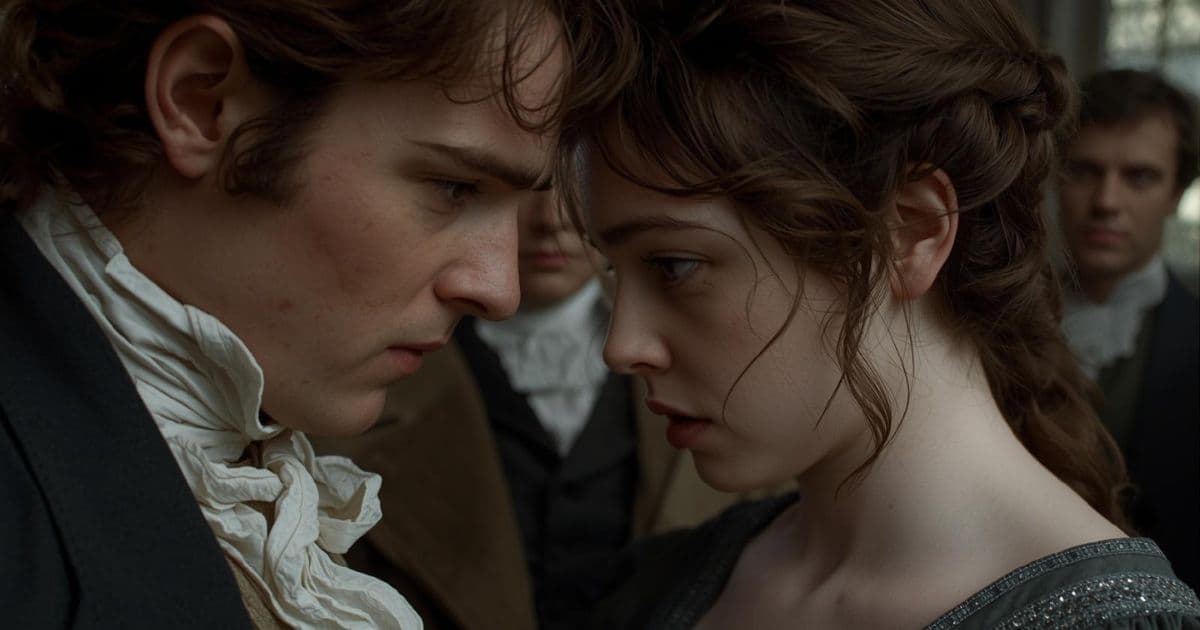
An excerpt from the original text.(complete · 3489 words)
arriet Smith’s intimacy at Hartfield was soon a settled thing. Quick
and decided in her ways, Emma lost no time in inviting, encouraging,
and telling her to come very often; and as their acquaintance
increased, so did their satisfaction in each other. As a walking
companion, Emma had very early foreseen how useful she might find her.
In that respect Mrs. Weston’s loss had been important. Her father never
went beyond the shrubbery, where two divisions of the ground sufficed
him for his long walk, or his short, as the year varied; and since Mrs.
Weston’s marriage her exercise had been too much confined. She had
ventured once alone to Randalls, but it was not pleasant; and a Harriet
Smith, therefore, one whom she could summon at any time to a walk,
would be a valuable addition to her privileges. But in every respect,
as she saw more of her, she approved her, and was confirmed in all her
kind designs.
Harriet certainly was not clever, but she had a sweet, docile, grateful
disposition, was totally free from conceit, and only desiring to be
guided by any one she looked up to. Her early attachment to herself was
very amiable; and her inclination for good company, and power of
appreciating what was elegant and clever, shewed that there was no want
of taste, though strength of understanding must not be expected.
Altogether she was quite convinced of Harriet Smith’s being exactly the
young friend she wanted—exactly the something which her home required.
Such a friend as Mrs. Weston was out of the question. Two such could
never be granted. Two such she did not want. It was quite a different
sort of thing, a sentiment distinct and independent. Mrs. Weston was
the object of a regard which had its basis in gratitude and esteem.
Harriet would be loved as one to whom she could be useful. For Mrs.
Weston there was nothing to be done; for Harriet every thing.
Her first attempts at usefulness were in an endeavour to find out who
were the parents, but Harriet could not tell. She was ready to tell
every thing in her power, but on this subject questions were vain. Emma
was obliged to fancy what she liked—but she could never believe that in
the same situation she should not have discovered the truth. Harriet
had no penetration. She had been satisfied to hear and believe just
what Mrs. Goddard chose to tell her; and looked no farther.
Mrs. Goddard, and the teachers, and the girls and the affairs of the
school in general, formed naturally a great part of the
conversation—and but for her acquaintance with the Martins of
Abbey-Mill Farm, it must have been the whole. But the Martins occupied
her thoughts a good deal; she had spent two very happy months with
them, and now loved to talk of the pleasures of her visit, and describe
the many comforts and wonders of the place. Emma encouraged her
talkativeness—amused by such a picture of another set of beings, and
enjoying the youthful simplicity which could speak with so much
exultation of Mrs. Martin’s having “two parlours, two very good
parlours, indeed; one of them quite as large as Mrs. Goddard’s
drawing-room; and of her having an upper maid who had lived
five-and-twenty years with her; and of their having eight cows, two of
them Alderneys, and one a little Welch cow, a very pretty little Welch
cow indeed; and of Mrs. Martin’s saying as she was so fond of it, it
should be called her cow; and of their having a very handsome
summer-house in their garden, where some day next year they were all to
drink tea:—a very handsome summer-house, large enough to hold a dozen
people.”
For some time she was amused, without thinking beyond the immediate
cause; but as she came to understand the family better, other feelings
arose. She had taken up a wrong idea, fancying it was a mother and
daughter, a son and son’s wife, who all lived together; but when it
appeared that the Mr. Martin, who bore a part in the narrative, and was
always mentioned with approbation for his great good-nature in doing
something or other, was a single man; that there was no young Mrs.
Martin, no wife in the case; she did suspect danger to her poor little
friend from all this hospitality and kindness, and that, if she were
not taken care of, she might be required to sink herself forever.
With this inspiriting notion, her questions increased in number and
meaning; and she particularly led Harriet to talk more of Mr. Martin,
and there was evidently no dislike to it. Harriet was very ready to
speak of the share he had had in their moonlight walks and merry
evening games; and dwelt a good deal upon his being so very
good-humoured and obliging. He had gone three miles round one day in
order to bring her some walnuts, because she had said how fond she was
of them, and in every thing else he was so very obliging. He had his
shepherd’s son into the parlour one night on purpose to sing to her.
She was very fond of singing. He could sing a little himself. She
believed he was very clever, and understood every thing. He had a very
fine flock, and, while she was with them, he had been bid more for his
wool than any body in the country. She believed every body spoke well
of him. His mother and sisters were very fond of him. Mrs. Martin had
told her one day (and there was a blush as she said it,) that it was
impossible for any body to be a better son, and therefore she was sure,
whenever he married, he would make a good husband. Not that she
wanted him to marry. She was in no hurry at all.
“Well done, Mrs. Martin!” thought Emma. “You know what you are about.”
“And when she had come away, Mrs. Martin was so very kind as to send
Mrs. Goddard a beautiful goose—the finest goose Mrs. Goddard had ever
seen. Mrs. Goddard had dressed it on a Sunday, and asked all the three
teachers, Miss Nash, and Miss Prince, and Miss Richardson, to sup with
her.”
“Mr. Martin, I suppose, is not a man of information beyond the line of
his own business? He does not read?”
“Oh yes!—that is, no—I do not know—but I believe he has read a good
deal—but not what you would think any thing of. He reads the
Agricultural Reports, and some other books that lay in one of the
window seats—but he reads all them to himself. But sometimes of an
evening, before we went to cards, he would read something aloud out of
the Elegant Extracts, very entertaining. And I know he has read the
Vicar of Wakefield. He never read the Romance of the Forest, nor The
Children of the Abbey. He had never heard of such books before I
mentioned them, but he is determined to get them now as soon as ever he
can.”
The next question was—
“What sort of looking man is Mr. Martin?”
“Oh! not handsome—not at all handsome. I thought him very plain at
first, but I do not think him so plain now. One does not, you know,
after a time. But did you never see him? He is in Highbury every now
and then, and he is sure to ride through every week in his way to
Kingston. He has passed you very often.”
“That may be, and I may have seen him fifty times, but without having
any idea of his name. A young farmer, whether on horseback or on foot,
is the very last sort of person to raise my curiosity. The yeomanry are
precisely the order of people with whom I feel I can have nothing to
do. A degree or two lower, and a creditable appearance might interest
me; I might hope to be useful to their families in some way or other.
But a farmer can need none of my help, and is, therefore, in one sense,
as much above my notice as in every other he is below it.”
“To be sure. Oh yes! It is not likely you should ever have observed
him; but he knows you very well indeed—I mean by sight.”
“I have no doubt of his being a very respectable young man. I know,
indeed, that he is so, and, as such, wish him well. What do you imagine
his age to be?”
“He was four-and-twenty the 8th of last June, and my birthday is the
23rd just a fortnight and a day’s difference—which is very odd.”
“Only four-and-twenty. That is too young to settle. His mother is
perfectly right not to be in a hurry. They seem very comfortable as
they are, and if she were to take any pains to marry him, she would
probably repent it. Six years hence, if he could meet with a good sort
of young woman in the same rank as his own, with a little money, it
might be very desirable.”
“Six years hence! Dear Miss Woodhouse, he would be thirty years old!”
“Well, and that is as early as most men can afford to marry, who are
not born to an independence. Mr. Martin, I imagine, has his fortune
entirely to make—cannot be at all beforehand with the world. Whatever
money he might come into when his father died, whatever his share of
the family property, it is, I dare say, all afloat, all employed in his
stock, and so forth; and though, with diligence and good luck, he may
be rich in time, it is next to impossible that he should have realised
any thing yet.”
“To be sure, so it is. But they live very comfortably. They have no
indoors man, else they do not want for any thing; and Mrs. Martin talks
of taking a boy another year.”
“I wish you may not get into a scrape, Harriet, whenever he does
marry;—I mean, as to being acquainted with his wife—for though his
sisters, from a superior education, are not to be altogether objected
to, it does not follow that he might marry any body at all fit for you
to notice. The misfortune of your birth ought to make you particularly
careful as to your associates. There can be no doubt of your being a
gentleman’s daughter, and you must support your claim to that station
by every thing within your own power, or there will be plenty of people
who would take pleasure in degrading you.”
“Yes, to be sure, I suppose there are. But while I visit at Hartfield,
and you are so kind to me, Miss Woodhouse, I am not afraid of what any
body can do.”
“You understand the force of influence pretty well, Harriet; but I
would have you so firmly established in good society, as to be
independent even of Hartfield and Miss Woodhouse. I want to see you
permanently well connected, and to that end it will be advisable to
have as few odd acquaintance as may be; and, therefore, I say that if
you should still be in this country when Mr. Martin marries, I wish you
may not be drawn in by your intimacy with the sisters, to be acquainted
with the wife, who will probably be some mere farmer’s daughter,
without education.”
“To be sure. Yes. Not that I think Mr. Martin would ever marry any body
but what had had some education—and been very well brought up. However,
I do not mean to set up my opinion against yours—and I am sure I shall
not wish for the acquaintance of his wife. I shall always have a great
regard for the Miss Martins, especially Elizabeth, and should be very
sorry to give them up, for they are quite as well educated as me. But
if he marries a very ignorant, vulgar woman, certainly I had better not
visit her, if I can help it.”
Emma watched her through the fluctuations of this speech, and saw no
alarming symptoms of love. The young man had been the first admirer,
but she trusted there was no other hold, and that there would be no
serious difficulty, on Harriet’s side, to oppose any friendly
arrangement of her own.
They met Mr. Martin the very next day, as they were walking on the
Donwell road. He was on foot, and after looking very respectfully at
her, looked with most unfeigned satisfaction at her companion. Emma was
not sorry to have such an opportunity of survey; and walking a few
yards forward, while they talked together, soon made her quick eye
sufficiently acquainted with Mr. Robert Martin. His appearance was very
neat, and he looked like a sensible young man, but his person had no
other advantage; and when he came to be contrasted with gentlemen, she
thought he must lose all the ground he had gained in Harriet’s
inclination. Harriet was not insensible of manner; she had voluntarily
noticed her father’s gentleness with admiration as well as wonder. Mr.
Martin looked as if he did not know what manner was.
They remained but a few minutes together, as Miss Woodhouse must not be
kept waiting; and Harriet then came running to her with a smiling face,
and in a flutter of spirits, which Miss Woodhouse hoped very soon to
compose.
“Only think of our happening to meet him!—How very odd! It was quite a
chance, he said, that he had not gone round by Randalls. He did not
think we ever walked this road. He thought we walked towards Randalls
most days. He has not been able to get the Romance of the Forest yet.
He was so busy the last time he was at Kingston that he quite forgot
it, but he goes again to-morrow. So very odd we should happen to meet!
Well, Miss Woodhouse, is he like what you expected? What do you think
of him? Do you think him so very plain?”
“He is very plain, undoubtedly—remarkably plain:—but that is nothing
compared with his entire want of gentility. I had no right to expect
much, and I did not expect much; but I had no idea that he could be so
very clownish, so totally without air. I had imagined him, I confess, a
degree or two nearer gentility.”
“To be sure,” said Harriet, in a mortified voice, “he is not so genteel
as real gentlemen.”
“I think, Harriet, since your acquaintance with us, you have been
repeatedly in the company of some such very real gentlemen, that you
must yourself be struck with the difference in Mr. Martin. At
Hartfield, you have had very good specimens of well educated, well bred
men. I should be surprized if, after seeing them, you could be in
company with Mr. Martin again without perceiving him to be a very
inferior creature—and rather wondering at yourself for having ever
thought him at all agreeable before. Do not you begin to feel that now?
Were not you struck? I am sure you must have been struck by his awkward
look and abrupt manner, and the uncouthness of a voice which I heard to
be wholly unmodulated as I stood here.”
“Certainly, he is not like Mr. Knightley. He has not such a fine air
and way of walking as Mr. Knightley. I see the difference plain enough.
But Mr. Knightley is so very fine a man!”
“Mr. Knightley’s air is so remarkably good that it is not fair to
compare Mr. Martin with him. You might not see one in a hundred with
gentleman so plainly written as in Mr. Knightley. But he is not the
only gentleman you have been lately used to. What say you to Mr. Weston
and Mr. Elton? Compare Mr. Martin with either of them. Compare their
manner of carrying themselves; of walking; of speaking; of being
silent. You must see the difference.”
“Oh yes!—there is a great difference. But Mr. Weston is almost an old
man. Mr. Weston must be between forty and fifty.”
“Which makes his good manners the more valuable. The older a person
grows, Harriet, the more important it is that their manners should not
be bad; the more glaring and disgusting any loudness, or coarseness, or
awkwardness becomes. What is passable in youth is detestable in later
age. Mr. Martin is now awkward and abrupt; what will he be at Mr.
Weston’s time of life?”
“There is no saying, indeed,” replied Harriet rather solemnly.
“But there may be pretty good guessing. He will be a completely gross,
vulgar farmer, totally inattentive to appearances, and thinking of
nothing but profit and loss.”
“Will he, indeed? That will be very bad.”
“How much his business engrosses him already is very plain from the
circumstance of his forgetting to inquire for the book you recommended.
He was a great deal too full of the market to think of any thing
else—which is just as it should be, for a thriving man. What has he to
do with books? And I have no doubt that he will thrive, and be a very
rich man in time—and his being illiterate and coarse need not disturb
us.”
“I wonder he did not remember the book”—was all Harriet’s answer, and
spoken with a degree of grave displeasure which Emma thought might be
safely left to itself. She, therefore, said no more for some time. Her
next beginning was,
“In one respect, perhaps, Mr. Elton’s manners are superior to Mr.
Knightley’s or Mr. Weston’s. They have more gentleness. They might be
more safely held up as a pattern. There is an openness, a quickness,
almost a bluntness in Mr. Weston, which every body likes in him,
because there is so much good-humour with it—but that would not do to
be copied. Neither would Mr. Knightley’s downright, decided, commanding
sort of manner, though it suits him very well; his figure, and look,
and situation in life seem to allow it; but if any young man were to
set about copying him, he would not be sufferable. On the contrary, I
think a young man might be very safely recommended to take Mr. Elton as
a model. Mr. Elton is good-humoured, cheerful, obliging, and gentle. He
seems to me to be grown particularly gentle of late. I do not know
whether he has any design of ingratiating himself with either of us,
Harriet, by additional softness, but it strikes me that his manners are
softer than they used to be. If he means any thing, it must be to
please you. Did not I tell you what he said of you the other day?”
She then repeated some warm personal praise which she had drawn from
Mr. Elton, and now did full justice to; and Harriet blushed and smiled,
and said she had always thought Mr. Elton very agreeable.
Mr. Elton was the very person fixed on by Emma for driving the young
farmer out of Harriet’s head. She thought it would be an excellent
match; and only too palpably desirable, natural, and probable, for her
to have much merit in planning it. She feared it was what every body
else must think of and predict. It was not likely, however, that any
body should have equalled her in the date of the plan, as it had
entered her brain during the very first evening of Harriet’s coming to
Hartfield. The longer she considered it, the greater was her sense of
its expediency. Mr. Elton’s situation was most suitable, quite the
gentleman himself, and without low connexions; at the same time, not of
any family that could fairly object to the doubtful birth of Harriet.
He had a comfortable home for her, and Emma imagined a very sufficient
income; for though the vicarage of Highbury was not large, he was known
to have some independent property; and she thought very highly of him
as a good-humoured, well-meaning, respectable young man, without any
deficiency of useful understanding or knowledge of the world.
She had already satisfied herself that he thought Harriet a beautiful
girl, which she trusted, with such frequent meetings at Hartfield, was
foundation enough on his side; and on Harriet’s there could be little
doubt that the idea of being preferred by him would have all the usual
weight and efficacy. And he was really a very pleasing young man, a
young man whom any woman not fastidious might like. He was reckoned
very handsome; his person much admired in general, though not by her,
there being a want of elegance of feature which she could not dispense
with:—but the girl who could be gratified by a Robert Martin’s riding
about the country to get walnuts for her might very well be conquered
by Mr. Elton’s admiration.
Master this chapter. Complete your experience
Purchase the complete book to access all chapters and support classic literature
As an Amazon Associate, we earn a small commission from qualifying purchases at no additional cost to you.
Available in paperback, hardcover, and e-book formats
Let's Analyse the Pattern
When our desire to control others disguises itself as care, leading us to override their judgment while convincing ourselves we're helping.
Why This Matters
Connect literature to life
This chapter teaches how to identify when someone uses their perceived authority or sophistication to override another person's judgment.
Practice This Today
This week, notice when you feel the urge to 'fix' someone else's choices—pause and ask if your advice was requested and if you're respecting their right to decide.
Now let's explore the literary elements.
Key Quotes & Analysis
"Harriet certainly was not clever, but she had a sweet, docile, grateful disposition, was totally free from conceit, and only desiring to be guided by any one she looked up to."
Context: Emma evaluating why Harriet makes the perfect friend and project
This reveals Emma's preference for people she can control rather than equals who might challenge her. She values Harriet's submissiveness over her intelligence, showing how Emma's friendships are really about power and influence.
In Today's Words:
Harriet wasn't the brightest, but she was sweet, easy to manage, and grateful - exactly the kind of person who'd let Emma be in charge.
"She was quite convinced of Harriet Smith's being exactly the young friend she wanted—exactly the something which her home required."
Context: Emma deciding Harriet fills a perfect role in her life
Emma treats friendship like filling a job opening rather than genuine connection. Harriet is 'exactly the something' - not even a someone - that Emma's life requires, revealing how she sees people as accessories to her own comfort.
In Today's Words:
Emma was sure Harriet was exactly what she needed - the perfect person to fill the friend-shaped hole in her life.
"The yeomanry are precisely the order of people with whom I feel I can have nothing to do."
Context: Emma explaining why Robert Martin isn't suitable for Harriet
Emma's class prejudice is laid bare here. She dismisses an entire group of hardworking, respectable farmers simply because they're not genteel enough for her social circle. This shows how rigid social hierarchies corrupt even well-meaning people.
In Today's Words:
Those farming people are exactly the type I don't associate with.
Thematic Threads
Class
In This Chapter
Emma's horror at Harriet's attraction to farmer Robert Martin reveals her deep class prejudices—she can't see past his occupation to his character
Development
Introduced here as Emma's major blind spot
In Your Life:
You might catch yourself judging someone's worth by their job title or education level rather than how they treat people.
Control
In This Chapter
Emma systematically undermines Harriet's feelings for Martin while promoting Mr. Elton, treating Harriet like a chess piece in her social game
Development
Builds on Emma's earlier need to be the center of attention
In Your Life:
You might recognize when you're giving advice that's really about your need to feel important rather than what's best for the other person.
Friendship
In This Chapter
Emma's friendship with Harriet is based on inequality and control rather than mutual respect and genuine care
Development
Introduced here as a corrupted form of connection
In Your Life:
You might notice when a relationship feels good because someone always defers to you, rather than because you genuinely enjoy each other as equals.
Authenticity
In This Chapter
Martin's genuine care for Harriet contrasts sharply with Emma's manufactured matchmaking schemes
Development
Introduced as the standard against which Emma's manipulations are measured
In Your Life:
You might recognize the difference between someone who loves you as you are versus someone who wants to improve you into their ideal.
Self-Deception
In This Chapter
Emma convinces herself that her interference in Harriet's love life is motivated by friendship rather than her own need for control
Development
Builds on Emma's earlier pattern of avoiding uncomfortable self-reflection
In Your Life:
You might catch yourself creating noble reasons for behavior that's really about your own ego or comfort.
You now have the context. Time to form your own thoughts.
Discussion Questions
- 1
What specific tactics does Emma use to turn Harriet against Robert Martin, and how does she justify these actions to herself?
analysis • surface - 2
Why does Emma feel threatened by Harriet's genuine affection for Robert Martin, even though he seems to make Harriet happy?
analysis • medium - 3
Where do you see this pattern of 'helpful interference' in modern relationships—at work, in families, or among friends?
application • medium - 4
How can you tell the difference between someone genuinely supporting your choices versus someone trying to control them for their own satisfaction?
application • deep - 5
What does Emma's treatment of Harriet reveal about how privilege and social position can corrupt even well-intentioned relationships?
reflection • deep
Critical Thinking Exercise
Rewrite the Advice Session
Imagine you're Harriet's friend instead of Emma. Robert Martin has just expressed interest, and Harriet is excited but uncertain. Write the conversation you would have with her—one that helps her think through her feelings without pushing your own agenda. Focus on asking questions rather than giving answers.
Consider:
- •What questions help someone explore their own feelings versus leading them to your preferred conclusion?
- •How do you separate your own biases about 'what's best' from supporting someone's authentic choice?
- •What's the difference between sharing concerns and undermining confidence?
Journaling Prompt
Write about a time when someone's 'helpful advice' steered you away from something you wanted. How did you recognize what was happening, and what would you do differently now?
Coming Up Next...
Chapter 5: When Friends Disagree About Friends
Emma's matchmaking scheme begins to take shape as she continues her campaign to elevate Harriet's romantic prospects. But her manipulations may have consequences she hasn't anticipated.