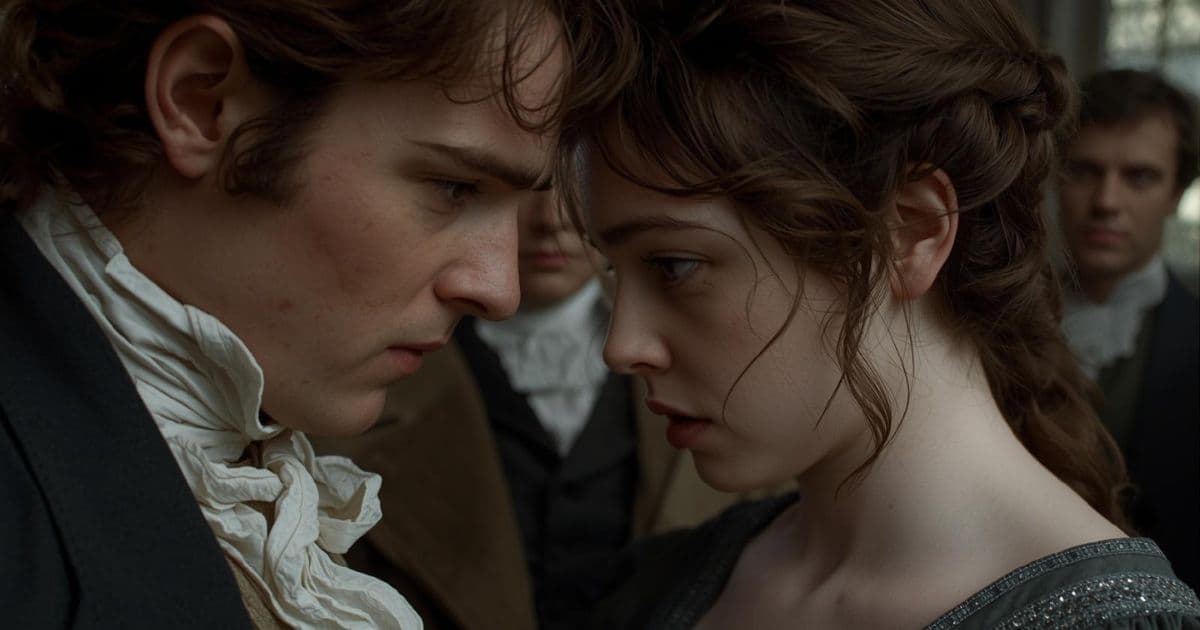
An excerpt from the original text.(complete · 4134 words)
“arriet, poor Harriet!”—Those were the words; in them lay the
tormenting ideas which Emma could not get rid of, and which constituted
the real misery of the business to her. Frank Churchill had behaved
very ill by herself—very ill in many ways,—but it was not so much his
behaviour as her own, which made her so angry with him. It was the
scrape which he had drawn her into on Harriet’s account, that gave the
deepest hue to his offence.—Poor Harriet! to be a second time the dupe
of her misconceptions and flattery. Mr. Knightley had spoken
prophetically, when he once said, “Emma, you have been no friend to
Harriet Smith.”—She was afraid she had done her nothing but
disservice.—It was true that she had not to charge herself, in this
instance as in the former, with being the sole and original author of
the mischief; with having suggested such feelings as might otherwise
never have entered Harriet’s imagination; for Harriet had acknowledged
her admiration and preference of Frank Churchill before she had ever
given her a hint on the subject; but she felt completely guilty of
having encouraged what she might have repressed. She might have
prevented the indulgence and increase of such sentiments. Her influence
would have been enough. And now she was very conscious that she ought
to have prevented them.—She felt that she had been risking her friend’s
happiness on most insufficient grounds. Common sense would have
directed her to tell Harriet, that she must not allow herself to think
of him, and that there were five hundred chances to one against his
ever caring for her.—“But, with common sense,” she added, “I am afraid
I have had little to do.”
She was extremely angry with herself. If she could not have been angry
with Frank Churchill too, it would have been dreadful.—As for Jane
Fairfax, she might at least relieve her feelings from any present
solicitude on her account. Harriet would be anxiety enough; she need no
longer be unhappy about Jane, whose troubles and whose ill-health
having, of course, the same origin, must be equally under cure.—Her
days of insignificance and evil were over.—She would soon be well, and
happy, and prosperous.—Emma could now imagine why her own attentions
had been slighted. This discovery laid many smaller matters open. No
doubt it had been from jealousy.—In Jane’s eyes she had been a rival;
and well might any thing she could offer of assistance or regard be
repulsed. An airing in the Hartfield carriage would have been the rack,
and arrowroot from the Hartfield storeroom must have been poison. She
understood it all; and as far as her mind could disengage itself from
the injustice and selfishness of angry feelings, she acknowledged that
Jane Fairfax would have neither elevation nor happiness beyond her
desert. But poor Harriet was such an engrossing charge! There was
little sympathy to be spared for any body else. Emma was sadly fearful
that this second disappointment would be more severe than the first.
Considering the very superior claims of the object, it ought; and
judging by its apparently stronger effect on Harriet’s mind, producing
reserve and self-command, it would.—She must communicate the painful
truth, however, and as soon as possible. An injunction of secresy had
been among Mr. Weston’s parting words. “For the present, the whole
affair was to be completely a secret. Mr. Churchill had made a point of
it, as a token of respect to the wife he had so very recently lost; and
every body admitted it to be no more than due decorum.”—Emma had
promised; but still Harriet must be excepted. It was her superior duty.
In spite of her vexation, she could not help feeling it almost
ridiculous, that she should have the very same distressing and delicate
office to perform by Harriet, which Mrs. Weston had just gone through
by herself. The intelligence, which had been so anxiously announced to
her, she was now to be anxiously announcing to another. Her heart beat
quick on hearing Harriet’s footstep and voice; so, she supposed, had
poor Mrs. Weston felt when she was approaching Randalls. Could the
event of the disclosure bear an equal resemblance!—But of that,
unfortunately, there could be no chance.
“Well, Miss Woodhouse!” cried Harriet, coming eagerly into the room—“is
not this the oddest news that ever was?”
“What news do you mean?” replied Emma, unable to guess, by look or
voice, whether Harriet could indeed have received any hint.
“About Jane Fairfax. Did you ever hear any thing so strange? Oh!—you
need not be afraid of owning it to me, for Mr. Weston has told me
himself. I met him just now. He told me it was to be a great secret;
and, therefore, I should not think of mentioning it to any body but
you, but he said you knew it.”
“What did Mr. Weston tell you?”—said Emma, still perplexed.
“Oh! he told me all about it; that Jane Fairfax and Mr. Frank Churchill
are to be married, and that they have been privately engaged to one
another this long while. How very odd!”
It was, indeed, so odd; Harriet’s behaviour was so extremely odd, that
Emma did not know how to understand it. Her character appeared
absolutely changed. She seemed to propose shewing no agitation, or
disappointment, or peculiar concern in the discovery. Emma looked at
her, quite unable to speak.
“Had you any idea,” cried Harriet, “of his being in love with her?—You,
perhaps, might.—You (blushing as she spoke) who can see into every
body’s heart; but nobody else—”
“Upon my word,” said Emma, “I begin to doubt my having any such talent.
Can you seriously ask me, Harriet, whether I imagined him attached to
another woman at the very time that I was—tacitly, if not
openly—encouraging you to give way to your own feelings?—I never had
the slightest suspicion, till within the last hour, of Mr. Frank
Churchill’s having the least regard for Jane Fairfax. You may be very
sure that if I had, I should have cautioned you accordingly.”
“Me!” cried Harriet, colouring, and astonished. “Why should you caution
me?—You do not think I care about Mr. Frank Churchill.”
“I am delighted to hear you speak so stoutly on the subject,” replied
Emma, smiling; “but you do not mean to deny that there was a time—and
not very distant either—when you gave me reason to understand that you
did care about him?”
“Him!—never, never. Dear Miss Woodhouse, how could you so mistake me?”
turning away distressed.
“Harriet!” cried Emma, after a moment’s pause—“What do you mean?—Good
Heaven! what do you mean?—Mistake you!—Am I to suppose then?—”
She could not speak another word.—Her voice was lost; and she sat down,
waiting in great terror till Harriet should answer.
Harriet, who was standing at some distance, and with face turned from
her, did not immediately say any thing; and when she did speak, it was
in a voice nearly as agitated as Emma’s.
“I should not have thought it possible,” she began, “that you could
have misunderstood me! I know we agreed never to name him—but
considering how infinitely superior he is to every body else, I should
not have thought it possible that I could be supposed to mean any other
person. Mr. Frank Churchill, indeed! I do not know who would ever look
at him in the company of the other. I hope I have a better taste than
to think of Mr. Frank Churchill, who is like nobody by his side. And
that you should have been so mistaken, is amazing!—I am sure, but for
believing that you entirely approved and meant to encourage me in my
attachment, I should have considered it at first too great a
presumption almost, to dare to think of him. At first, if you had not
told me that more wonderful things had happened; that there had been
matches of greater disparity (those were your very words);—I should not
have dared to give way to—I should not have thought it possible—But if
you, who had been always acquainted with him—”
“Harriet!” cried Emma, collecting herself resolutely—“Let us understand
each other now, without the possibility of farther mistake. Are you
speaking of—Mr. Knightley?”
“To be sure I am. I never could have an idea of any body else—and so I
thought you knew. When we talked about him, it was as clear as
possible.”
“Not quite,” returned Emma, with forced calmness, “for all that you
then said, appeared to me to relate to a different person. I could
almost assert that you had named Mr. Frank Churchill. I am sure the
service Mr. Frank Churchill had rendered you, in protecting you from
the gipsies, was spoken of.”
“Oh! Miss Woodhouse, how you do forget!”
“My dear Harriet, I perfectly remember the substance of what I said on
the occasion. I told you that I did not wonder at your attachment; that
considering the service he had rendered you, it was extremely
natural:—and you agreed to it, expressing yourself very warmly as to
your sense of that service, and mentioning even what your sensations
had been in seeing him come forward to your rescue.—The impression of
it is strong on my memory.”
“Oh, dear,” cried Harriet, “now I recollect what you mean; but I was
thinking of something very different at the time. It was not the
gipsies—it was not Mr. Frank Churchill that I meant. No! (with some
elevation) I was thinking of a much more precious circumstance—of Mr.
Knightley’s coming and asking me to dance, when Mr. Elton would not
stand up with me; and when there was no other partner in the room. That
was the kind action; that was the noble benevolence and generosity;
that was the service which made me begin to feel how superior he was to
every other being upon earth.”
“Good God!” cried Emma, “this has been a most unfortunate—most
deplorable mistake!—What is to be done?”
“You would not have encouraged me, then, if you had understood me? At
least, however, I cannot be worse off than I should have been, if the
other had been the person; and now—it is possible—”
She paused a few moments. Emma could not speak.
“I do not wonder, Miss Woodhouse,” she resumed, “that you should feel a
great difference between the two, as to me or as to any body. You must
think one five hundred million times more above me than the other. But
I hope, Miss Woodhouse, that supposing—that if—strange as it may
appear—. But you know they were your own words, that more wonderful
things had happened, matches of greater disparity had taken place
than between Mr. Frank Churchill and me; and, therefore, it seems as if
such a thing even as this, may have occurred before—and if I should be
so fortunate, beyond expression, as to—if Mr. Knightley should
really—if he does not mind the disparity, I hope, dear Miss
Woodhouse, you will not set yourself against it, and try to put
difficulties in the way. But you are too good for that, I am sure.”
Harriet was standing at one of the windows. Emma turned round to look
at her in consternation, and hastily said,
“Have you any idea of Mr. Knightley’s returning your affection?”
“Yes,” replied Harriet modestly, but not fearfully—“I must say that I
have.”
Emma’s eyes were instantly withdrawn; and she sat silently meditating,
in a fixed attitude, for a few minutes. A few minutes were sufficient
for making her acquainted with her own heart. A mind like hers, once
opening to suspicion, made rapid progress. She touched—she admitted—she
acknowledged the whole truth. Why was it so much worse that Harriet
should be in love with Mr. Knightley, than with Frank Churchill? Why
was the evil so dreadfully increased by Harriet’s having some hope of a
return? It darted through her, with the speed of an arrow, that Mr.
Knightley must marry no one but herself!
Her own conduct, as well as her own heart, was before her in the same
few minutes. She saw it all with a clearness which had never blessed
her before. How improperly had she been acting by Harriet! How
inconsiderate, how indelicate, how irrational, how unfeeling had been
her conduct! What blindness, what madness, had led her on! It struck
her with dreadful force, and she was ready to give it every bad name in
the world. Some portion of respect for herself, however, in spite of
all these demerits—some concern for her own appearance, and a strong
sense of justice by Harriet—(there would be no need of compassion to
the girl who believed herself loved by Mr. Knightley—but justice
required that she should not be made unhappy by any coldness now,) gave
Emma the resolution to sit and endure farther with calmness, with even
apparent kindness.—For her own advantage indeed, it was fit that the
utmost extent of Harriet’s hopes should be enquired into; and Harriet
had done nothing to forfeit the regard and interest which had been so
voluntarily formed and maintained—or to deserve to be slighted by the
person, whose counsels had never led her right.—Rousing from
reflection, therefore, and subduing her emotion, she turned to Harriet
again, and, in a more inviting accent, renewed the conversation; for as
to the subject which had first introduced it, the wonderful story of
Jane Fairfax, that was quite sunk and lost.—Neither of them thought but
of Mr. Knightley and themselves.
Harriet, who had been standing in no unhappy reverie, was yet very glad
to be called from it, by the now encouraging manner of such a judge,
and such a friend as Miss Woodhouse, and only wanted invitation, to
give the history of her hopes with great, though trembling
delight.—Emma’s tremblings as she asked, and as she listened, were
better concealed than Harriet’s, but they were not less. Her voice was
not unsteady; but her mind was in all the perturbation that such a
development of self, such a burst of threatening evil, such a confusion
of sudden and perplexing emotions, must create.—She listened with much
inward suffering, but with great outward patience, to Harriet’s
detail.—Methodical, or well arranged, or very well delivered, it could
not be expected to be; but it contained, when separated from all the
feebleness and tautology of the narration, a substance to sink her
spirit—especially with the corroborating circumstances, which her own
memory brought in favour of Mr. Knightley’s most improved opinion of
Harriet.
Harriet had been conscious of a difference in his behaviour ever since
those two decisive dances.—Emma knew that he had, on that occasion,
found her much superior to his expectation. From that evening, or at
least from the time of Miss Woodhouse’s encouraging her to think of
him, Harriet had begun to be sensible of his talking to her much more
than he had been used to do, and of his having indeed quite a different
manner towards her; a manner of kindness and sweetness!—Latterly she
had been more and more aware of it. When they had been all walking
together, he had so often come and walked by her, and talked so very
delightfully!—He seemed to want to be acquainted with her. Emma knew it
to have been very much the case. She had often observed the change, to
almost the same extent.—Harriet repeated expressions of approbation and
praise from him—and Emma felt them to be in the closest agreement with
what she had known of his opinion of Harriet. He praised her for being
without art or affectation, for having simple, honest, generous,
feelings.—She knew that he saw such recommendations in Harriet; he had
dwelt on them to her more than once.—Much that lived in Harriet’s
memory, many little particulars of the notice she had received from
him, a look, a speech, a removal from one chair to another, a
compliment implied, a preference inferred, had been unnoticed, because
unsuspected, by Emma. Circumstances that might swell to half an hour’s
relation, and contained multiplied proofs to her who had seen them, had
passed undiscerned by her who now heard them; but the two latest
occurrences to be mentioned, the two of strongest promise to Harriet,
were not without some degree of witness from Emma herself.—The first,
was his walking with her apart from the others, in the lime-walk at
Donwell, where they had been walking some time before Emma came, and he
had taken pains (as she was convinced) to draw her from the rest to
himself—and at first, he had talked to her in a more particular way
than he had ever done before, in a very particular way indeed!—(Harriet
could not recall it without a blush.) He seemed to be almost asking
her, whether her affections were engaged.—But as soon as she (Miss
Woodhouse) appeared likely to join them, he changed the subject, and
began talking about farming:—The second, was his having sat talking
with her nearly half an hour before Emma came back from her visit, the
very last morning of his being at Hartfield—though, when he first came
in, he had said that he could not stay five minutes—and his having told
her, during their conversation, that though he must go to London, it
was very much against his inclination that he left home at all, which
was much more (as Emma felt) than he had acknowledged to her. The
superior degree of confidence towards Harriet, which this one article
marked, gave her severe pain.
On the subject of the first of the two circumstances, she did, after a
little reflection, venture the following question. “Might he not?—Is
not it possible, that when enquiring, as you thought, into the state of
your affections, he might be alluding to Mr. Martin—he might have Mr.
Martin’s interest in view? But Harriet rejected the suspicion with
spirit.
“Mr. Martin! No indeed!—There was not a hint of Mr. Martin. I hope I
know better now, than to care for Mr. Martin, or to be suspected of
it.”
When Harriet had closed her evidence, she appealed to her dear Miss
Woodhouse, to say whether she had not good ground for hope.
“I never should have presumed to think of it at first,” said she, “but
for you. You told me to observe him carefully, and let his behaviour be
the rule of mine—and so I have. But now I seem to feel that I may
deserve him; and that if he does chuse me, it will not be any thing so
very wonderful.”
The bitter feelings occasioned by this speech, the many bitter
feelings, made the utmost exertion necessary on Emma’s side, to enable
her to say on reply,
“Harriet, I will only venture to declare, that Mr. Knightley is the
last man in the world, who would intentionally give any woman the idea
of his feeling for her more than he really does.”
Harriet seemed ready to worship her friend for a sentence so
satisfactory; and Emma was only saved from raptures and fondness, which
at that moment would have been dreadful penance, by the sound of her
father’s footsteps. He was coming through the hall. Harriet was too
much agitated to encounter him. “She could not compose herself— Mr.
Woodhouse would be alarmed—she had better go;”—with most ready
encouragement from her friend, therefore, she passed off through
another door—and the moment she was gone, this was the spontaneous
burst of Emma’s feelings: “Oh God! that I had never seen her!”
The rest of the day, the following night, were hardly enough for her
thoughts.—She was bewildered amidst the confusion of all that had
rushed on her within the last few hours. Every moment had brought a
fresh surprize; and every surprize must be matter of humiliation to
her.—How to understand it all! How to understand the deceptions she had
been thus practising on herself, and living under!—The blunders, the
blindness of her own head and heart!—she sat still, she walked about,
she tried her own room, she tried the shrubbery—in every place, every
posture, she perceived that she had acted most weakly; that she had
been imposed on by others in a most mortifying degree; that she had
been imposing on herself in a degree yet more mortifying; that she was
wretched, and should probably find this day but the beginning of
wretchedness.
To understand, thoroughly understand her own heart, was the first
endeavour. To that point went every leisure moment which her father’s
claims on her allowed, and every moment of involuntary absence of mind.
How long had Mr. Knightley been so dear to her, as every feeling
declared him now to be? When had his influence, such influence begun?—
When had he succeeded to that place in her affection, which Frank
Churchill had once, for a short period, occupied?—She looked back; she
compared the two—compared them, as they had always stood in her
estimation, from the time of the latter’s becoming known to her—and as
they must at any time have been compared by her, had it—oh! had it, by
any blessed felicity, occurred to her, to institute the comparison.—She
saw that there never had been a time when she did not consider Mr.
Knightley as infinitely the superior, or when his regard for her had
not been infinitely the most dear. She saw, that in persuading herself,
in fancying, in acting to the contrary, she had been entirely under a
delusion, totally ignorant of her own heart—and, in short, that she had
never really cared for Frank Churchill at all!
This was the conclusion of the first series of reflection. This was the
knowledge of herself, on the first question of inquiry, which she
reached; and without being long in reaching it.—She was most
sorrowfully indignant; ashamed of every sensation but the one revealed
to her—her affection for Mr. Knightley.—Every other part of her mind
was disgusting.
With insufferable vanity had she believed herself in the secret of
every body’s feelings; with unpardonable arrogance proposed to arrange
every body’s destiny. She was proved to have been universally mistaken;
and she had not quite done nothing—for she had done mischief. She had
brought evil on Harriet, on herself, and she too much feared, on Mr.
Knightley.—Were this most unequal of all connexions to take place, on
her must rest all the reproach of having given it a beginning; for his
attachment, she must believe to be produced only by a consciousness of
Harriet’s;—and even were this not the case, he would never have known
Harriet at all but for her folly.
Mr. Knightley and Harriet Smith!—It was a union to distance every
wonder of the kind.—The attachment of Frank Churchill and Jane Fairfax
became commonplace, threadbare, stale in the comparison, exciting no
surprize, presenting no disparity, affording nothing to be said or
thought.—Mr. Knightley and Harriet Smith!—Such an elevation on her
side! Such a debasement on his! It was horrible to Emma to think how it
must sink him in the general opinion, to foresee the smiles, the
sneers, the merriment it would prompt at his expense; the mortification
and disdain of his brother, the thousand inconveniences to
himself.—Could it be?—No; it was impossible. And yet it was far, very
far, from impossible.—Was it a new circumstance for a man of first-rate
abilities to be captivated by very inferior powers? Was it new for one,
perhaps too busy to seek, to be the prize of a girl who would seek
him?—Was it new for any thing in this world to be unequal,
inconsistent, incongruous—or for chance and circumstance (as second
causes) to direct the human fate?
Oh! had she never brought Harriet forward! Had she left her where she
ought, and where he had told her she ought!—Had she not, with a folly
which no tongue could express, prevented her marrying the
unexceptionable young man who would have made her happy and respectable
in the line of life to which she ought to belong—all would have been
safe; none of this dreadful sequel would have been.
How Harriet could ever have had the presumption to raise her thoughts
to Mr. Knightley!—How she could dare to fancy herself the chosen of
such a man till actually assured of it!—But Harriet was less humble,
had fewer scruples than formerly.—Her inferiority, whether of mind or
situation, seemed little felt.—She had seemed more sensible of Mr.
Elton’s being to stoop in marrying her, than she now seemed of Mr.
Knightley’s.—Alas! was not that her own doing too? Who had been at
pains to give Harriet notions of self-consequence but herself?—Who but
herself had taught her, that she was to elevate herself if possible,
and that her claims were great to a high worldly establishment?—If
Harriet, from being humble, were grown vain, it was her doing too.
Master this chapter. Complete your experience
Purchase the complete book to access all chapters and support classic literature
As an Amazon Associate, we earn a small commission from qualifying purchases at no additional cost to you.
Available in paperback, hardcover, and e-book formats
Let's Analyse the Pattern
The more confident we become in our abilities, the more likely we are to miss crucial information in our area of supposed expertise.
Why This Matters
Connect literature to life
This chapter teaches how past success in reading people can make you stop actually looking at what's happening now.
Practice This Today
This week, notice when you feel most confident about understanding someone's motivations, then ask one clarifying question before acting on your assumptions.
Now let's explore the literary elements.
Key Quotes & Analysis
"Harriet, poor Harriet!"
Context: Emma's first thoughts as she processes the full scope of her mistakes
This repetition shows Emma's guilt and horror at realizing she's hurt her friend twice through meddling. The exclamation reveals genuine remorse rather than self-pity.
In Today's Words:
Oh God, what have I done to my friend?
"Emma, you have been no friend to Harriet Smith."
Context: Emma recalls Knightley's earlier warning about her influence on Harriet
This memory hits Emma like a slap because she now sees he was completely right. It shows how wisdom often comes disguised as criticism we don't want to hear.
In Today's Words:
You're not helping her, you're hurting her.
"She felt that she had been risking her friend's happiness on most insufficient grounds."
Context: Emma's realization about her reckless matchmaking
This captures the moment Emma understands she's been playing with people's lives based on assumptions rather than facts. It's about taking responsibility for the consequences of your actions.
In Today's Words:
She realized she'd been gambling with her friend's heart for no good reason.
Thematic Threads
Self-Knowledge
In This Chapter
Emma discovers she's been completely wrong about her own feelings and motivations
Development
Culmination of her journey from false confidence to genuine self-awareness
In Your Life:
You might realize you've been pursuing goals that aren't actually yours, or avoiding what you really want.
Class
In This Chapter
Emma's horror at encouraging Harriet to aim above her station comes crashing down
Development
Her casual class manipulation finally shows its real consequences
In Your Life:
You might catch yourself making assumptions about who belongs where based on background or education.
Control
In This Chapter
Emma's need to orchestrate everyone's lives backfires spectacularly
Development
Her controlling tendencies reach their breaking point with devastating results
In Your Life:
You might recognize how your helpful advice or matchmaking actually serves your need to feel important.
Recognition
In This Chapter
The painful moment when Emma finally sees clearly what was always there
Development
The climax of her gradual awakening to reality throughout the novel
In Your Life:
You might have that awful moment when you realize you've been completely misreading a situation for months or years.
You now have the context. Time to form your own thoughts.
Discussion Questions
- 1
What shocking discovery does Emma make about Harriet's feelings, and how did this misunderstanding happen?
analysis • surface - 2
Why didn't Emma realize she was in love with Mr. Knightley until she thought she might lose him?
analysis • medium - 3
Where do you see people making assumptions instead of asking clarifying questions in your daily life?
application • medium - 4
When have you been so confident in your understanding of a situation that you stopped actually paying attention to what was really happening?
reflection • deep - 5
What does Emma's expertise blindness teach us about the relationship between confidence and accuracy?
reflection • deep
Critical Thinking Exercise
Check Your Assumptions
Think of a current situation where you feel very confident about what someone else is thinking or feeling. Write down three assumptions you're making about their motivations or emotions. Then, for each assumption, write one specific question you could ask to verify whether you're right. This exercise helps you catch expertise blindness before it causes problems.
Consider:
- •Focus on situations where the stakes matter - relationships, work conflicts, family dynamics
- •Notice how confident you feel versus how much you've actually verified
- •Pay attention to areas where your past experience might be filling in gaps
Journaling Prompt
Write about a time when you were completely wrong about what someone was thinking or feeling. What assumptions led you astray, and what questions could have prevented the misunderstanding?
Coming Up Next...
Chapter 48: The Fear of Losing What You Never Knew You Had
With her heart finally revealed to herself, Emma must now face the terrifying possibility that she may have lost Mr. Knightley forever through her own meddling. How can she undo the damage she's caused?