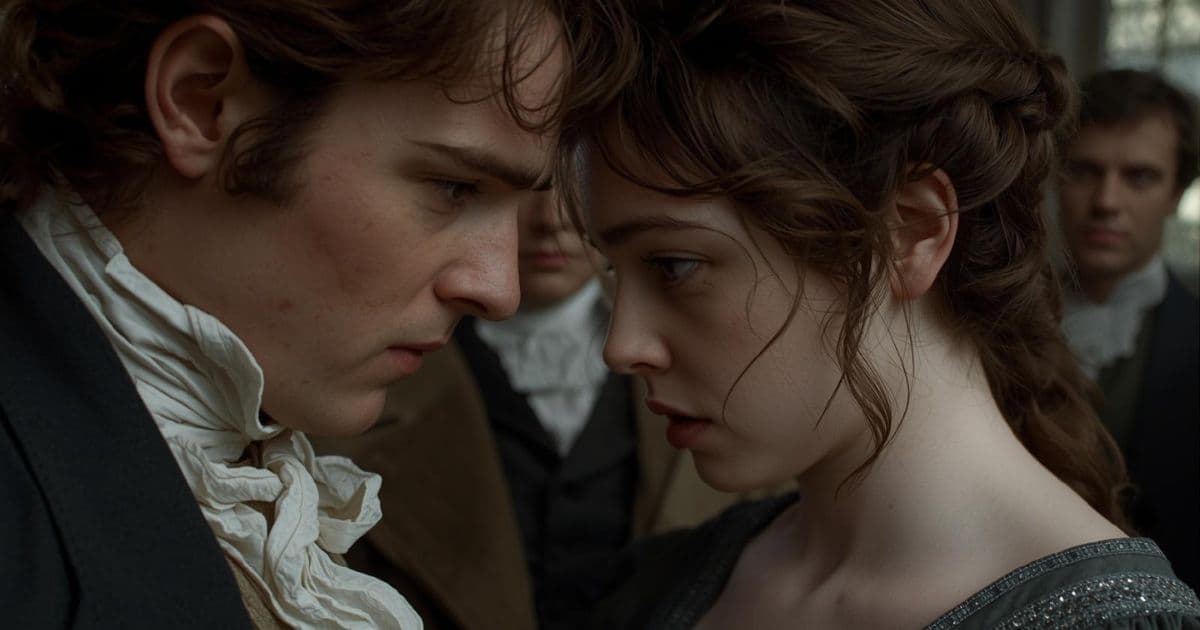
An excerpt from the original text.(complete · 3077 words)
ne morning, about ten days after Mrs. Churchill’s decease, Emma was
called downstairs to Mr. Weston, who “could not stay five minutes, and
wanted particularly to speak with her.”—He met her at the parlour-door,
and hardly asking her how she did, in the natural key of his voice,
sunk it immediately, to say, unheard by her father,
“Can you come to Randalls at any time this morning?—Do, if it be
possible. Mrs. Weston wants to see you. She must see you.”
“Is she unwell?”
“No, no, not at all—only a little agitated. She would have ordered the
carriage, and come to you, but she must see you alone, and that you
know—(nodding towards her father)—Humph!—Can you come?”
“Certainly. This moment, if you please. It is impossible to refuse what
you ask in such a way. But what can be the matter?—Is she really not
ill?”
“Depend upon me—but ask no more questions. You will know it all in
time. The most unaccountable business! But hush, hush!”
To guess what all this meant, was impossible even for Emma. Something
really important seemed announced by his looks; but, as her friend was
well, she endeavoured not to be uneasy, and settling it with her
father, that she would take her walk now, she and Mr. Weston were soon
out of the house together and on their way at a quick pace for
Randalls.
“Now,”—said Emma, when they were fairly beyond the sweep gates,—“now
Mr. Weston, do let me know what has happened.”
“No, no,”—he gravely replied.—“Don’t ask me. I promised my wife to
leave it all to her. She will break it to you better than I can. Do not
be impatient, Emma; it will all come out too soon.”
“Break it to me,” cried Emma, standing still with terror.—“Good
God!—Mr. Weston, tell me at once.—Something has happened in Brunswick
Square. I know it has. Tell me, I charge you tell me this moment what
it is.”
“No, indeed you are mistaken.”—
“Mr. Weston do not trifle with me.—Consider how many of my dearest
friends are now in Brunswick Square. Which of them is it?—I charge you
by all that is sacred, not to attempt concealment.”
“Upon my word, Emma.”—
“Your word!—why not your honour!—why not say upon your honour, that it
has nothing to do with any of them? Good Heavens!—What can be to be
broke to me, that does not relate to one of that family?”
“Upon my honour,” said he very seriously, “it does not. It is not in
the smallest degree connected with any human being of the name of
Knightley.”
Emma’s courage returned, and she walked on.
“I was wrong,” he continued, “in talking of its being broke to you. I
should not have used the expression. In fact, it does not concern
you—it concerns only myself,—that is, we hope.—Humph!—In short, my dear
Emma, there is no occasion to be so uneasy about it. I don’t say that
it is not a disagreeable business—but things might be much worse.—If we
walk fast, we shall soon be at Randalls.”
Emma found that she must wait; and now it required little effort. She
asked no more questions therefore, merely employed her own fancy, and
that soon pointed out to her the probability of its being some money
concern—something just come to light, of a disagreeable nature in the
circumstances of the family,—something which the late event at Richmond
had brought forward. Her fancy was very active. Half a dozen natural
children, perhaps—and poor Frank cut off!—This, though very
undesirable, would be no matter of agony to her. It inspired little
more than an animating curiosity.
“Who is that gentleman on horseback?” said she, as they
proceeded—speaking more to assist Mr. Weston in keeping his secret,
than with any other view.
“I do not know.—One of the Otways.—Not Frank;—it is not Frank, I assure
you. You will not see him. He is half way to Windsor by this time.”
“Has your son been with you, then?”
“Oh! yes—did not you know?—Well, well, never mind.”
For a moment he was silent; and then added, in a tone much more guarded
and demure,
“Yes, Frank came over this morning, just to ask us how we did.”
They hurried on, and were speedily at Randalls.—“Well, my dear,” said
he, as they entered the room—“I have brought her, and now I hope you
will soon be better. I shall leave you together. There is no use in
delay. I shall not be far off, if you want me.”—And Emma distinctly
heard him add, in a lower tone, before he quitted the room,—“I have
been as good as my word. She has not the least idea.”
Mrs. Weston was looking so ill, and had an air of so much perturbation,
that Emma’s uneasiness increased; and the moment they were alone, she
eagerly said,
“What is it my dear friend? Something of a very unpleasant nature, I
find, has occurred;—do let me know directly what it is. I have been
walking all this way in complete suspense. We both abhor suspense. Do
not let mine continue longer. It will do you good to speak of your
distress, whatever it may be.”
“Have you indeed no idea?” said Mrs. Weston in a trembling voice.
“Cannot you, my dear Emma—cannot you form a guess as to what you are to
hear?”
“So far as that it relates to Mr. Frank Churchill, I do guess.”
“You are right. It does relate to him, and I will tell you directly;”
(resuming her work, and seeming resolved against looking up.) “He has
been here this very morning, on a most extraordinary errand. It is
impossible to express our surprize. He came to speak to his father on a
subject,—to announce an attachment—”
She stopped to breathe. Emma thought first of herself, and then of
Harriet.
“More than an attachment, indeed,” resumed Mrs. Weston; “an
engagement—a positive engagement.—What will you say, Emma—what will any
body say, when it is known that Frank Churchill and Miss Fairfax are
engaged;—nay, that they have been long engaged!”
Emma even jumped with surprize;—and, horror-struck, exclaimed,
“Jane Fairfax!—Good God! You are not serious? You do not mean it?”
“You may well be amazed,” returned Mrs. Weston, still averting her
eyes, and talking on with eagerness, that Emma might have time to
recover— “You may well be amazed. But it is even so. There has been a
solemn engagement between them ever since October—formed at Weymouth,
and kept a secret from every body. Not a creature knowing it but
themselves—neither the Campbells, nor her family, nor his.—It is so
wonderful, that though perfectly convinced of the fact, it is yet
almost incredible to myself. I can hardly believe it.—I thought I knew
him.”
Emma scarcely heard what was said.—Her mind was divided between two
ideas—her own former conversations with him about Miss Fairfax; and
poor Harriet;—and for some time she could only exclaim, and require
confirmation, repeated confirmation.
“Well,” said she at last, trying to recover herself; “this is a
circumstance which I must think of at least half a day, before I can at
all comprehend it. What!—engaged to her all the winter—before either of
them came to Highbury?”
“Engaged since October,—secretly engaged.—It has hurt me, Emma, very
much. It has hurt his father equally. Some part of his conduct we
cannot excuse.”
Emma pondered a moment, and then replied, “I will not pretend not to
understand you; and to give you all the relief in my power, be assured
that no such effect has followed his attentions to me, as you are
apprehensive of.”
Mrs. Weston looked up, afraid to believe; but Emma’s countenance was as
steady as her words.
“That you may have less difficulty in believing this boast, of my
present perfect indifference,” she continued, “I will farther tell you,
that there was a period in the early part of our acquaintance, when I
did like him, when I was very much disposed to be attached to him—nay,
was attached—and how it came to cease, is perhaps the wonder.
Fortunately, however, it did cease. I have really for some time past,
for at least these three months, cared nothing about him. You may
believe me, Mrs. Weston. This is the simple truth.”
Mrs. Weston kissed her with tears of joy; and when she could find
utterance, assured her, that this protestation had done her more good
than any thing else in the world could do.
“Mr. Weston will be almost as much relieved as myself,” said she. “On
this point we have been wretched. It was our darling wish that you
might be attached to each other—and we were persuaded that it was so.—
Imagine what we have been feeling on your account.”
“I have escaped; and that I should escape, may be a matter of grateful
wonder to you and myself. But this does not acquit him, Mrs. Weston;
and I must say, that I think him greatly to blame. What right had he to
come among us with affection and faith engaged, and with manners so
very disengaged? What right had he to endeavour to please, as he
certainly did—to distinguish any one young woman with persevering
attention, as he certainly did—while he really belonged to another?—How
could he tell what mischief he might be doing?—How could he tell that
he might not be making me in love with him?—very wrong, very wrong
indeed.”
“From something that he said, my dear Emma, I rather imagine—”
“And how could she bear such behaviour! Composure with a witness! to
look on, while repeated attentions were offering to another woman,
before her face, and not resent it.—That is a degree of placidity,
which I can neither comprehend nor respect.”
“There were misunderstandings between them, Emma; he said so expressly.
He had not time to enter into much explanation. He was here only a
quarter of an hour, and in a state of agitation which did not allow the
full use even of the time he could stay—but that there had been
misunderstandings he decidedly said. The present crisis, indeed, seemed
to be brought on by them; and those misunderstandings might very
possibly arise from the impropriety of his conduct.”
“Impropriety! Oh! Mrs. Weston—it is too calm a censure. Much, much
beyond impropriety!—It has sunk him, I cannot say how it has sunk him
in my opinion. So unlike what a man should be!—None of that upright
integrity, that strict adherence to truth and principle, that disdain
of trick and littleness, which a man should display in every
transaction of his life.”
“Nay, dear Emma, now I must take his part; for though he has been wrong
in this instance, I have known him long enough to answer for his having
many, very many, good qualities; and—”
“Good God!” cried Emma, not attending to her.—“Mrs. Smallridge, too!
Jane actually on the point of going as governess! What could he mean by
such horrible indelicacy? To suffer her to engage herself—to suffer her
even to think of such a measure!”
“He knew nothing about it, Emma. On this article I can fully acquit
him. It was a private resolution of hers, not communicated to him—or at
least not communicated in a way to carry conviction.—Till yesterday, I
know he said he was in the dark as to her plans. They burst on him, I
do not know how, but by some letter or message—and it was the discovery
of what she was doing, of this very project of hers, which determined
him to come forward at once, own it all to his uncle, throw himself on
his kindness, and, in short, put an end to the miserable state of
concealment that had been carrying on so long.”
Emma began to listen better.
“I am to hear from him soon,” continued Mrs. Weston. “He told me at
parting, that he should soon write; and he spoke in a manner which
seemed to promise me many particulars that could not be given now. Let
us wait, therefore, for this letter. It may bring many extenuations. It
may make many things intelligible and excusable which now are not to be
understood. Don’t let us be severe, don’t let us be in a hurry to
condemn him. Let us have patience. I must love him; and now that I am
satisfied on one point, the one material point, I am sincerely anxious
for its all turning out well, and ready to hope that it may. They must
both have suffered a great deal under such a system of secresy and
concealment.”
“His sufferings,” replied Emma dryly, “do not appear to have done him
much harm. Well, and how did Mr. Churchill take it?”
“Most favourably for his nephew—gave his consent with scarcely a
difficulty. Conceive what the events of a week have done in that
family! While poor Mrs. Churchill lived, I suppose there could not have
been a hope, a chance, a possibility;—but scarcely are her remains at
rest in the family vault, than her husband is persuaded to act exactly
opposite to what she would have required. What a blessing it is, when
undue influence does not survive the grave!—He gave his consent with
very little persuasion.”
“Ah!” thought Emma, “he would have done as much for Harriet.”
“This was settled last night, and Frank was off with the light this
morning. He stopped at Highbury, at the Bates’s, I fancy, some time—and
then came on hither; but was in such a hurry to get back to his uncle,
to whom he is just now more necessary than ever, that, as I tell you,
he could stay with us but a quarter of an hour.—He was very much
agitated—very much, indeed—to a degree that made him appear quite a
different creature from any thing I had ever seen him before.—In
addition to all the rest, there had been the shock of finding her so
very unwell, which he had had no previous suspicion of—and there was
every appearance of his having been feeling a great deal.”
“And do you really believe the affair to have been carrying on with
such perfect secresy?—The Campbells, the Dixons, did none of them know
of the engagement?”
Emma could not speak the name of Dixon without a little blush.
“None; not one. He positively said that it had been known to no being
in the world but their two selves.”
“Well,” said Emma, “I suppose we shall gradually grow reconciled to the
idea, and I wish them very happy. But I shall always think it a very
abominable sort of proceeding. What has it been but a system of
hypocrisy and deceit,—espionage, and treachery?—To come among us with
professions of openness and simplicity; and such a league in secret to
judge us all!—Here have we been, the whole winter and spring,
completely duped, fancying ourselves all on an equal footing of truth
and honour, with two people in the midst of us who may have been
carrying round, comparing and sitting in judgment on sentiments and
words that were never meant for both to hear.—They must take the
consequence, if they have heard each other spoken of in a way not
perfectly agreeable!”
“I am quite easy on that head,” replied Mrs. Weston. “I am very sure
that I never said any thing of either to the other, which both might
not have heard.”
“You are in luck.—Your only blunder was confined to my ear, when you
imagined a certain friend of ours in love with the lady.”
“True. But as I have always had a thoroughly good opinion of Miss
Fairfax, I never could, under any blunder, have spoken ill of her; and
as to speaking ill of him, there I must have been safe.”
At this moment Mr. Weston appeared at a little distance from the
window, evidently on the watch. His wife gave him a look which invited
him in; and, while he was coming round, added, “Now, dearest Emma, let
me intreat you to say and look every thing that may set his heart at
ease, and incline him to be satisfied with the match. Let us make the
best of it—and, indeed, almost every thing may be fairly said in her
favour. It is not a connexion to gratify; but if Mr. Churchill does not
feel that, why should we? and it may be a very fortunate circumstance
for him, for Frank, I mean, that he should have attached himself to a
girl of such steadiness of character and good judgment as I have always
given her credit for—and still am disposed to give her credit for, in
spite of this one great deviation from the strict rule of right. And
how much may be said in her situation for even that error!”
“Much, indeed!” cried Emma feelingly. “If a woman can ever be excused
for thinking only of herself, it is in a situation like Jane
Fairfax’s.—Of such, one may almost say, that ‘the world is not their’s,
nor the world’s law.’”
She met Mr. Weston on his entrance, with a smiling countenance,
exclaiming,
“A very pretty trick you have been playing me, upon my word! This was a
device, I suppose, to sport with my curiosity, and exercise my talent
of guessing. But you really frightened me. I thought you had lost half
your property, at least. And here, instead of its being a matter of
condolence, it turns out to be one of congratulation.—I congratulate
you, Mr. Weston, with all my heart, on the prospect of having one of
the most lovely and accomplished young women in England for your
daughter.”
A glance or two between him and his wife, convinced him that all was as
right as this speech proclaimed; and its happy effect on his spirits
was immediate. His air and voice recovered their usual briskness: he
shook her heartily and gratefully by the hand, and entered on the
subject in a manner to prove, that he now only wanted time and
persuasion to think the engagement no very bad thing. His companions
suggested only what could palliate imprudence, or smooth objections;
and by the time they had talked it all over together, and he had talked
it all over again with Emma, in their walk back to Hartfield, he was
become perfectly reconciled, and not far from thinking it the very best
thing that Frank could possibly have done.
Master this chapter. Complete your experience
Purchase the complete book to access all chapters and support classic literature
As an Amazon Associate, we earn a small commission from qualifying purchases at no additional cost to you.
Available in paperback, hardcover, and e-book formats
Let's Analyse the Pattern
When someone maintains a false front while pursuing secret goals, exploiting others' trust and honest expectations.
Why This Matters
Connect literature to life
This chapter teaches how to recognize when someone has crucial information they're deliberately withholding while using your ignorance to their advantage.
Practice This Today
This week, notice when someone seems to know more about a situation than they're letting on—watch for inside jokes, knowing looks, or conversations that stop when you approach.
Now let's explore the literary elements.
Key Quotes & Analysis
"The most unaccountable business!"
Context: He's trying to prepare Emma for shocking news without giving it away
Shows how completely unexpected Frank's secret engagement is to everyone. Even his own father can't make sense of how this happened under everyone's noses.
In Today's Words:
This whole thing is completely crazy and makes no sense!
"She must see you alone"
Context: Explaining why Mrs. Weston needs privacy to tell Emma the news
Reveals this is personal, potentially hurtful information that requires careful handling. The secrecy shows they know this will be a shock to Emma's system.
In Today's Words:
This is sensitive stuff that needs to be handled privately.
"Something really important seemed announced by his looks"
Context: Emma trying to read Mr. Weston's expression and body language
Shows how we pick up on emotional cues even when people try to hide them. Emma knows something major is happening before she knows what it is.
In Today's Words:
You could tell from his face that something big was going down.
Thematic Threads
Deception
In This Chapter
Frank's elaborate charade of flirting with Emma while secretly engaged to Jane reveals the damage of calculated dishonesty
Development
Escalated from earlier social white lies to full-scale manipulation with real emotional consequences
In Your Life:
You might recognize this when someone's words consistently don't match their actions over time.
Class
In This Chapter
Frank's privilege allows him to play games without consequences while Jane faces real risks to her future security
Development
Continued exploration of how social position determines who can afford to take risks and who bears the costs
In Your Life:
You see this when wealthy people make 'mistakes' that would destroy your life but barely inconvenience theirs.
Personal Growth
In This Chapter
Emma handles the shocking revelation with grace while internally processing her anger and sense of being manipulated
Development
Shows Emma's increasing emotional maturity and ability to manage complex social situations
In Your Life:
You experience this when you learn to respond thoughtfully rather than reactively to upsetting news.
Social Expectations
In This Chapter
The engagement was hidden because it violated social norms about family approval and proper courtship procedures
Development
Continued examination of how social rules can be bent by those with power while constraining others
In Your Life:
You might notice this when workplace 'rules' seem to apply differently depending on who's breaking them.
Identity
In This Chapter
Emma must reconcile her self-image as perceptive with the reality that she completely misread the situation
Development
Ongoing theme of Emma confronting gaps between her self-perception and actual abilities
In Your Life:
You face this when you discover you've been wrong about something you felt confident understanding.
You now have the context. Time to form your own thoughts.
Discussion Questions
- 1
What shocking news does Emma learn about Frank Churchill and Jane Fairfax, and how long has this situation been going on?
analysis • surface - 2
Why was Frank able to carry on this deception while Jane had to endure it? What does this reveal about their different positions in society?
analysis • medium - 3
Where do you see people today maintaining friendly facades while pursuing hidden agendas? Think about workplace dynamics, family relationships, or dating situations.
application • medium - 4
What warning signs might help you identify when someone is playing games versus being genuine? How would you protect yourself without becoming paranoid?
application • deep - 5
Emma feels foolish for missing obvious clues, but was she really naive or was Frank skilled at manipulation? What does this teach us about trust and deception?
reflection • deep
Critical Thinking Exercise
Decode the Performance
Think of a situation where you later realized someone had a hidden agenda. Map out what they said versus what they actually wanted. Then identify three specific warning signs you could watch for in future interactions to spot this pattern earlier.
Consider:
- •Focus on the gap between words and actions, not just your hurt feelings
- •Consider what the person gained by keeping their real motives hidden
- •Think about power dynamics - who had more to lose if the truth came out?
Journaling Prompt
Write about a time when you discovered someone close to you had been less than honest about their intentions. How did you handle it, and what would you do differently now?
Coming Up Next...
Chapter 47: The Truth About Hearts
With Frank's secret out, Emma must face an even more painful realization about the damage his deception has caused. Someone else's heart hangs in the balance, and Emma bears responsibility for the pain that's coming.