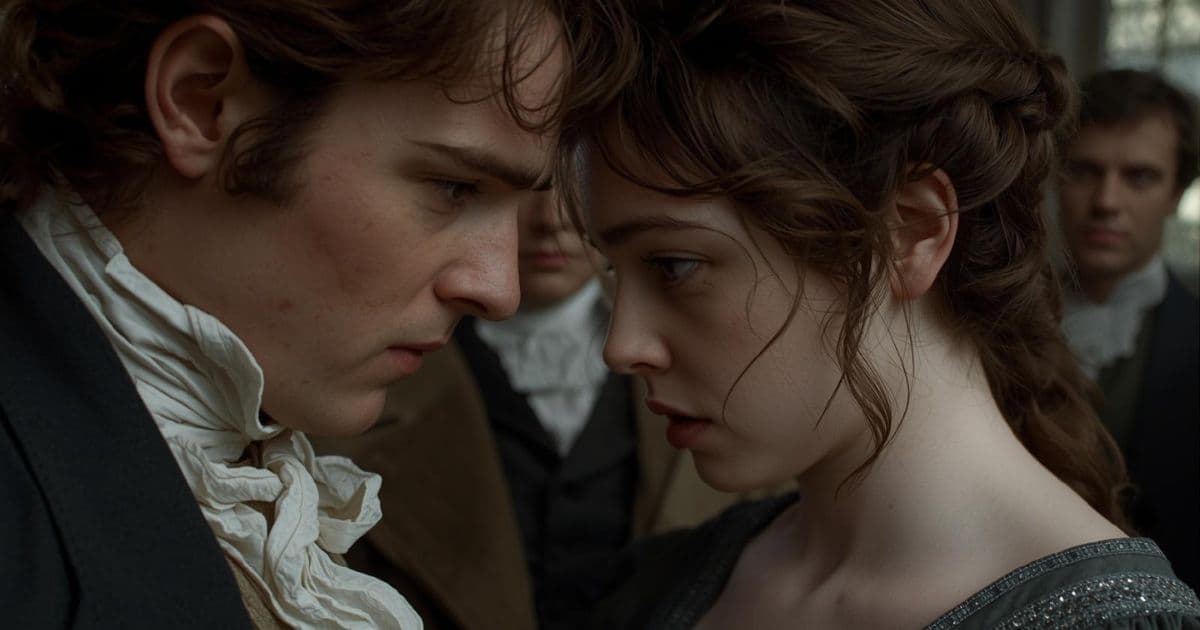
An excerpt from the original text.(complete · 2992 words)
mma and Harriet had been walking together one morning, and, in Emma’s
opinion, had been talking enough of Mr. Elton for that day. She could
not think that Harriet’s solace or her own sins required more; and she
was therefore industriously getting rid of the subject as they
returned;—but it burst out again when she thought she had succeeded,
and after speaking some time of what the poor must suffer in winter,
and receiving no other answer than a very plaintive—“Mr. Elton is so
good to the poor!” she found something else must be done.
They were just approaching the house where lived Mrs. and Miss Bates.
She determined to call upon them and seek safety in numbers. There was
always sufficient reason for such an attention; Mrs. and Miss Bates
loved to be called on, and she knew she was considered by the very few
who presumed ever to see imperfection in her, as rather negligent in
that respect, and as not contributing what she ought to the stock of
their scanty comforts.
She had had many a hint from Mr. Knightley and some from her own heart,
as to her deficiency—but none were equal to counteract the persuasion
of its being very disagreeable,—a waste of time—tiresome women—and all
the horror of being in danger of falling in with the second-rate and
third-rate of Highbury, who were calling on them for ever, and
therefore she seldom went near them. But now she made the sudden
resolution of not passing their door without going in—observing, as she
proposed it to Harriet, that, as well as she could calculate, they were
just now quite safe from any letter from Jane Fairfax.
The house belonged to people in business. Mrs. and Miss Bates occupied
the drawing-room floor; and there, in the very moderate-sized
apartment, which was every thing to them, the visitors were most
cordially and even gratefully welcomed; the quiet neat old lady, who
with her knitting was seated in the warmest corner, wanting even to
give up her place to Miss Woodhouse, and her more active, talking
daughter, almost ready to overpower them with care and kindness, thanks
for their visit, solicitude for their shoes, anxious inquiries after
Mr. Woodhouse’s health, cheerful communications about her mother’s, and
sweet-cake from the beaufet—“Mrs. Cole had just been there, just called
in for ten minutes, and had been so good as to sit an hour with them,
and she had taken a piece of cake and been so kind as to say she
liked it very much; and, therefore, she hoped Miss Woodhouse and Miss
Smith would do them the favour to eat a piece too.”
The mention of the Coles was sure to be followed by that of Mr. Elton.
There was intimacy between them, and Mr. Cole had heard from Mr. Elton
since his going away. Emma knew what was coming; they must have the
letter over again, and settle how long he had been gone, and how much
he was engaged in company, and what a favourite he was wherever he
went, and how full the Master of the Ceremonies’ ball had been; and she
went through it very well, with all the interest and all the
commendation that could be requisite, and always putting forward to
prevent Harriet’s being obliged to say a word.
This she had been prepared for when she entered the house; but meant,
having once talked him handsomely over, to be no farther incommoded by
any troublesome topic, and to wander at large amongst all the
Mistresses and Misses of Highbury, and their card-parties. She had not
been prepared to have Jane Fairfax succeed Mr. Elton; but he was
actually hurried off by Miss Bates, she jumped away from him at last
abruptly to the Coles, to usher in a letter from her niece.
“Oh! yes—Mr. Elton, I understand—certainly as to dancing—Mrs. Cole was
telling me that dancing at the rooms at Bath was—Mrs. Cole was so kind
as to sit some time with us, talking of Jane; for as soon as she came
in, she began inquiring after her, Jane is so very great a favourite
there. Whenever she is with us, Mrs. Cole does not know how to shew her
kindness enough; and I must say that Jane deserves it as much as any
body can. And so she began inquiring after her directly, saying, ‘I
know you cannot have heard from Jane lately, because it is not her time
for writing;’ and when I immediately said, ‘But indeed we have, we had
a letter this very morning,’ I do not know that I ever saw any body
more surprized. ‘Have you, upon your honour?’ said she; ‘well, that is
quite unexpected. Do let me hear what she says.’”
Emma’s politeness was at hand directly, to say, with smiling interest—
“Have you heard from Miss Fairfax so lately? I am extremely happy. I
hope she is well?”
“Thank you. You are so kind!” replied the happily deceived aunt, while
eagerly hunting for the letter.—“Oh! here it is. I was sure it could
not be far off; but I had put my huswife upon it, you see, without
being aware, and so it was quite hid, but I had it in my hand so very
lately that I was almost sure it must be on the table. I was reading it
to Mrs. Cole, and since she went away, I was reading it again to my
mother, for it is such a pleasure to her—a letter from Jane—that she
can never hear it often enough; so I knew it could not be far off, and
here it is, only just under my huswife—and since you are so kind as to
wish to hear what she says;—but, first of all, I really must, in
justice to Jane, apologise for her writing so short a letter—only two
pages you see—hardly two—and in general she fills the whole paper and
crosses half. My mother often wonders that I can make it out so well.
She often says, when the letter is first opened, ‘Well, Hetty, now I
think you will be put to it to make out all that checker-work’—don’t
you, ma’am?—And then I tell her, I am sure she would contrive to make
it out herself, if she had nobody to do it for her—every word of it—I
am sure she would pore over it till she had made out every word. And,
indeed, though my mother’s eyes are not so good as they were, she can
see amazingly well still, thank God! with the help of spectacles. It is
such a blessing! My mother’s are really very good indeed. Jane often
says, when she is here, ‘I am sure, grandmama, you must have had very
strong eyes to see as you do—and so much fine work as you have done
too!—I only wish my eyes may last me as well.’”
All this spoken extremely fast obliged Miss Bates to stop for breath;
and Emma said something very civil about the excellence of Miss
Fairfax’s handwriting.
“You are extremely kind,” replied Miss Bates, highly gratified; “you
who are such a judge, and write so beautifully yourself. I am sure
there is nobody’s praise that could give us so much pleasure as Miss
Woodhouse’s. My mother does not hear; she is a little deaf you know.
Ma’am,” addressing her, “do you hear what Miss Woodhouse is so obliging
to say about Jane’s handwriting?”
And Emma had the advantage of hearing her own silly compliment repeated
twice over before the good old lady could comprehend it. She was
pondering, in the meanwhile, upon the possibility, without seeming very
rude, of making her escape from Jane Fairfax’s letter, and had almost
resolved on hurrying away directly under some slight excuse, when Miss
Bates turned to her again and seized her attention.
“My mother’s deafness is very trifling you see—just nothing at all. By
only raising my voice, and saying any thing two or three times over,
she is sure to hear; but then she is used to my voice. But it is very
remarkable that she should always hear Jane better than she does me.
Jane speaks so distinct! However, she will not find her grandmama at
all deafer than she was two years ago; which is saying a great deal at
my mother’s time of life—and it really is full two years, you know,
since she was here. We never were so long without seeing her before,
and as I was telling Mrs. Cole, we shall hardly know how to make enough
of her now.”
“Are you expecting Miss Fairfax here soon?”
“Oh yes; next week.”
“Indeed!—that must be a very great pleasure.”
“Thank you. You are very kind. Yes, next week. Every body is so
surprized; and every body says the same obliging things. I am sure she
will be as happy to see her friends at Highbury, as they can be to see
her. Yes, Friday or Saturday; she cannot say which, because Colonel
Campbell will be wanting the carriage himself one of those days. So
very good of them to send her the whole way! But they always do, you
know. Oh yes, Friday or Saturday next. That is what she writes about.
That is the reason of her writing out of rule, as we call it; for, in
the common course, we should not have heard from her before next
Tuesday or Wednesday.”
“Yes, so I imagined. I was afraid there could be little chance of my
hearing any thing of Miss Fairfax to-day.”
“So obliging of you! No, we should not have heard, if it had not been
for this particular circumstance, of her being to come here so soon. My
mother is so delighted!—for she is to be three months with us at least.
Three months, she says so, positively, as I am going to have the
pleasure of reading to you. The case is, you see, that the Campbells
are going to Ireland. Mrs. Dixon has persuaded her father and mother to
come over and see her directly. They had not intended to go over till
the summer, but she is so impatient to see them again—for till she
married, last October, she was never away from them so much as a week,
which must make it very strange to be in different kingdoms, I was
going to say, but however different countries, and so she wrote a very
urgent letter to her mother—or her father, I declare I do not know
which it was, but we shall see presently in Jane’s letter—wrote in Mr.
Dixon’s name as well as her own, to press their coming over directly,
and they would give them the meeting in Dublin, and take them back to
their country seat, Baly-craig, a beautiful place, I fancy. Jane has
heard a great deal of its beauty; from Mr. Dixon, I mean—I do not know
that she ever heard about it from any body else; but it was very
natural, you know, that he should like to speak of his own place while
he was paying his addresses—and as Jane used to be very often walking
out with them—for Colonel and Mrs. Campbell were very particular about
their daughter’s not walking out often with only Mr. Dixon, for which I
do not at all blame them; of course she heard every thing he might be
telling Miss Campbell about his own home in Ireland; and I think she
wrote us word that he had shewn them some drawings of the place, views
that he had taken himself. He is a most amiable, charming young man, I
believe. Jane was quite longing to go to Ireland, from his account of
things.”
At this moment, an ingenious and animating suspicion entering Emma’s
brain with regard to Jane Fairfax, this charming Mr. Dixon, and the not
going to Ireland, she said, with the insidious design of farther
discovery,
“You must feel it very fortunate that Miss Fairfax should be allowed to
come to you at such a time. Considering the very particular friendship
between her and Mrs. Dixon, you could hardly have expected her to be
excused from accompanying Colonel and Mrs. Campbell.”
“Very true, very true, indeed. The very thing that we have always been
rather afraid of; for we should not have liked to have her at such a
distance from us, for months together—not able to come if any thing was
to happen. But you see, every thing turns out for the best. They want
her (Mr. and Mrs. Dixon) excessively to come over with Colonel and Mrs.
Campbell; quite depend upon it; nothing can be more kind or pressing
than their joint invitation, Jane says, as you will hear presently;
Mr. Dixon does not seem in the least backward in any attention. He is a
most charming young man. Ever since the service he rendered Jane at
Weymouth, when they were out in that party on the water, and she, by
the sudden whirling round of something or other among the sails, would
have been dashed into the sea at once, and actually was all but gone,
if he had not, with the greatest presence of mind, caught hold of her
habit— (I can never think of it without trembling!)—But ever since we
had the history of that day, I have been so fond of Mr. Dixon!”
“But, in spite of all her friends’ urgency, and her own wish of seeing
Ireland, Miss Fairfax prefers devoting the time to you and Mrs. Bates?”
“Yes—entirely her own doing, entirely her own choice; and Colonel and
Mrs. Campbell think she does quite right, just what they should
recommend; and indeed they particularly wish her to try her native
air, as she has not been quite so well as usual lately.”
“I am concerned to hear of it. I think they judge wisely. But Mrs.
Dixon must be very much disappointed. Mrs. Dixon, I understand, has no
remarkable degree of personal beauty; is not, by any means, to be
compared with Miss Fairfax.”
“Oh! no. You are very obliging to say such things—but certainly not.
There is no comparison between them. Miss Campbell always was
absolutely plain—but extremely elegant and amiable.”
“Yes, that of course.”
“Jane caught a bad cold, poor thing! so long ago as the 7th of
November, (as I am going to read to you,) and has never been well
since. A long time, is not it, for a cold to hang upon her? She never
mentioned it before, because she would not alarm us. Just like her! so
considerate!—But however, she is so far from well, that her kind
friends the Campbells think she had better come home, and try an air
that always agrees with her; and they have no doubt that three or four
months at Highbury will entirely cure her—and it is certainly a great
deal better that she should come here, than go to Ireland, if she is
unwell. Nobody could nurse her, as we should do.”
“It appears to me the most desirable arrangement in the world.”
“And so she is to come to us next Friday or Saturday, and the Campbells
leave town in their way to Holyhead the Monday following—as you will
find from Jane’s letter. So sudden!—You may guess, dear Miss Woodhouse,
what a flurry it has thrown me in! If it was not for the drawback of
her illness—but I am afraid we must expect to see her grown thin, and
looking very poorly. I must tell you what an unlucky thing happened to
me, as to that. I always make a point of reading Jane’s letters through
to myself first, before I read them aloud to my mother, you know, for
fear of there being any thing in them to distress her. Jane desired me
to do it, so I always do: and so I began to-day with my usual caution;
but no sooner did I come to the mention of her being unwell, than I
burst out, quite frightened, with ‘Bless me! poor Jane is ill!’—which
my mother, being on the watch, heard distinctly, and was sadly alarmed
at. However, when I read on, I found it was not near so bad as I had
fancied at first; and I make so light of it now to her, that she does
not think much about it. But I cannot imagine how I could be so off my
guard. If Jane does not get well soon, we will call in Mr. Perry. The
expense shall not be thought of; and though he is so liberal, and so
fond of Jane that I dare say he would not mean to charge any thing for
attendance, we could not suffer it to be so, you know. He has a wife
and family to maintain, and is not to be giving away his time. Well,
now I have just given you a hint of what Jane writes about, we will
turn to her letter, and I am sure she tells her own story a great deal
better than I can tell it for her.”
“I am afraid we must be running away,” said Emma, glancing at Harriet,
and beginning to rise—“My father will be expecting us. I had no
intention, I thought I had no power of staying more than five minutes,
when I first entered the house. I merely called, because I would not
pass the door without inquiring after Mrs. Bates; but I have been so
pleasantly detained! Now, however, we must wish you and Mrs. Bates good
morning.”
And not all that could be urged to detain her succeeded. She regained
the street—happy in this, that though much had been forced on her
against her will, though she had in fact heard the whole substance of
Jane Fairfax’s letter, she had been able to escape the letter itself.
Master this chapter. Complete your experience
Purchase the complete book to access all chapters and support classic literature
As an Amazon Associate, we earn a small commission from qualifying purchases at no additional cost to you.
Available in paperback, hardcover, and e-book formats
Let's Analyse the Pattern
We unconsciously ration kindness and attention based on what people can do for our status or goals.
Why This Matters
Connect literature to life
This chapter teaches how to recognize when you're unconsciously categorizing people by their usefulness to your image and ambitions.
Practice This Today
This week, notice when you give your patience to some people but just politeness to others—track the pattern and ask what drives the difference.
Now let's explore the literary elements.
Key Quotes & Analysis
"Mr. Elton is so good to the poor!"
Context: When Emma tries to discuss poverty, Harriet immediately turns it back to praising Mr. Elton
Shows how completely obsessed Harriet has become - she can't have any conversation without bringing it back to him. It's both funny and concerning how one-track her mind has become.
In Today's Words:
Even talking about serious issues, she's like 'But isn't Jake amazing?'
"tiresome women—and all the horror of being in danger of falling in with the second-rate and third-rate of Highbury"
Context: Explaining why Emma usually avoids visiting the Bates women
Reveals Emma's snobbery and class consciousness. She's more worried about her social image than being kind to people who need company.
In Today's Words:
She avoided them because they were boring and she might run into people she thought were beneath her.
"she knew she was considered by the very few who presumed ever to see imperfection in her, as rather negligent in that respect"
Context: Describing how others see Emma's failure to visit the Bates family regularly
Shows Emma knows people judge her for not doing her social duty, but she doesn't care enough to change. The phrase 'presumed to see imperfection' reveals her arrogance.
In Today's Words:
She knew that the few people brave enough to criticize her thought she was slacking on visiting them.
Thematic Threads
Class Consciousness
In This Chapter
Emma openly admits avoiding the Bates family partly to escape Highbury's 'second-rate' society
Development
Evolved from subtle snobbery to explicit class calculation
In Your Life:
You might catch yourself being friendlier to customers who look wealthy or educated
Social Obligation
In This Chapter
Emma forces herself to visit despite finding it tedious, trapped between duty and personal comfort
Development
Building from earlier chapters showing Emma's struggle with social expectations
In Your Life:
You probably maintain relationships that drain you because you feel you 'should'
Hidden Information
In This Chapter
Emma detects romantic secrets about Jane Fairfax through what's not said about Mr. Dixon
Development
Emma's pattern of reading between lines continues to sharpen
In Your Life:
You might notice family drama through what relatives avoid mentioning at gatherings
Emotional Efficiency
In This Chapter
Emma strategically manages her attention, staying alert for useful gossip while tuning out boring details
Development
New theme showing Emma's calculated approach to social interaction
In Your Life:
You probably give different levels of listening to different people based on their importance to you
You now have the context. Time to form your own thoughts.
Discussion Questions
- 1
Why does Emma avoid visiting the Bates women, and what does she tell herself to justify it?
analysis • surface - 2
How does Emma's behavior during the visit reveal her true feelings about social obligations versus personal preferences?
analysis • medium - 3
Where do you see this pattern of 'selective compassion' in modern workplaces, schools, or social media interactions?
application • medium - 4
If you were in Emma's position, how would you balance genuine kindness with the reality that some social interactions drain your energy?
application • deep - 5
What does Emma's treatment of the Bates women reveal about how we unconsciously rank people's worth based on what they can do for us?
reflection • deep
Critical Thinking Exercise
Map Your Emotional Investment Portfolio
List the last 10 people you interacted with this week. Next to each name, rate how much energy and attention you gave them (1-5 scale). Then note what each person can potentially do for your goals, status, or comfort. Look for patterns in who gets your best versus who gets your leftovers.
Consider:
- •Notice if your energy investment correlates with what people can offer you
- •Consider whether duty visits feel different from chosen interactions
- •Identify people you might be overlooking who deserve genuine attention
Journaling Prompt
Write about a time when you realized you were treating someone poorly because they couldn't advance your interests. How did that recognition change your behavior, and what would you do differently now?
Coming Up Next...
Chapter 20: Jane Fairfax's Hidden Story
Emma's suspicions about Jane Fairfax and Mr. Dixon will likely develop further as she processes what she's learned. The upcoming arrival of Jane promises to shake up Highbury's social dynamics in unexpected ways.