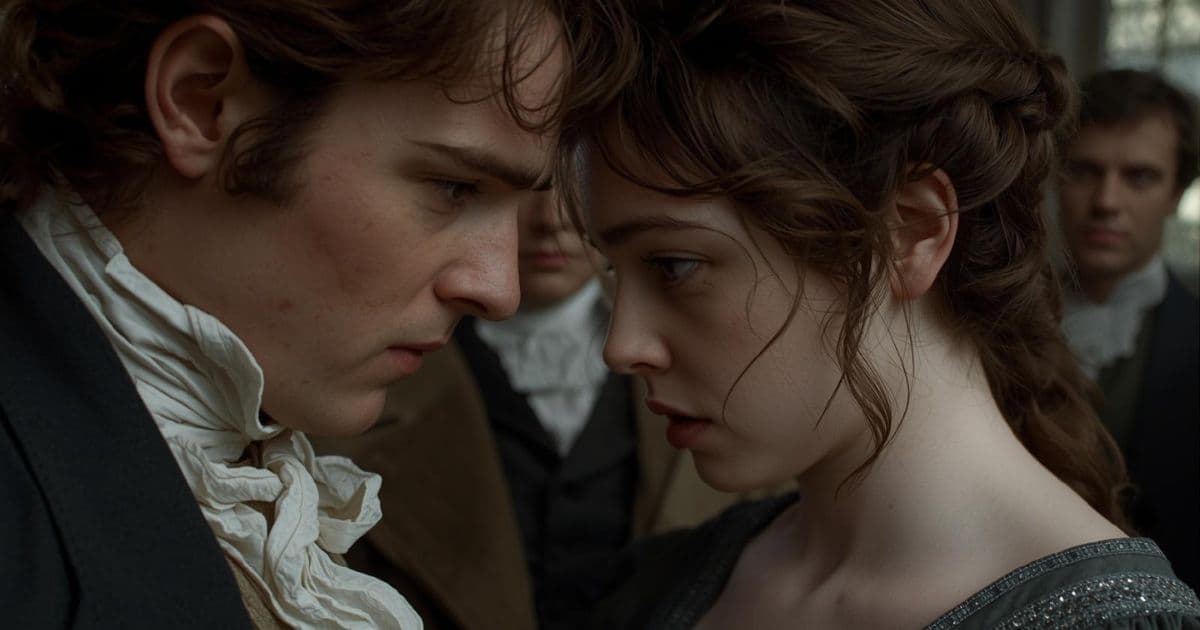
An excerpt from the original text.(complete · 2407 words)
ome change of countenance was necessary for each gentleman as they
walked into Mrs. Weston’s drawing-room;—Mr. Elton must compose his
joyous looks, and Mr. John Knightley disperse his ill-humour. Mr. Elton
must smile less, and Mr. John Knightley more, to fit them for the
place.—Emma only might be as nature prompted, and shew herself just as
happy as she was. To her it was real enjoyment to be with the Westons.
Mr. Weston was a great favourite, and there was not a creature in the
world to whom she spoke with such unreserve, as to his wife; not any
one, to whom she related with such conviction of being listened to and
understood, of being always interesting and always intelligible, the
little affairs, arrangements, perplexities, and pleasures of her father
and herself. She could tell nothing of Hartfield, in which Mrs. Weston
had not a lively concern; and half an hour’s uninterrupted
communication of all those little matters on which the daily happiness
of private life depends, was one of the first gratifications of each.
This was a pleasure which perhaps the whole day’s visit might not
afford, which certainly did not belong to the present half-hour; but
the very sight of Mrs. Weston, her smile, her touch, her voice was
grateful to Emma, and she determined to think as little as possible of
Mr. Elton’s oddities, or of any thing else unpleasant, and enjoy all
that was enjoyable to the utmost.
The misfortune of Harriet’s cold had been pretty well gone through
before her arrival. Mr. Woodhouse had been safely seated long enough to
give the history of it, besides all the history of his own and
Isabella’s coming, and of Emma’s being to follow, and had indeed just
got to the end of his satisfaction that James should come and see his
daughter, when the others appeared, and Mrs. Weston, who had been
almost wholly engrossed by her attentions to him, was able to turn away
and welcome her dear Emma.
Emma’s project of forgetting Mr. Elton for a while made her rather
sorry to find, when they had all taken their places, that he was close
to her. The difficulty was great of driving his strange insensibility
towards Harriet, from her mind, while he not only sat at her elbow, but
was continually obtruding his happy countenance on her notice, and
solicitously addressing her upon every occasion. Instead of forgetting
him, his behaviour was such that she could not avoid the internal
suggestion of “Can it really be as my brother imagined? can it be
possible for this man to be beginning to transfer his affections from
Harriet to me?—Absurd and insufferable!”—Yet he would be so anxious for
her being perfectly warm, would be so interested about her father, and
so delighted with Mrs. Weston; and at last would begin admiring her
drawings with so much zeal and so little knowledge as seemed terribly
like a would-be lover, and made it some effort with her to preserve her
good manners. For her own sake she could not be rude; and for
Harriet’s, in the hope that all would yet turn out right, she was even
positively civil; but it was an effort; especially as something was
going on amongst the others, in the most overpowering period of Mr.
Elton’s nonsense, which she particularly wished to listen to. She heard
enough to know that Mr. Weston was giving some information about his
son; she heard the words “my son,” and “Frank,” and “my son,” repeated
several times over; and, from a few other half-syllables very much
suspected that he was announcing an early visit from his son; but
before she could quiet Mr. Elton, the subject was so completely past
that any reviving question from her would have been awkward.
Now, it so happened that in spite of Emma’s resolution of never
marrying, there was something in the name, in the idea of Mr. Frank
Churchill, which always interested her. She had frequently
thought—especially since his father’s marriage with Miss Taylor—that if
she were to marry, he was the very person to suit her in age,
character and condition. He seemed by this connexion between the
families, quite to belong to her. She could not but suppose it to be a
match that every body who knew them must think of. That Mr. and Mrs.
Weston did think of it, she was very strongly persuaded; and though not
meaning to be induced by him, or by any body else, to give up a
situation which she believed more replete with good than any she could
change it for, she had a great curiosity to see him, a decided
intention of finding him pleasant, of being liked by him to a certain
degree, and a sort of pleasure in the idea of their being coupled in
their friends’ imaginations.
With such sensations, Mr. Elton’s civilities were dreadfully ill-timed;
but she had the comfort of appearing very polite, while feeling very
cross—and of thinking that the rest of the visit could not possibly
pass without bringing forward the same information again, or the
substance of it, from the open-hearted Mr. Weston.—So it proved;—for
when happily released from Mr. Elton, and seated by Mr. Weston, at
dinner, he made use of the very first interval in the cares of
hospitality, the very first leisure from the saddle of mutton, to say
to her,
“We want only two more to be just the right number. I should like to
see two more here,—your pretty little friend, Miss Smith, and my
son—and then I should say we were quite complete. I believe you did not
hear me telling the others in the drawing-room that we are expecting
Frank. I had a letter from him this morning, and he will be with us
within a fortnight.”
Emma spoke with a very proper degree of pleasure; and fully assented to
his proposition of Mr. Frank Churchill and Miss Smith making their
party quite complete.
“He has been wanting to come to us,” continued Mr. Weston, “ever since
September: every letter has been full of it; but he cannot command his
own time. He has those to please who must be pleased, and who (between
ourselves) are sometimes to be pleased only by a good many sacrifices.
But now I have no doubt of seeing him here about the second week in
January.”
“What a very great pleasure it will be to you! and Mrs. Weston is so
anxious to be acquainted with him, that she must be almost as happy as
yourself.”
“Yes, she would be, but that she thinks there will be another put-off.
She does not depend upon his coming so much as I do: but she does not
know the parties so well as I do. The case, you see, is—(but this is
quite between ourselves: I did not mention a syllable of it in the
other room. There are secrets in all families, you know)—The case is,
that a party of friends are invited to pay a visit at Enscombe in
January; and that Frank’s coming depends upon their being put off. If
they are not put off, he cannot stir. But I know they will, because it
is a family that a certain lady, of some consequence, at Enscombe, has
a particular dislike to: and though it is thought necessary to invite
them once in two or three years, they always are put off when it comes
to the point. I have not the smallest doubt of the issue. I am as
confident of seeing Frank here before the middle of January, as I am of
being here myself: but your good friend there (nodding towards the
upper end of the table) has so few vagaries herself, and has been so
little used to them at Hartfield, that she cannot calculate on their
effects, as I have been long in the practice of doing.”
“I am sorry there should be any thing like doubt in the case,” replied
Emma; “but am disposed to side with you, Mr. Weston. If you think he
will come, I shall think so too; for you know Enscombe.”
“Yes—I have some right to that knowledge; though I have never been at
the place in my life.—She is an odd woman!—But I never allow myself to
speak ill of her, on Frank’s account; for I do believe her to be very
fond of him. I used to think she was not capable of being fond of any
body, except herself: but she has always been kind to him (in her
way—allowing for little whims and caprices, and expecting every thing
to be as she likes). And it is no small credit, in my opinion, to him,
that he should excite such an affection; for, though I would not say it
to any body else, she has no more heart than a stone to people in
general; and the devil of a temper.”
Emma liked the subject so well, that she began upon it, to Mrs. Weston,
very soon after their moving into the drawing-room: wishing her joy—yet
observing, that she knew the first meeting must be rather alarming.—
Mrs. Weston agreed to it; but added, that she should be very glad to be
secure of undergoing the anxiety of a first meeting at the time talked
of: “for I cannot depend upon his coming. I cannot be so sanguine as
Mr. Weston. I am very much afraid that it will all end in nothing. Mr.
Weston, I dare say, has been telling you exactly how the matter
stands?”
“Yes—it seems to depend upon nothing but the ill-humour of Mrs.
Churchill, which I imagine to be the most certain thing in the world.”
“My Emma!” replied Mrs. Weston, smiling, “what is the certainty of
caprice?” Then turning to Isabella, who had not been attending
before—“You must know, my dear Mrs. Knightley, that we are by no means
so sure of seeing Mr. Frank Churchill, in my opinion, as his father
thinks. It depends entirely upon his aunt’s spirits and pleasure; in
short, upon her temper. To you—to my two daughters—I may venture on the
truth. Mrs. Churchill rules at Enscombe, and is a very odd-tempered
woman; and his coming now, depends upon her being willing to spare
him.”
“Oh, Mrs. Churchill; every body knows Mrs. Churchill,” replied
Isabella: “and I am sure I never think of that poor young man without
the greatest compassion. To be constantly living with an ill-tempered
person, must be dreadful. It is what we happily have never known any
thing of; but it must be a life of misery. What a blessing, that she
never had any children! Poor little creatures, how unhappy she would
have made them!”
Emma wished she had been alone with Mrs. Weston. She should then have
heard more: Mrs. Weston would speak to her, with a degree of unreserve
which she would not hazard with Isabella; and, she really believed,
would scarcely try to conceal any thing relative to the Churchills from
her, excepting those views on the young man, of which her own
imagination had already given her such instinctive knowledge. But at
present there was nothing more to be said. Mr. Woodhouse very soon
followed them into the drawing-room. To be sitting long after dinner,
was a confinement that he could not endure. Neither wine nor
conversation was any thing to him; and gladly did he move to those with
whom he was always comfortable.
While he talked to Isabella, however, Emma found an opportunity of
saying,
“And so you do not consider this visit from your son as by any means
certain. I am sorry for it. The introduction must be unpleasant,
whenever it takes place; and the sooner it could be over, the better.”
“Yes; and every delay makes one more apprehensive of other delays. Even
if this family, the Braithwaites, are put off, I am still afraid that
some excuse may be found for disappointing us. I cannot bear to imagine
any reluctance on his side; but I am sure there is a great wish on the
Churchills’ to keep him to themselves. There is jealousy. They are
jealous even of his regard for his father. In short, I can feel no
dependence on his coming, and I wish Mr. Weston were less sanguine.”
“He ought to come,” said Emma. “If he could stay only a couple of days,
he ought to come; and one can hardly conceive a young man’s not having
it in his power to do as much as that. A young woman, if she fall
into bad hands, may be teased, and kept at a distance from those she
wants to be with; but one cannot comprehend a young man’s being under
such restraint, as not to be able to spend a week with his father, if
he likes it.”
“One ought to be at Enscombe, and know the ways of the family, before
one decides upon what he can do,” replied Mrs. Weston. “One ought to
use the same caution, perhaps, in judging of the conduct of any one
individual of any one family; but Enscombe, I believe, certainly must
not be judged by general rules: she is so very unreasonable; and
every thing gives way to her.”
“But she is so fond of the nephew: he is so very great a favourite.
Now, according to my idea of Mrs. Churchill, it would be most natural,
that while she makes no sacrifice for the comfort of the husband, to
whom she owes every thing, while she exercises incessant caprice
towards him, she should frequently be governed by the nephew, to whom
she owes nothing at all.”
“My dearest Emma, do not pretend, with your sweet temper, to understand
a bad one, or to lay down rules for it: you must let it go its own way.
I have no doubt of his having, at times, considerable influence; but it
may be perfectly impossible for him to know beforehand when it will
be.”
Emma listened, and then coolly said, “I shall not be satisfied, unless
he comes.”
“He may have a great deal of influence on some points,” continued Mrs.
Weston, “and on others, very little: and among those, on which she is
beyond his reach, it is but too likely, may be this very circumstance
of his coming away from them to visit us.”
Master this chapter. Complete your experience
Purchase the complete book to access all chapters and support classic literature
As an Amazon Associate, we earn a small commission from qualifying purchases at no additional cost to you.
Available in paperback, hardcover, and e-book formats
Let's Analyse the Pattern
We unconsciously devalue what's easily available to us while being drawn to what seems just out of reach.
Why This Matters
Connect literature to life
This chapter teaches how to recognize when someone's attention feels off - not because they're bad, but because the dynamic is unbalanced.
Practice This Today
This week, notice when you feel uncomfortable with someone's interest and ask yourself: am I rejecting them or just rejecting how easy they're making it?
Now let's explore the literary elements.
Key Quotes & Analysis
"Emma only might be as nature prompted, and shew herself just as happy as she was."
Context: Describing how Emma, unlike the men, doesn't have to change her demeanor for the social situation
This shows Emma's privileged position as the social center of her world. She doesn't have to perform or adjust her mood like others do because she's comfortable and welcome everywhere.
In Today's Words:
Emma was the only one who could just be herself and show how happy she really was.
"There was not a creature in the world to whom she spoke with such unreserve, as to his wife."
Context: Describing Emma's relationship with Mrs. Weston
This reveals how rare true intimacy was in Emma's world. Even someone as socially confident as Emma has only one person she can be completely honest with.
In Today's Words:
Mrs. Weston was the only person Emma could tell absolutely everything to.
"She determined to think as little as possible of Mr. Elton's oddities, or of any thing else unpleasant, and enjoy all that was enjoyable to the utmost."
Context: Emma deciding how to handle the awkward situation with Mr. Elton
This shows Emma's strategy for dealing with uncomfortable social situations - ignore the bad parts and focus on the good. It's both practical and revealing of her tendency to avoid unpleasant realities.
In Today's Words:
She decided to just ignore Mr. Elton being weird and focus on having a good time.
Thematic Threads
Social Expectations
In This Chapter
Emma must be polite to Mr. Elton despite her discomfort, trapped by social rules about proper behavior
Development
Building from earlier chapters where social rules constrained her matchmaking attempts
In Your Life:
You might feel trapped between being polite to pushy coworkers and protecting your own boundaries.
Identity
In This Chapter
Emma's horror at the idea that Mr. Elton might prefer her to Harriet challenges her self-image as matchmaker rather than participant
Development
Deepening from her initial confidence in controlling romantic outcomes for others
In Your Life:
You might resist seeing yourself in a role that conflicts with how you've defined yourself.
Fantasy vs Reality
In This Chapter
Emma builds an appealing image of Frank Churchill based on limited information while rejecting the reality of Mr. Elton's actual presence
Development
Introduced here as a new pattern of romantic imagination
In Your Life:
You might find yourself more excited about potential relationships than actual ones right in front of you.
Class
In This Chapter
Emma's discomfort with Mr. Elton partly stems from the social awkwardness of his attention crossing class boundaries inappropriately
Development
Continuing from earlier subtle class tensions in her matchmaking
In Your Life:
You might feel uncomfortable when workplace hierarchies get blurred in social situations.
Control
In This Chapter
Emma realizes she can't control Mr. Elton's romantic focus any more than she could control the outcomes of her matchmaking
Development
Evolving from her initial confidence in managing other people's romantic lives
In Your Life:
You might discover that other people's feelings and choices are beyond your influence, no matter how well-intentioned your efforts.
You now have the context. Time to form your own thoughts.
Discussion Questions
- 1
Why does Emma feel uncomfortable with Mr. Elton's attention, even though she was trying to match him with Harriet?
analysis • surface - 2
What makes Frank Churchill appealing to Emma when she's never even met him?
analysis • medium - 3
Where do you see this pattern of being attracted to unavailable people and turned off by eager attention in modern relationships or workplace dynamics?
application • medium - 4
How could Emma handle Mr. Elton's unwanted attention without being rude or hurting Harriet's feelings?
application • deep - 5
What does this chapter reveal about how our minds create stories about people we barely know versus people who are right in front of us?
reflection • deep
Critical Thinking Exercise
Map Your Attraction Patterns
Think about three people you've been attracted to (romantically, as friends, or professionally) and three you've dismissed or felt uncomfortable around. Write down what you actually knew about each person versus what story you told yourself about them. Look for patterns in your responses to availability versus scarcity.
Consider:
- •Notice whether you're drawn to mystery or put off by transparency
- •Consider how much you filled in gaps with your imagination
- •Ask whether your attractions were based on the person or the challenge they represented
Journaling Prompt
Write about a time when you dismissed someone's genuine interest or chased someone who was clearly unavailable. What were you really responding to, and what might you do differently now?
Coming Up Next...
Chapter 15: The Carriage Ride Revelation
Emma's curiosity about the elusive Frank Churchill continues to grow, while her discomfort with Mr. Elton's increasingly obvious attentions reaches a breaking point. The social dynamics at Hartfield are about to shift dramatically.