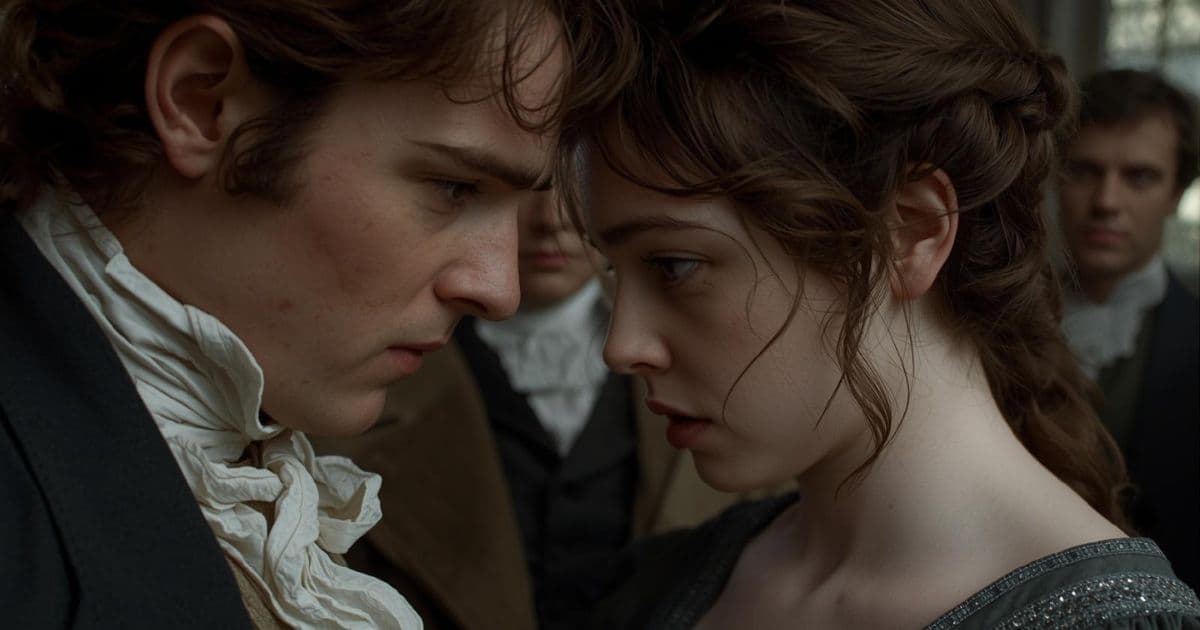
An excerpt from the original text.(complete · 2959 words)
here could hardly be a happier creature in the world than Mrs. John
Knightley, in this short visit to Hartfield, going about every morning
among her old acquaintance with her five children, and talking over
what she had done every evening with her father and sister. She had
nothing to wish otherwise, but that the days did not pass so swiftly.
It was a delightful visit;—perfect, in being much too short.
In general their evenings were less engaged with friends than their
mornings; but one complete dinner engagement, and out of the house too,
there was no avoiding, though at Christmas. Mr. Weston would take no
denial; they must all dine at Randalls one day;—even Mr. Woodhouse was
persuaded to think it a possible thing in preference to a division of
the party.
How they were all to be conveyed, he would have made a difficulty if he
could, but as his son and daughter’s carriage and horses were actually
at Hartfield, he was not able to make more than a simple question on
that head; it hardly amounted to a doubt; nor did it occupy Emma long
to convince him that they might in one of the carriages find room for
Harriet also.
Harriet, Mr. Elton, and Mr. Knightley, their own especial set, were the
only persons invited to meet them;—the hours were to be early, as well
as the numbers few; Mr. Woodhouse’s habits and inclination being
consulted in every thing.
The evening before this great event (for it was a very great event that
Mr. Woodhouse should dine out, on the 24th of December) had been spent
by Harriet at Hartfield, and she had gone home so much indisposed with
a cold, that, but for her own earnest wish of being nursed by Mrs.
Goddard, Emma could not have allowed her to leave the house. Emma
called on her the next day, and found her doom already signed with
regard to Randalls. She was very feverish and had a bad sore throat:
Mrs. Goddard was full of care and affection, Mr. Perry was talked of,
and Harriet herself was too ill and low to resist the authority which
excluded her from this delightful engagement, though she could not
speak of her loss without many tears.
Emma sat with her as long as she could, to attend her in Mrs. Goddard’s
unavoidable absences, and raise her spirits by representing how much
Mr. Elton’s would be depressed when he knew her state; and left her at
last tolerably comfortable, in the sweet dependence of his having a
most comfortless visit, and of their all missing her very much. She had
not advanced many yards from Mrs. Goddard’s door, when she was met by
Mr. Elton himself, evidently coming towards it, and as they walked on
slowly together in conversation about the invalid—of whom he, on the
rumour of considerable illness, had been going to inquire, that he
might carry some report of her to Hartfield—they were overtaken by Mr.
John Knightley returning from the daily visit to Donwell, with his two
eldest boys, whose healthy, glowing faces shewed all the benefit of a
country run, and seemed to ensure a quick despatch of the roast mutton
and rice pudding they were hastening home for. They joined company and
proceeded together. Emma was just describing the nature of her friend’s
complaint;—“a throat very much inflamed, with a great deal of heat
about her, a quick, low pulse, &c. and she was sorry to find from Mrs.
Goddard that Harriet was liable to very bad sore-throats, and had often
alarmed her with them.” Mr. Elton looked all alarm on the occasion, as
he exclaimed,
“A sore-throat!—I hope not infectious. I hope not of a putrid
infectious sort. Has Perry seen her? Indeed you should take care of
yourself as well as of your friend. Let me entreat you to run no risks.
Why does not Perry see her?”
Emma, who was not really at all frightened herself, tranquillised this
excess of apprehension by assurances of Mrs. Goddard’s experience and
care; but as there must still remain a degree of uneasiness which she
could not wish to reason away, which she would rather feed and assist
than not, she added soon afterwards—as if quite another subject,
“It is so cold, so very cold—and looks and feels so very much like
snow, that if it were to any other place or with any other party, I
should really try not to go out to-day—and dissuade my father from
venturing; but as he has made up his mind, and does not seem to feel
the cold himself, I do not like to interfere, as I know it would be so
great a disappointment to Mr. and Mrs. Weston. But, upon my word, Mr.
Elton, in your case, I should certainly excuse myself. You appear to me
a little hoarse already, and when you consider what demand of voice and
what fatigues to-morrow will bring, I think it would be no more than
common prudence to stay at home and take care of yourself to-night.”
Mr. Elton looked as if he did not very well know what answer to make;
which was exactly the case; for though very much gratified by the kind
care of such a fair lady, and not liking to resist any advice of her’s,
he had not really the least inclination to give up the visit;—but Emma,
too eager and busy in her own previous conceptions and views to hear
him impartially, or see him with clear vision, was very well satisfied
with his muttering acknowledgment of its being “very cold, certainly
very cold,” and walked on, rejoicing in having extricated him from
Randalls, and secured him the power of sending to inquire after Harriet
every hour of the evening.
“You do quite right,” said she;—“we will make your apologies to Mr. and
Mrs. Weston.”
But hardly had she so spoken, when she found her brother was civilly
offering a seat in his carriage, if the weather were Mr. Elton’s only
objection, and Mr. Elton actually accepting the offer with much prompt
satisfaction. It was a done thing; Mr. Elton was to go, and never had
his broad handsome face expressed more pleasure than at this moment;
never had his smile been stronger, nor his eyes more exulting than when
he next looked at her.
“Well,” said she to herself, “this is most strange!—After I had got him
off so well, to chuse to go into company, and leave Harriet ill
behind!—Most strange indeed!—But there is, I believe, in many men,
especially single men, such an inclination—such a passion for dining
out—a dinner engagement is so high in the class of their pleasures,
their employments, their dignities, almost their duties, that any thing
gives way to it—and this must be the case with Mr. Elton; a most
valuable, amiable, pleasing young man undoubtedly, and very much in
love with Harriet; but still, he cannot refuse an invitation, he must
dine out wherever he is asked. What a strange thing love is! he can see
ready wit in Harriet, but will not dine alone for her.”
Soon afterwards Mr. Elton quitted them, and she could not but do him
the justice of feeling that there was a great deal of sentiment in his
manner of naming Harriet at parting; in the tone of his voice while
assuring her that he should call at Mrs. Goddard’s for news of her fair
friend, the last thing before he prepared for the happiness of meeting
her again, when he hoped to be able to give a better report; and he
sighed and smiled himself off in a way that left the balance of
approbation much in his favour.
After a few minutes of entire silence between them, John Knightley
began with—
“I never in my life saw a man more intent on being agreeable than Mr.
Elton. It is downright labour to him where ladies are concerned. With
men he can be rational and unaffected, but when he has ladies to
please, every feature works.”
“Mr. Elton’s manners are not perfect,” replied Emma; “but where there
is a wish to please, one ought to overlook, and one does overlook a
great deal. Where a man does his best with only moderate powers, he
will have the advantage over negligent superiority. There is such
perfect good-temper and good-will in Mr. Elton as one cannot but
value.”
“Yes,” said Mr. John Knightley presently, with some slyness, “he seems
to have a great deal of good-will towards you.”
“Me!” she replied with a smile of astonishment, “are you imagining me
to be Mr. Elton’s object?”
“Such an imagination has crossed me, I own, Emma; and if it never
occurred to you before, you may as well take it into consideration
now.”
“Mr. Elton in love with me!—What an idea!”
“I do not say it is so; but you will do well to consider whether it is
so or not, and to regulate your behaviour accordingly. I think your
manners to him encouraging. I speak as a friend, Emma. You had better
look about you, and ascertain what you do, and what you mean to do.”
“I thank you; but I assure you you are quite mistaken. Mr. Elton and I
are very good friends, and nothing more;” and she walked on, amusing
herself in the consideration of the blunders which often arise from a
partial knowledge of circumstances, of the mistakes which people of
high pretensions to judgment are for ever falling into; and not very
well pleased with her brother for imagining her blind and ignorant, and
in want of counsel. He said no more.
Mr. Woodhouse had so completely made up his mind to the visit, that in
spite of the increasing coldness, he seemed to have no idea of
shrinking from it, and set forward at last most punctually with his
eldest daughter in his own carriage, with less apparent consciousness
of the weather than either of the others; too full of the wonder of his
own going, and the pleasure it was to afford at Randalls to see that it
was cold, and too well wrapt up to feel it. The cold, however, was
severe; and by the time the second carriage was in motion, a few flakes
of snow were finding their way down, and the sky had the appearance of
being so overcharged as to want only a milder air to produce a very
white world in a very short time.
Emma soon saw that her companion was not in the happiest humour. The
preparing and the going abroad in such weather, with the sacrifice of
his children after dinner, were evils, were disagreeables at least,
which Mr. John Knightley did not by any means like; he anticipated
nothing in the visit that could be at all worth the purchase; and the
whole of their drive to the vicarage was spent by him in expressing his
discontent.
“A man,” said he, “must have a very good opinion of himself when he
asks people to leave their own fireside, and encounter such a day as
this, for the sake of coming to see him. He must think himself a most
agreeable fellow; I could not do such a thing. It is the greatest
absurdity—Actually snowing at this moment!—The folly of not allowing
people to be comfortable at home—and the folly of people’s not staying
comfortably at home when they can! If we were obliged to go out such an
evening as this, by any call of duty or business, what a hardship we
should deem it;—and here are we, probably with rather thinner clothing
than usual, setting forward voluntarily, without excuse, in defiance of
the voice of nature, which tells man, in every thing given to his view
or his feelings, to stay at home himself, and keep all under shelter
that he can;—here are we setting forward to spend five dull hours in
another man’s house, with nothing to say or to hear that was not said
and heard yesterday, and may not be said and heard again to-morrow.
Going in dismal weather, to return probably in worse;—four horses and
four servants taken out for nothing but to convey five idle, shivering
creatures into colder rooms and worse company than they might have had
at home.”
Emma did not find herself equal to give the pleased assent, which no
doubt he was in the habit of receiving, to emulate the “Very true, my
love,” which must have been usually administered by his travelling
companion; but she had resolution enough to refrain from making any
answer at all. She could not be complying, she dreaded being
quarrelsome; her heroism reached only to silence. She allowed him to
talk, and arranged the glasses, and wrapped herself up, without opening
her lips.
They arrived, the carriage turned, the step was let down, and Mr.
Elton, spruce, black, and smiling, was with them instantly. Emma
thought with pleasure of some change of subject. Mr. Elton was all
obligation and cheerfulness; he was so very cheerful in his civilities
indeed, that she began to think he must have received a different
account of Harriet from what had reached her. She had sent while
dressing, and the answer had been, “Much the same—not better.”
“My report from Mrs. Goddard’s,” said she presently, “was not so
pleasant as I had hoped—‘Not better’ was my answer.”
His face lengthened immediately; and his voice was the voice of
sentiment as he answered.
“Oh! no—I am grieved to find—I was on the point of telling you that
when I called at Mrs. Goddard’s door, which I did the very last thing
before I returned to dress, I was told that Miss Smith was not better,
by no means better, rather worse. Very much grieved and concerned—I had
flattered myself that she must be better after such a cordial as I knew
had been given her in the morning.”
Emma smiled and answered—“My visit was of use to the nervous part of
her complaint, I hope; but not even I can charm away a sore throat; it
is a most severe cold indeed. Mr. Perry has been with her, as you
probably heard.”
“Yes—I imagined—that is—I did not—”
“He has been used to her in these complaints, and I hope to-morrow
morning will bring us both a more comfortable report. But it is
impossible not to feel uneasiness. Such a sad loss to our party
to-day!”
“Dreadful!—Exactly so, indeed.—She will be missed every moment.”
This was very proper; the sigh which accompanied it was really
estimable; but it should have lasted longer. Emma was rather in dismay
when only half a minute afterwards he began to speak of other things,
and in a voice of the greatest alacrity and enjoyment.
“What an excellent device,” said he, “the use of a sheepskin for
carriages. How very comfortable they make it;—impossible to feel cold
with such precautions. The contrivances of modern days indeed have
rendered a gentleman’s carriage perfectly complete. One is so fenced
and guarded from the weather, that not a breath of air can find its way
unpermitted. Weather becomes absolutely of no consequence. It is a very
cold afternoon—but in this carriage we know nothing of the matter.—Ha!
snows a little I see.”
“Yes,” said John Knightley, “and I think we shall have a good deal of
it.”
“Christmas weather,” observed Mr. Elton. “Quite seasonable; and
extremely fortunate we may think ourselves that it did not begin
yesterday, and prevent this day’s party, which it might very possibly
have done, for Mr. Woodhouse would hardly have ventured had there been
much snow on the ground; but now it is of no consequence. This is quite
the season indeed for friendly meetings. At Christmas every body
invites their friends about them, and people think little of even the
worst weather. I was snowed up at a friend’s house once for a week.
Nothing could be pleasanter. I went for only one night, and could not
get away till that very day se’nnight.”
Mr. John Knightley looked as if he did not comprehend the pleasure, but
said only, coolly,
“I cannot wish to be snowed up a week at Randalls.”
At another time Emma might have been amused, but she was too much
astonished now at Mr. Elton’s spirits for other feelings. Harriet
seemed quite forgotten in the expectation of a pleasant party.
“We are sure of excellent fires,” continued he, “and every thing in the
greatest comfort. Charming people, Mr. and Mrs. Weston;—Mrs. Weston
indeed is much beyond praise, and he is exactly what one values, so
hospitable, and so fond of society;—it will be a small party, but where
small parties are select, they are perhaps the most agreeable of any.
Mr. Weston’s dining-room does not accommodate more than ten
comfortably; and for my part, I would rather, under such circumstances,
fall short by two than exceed by two. I think you will agree with me,
(turning with a soft air to Emma,) I think I shall certainly have your
approbation, though Mr. Knightley perhaps, from being used to the large
parties of London, may not quite enter into our feelings.”
“I know nothing of the large parties of London, sir—I never dine with
any body.”
“Indeed! (in a tone of wonder and pity,) I had no idea that the law had
been so great a slavery. Well, sir, the time must come when you will be
paid for all this, when you will have little labour and great
enjoyment.”
“My first enjoyment,” replied John Knightley, as they passed through
the sweep-gate, “will be to find myself safe at Hartfield again.”
Master this chapter. Complete your experience
Purchase the complete book to access all chapters and support classic literature
As an Amazon Associate, we earn a small commission from qualifying purchases at no additional cost to you.
Available in paperback, hardcover, and e-book formats
Let's Analyse the Pattern
The tendency to interpret contradictory information as supporting our desired outcome rather than questioning our assumptions.
Why This Matters
Connect literature to life
This chapter teaches how to recognize when we're interpreting evidence through the lens of what we want to be true rather than what actually is.
Practice This Today
This week, notice when you catch yourself making excuses for someone's behavior—if their actions consistently contradict their words, believe the actions.
Now let's explore the literary elements.
Key Quotes & Analysis
"Better not go at all, than not be in good time."
Context: Grumbling about having to venture out in bad weather for a dinner party
Shows the different attitudes toward social obligations - some see them as burdens while others see them as pleasures. John represents practical thinking over social convention.
In Today's Words:
If we're going to do this, let's at least do it right and not be late.
"I think it is very well that the end of the evening should be for dancing."
Context: Enthusiastically discussing the evening's entertainment while supposedly worried about Harriet
Reveals where his true interests lie - not with the supposedly sick Harriet, but with his own social enjoyment. His priorities become clear through his excited focus on entertainment.
In Today's Words:
I'm really looking forward to the fun part of tonight.
"Mr. Elton is good humoured, cheerful, obliging, and gentle."
Context: Describing Elton's demeanor during the carriage ride to the party
The irony is thick - he's showing all these positive qualities while supposedly concerned about his beloved's illness. His cheerfulness contradicts genuine romantic worry.
In Today's Words:
He was acting perfectly happy and social for someone whose 'girlfriend' was supposedly sick.
Thematic Threads
Self-Deception
In This Chapter
Emma explains away Elton's obvious excitement about the party rather than questioning his feelings for Harriet
Development
Deepening from earlier chapters where Emma dismissed obvious signs of Elton's disinterest
In Your Life:
You might catch yourself making excuses for someone's behavior when their actions don't match what you want to believe about them.
Class Awareness
In This Chapter
John Knightley suggests Elton might be interested in Emma's social position rather than Harriet's person
Development
Building on earlier hints about Elton's social ambitions and awareness of Emma's status
In Your Life:
You might notice people treating you differently based on your job title, income level, or perceived status rather than who you are as a person.
Social Obligations
In This Chapter
Contrast between John Knightley's grumbling about dinner parties and Elton's enthusiasm for social events
Development
Introduced here as a new lens for understanding character motivations
In Your Life:
You might recognize the tension between genuine relationships and performative social interactions in your own social circles.
Truth-Telling
In This Chapter
John Knightley delivers uncomfortable truths about Elton's likely motivations that Emma doesn't want to hear
Development
Continuing the pattern of outside perspectives challenging Emma's assumptions
In Your Life:
You might find yourself dismissing advice from people who see your situation more clearly because you're too invested in your version of events.
Identity Crisis
In This Chapter
Emma's confidence in her matchmaking abilities begins to crack under the weight of contradictory evidence
Development
Escalating from earlier moments of doubt into more serious questioning
In Your Life:
You might experience moments when evidence challenges a skill or talent you've built your self-image around.
You now have the context. Time to form your own thoughts.
Discussion Questions
- 1
What specific behaviors show that Mr. Elton isn't as devoted to Harriet as Emma believes? List the concrete actions that contradict his words.
analysis • surface - 2
Why does Emma dismiss John Knightley's suggestion that Elton might be interested in her instead of Harriet? What's she protecting by refusing to consider this possibility?
analysis • medium - 3
Where have you seen this pattern of 'wishful evidence' in your own life or workplace - times when someone explained away red flags instead of facing an uncomfortable truth?
application • medium - 4
If you were Emma's friend and noticed this disconnect between Elton's words and actions, how would you help her see reality without making her defensive?
application • deep - 5
What does Emma's reaction reveal about how personal investment in being 'right' can blind us to obvious truths? How does this apply beyond matchmaking?
reflection • deep
Critical Thinking Exercise
Reality Check Audit
Think of a current situation where someone's actions don't quite match their words - a colleague, family member, or friend. Write down what they say versus what they actually do. Then honestly assess: are you making excuses for the gap because facing the truth would be uncomfortable or inconvenient?
Consider:
- •Focus on patterns of behavior over time, not isolated incidents
- •Consider what you might be invested in believing about this person
- •Ask yourself what advice you'd give a friend in the exact same situation
Journaling Prompt
Write about a time when you ignored red flags because admitting the truth would have meant changing course on something important. What did that cost you, and what would you do differently now?
Coming Up Next...
Chapter 14: When Someone Shows Interest
At the Westons' dinner party, Emma will face more uncomfortable truths about Mr. Elton's real intentions. The cozy evening gathering becomes the stage for revelations that will shatter her carefully constructed romantic plans.