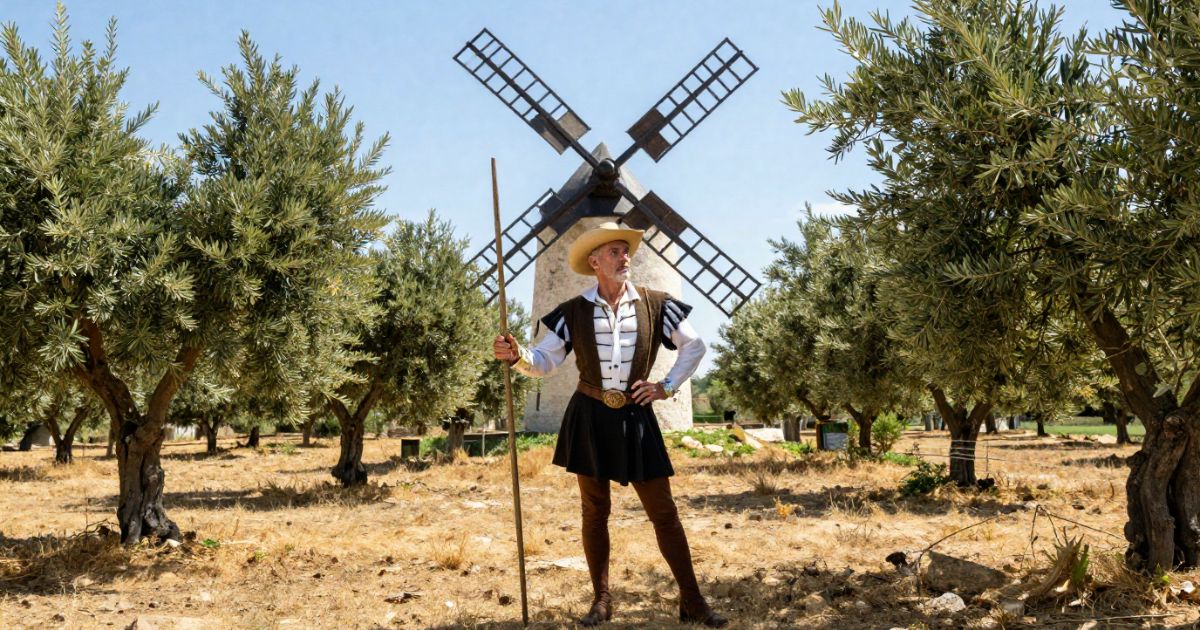
An excerpt from the original text.(complete · 2573 words)
HEREIN ARE RELATED A THOUSAND TRIFLING MATTERS, AS TRIVIAL AS THEY ARE
NECESSARY TO THE RIGHT UNDERSTANDING OF THIS GREAT HISTORY
He who translated this great history from the original written by its
first author, Cide Hamete Benengeli, says that on coming to the chapter
giving the adventures of the cave of Montesinos he found written on the
margin of it, in Hamete’s own hand, these exact words:
“I cannot convince or persuade myself that everything that is written
in the preceding chapter could have precisely happened to the valiant
Don Quixote; and for this reason, that all the adventures that have
occurred up to the present have been possible and probable; but as for
this one of the cave, I see no way of accepting it as true, as it
passes all reasonable bounds. For me to believe that Don Quixote could
lie, he being the most truthful gentleman and the noblest knight of his
time, is impossible; he would not have told a lie though he were shot
to death with arrows. On the other hand, I reflect that he related and
told the story with all the circumstances detailed, and that he could
not in so short a space have fabricated such a vast complication of
absurdities; if, then, this adventure seems apocryphal, it is no fault
of mine; and so, without affirming its falsehood or its truth, I write
it down. Decide for thyself in thy wisdom, reader; for I am not bound,
nor is it in my power, to do more; though certain it is they say that
at the time of his death he retracted, and said he had invented it,
thinking it matched and tallied with the adventures he had read of in
his histories.” And then he goes on to say:
The cousin was amazed as well at Sancho’s boldness as at the patience
of his master, and concluded that the good temper the latter displayed
arose from the happiness he felt at having seen his lady Dulcinea, even
enchanted as she was; because otherwise the words and language Sancho
had addressed to him deserved a thrashing; for indeed he seemed to him
to have been rather impudent to his master, to whom he now observed,
“I, Señor Don Quixote of La Mancha, look upon the time I have spent in
travelling with your worship as very well employed, for I have gained
four things in the course of it; the first is that I have made your
acquaintance, which I consider great good fortune; the second, that I
have learned what the cave of Montesinos contains, together with the
transformations of Guadiana and of the lakes of Ruidera; which will be
of use to me for the Spanish Ovid that I have in hand; the third, to
have discovered the antiquity of cards, that they were in use at least
in the time of Charlemagne, as may be inferred from the words you say
Durandarte uttered when, at the end of that long spell while Montesinos
was talking to him, he woke up and said, ‘Patience and shuffle.’ This
phrase and expression he could not have learned while he was enchanted,
but only before he had become so, in France, and in the time of the
aforesaid emperor Charlemagne. And this demonstration is just the thing
for me for that other book I am writing, the ‘Supplement to Polydore
Vergil on the Invention of Antiquities;’ for I believe he never thought
of inserting that of cards in his book, as I mean to do in mine, and it
will be a matter of great importance, particularly when I can cite so
grave and veracious an authority as Señor Durandarte. And the fourth
thing is, that I have ascertained the source of the river Guadiana,
heretofore unknown to mankind.”
“You are right,” said Don Quixote; “but I should like to know, if by
God’s favour they grant you a licence to print those books of
yours—which I doubt—to whom do you mean to dedicate them?”
“There are lords and grandees in Spain to whom they can be dedicated,”
said the cousin.
“Not many,” said Don Quixote; “not that they are unworthy of it, but
because they do not care to accept books and incur the obligation of
making the return that seems due to the author’s labour and courtesy.
One prince I know who makes up for all the rest, and more—how much
more, if I ventured to say, perhaps I should stir up envy in many a
noble breast; but let this stand over for some more convenient time,
and let us go and look for some place to shelter ourselves in
to-night.”
“Not far from this,” said the cousin, “there is a hermitage, where
there lives a hermit, who they say was a soldier, and who has the
reputation of being a good Christian and a very intelligent and
charitable man. Close to the hermitage he has a small house which he
built at his own cost, but though small it is large enough for the
reception of guests.”
“Has this hermit any hens, do you think?” asked Sancho.
“Few hermits are without them,” said Don Quixote; “for those we see
now-a-days are not like the hermits of the Egyptian deserts who were
clad in palm-leaves, and lived on the roots of the earth. But do not
think that by praising these I am disparaging the others; all I mean to
say is that the penances of those of the present day do not come up to
the asceticism and austerity of former times; but it does not follow
from this that they are not all worthy; at least I think them so; and
at the worst the hypocrite who pretends to be good does less harm than
the open sinner.”
At this point they saw approaching the spot where they stood a man on
foot, proceeding at a rapid pace, and beating a mule loaded with lances
and halberds. When he came up to them, he saluted them and passed on
without stopping. Don Quixote called to him, “Stay, good fellow; you
seem to be making more haste than suits that mule.”
“I cannot stop, señor,” answered the man; “for the arms you see I carry
here are to be used to-morrow, so I must not delay; God be with you.
But if you want to know what I am carrying them for, I mean to lodge
to-night at the inn that is beyond the hermitage, and if you be going
the same road you will find me there, and I will tell you some curious
things; once more God be with you;” and he urged on his mule at such a
pace that Don Quixote had no time to ask him what these curious things
were that he meant to tell them; and as he was somewhat inquisitive,
and always tortured by his anxiety to learn something new, he decided
to set out at once, and go and pass the night at the inn instead of
stopping at the hermitage, where the cousin would have had them halt.
Accordingly they mounted and all three took the direct road for the
inn, which they reached a little before nightfall. On the road the
cousin proposed they should go up to the hermitage to drink a sup. The
instant Sancho heard this he steered his Dapple towards it, and Don
Quixote and the cousin did the same; but it seems Sancho’s bad luck so
ordered it that the hermit was not at home, for so a sub-hermit they
found in the hermitage told them. They called for some of the best. She
replied that her master had none, but that if they liked cheap water
she would give it with great pleasure.
“If I found any in water,” said Sancho, “there are wells along the road
where I could have had enough of it. Ah, Camacho’s wedding, and
plentiful house of Don Diego, how often do I miss you!”
Leaving the hermitage, they pushed on towards the inn, and a little
farther they came upon a youth who was pacing along in front of them at
no great speed, so that they overtook him. He carried a sword over his
shoulder, and slung on it a budget or bundle of his clothes apparently,
probably his breeches or pantaloons, and his cloak and a shirt or two;
for he had on a short jacket of velvet with a gloss like satin on it in
places, and had his shirt out; his stockings were of silk, and his
shoes square-toed as they wear them at court. His age might have been
eighteen or nineteen; he was of a merry countenance, and to all
appearance of an active habit, and he went along singing seguidillas to
beguile the wearisomeness of the road. As they came up with him he was
just finishing one, which the cousin got by heart and they say ran
thus—
I’m off to the wars
For the want of pence,
Oh, had I but money
I’d show more sense.
The first to address him was Don Quixote, who said, “You travel very
airily, sir gallant; whither bound, may we ask, if it is your pleasure
to tell us?”
To which the youth replied, “The heat and my poverty are the reason of
my travelling so airily, and it is to the wars that I am bound.”
“How poverty?” asked Don Quixote; “the heat one can understand.”
“Señor,” replied the youth, “in this bundle I carry velvet pantaloons
to match this jacket; if I wear them out on the road, I shall not be
able to make a decent appearance in them in the city, and I have not
the wherewithal to buy others; and so for this reason, as well as to
keep myself cool, I am making my way in this fashion to overtake some
companies of infantry that are not twelve leagues off, in which I shall
enlist, and there will be no want of baggage trains to travel with
after that to the place of embarkation, which they say will be
Carthagena; I would rather have the King for a master, and serve him in
the wars, than serve a court pauper.”
“And did you get any bounty, now?” asked the cousin.
“If I had been in the service of some grandee of Spain or personage of
distinction,” replied the youth, “I should have been safe to get it;
for that is the advantage of serving good masters, that out of the
servants’ hall men come to be ancients or captains, or get a good
pension. But I, to my misfortune, always served place-hunters and
adventurers, whose keep and wages were so miserable and scanty that
half went in paying for the starching of one’s collars; it would be a
miracle indeed if a page volunteer ever got anything like a reasonable
bounty.”
“And tell me, for heaven’s sake,” asked Don Quixote, “is it possible,
my friend, that all the time you served you never got any livery?”
“They gave me two,” replied the page; “but just as when one quits a
religious community before making profession, they strip him of the
dress of the order and give him back his own clothes, so did my masters
return me mine; for as soon as the business on which they came to court
was finished, they went home and took back the liveries they had given
merely for show.”
“What spilorceria!—as an Italian would say,” said Don Quixote; “but for
all that, consider yourself happy in having left court with as worthy
an object as you have, for there is nothing on earth more honourable or
profitable than serving, first of all God, and then one’s king and
natural lord, particularly in the profession of arms, by which, if not
more wealth, at least more honour is to be won than by letters, as I
have said many a time; for though letters may have founded more great
houses than arms, still those founded by arms have I know not what
superiority over those founded by letters, and a certain splendour
belonging to them that distinguishes them above all. And bear in mind
what I am now about to say to you, for it will be of great use and
comfort to you in time of trouble; it is, not to let your mind dwell on
the adverse chances that may befall you; for the worst of all is death,
and if it be a good death, the best of all is to die. They asked Julius
Cæsar, the valiant Roman emperor, what was the best death. He answered,
that which is unexpected, which comes suddenly and unforeseen; and
though he answered like a pagan, and one without the knowledge of the
true God, yet, as far as sparing our feelings is concerned, he was
right; for suppose you are killed in the first engagement or skirmish,
whether by a cannon ball or blown up by mine, what matters it? It is
only dying, and all is over; and according to Terence, a soldier shows
better dead in battle, than alive and safe in flight; and the good
soldier wins fame in proportion as he is obedient to his captains and
those in command over him. And remember, my son, that it is better for
the soldier to smell of gunpowder than of civet, and that if old age
should come upon you in this honourable calling, though you may be
covered with wounds and crippled and lame, it will not come upon you
without honour, and that such as poverty cannot lessen; especially now
that provisions are being made for supporting and relieving old and
disabled soldiers; for it is not right to deal with them after the
fashion of those who set free and get rid of their black slaves when
they are old and useless, and, turning them out of their houses under
the pretence of making them free, make them slaves to hunger, from
which they cannot expect to be released except by death. But for the
present I won’t say more than get ye up behind me on my horse as far as
the inn, and sup with me there, and to-morrow you shall pursue your
journey, and God give you as good speed as your intentions deserve.”
The page did not accept the invitation to mount, though he did that to
supper at the inn; and here they say Sancho said to himself, “God be
with you for a master; is it possible that a man who can say things so
many and so good as he has said just now, can say that he saw the
impossible absurdities he reports about the cave of Montesinos? Well,
well, we shall see.”
And now, just as night was falling, they reached the inn, and it was
not without satisfaction that Sancho perceived his master took it for a
real inn, and not for a castle as usual. The instant they entered Don
Quixote asked the landlord after the man with the lances and halberds,
and was told that he was in the stable seeing to his mule; which was
what Sancho and the cousin proceeded to do for their beasts, giving the
best manger and the best place in the stable to Rocinante.
p24e.jpg (61K)
Master this chapter. Complete your experience
Purchase the complete book to access all chapters and support classic literature
As an Amazon Associate, we earn a small commission from qualifying purchases at no additional cost to you.
Available in paperback, hardcover, and e-book formats
Let's Analyse the Pattern
Complex situations contain multiple valid perspectives that must be held simultaneously rather than reduced to simple either/or choices.
Why This Matters
Connect literature to life
This chapter teaches how to process conflicting viewpoints without immediately choosing sides or demanding absolute certainty.
Practice This Today
This week, notice when you encounter conflicting stories about the same event and ask yourself what truth each perspective might contain before deciding which version to believe.
Now let's explore the literary elements.
Key Quotes & Analysis
"I cannot convince or persuade myself that everything that is written in the preceding chapter could have precisely happened to the valiant Don Quixote"
Context: The fictional historian questions the truth of Don Quixote's cave adventure
This breaks the fourth wall of storytelling, admitting that even within fiction, some things seem too unbelievable. It highlights how we process information that doesn't fit our expectations.
In Today's Words:
I just can't believe this actually happened, even for Don Quixote
"Decide for thyself in thy wisdom, reader; for I am not bound, nor is it possible, to give certainty to doubtful things"
Context: After admitting uncertainty about the cave story's truth
This puts responsibility on readers to judge for themselves rather than accepting everything at face value. It's remarkably modern in acknowledging multiple possible truths.
In Today's Words:
You figure it out - I can't prove what really happened
"The profession of arms, though it seems rough and unpolished, has in it a certain something that makes it superior to all others"
Context: Speaking to the young man heading to war for money
Don Quixote transforms economic necessity into noble calling, showing his ability to find meaning and dignity in harsh realities. It demonstrates how perspective can reframe experience.
In Today's Words:
Military service might look tough, but there's something special about it that beats other jobs
Thematic Threads
Truth
In This Chapter
The narrator openly questions the veracity of Don Quixote's cave story while still recording it
Development
Evolved from earlier themes of reality vs. fantasy to embrace uncertainty itself
In Your Life:
You might recognize this when family members tell completely different versions of the same childhood event
Economic Necessity
In This Chapter
The young man joins the military not for honor but because he needs steady pay
Development
Continues the book's examination of how financial pressure shapes choices
In Your Life:
You might see this in your own career decisions driven more by bills than passion
Dignity
In This Chapter
Don Quixote transforms the soldier's economic desperation into a noble calling
Development
Shows his consistent ability to find meaning in difficult circumstances
In Your Life:
You might recognize this when someone helps you see your challenging job as valuable service
Perspective
In This Chapter
The same military service appears as economic necessity, scholarly material, and noble calling
Development
Demonstrates how viewpoint shapes meaning throughout the story
In Your Life:
You might notice this when your 'boring' routine job looks different through a grateful patient's eyes
Uncertainty
In This Chapter
The narrator admits he cannot verify truth but records the story anyway
Development
Acknowledges the limits of knowledge while still finding value in the telling
In Your Life:
You might feel this when making major decisions without having all the information you wish you had
You now have the context. Time to form your own thoughts.
Discussion Questions
- 1
Why does the narrator admit he can't verify whether Don Quixote's cave adventure really happened, and what does this tell us about how stories get passed down?
analysis • surface - 2
The young soldier is going to war because he needs money, not out of patriotic duty. How does Don Quixote reframe this situation, and why might both perspectives be true?
analysis • medium - 3
Think of a recent news story or workplace conflict where people had completely different takes on the same situation. What underlying needs or pressures might have shaped each viewpoint?
application • medium - 4
When you encounter conflicting accounts of the same event, how do you decide what to believe? What strategies could help you navigate uncertainty without getting paralyzed?
application • deep - 5
The chapter shows how the same situation can look like scholarly curiosity, economic desperation, or noble service depending on your angle. What does this reveal about why people struggle to understand each other?
reflection • deep
Critical Thinking Exercise
Map the Multiple Truths
Think of a current disagreement in your life - at work, in your family, or in your community. Write down each person's perspective in one sentence, then identify what underlying need or pressure might be driving their viewpoint. Look for where multiple truths might coexist rather than cancel each other out.
Consider:
- •People's positions often reflect their circumstances more than their character
- •Strong emotions usually signal unmet needs or unacknowledged fears
- •The loudest voice in a conflict isn't necessarily the most unreasonable one
Journaling Prompt
Write about a time when you discovered your initial judgment of someone was incomplete. What changed when you learned more about their situation? How might this experience help you navigate future conflicts?
Coming Up Next...
Chapter 97: The Braying Town and the Divining Ape
At the inn, Don Quixote seeks out the mysterious man with weapons who promised to share 'curious things.' What strange tale will unfold, and how will it compare to the already questionable cave adventure?