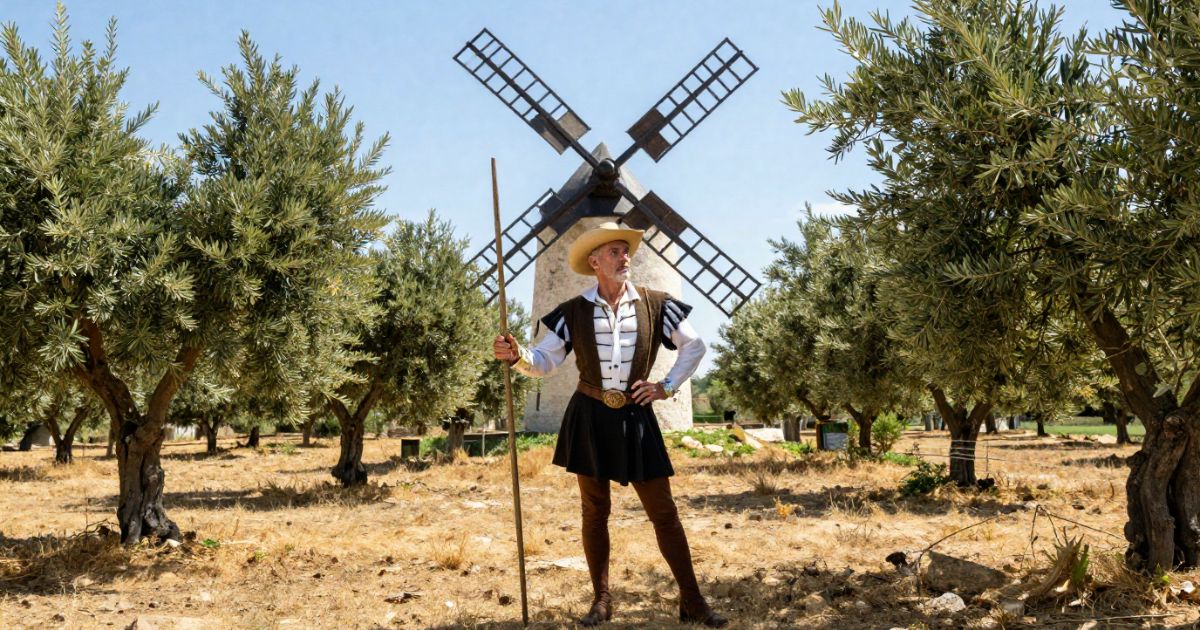
An excerpt from the original text.(complete · 4126 words)
OF THE WONDERFUL THINGS THE INCOMPARABLE DON QUIXOTE SAID HE SAW IN THE
PROFOUND CAVE OF MONTESINOS, THE IMPOSSIBILITY AND MAGNITUDE OF WHICH
CAUSE THIS ADVENTURE TO BE DEEMED APOCRYPHAL
It was about four in the afternoon when the sun, veiled in clouds, with
subdued light and tempered beams, enabled Don Quixote to relate,
without heat or inconvenience, what he had seen in the cave of
Montesinos to his two illustrious hearers, and he began as follows:
“A matter of some twelve or fourteen times a man’s height down in this
pit, on the right-hand side, there is a recess or space, roomy enough
to contain a large cart with its mules. A little light reaches it
through some chinks or crevices, communicating with it and open to the
surface of the earth. This recess or space I perceived when I was
already growing weary and disgusted at finding myself hanging suspended
by the rope, travelling downwards into that dark region without any
certainty or knowledge of where I was going, so I resolved to enter it
and rest myself for a while. I called out, telling you not to let out
more rope until I bade you, but you cannot have heard me. I then
gathered in the rope you were sending me, and making a coil or pile of
it I seated myself upon it, ruminating and considering what I was to do
to lower myself to the bottom, having no one to hold me up; and as I
was thus deep in thought and perplexity, suddenly and without
provocation a profound sleep fell upon me, and when I least expected
it, I know not how, I awoke and found myself in the midst of the most
beautiful, delightful meadow that nature could produce or the most
lively human imagination conceive. I opened my eyes, I rubbed them, and
found I was not asleep but thoroughly awake. Nevertheless, I felt my
head and breast to satisfy myself whether it was I myself who was there
or some empty delusive phantom; but touch, feeling, the collected
thoughts that passed through my mind, all convinced me that I was the
same then and there that I am this moment. Next there presented itself
to my sight a stately royal palace or castle, with walls that seemed
built of clear transparent crystal; and through two great doors that
opened wide therein, I saw coming forth and advancing towards me a
venerable old man, clad in a long gown of mulberry-coloured serge that
trailed upon the ground. On his shoulders and breast he had a green
satin collegiate hood, and covering his head a black Milanese bonnet,
and his snow-white beard fell below his girdle. He carried no arms
whatever, nothing but a rosary of beads bigger than fair-sized
filberts, each tenth bead being like a moderate ostrich egg; his
bearing, his gait, his dignity and imposing presence held me spellbound
and wondering. He approached me, and the first thing he did was to
embrace me closely, and then he said to me, ‘For a long time now, O
valiant knight Don Quixote of La Mancha, we who are here enchanted in
these solitudes have been hoping to see thee, that thou mayest make
known to the world what is shut up and concealed in this deep cave,
called the cave of Montesinos, which thou hast entered, an achievement
reserved for thy invincible heart and stupendous courage alone to
attempt. Come with me, illustrious sir, and I will show thee the
marvels hidden within this transparent castle, whereof I am the alcaide
and perpetual warden; for I am Montesinos himself, from whom the cave
takes its name.’
“The instant he told me he was Montesinos, I asked him if the story
they told in the world above here was true, that he had taken out the
heart of his great friend Durandarte from his breast with a little
dagger, and carried it to the lady Belerma, as his friend when at the
point of death had commanded him. He said in reply that they spoke the
truth in every respect except as to the dagger, for it was not a
dagger, nor little, but a burnished poniard sharper than an awl.”
“That poniard must have been made by Ramon de Hoces the Sevillian,”
said Sancho.
“I do not know,” said Don Quixote; “it could not have been by that
poniard maker, however, because Ramon de Hoces was a man of yesterday,
and the affair of Roncesvalles, where this mishap occurred, was long
ago; but the question is of no great importance, nor does it affect or
make any alteration in the truth or substance of the story.”
“That is true,” said the cousin; “continue, Señor Don Quixote, for I am
listening to you with the greatest pleasure in the world.”
“And with no less do I tell the tale,” said Don Quixote; “and so, to
proceed—the venerable Montesinos led me into the palace of crystal,
where, in a lower chamber, strangely cool and entirely of alabaster,
was an elaborately wrought marble tomb, upon which I beheld, stretched
at full length, a knight, not of bronze, or marble, or jasper, as are
seen on other tombs, but of actual flesh and bone. His right hand
(which seemed to me somewhat hairy and sinewy, a sign of great strength
in its owner) lay on the side of his heart; but before I could put any
question to Montesinos, he, seeing me gazing at the tomb in amazement,
said to me, ‘This is my friend Durandarte, flower and mirror of the
true lovers and valiant knights of his time. He is held enchanted here,
as I myself and many others are, by that French enchanter Merlin, who,
they say, was the devil’s son; but my belief is, not that he was the
devil’s son, but that he knew, as the saying is, a point more than the
devil. How or why he enchanted us, no one knows, but time will tell,
and I suspect that time is not far off. What I marvel at is, that I
know it to be as sure as that it is now day, that Durandarte ended his
life in my arms, and that, after his death, I took out his heart with
my own hands; and indeed it must have weighed more than two pounds,
for, according to naturalists, he who has a large heart is more largely
endowed with valour than he who has a small one. Then, as this is the
case, and as the knight did really die, how comes it that he now moans
and sighs from time to time, as if he were still alive?’
“As he said this, the wretched Durandarte cried out in a loud voice:
O cousin Montesinos!
’Twas my last request of thee,
When my soul hath left the body,
And that lying dead I be,
With thy poniard or thy dagger
Cut the heart from out my breast,
And bear it to Belerma.
This was my last request.”
“On hearing which, the venerable Montesinos fell on his knees before
the unhappy knight, and with tearful eyes exclaimed, ‘Long since, Señor
Durandarte, my beloved cousin, long since have I done what you bade me
on that sad day when I lost you; I took out your heart as well as I
could, not leaving an atom of it in your breast, I wiped it with a lace
handkerchief, and I took the road to France with it, having first laid
you in the bosom of the earth with tears enough to wash and cleanse my
hands of the blood that covered them after wandering among your bowels;
and more by token, O cousin of my soul, at the first village I came to
after leaving Roncesvalles, I sprinkled a little salt upon your heart
to keep it sweet, and bring it, if not fresh, at least pickled, into
the presence of the lady Belerma, whom, together with you, myself,
Guadiana your squire, the duenna Ruidera and her seven daughters and
two nieces, and many more of your friends and acquaintances, the sage
Merlin has been keeping enchanted here these many years; and although
more than five hundred have gone by, not one of us has died; Ruidera
and her daughters and nieces alone are missing, and these, because of
the tears they shed, Merlin, out of the compassion he seems to have
felt for them, changed into so many lakes, which to this day in the
world of the living, and in the province of La Mancha, are called the
Lakes of Ruidera. The seven daughters belong to the kings of Spain and
the two nieces to the knights of a very holy order called the Order of
St. John. Guadiana your squire, likewise bewailing your fate, was
changed into a river of his own name, but when he came to the surface
and beheld the sun of another heaven, so great was his grief at finding
he was leaving you, that he plunged into the bowels of the earth;
however, as he cannot help following his natural course, he from time
to time comes forth and shows himself to the sun and the world. The
lakes aforesaid send him their waters, and with these, and others that
come to him, he makes a grand and imposing entrance into Portugal; but
for all that, go where he may, he shows his melancholy and sadness, and
takes no pride in breeding dainty choice fish, only coarse and
tasteless sorts, very different from those of the golden Tagus. All
this that I tell you now, O cousin mine, I have told you many times
before, and as you make no answer, I fear that either you believe me
not, or do not hear me, whereat I feel God knows what grief. I have now
news to give you, which, if it serves not to alleviate your sufferings,
will not in any wise increase them. Know that you have here before you
(open your eyes and you will see) that great knight of whom the sage
Merlin has prophesied such great things; that Don Quixote of La Mancha
I mean, who has again, and to better purpose than in past times,
revived in these days knight-errantry, long since forgotten, and by
whose intervention and aid it may be we shall be disenchanted; for
great deeds are reserved for great men.’
“‘And if that may not be,’ said the wretched Durandarte in a low and
feeble voice, ‘if that may not be, then, my cousin, I say “patience and
shuffle;”’ and turning over on his side, he relapsed into his former
silence without uttering another word.
“And now there was heard a great outcry and lamentation, accompanied by
deep sighs and bitter sobs. I looked round, and through the crystal
wall I saw passing through another chamber a procession of two lines of
fair damsels all clad in mourning, and with white turbans of Turkish
fashion on their heads. Behind, in the rear of these, there came a
lady, for so from her dignity she seemed to be, also clad in black,
with a white veil so long and ample that it swept the ground. Her
turban was twice as large as the largest of any of the others; her
eyebrows met, her nose was rather flat, her mouth was large but with
ruddy lips, and her teeth, of which at times she allowed a glimpse,
were seen to be sparse and ill-set, though as white as peeled almonds.
She carried in her hands a fine cloth, and in it, as well as I could
make out, a heart that had been mummied, so parched and dried was it.
Montesinos told me that all those forming the procession were the
attendants of Durandarte and Belerma, who were enchanted there with
their master and mistress, and that the last, she who carried the heart
in the cloth, was the lady Belerma, who, with her damsels, four days in
the week went in procession singing, or rather weeping, dirges over the
body and miserable heart of his cousin; and that if she appeared to me
somewhat ill-favoured or not so beautiful as fame reported her, it was
because of the bad nights and worse days that she passed in that
enchantment, as I could see by the great dark circles round her eyes,
and her sickly complexion; ‘her sallowness, and the rings round her
eyes,’ said he, ‘are not caused by the periodical ailment usual with
women, for it is many months and even years since she has had any, but
by the grief her own heart suffers because of that which she holds in
her hand perpetually, and which recalls and brings back to her memory
the sad fate of her lost lover; were it not for this, hardly would the
great Dulcinea del Toboso, so celebrated in all these parts, and even
in the world, come up to her for beauty, grace, and gaiety.’
“‘Hold hard!’ said I at this, ‘tell your story as you ought, Señor Don
Montesinos, for you know very well that all comparisons are odious, and
there is no occasion to compare one person with another; the peerless
Dulcinea del Toboso is what she is, and the lady Doña Belerma is what
she is and has been, and that’s enough.’ To which he made answer,
‘Forgive me, Señor Don Quixote; I own I was wrong and spoke unadvisedly
in saying that the lady Dulcinea could scarcely come up to the lady
Belerma; for it were enough for me to have learned, by what means I
know not, that you are her knight, to make me bite my tongue out before
I compared her to anything save heaven itself.’ After this apology
which the great Montesinos made me, my heart recovered itself from the
shock I had received in hearing my lady compared with Belerma.”
“Still I wonder,” said Sancho, “that your worship did not get upon the
old fellow and bruise every bone of him with kicks, and pluck his beard
until you didn’t leave a hair in it.”
“Nay, Sancho, my friend,” said Don Quixote, “it would not have been
right in me to do that, for we are all bound to pay respect to the
aged, even though they be not knights, but especially to those who are,
and who are enchanted; I only know I gave him as good as he brought in
the many other questions and answers we exchanged.”
“I cannot understand, Señor Don Quixote,” remarked the cousin here,
“how it is that your worship, in such a short space of time as you have
been below there, could have seen so many things, and said and answered
so much.”
“How long is it since I went down?” asked Don Quixote.
“Little better than an hour,” replied Sancho.
“That cannot be,” returned Don Quixote, “because night overtook me
while I was there, and day came, and it was night again and day again
three times; so that, by my reckoning, I have been three days in those
remote regions beyond our ken.”
“My master must be right,” replied Sancho; “for as everything that has
happened to him is by enchantment, maybe what seems to us an hour would
seem three days and nights there.”
“That’s it,” said Don Quixote.
“And did your worship eat anything all that time, señor?” asked the
cousin.
“I never touched a morsel,” answered Don Quixote, “nor did I feel
hunger, or think of it.”
“And do the enchanted eat?” said the cousin.
“They neither eat,” said Don Quixote; “nor are they subject to the
greater excrements, though it is thought that their nails, beards, and
hair grow.”
“And do the enchanted sleep, now, señor?” asked Sancho.
“Certainly not,” replied Don Quixote; “at least, during those three
days I was with them not one of them closed an eye, nor did I either.”
“The proverb, ‘Tell me what company thou keepest and I’ll tell thee
what thou art,’ is to the point here,” said Sancho; “your worship keeps
company with enchanted people that are always fasting and watching;
what wonder is it, then, that you neither eat nor sleep while you are
with them? But forgive me, señor, if I say that of all this you have
told us now, may God take me—I was just going to say the devil—if I
believe a single particle.”
“What!” said the cousin, “has Señor Don Quixote, then, been lying? Why,
even if he wished it he has not had time to imagine and put together
such a host of lies.”
“I don’t believe my master lies,” said Sancho.
“If not, what dost thou believe?” asked Don Quixote.
“I believe,” replied Sancho, “that this Merlin, or those enchanters who
enchanted the whole crew your worship says you saw and discoursed with
down there, stuffed your imagination or your mind with all this
rigmarole you have been treating us to, and all that is still to come.”
“All that might be, Sancho,” replied Don Quixote; “but it is not so,
for everything that I have told you I saw with my own eyes, and touched
with my own hands. But what will you say when I tell you now how, among
the countless other marvellous things Montesinos showed me (of which at
leisure and at the proper time I will give thee an account in the
course of our journey, for they would not be all in place here), he
showed me three country girls who went skipping and capering like goats
over the pleasant fields there, and the instant I beheld them I knew
one to be the peerless Dulcinea del Toboso, and the other two those
same country girls that were with her and that we spoke to on the road
from El Toboso! I asked Montesinos if he knew them, and he told me he
did not, but he thought they must be some enchanted ladies of
distinction, for it was only a few days before that they had made their
appearance in those meadows; but I was not to be surprised at that,
because there were a great many other ladies there of times past and
present, enchanted in various strange shapes, and among them he had
recognised Queen Guinevere and her dame Quintañona, she who poured out
the wine for Lancelot when he came from Britain.”
When Sancho Panza heard his master say this he was ready to take leave
of his senses, or die with laughter; for, as he knew the real truth
about the pretended enchantment of Dulcinea, in which he himself had
been the enchanter and concocter of all the evidence, he made up his
mind at last that, beyond all doubt, his master was out of his wits and
stark mad, so he said to him, “It was an evil hour, a worse season, and
a sorrowful day, when your worship, dear master mine, went down to the
other world, and an unlucky moment when you met with Señor Montesinos,
who has sent you back to us like this. You were well enough here above
in your full senses, such as God had given you, delivering maxims and
giving advice at every turn, and not as you are now, talking the
greatest nonsense that can be imagined.”
“As I know thee, Sancho,” said Don Quixote, “I heed not thy words.”
“Nor I your worship’s,” said Sancho, “whether you beat me or kill me
for those I have spoken, and will speak if you don’t correct and mend
your own. But tell me, while we are still at peace, how or by what did
you recognise the lady our mistress; and if you spoke to her, what did
you say, and what did she answer?”
“I recognised her,” said Don Quixote, “by her wearing the same garments
she wore when thou didst point her out to me. I spoke to her, but she
did not utter a word in reply; on the contrary, she turned her back on
me and took to flight, at such a pace that crossbow bolt could not have
overtaken her. I wished to follow her, and would have done so had not
Montesinos recommended me not to take the trouble as it would be
useless, particularly as the time was drawing near when it would be
necessary for me to quit the cavern. He told me, moreover, that in
course of time he would let me know how he and Belerma, and Durandarte,
and all who were there, were to be disenchanted. But of all I saw and
observed down there, what gave me most pain was, that while Montesinos
was speaking to me, one of the two companions of the hapless Dulcinea
approached me on one without my having seen her coming, and with tears
in her eyes said to me, in a low, agitated voice, ‘My lady Dulcinea del
Toboso kisses your worship’s hands, and entreats you to do her the
favour of letting her know how you are; and, being in great need, she
also entreats your worship as earnestly as she can to be so good as to
lend her half a dozen reals, or as much as you may have about you, on
this new dimity petticoat that I have here; and she promises to repay
them very speedily.’ I was amazed and taken aback by such a message,
and turning to Señor Montesinos I asked him, ‘Is it possible, Señor
Montesinos, that persons of distinction under enchantment can be in
need?’ To which he replied, ‘Believe me, Señor Don Quixote, that which
is called need is to be met with everywhere, and penetrates all
quarters and reaches everyone, and does not spare even the enchanted;
and as the lady Dulcinea del Toboso sends to beg those six reals, and
the pledge is to all appearance a good one, there is nothing for it but
to give them to her, for no doubt she must be in some great strait.’ ‘I
will take no pledge of her,’ I replied, ‘nor yet can I give her what
she asks, for all I have is four reals; which I gave (they were those
which thou, Sancho, gavest me the other day to bestow in alms upon the
poor I met along the road), and I said, ‘Tell your mistress, my dear,
that I am grieved to the heart because of her distresses, and wish I
was a Fucar to remedy them, and that I would have her know that I
cannot be, and ought not be, in health while deprived of the happiness
of seeing her and enjoying her discreet conversation, and that I
implore her as earnestly as I can, to allow herself to be seen and
addressed by this her captive servant and forlorn knight. Tell her,
too, that when she least expects it she will hear it announced that I
have made an oath and vow after the fashion of that which the Marquis
of Mantua made to avenge his nephew Baldwin, when he found him at the
point of death in the heart of the mountains, which was, not to eat
bread off a tablecloth, and other trifling matters which he added,
until he had avenged him; and I will make the same to take no rest, and
to roam the seven regions of the earth more thoroughly than the Infante
Don Pedro of Portugal ever roamed them, until I have disenchanted her.’
‘All that and more, you owe my lady,’ the damsel’s answer to me, and
taking the four reals, instead of making me a curtsey she cut a caper,
springing two full yards into the air.”
“O blessed God!” exclaimed Sancho aloud at this, “is it possible that
such things can be in the world, and that enchanters and enchantments
can have such power in it as to have changed my master’s right senses
into a craze so full of absurdity! O señor, señor, for God’s sake,
consider yourself, have a care for your honour, and give no credit to
this silly stuff that has left you scant and short of wits.”
“Thou talkest in this way because thou lovest me, Sancho,” said Don
Quixote; “and not being experienced in the things of the world,
everything that has some difficulty about it seems to thee impossible;
but time will pass, as I said before, and I will tell thee some of the
things I saw down there which will make thee believe what I have
related now, the truth of which admits of neither reply nor question.”
p23e.jpg (54K)
Master this chapter. Complete your experience
Purchase the complete book to access all chapters and support classic literature
As an Amazon Associate, we earn a small commission from qualifying purchases at no additional cost to you.
Available in paperback, hardcover, and e-book formats
Let's Analyse the Pattern
When minds construct elaborate alternate realities to protect against unbearable truths, creating detailed fantasies that feel more real than reality itself.
Why This Matters
Connect literature to life
This chapter teaches how to recognize when our minds are working overtime to protect us from uncomfortable truths by creating elaborate alternative explanations.
Practice This Today
This week, notice when you find yourself creating complex explanations for simple situations—if your reasoning becomes more complicated than the facts warrant, pause and ask what truth you might be avoiding.
Now let's explore the literary elements.
Key Quotes & Analysis
"I called out, telling you not to let out more rope until I bade you, but you cannot have heard me."
Context: He's explaining why he entered the cave's recess, claiming he called up to his companions
This shows how Don Quixote constructs his narrative to explain away inconsistencies. He needs his story to make sense, so he creates details that weren't there.
In Today's Words:
I tried to tell you guys to stop, but you must not have heard me.
"Patience, and shuffle the cards."
Context: The enchanted knight's response when told about the passage of time
This mundane, almost modern phrase breaks the spell of the chivalric fantasy. Even in Don Quixote's grand vision, reality keeps intruding with ordinary expressions.
In Today's Words:
Whatever, just deal with it.
"She sent to beg me to lend her upon this new dimity petticoat that I have on, six reals."
Context: Describing how the enchanted Dulcinea asked him for money
This reveals how Don Quixote's idealized love has been contaminated by practical concerns. Even his fantasies can't escape the reality of money and mundane needs.
In Today's Words:
She asked me to loan her six bucks for a new skirt.
Thematic Threads
Reality vs. Perception
In This Chapter
Don Quixote's cave experience feels completely real to him despite physical impossibilities, showing how conviction doesn't equal truth
Development
Evolved from earlier windmill episodes—now his delusions are becoming more elaborate and internally consistent
In Your Life:
You might find yourself creating complex explanations for simple situations when the truth is too painful to accept
Isolation
In This Chapter
Don Quixote's solo cave experience allows his fantasies to develop unchecked by external reality
Development
Building on his pattern of withdrawing into books and imagination when the world disappoints
In Your Life:
You might notice that your most unrealistic plans or beliefs develop when you're avoiding input from trusted friends
Love and Enabling
In This Chapter
Sancho listens to Don Quixote's impossible story, torn between loyalty and growing concern for his master's mental state
Development
Sancho's role evolving from simple sidekick to someone genuinely worried about his friend's wellbeing
In Your Life:
You might struggle with when to support someone's dreams versus when to confront their dangerous delusions
Identity Crisis
In This Chapter
Don Quixote's need to be a knight-errant is so strong that reality must bend to accommodate it, even in impossible ways
Development
His identity investment deepening—now requiring magical explanations to maintain his self-concept
In Your Life:
You might find yourself defending choices or beliefs not because they're working, but because changing would threaten who you think you are
You now have the context. Time to form your own thoughts.
Discussion Questions
- 1
What specific details does Don Quixote share about his cave experience, and how do others react to his story?
analysis • surface - 2
Why does Don Quixote's mind create such an elaborate fantasy rather than simply accepting what really happened in the cave?
analysis • medium - 3
Where have you seen people construct detailed explanations to avoid facing uncomfortable truths about their relationships, work, or family situations?
application • medium - 4
When someone you care about is living in a necessary delusion, how do you balance supporting them with helping them see reality?
application • deep - 5
What does Don Quixote's cave experience reveal about how our minds protect us from truths we're not ready to handle?
reflection • deep
Critical Thinking Exercise
Map Your Own Reality Checks
Think of a situation where you've worked hard to explain away obvious warning signs or red flags. Write down the 'story' you told yourself versus what the evidence actually showed. Then identify what truth you were protecting yourself from and why your mind needed that protection at the time.
Consider:
- •Consider how your explanations became more complex than the actual situation
- •Notice what emotional need the delusion was serving
- •Think about what finally helped you see the reality, if you have
Journaling Prompt
Write about a time when someone you loved was living in a necessary delusion. How did you handle it? What would you do differently now, knowing what you know about how the mind protects itself?
Coming Up Next...
Chapter 96: The Art of Questioning Truth
The narrator steps in to question the truth of Don Quixote's cave adventure, revealing that even the original chronicler had doubts about this particular tale. What happens when even a story's author isn't sure what to believe?