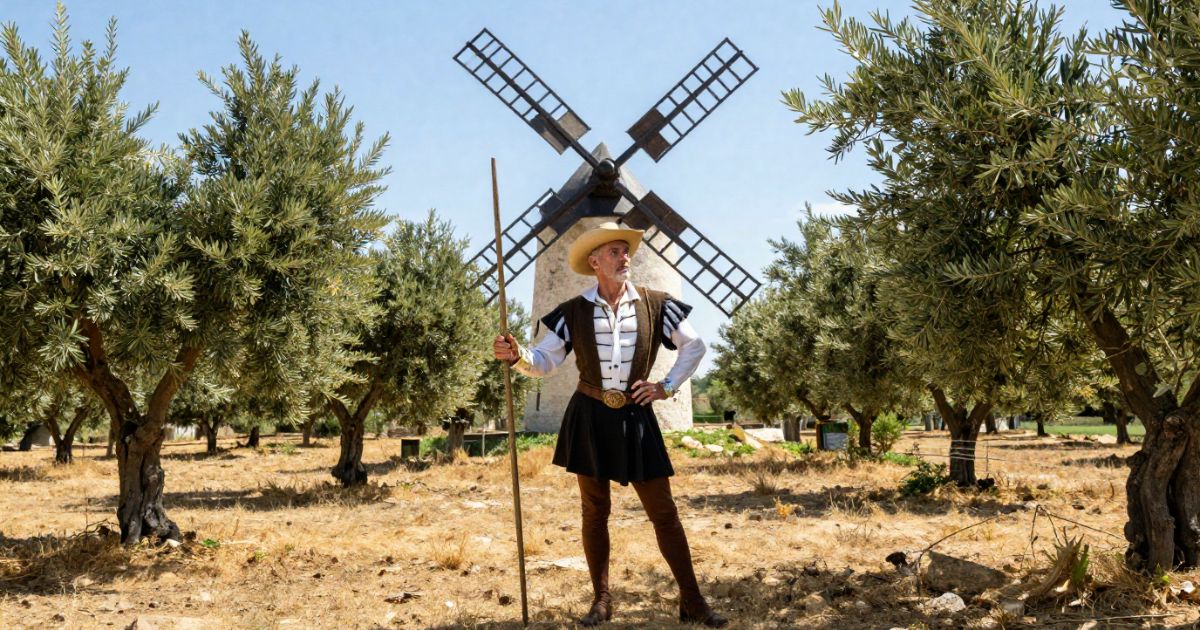
An excerpt from the original text.(complete · 3893 words)
HEREIN IS SET DOWN THE BRAYING ADVENTURE, AND THE DROLL ONE OF THE
PUPPET-SHOWMAN, TOGETHER WITH THE MEMORABLE DIVINATIONS OF THE DIVINING
APE
Don Quixote’s bread would not bake, as the common saying is, until he
had heard and learned the curious things promised by the man who
carried the arms. He went to seek him where the innkeeper said he was
and having found him, bade him say now at any rate what he had to say
in answer to the question he had asked him on the road. “The tale of my
wonders must be taken more leisurely and not standing,” said the man;
“let me finish foddering my beast, good sir; and then I’ll tell you
things that will astonish you.”
“Don’t wait for that,” said Don Quixote; “I’ll help you in everything,”
and so he did, sifting the barley for him and cleaning out the manger;
a degree of humility which made the other feel bound to tell him with a
good grace what he had asked; so seating himself on a bench, with Don
Quixote beside him, and the cousin, the page, Sancho Panza, and the
landlord, for a senate and an audience, he began his story in this way:
“You must know that in a village four leagues and a half from this inn,
it so happened that one of the regidors, by the tricks and roguery of a
servant girl of his (it’s too long a tale to tell), lost an ass; and
though he did all he possibly could to find it, it was all to no
purpose. A fortnight might have gone by, so the story goes, since the
ass had been missing, when, as the regidor who had lost it was standing
in the plaza, another regidor of the same town said to him, ‘Pay me for
good news, gossip; your ass has turned up.’ ‘That I will, and well,
gossip,’ said the other; ‘but tell us, where has he turned up?’ ‘In the
forest,’ said the finder; ‘I saw him this morning without pack-saddle
or harness of any sort, and so lean that it went to one’s heart to see
him. I tried to drive him before me and bring him to you, but he is
already so wild and shy that when I went near him he made off into the
thickest part of the forest. If you have a mind that we two should go
back and look for him, let me put up this she-ass at my house and I’ll
be back at once.’ ‘You will be doing me a great kindness,’ said the
owner of the ass, ‘and I’ll try to pay it back in the same coin.’ It is
with all these circumstances, and in the very same way I am telling it
now, that those who know all about the matter tell the story. Well
then, the two regidors set off on foot, arm in arm, for the forest, and
coming to the place where they hoped to find the ass they could not
find him, nor was he to be seen anywhere about, search as they might.
Seeing, then, that there was no sign of him, the regidor who had seen
him said to the other, ‘Look here, gossip; a plan has occurred to me,
by which, beyond a doubt, we shall manage to discover the animal, even
if he is stowed away in the bowels of the earth, not to say the forest.
Here it is. I can bray to perfection, and if you can ever so little,
the thing’s as good as done.’ ‘Ever so little did you say, gossip?’
said the other; ‘by God, I’ll not give in to anybody, not even to the
asses themselves.’ ‘We’ll soon see,’ said the second regidor, ‘for my
plan is that you should go one side of the forest, and I the other, so
as to go all round about it; and every now and then you will bray and I
will bray; and it cannot be but that the ass will hear us, and answer
us if he is in the forest.’ To which the owner of the ass replied,
‘It’s an excellent plan, I declare, gossip, and worthy of your great
genius;’ and the two separating as agreed, it so fell out that they
brayed almost at the same moment, and each, deceived by the braying of
the other, ran to look, fancying the ass had turned up at last. When
they came in sight of one another, said the loser, ‘Is it possible,
gossip, that it was not my ass that brayed?’ ‘No, it was I,’ said the
other. ‘Well then, I can tell you, gossip,’ said the ass’s owner, ‘that
between you and an ass there is not an atom of difference as far as
braying goes, for I never in all my life saw or heard anything more
natural.’ ‘Those praises and compliments belong to you more justly than
to me, gossip,’ said the inventor of the plan; ‘for, by the God that
made me, you might give a couple of brays odds to the best and most
finished brayer in the world; the tone you have got is deep, your voice
is well kept up as to time and pitch, and your finishing notes come
thick and fast; in fact, I own myself beaten, and yield the palm to
you, and give in to you in this rare accomplishment.’ ‘Well then,’ said
the owner, ‘I’ll set a higher value on myself for the future, and
consider that I know something, as I have an excellence of some sort;
for though I always thought I brayed well, I never supposed I came up
to the pitch of perfection you say.’ ‘And I say too,’ said the second,
‘that there are rare gifts going to loss in the world, and that they
are ill bestowed upon those who don’t know how to make use of them.’
‘Ours,’ said the owner of the ass, ‘unless it is in cases like this we
have now in hand, cannot be of any service to us, and even in this God
grant they may be of some use.’ So saying they separated, and took to
their braying once more, but every instant they were deceiving one
another, and coming to meet one another again, until they arranged by
way of countersign, so as to know that it was they and not the ass, to
give two brays, one after the other. In this way, doubling the brays at
every step, they made the complete circuit of the forest, but the lost
ass never gave them an answer or even the sign of one. How could the
poor ill-starred brute have answered, when, in the thickest part of the
forest, they found him devoured by wolves? As soon as he saw him his
owner said, ‘I was wondering he did not answer, for if he wasn’t dead
he’d have brayed when he heard us, or he’d have been no ass; but for
the sake of having heard you bray to such perfection, gossip, I count
the trouble I have taken to look for him well bestowed, even though I
have found him dead.’ ‘It’s in a good hand, gossip,’ said the other;
‘if the abbot sings well, the acolyte is not much behind him.’ So they
returned disconsolate and hoarse to their village, where they told
their friends, neighbours, and acquaintances what had befallen them in
their search for the ass, each crying up the other’s perfection in
braying. The whole story came to be known and spread abroad through the
villages of the neighbourhood; and the devil, who never sleeps, with
his love for sowing dissensions and scattering discord everywhere,
blowing mischief about and making quarrels out of nothing, contrived to
make the people of the other towns fall to braying whenever they saw
anyone from our village, as if to throw the braying of our regidors in
our teeth. Then the boys took to it, which was the same thing for it as
getting into the hands and mouths of all the devils of hell; and
braying spread from one town to another in such a way that the men of
the braying town are as easy to be known as blacks are to be known from
whites, and the unlucky joke has gone so far that several times the
scoffed have come out in arms and in a body to do battle with the
scoffers, and neither king nor rook, fear nor shame, can mend matters.
To-morrow or the day after, I believe, the men of my town, that is, of
the braying town, are going to take the field against another village
two leagues away from ours, one of those that persecute us most; and
that we may turn out well prepared I have bought these lances and
halberds you have seen. These are the curious things I told you I had
to tell, and if you don’t think them so, I have got no others;” and
with this the worthy fellow brought his story to a close.
Just at this moment there came in at the gate of the inn a man entirely
clad in chamois leather, hose, breeches, and doublet, who said in a
loud voice, “Señor host, have you room? Here’s the divining ape and the
show of the Release of Melisendra just coming.”
“Ods body!” said the landlord, “why, it’s Master Pedro! We’re in for a
grand night!” I forgot to mention that the said Master Pedro had his
left eye and nearly half his cheek covered with a patch of green
taffety, showing that something ailed all that side. “Your worship is
welcome, Master Pedro,” continued the landlord; “but where are the ape
and the show, for I don’t see them?” “They are close at hand,” said he
in the chamois leather, “but I came on first to know if there was any
room.” “I’d make the Duke of Alva himself clear out to make room for
Master Pedro,” said the landlord; “bring in the ape and the show;
there’s company in the inn to-night that will pay to see that and the
cleverness of the ape.” “So be it by all means,” said the man with the
patch; “I’ll lower the price, and be well satisfied if I only pay my
expenses; and now I’ll go back and hurry on the cart with the ape and
the show;” and with this he went out of the inn.
Don Quixote at once asked the landlord what this Master Pedro was, and
what was the show and what was the ape he had with him; which the
landlord replied, “This is a famous puppet-showman, who for some time
past has been going about this Mancha de Aragon, exhibiting a show of
the release of Melisendra by the famous Don Gaiferos, one of the best
and best-represented stories that have been seen in this part of the
kingdom for many a year; he has also with him an ape with the most
extraordinary gift ever seen in an ape or imagined in a human being;
for if you ask him anything, he listens attentively to the question,
and then jumps on his master’s shoulder, and pressing close to his ear
tells him the answer which Master Pedro then delivers. He says a great
deal more about things past than about things to come; and though he
does not always hit the truth in every case, most times he is not far
wrong, so that he makes us fancy he has got the devil in him. He gets
two reals for every question if the ape answers; I mean if his master
answers for him after he has whispered into his ear; and so it is
believed that this same Master Pedro is very rich. He is a ‘gallant
man’ as they say in Italy, and good company, and leads the finest life
in the world; talks more than six, drinks more than a dozen, and all by
his tongue, and his ape, and his show.”
Master Pedro now came back, and in a cart followed the show and the
ape—a big one, without a tail and with buttocks as bare as felt, but
not vicious-looking. As soon as Don Quixote saw him, he asked him, “Can
you tell me, sir fortune-teller, what fish do we catch, and how will it
be with us? See, here are my two reals,” and he bade Sancho give them
to Master Pedro; but he answered for the ape and said, “Señor, this
animal does not give any answer or information touching things that are
to come; of things past he knows something, and more or less of things
present.”
“Gad,” said Sancho, “I would not give a farthing to be told what’s past
with me, for who knows that better than I do myself? And to pay for
being told what I know would be mighty foolish. But as you know things
present, here are my two reals, and tell me, most excellent sir ape,
what is my wife Teresa Panza doing now, and what is she diverting
herself with?”
Master Pedro refused to take the money, saying, “I will not receive
payment in advance or until the service has been first rendered;” and
then with his right hand he gave a couple of slaps on his left
shoulder, and with one spring the ape perched himself upon it, and
putting his mouth to his master’s ear began chattering his teeth
rapidly; and having kept this up as long as one would be saying a
credo, with another spring he brought himself to the ground, and the
same instant Master Pedro ran in great haste and fell upon his knees
before Don Quixote, and embracing his legs exclaimed, “These legs do I
embrace as I would embrace the two pillars of Hercules, O illustrious
reviver of knight-errantry, so long consigned to oblivion! O never yet
duly extolled knight, Don Quixote of La Mancha, courage of the
faint-hearted, prop of the tottering, arm of the fallen, staff and
counsel of all who are unfortunate!”
Don Quixote was thunderstruck, Sancho astounded, the cousin staggered,
the page astonished, the man from the braying town agape, the landlord
in perplexity, and, in short, everyone amazed at the words of the
puppet-showman, who went on to say, “And thou, worthy Sancho Panza, the
best squire and squire to the best knight in the world! Be of good
cheer, for thy good wife Teresa is well, and she is at this moment
hackling a pound of flax; and more by token she has at her left hand a
jug with a broken spout that holds a good drop of wine, with which she
solaces herself at her work.”
“That I can well believe,” said Sancho. “She is a lucky one, and if it
was not for her jealousy I would not change her for the giantess
Andandona, who by my master’s account was a very clever and worthy
woman; my Teresa is one of those that won’t let themselves want for
anything, though their heirs may have to pay for it.”
“Now I declare,” said Don Quixote, “he who reads much and travels much
sees and knows a great deal. I say so because what amount of persuasion
could have persuaded me that there are apes in the world that can
divine as I have seen now with my own eyes? For I am that very Don
Quixote of La Mancha this worthy animal refers to, though he has gone
rather too far in my praise; but whatever I may be, I thank heaven that
it has endowed me with a tender and compassionate heart, always
disposed to do good to all and harm to none.”
“If I had money,” said the page, “I would ask señor ape what will
happen to me in the peregrination I am making.”
To this Master Pedro, who had by this time risen from Don Quixote’s
feet, replied, “I have already said that this little beast gives no
answer as to the future; but if he did, not having money would be of no
consequence, for to oblige Señor Don Quixote, here present, I would
give up all the profits in the world. And now, because I have promised
it, and to afford him pleasure, I will set up my show and offer
entertainment to all who are in the inn, without any charge whatever.”
As soon as he heard this, the landlord, delighted beyond measure,
pointed out a place where the show might be fixed, which was done at
once.
Don Quixote was not very well satisfied with the divinations of the
ape, as he did not think it proper that an ape should divine anything,
either past or future; so while Master Pedro was arranging the show, he
retired with Sancho into a corner of the stable, where, without being
overheard by anyone, he said to him, “Look here, Sancho, I have been
seriously thinking over this ape’s extraordinary gift, and have come to
the conclusion that beyond doubt this Master Pedro, his master, has a
pact, tacit or express, with the devil.”
“If the packet is express from the devil,” said Sancho, “it must be a
very dirty packet no doubt; but what good can it do Master Pedro to
have such packets?”
“Thou dost not understand me, Sancho,” said Don Quixote; “I only mean
he must have made some compact with the devil to infuse this power into
the ape, that he may get his living, and after he has grown rich he
will give him his soul, which is what the enemy of mankind wants; this
I am led to believe by observing that the ape only answers about things
past or present, and the devil’s knowledge extends no further; for the
future he knows only by guesswork, and that not always; for it is
reserved for God alone to know the times and the seasons, and for him
there is neither past nor future; all is present. This being as it is,
it is clear that this ape speaks by the spirit of the devil; and I am
astonished they have not denounced him to the Holy Office, and put him
to the question, and forced it out of him by whose virtue it is that he
divines; because it is certain this ape is not an astrologer; neither
his master nor he sets up, or knows how to set up, those figures they
call judiciary, which are now so common in Spain that there is not a
jade, or page, or old cobbler, that will not undertake to set up a
figure as readily as pick up a knave of cards from the ground, bringing
to nought the marvellous truth of the science by their lies and
ignorance. I know of a lady who asked one of these figure schemers
whether her little lap-dog would be in pup and would breed, and how
many and of what colour the little pups would be. To which señor
astrologer, after having set up his figure, made answer that the bitch
would be in pup, and would drop three pups, one green, another bright
red, and the third parti-coloured, provided she conceived between
eleven and twelve either of the day or night, and on a Monday or
Saturday; but as things turned out, two days after this the bitch died
of a surfeit, and señor planet-ruler had the credit all over the place
of being a most profound astrologer, as most of these planet-rulers
have.”
“Still,” said Sancho, “I would be glad if your worship would make
Master Pedro ask his ape whether what happened your worship in the cave
of Montesinos is true; for, begging your worship’s pardon, I, for my
part, take it to have been all flam and lies, or at any rate something
you dreamt.”
“That may be,” replied Don Quixote; “however, I will do what you
suggest; though I have my own scruples about it.”
At this point Master Pedro came up in quest of Don Quixote, to tell him
the show was now ready and to come and see it, for it was worth seeing.
Don Quixote explained his wish, and begged him to ask his ape at once
to tell him whether certain things which had happened to him in the
cave of Montesinos were dreams or realities, for to him they appeared
to partake of both. Upon this Master Pedro, without answering, went
back to fetch the ape, and, having placed it in front of Don Quixote
and Sancho, said: “See here, señor ape, this gentleman wishes to know
whether certain things which happened to him in the cave called the
cave of Montesinos were false or true.” On his making the usual sign
the ape mounted on his left shoulder and seemed to whisper in his ear,
and Master Pedro said at once, “The ape says that the things you saw or
that happened to you in that cave are, part of them false, part true;
and that he only knows this and no more as regards this question; but
if your worship wishes to know more, on Friday next he will answer all
that may be asked him, for his virtue is at present exhausted, and will
not return to him till Friday, as he has said.”
“Did I not say, señor,” said Sancho, “that I could not bring myself to
believe that all your worship said about the adventures in the cave was
true, or even the half of it?”
“The course of events will tell, Sancho,” replied Don Quixote; “time,
that discloses all things, leaves nothing that it does not drag into
the light of day, though it be buried in the bosom of the earth. But
enough of that for the present; let us go and see Master Pedro’s show,
for I am sure there must be something novel in it.”
“Something!” said Master Pedro; “this show of mine has sixty thousand
novel things in it; let me tell you, Señor Don Quixote, it is one of
the best-worth-seeing things in the world this day; but operibus
credite et non verbis, and now let’s get to work, for it is growing
late, and we have a great deal to do and to say and show.”
Don Quixote and Sancho obeyed him and went to where the show was
already put up and uncovered, set all around with lighted wax tapers
which made it look splendid and bright. When they came to it Master
Pedro ensconced himself inside it, for it was he who had to work the
puppets, and a boy, a servant of his, posted himself outside to act as
showman and explain the mysteries of the exhibition, having a wand in
his hand to point to the figures as they came out. And so, all who were
in the inn being arranged in front of the show, some of them standing,
and Don Quixote, Sancho, the page, and cousin, accommodated with the
best places, the interpreter began to say what he will hear or see who
reads or hears the next chapter.
p25e.jpg (28K)
Master this chapter. Complete your experience
Purchase the complete book to access all chapters and support classic literature
As an Amazon Associate, we earn a small commission from qualifying purchases at no additional cost to you.
Available in paperback, hardcover, and e-book formats
Let's Analyse the Pattern
When our unique abilities become weapons others use against us, turning our strengths into sources of shame or exclusion.
Why This Matters
Connect literature to life
This chapter teaches how to identify when others turn your strengths into weapons against you.
Practice This Today
This week, notice when someone uses your positive qualities as criticism—like calling your thoroughness 'obsessive' or your helpfulness 'meddling'—and practice naming the pattern out loud.
Now let's explore the literary elements.
Key Quotes & Analysis
"The tale of my wonders must be taken more leisurely and not standing"
Context: When Don Quixote eagerly asks to hear his story immediately
Shows how good storytellers control the pace and setting to maximize impact. The man knows his story is worth the wait and creates anticipation by making Don Quixote help with chores first.
In Today's Words:
Hold on, this is a good story and I'm going to tell it right - sit down and get comfortable first.
"Don Quixote's bread would not bake, as the common saying is, until he had heard and learned the curious things promised"
Context: Describing Don Quixote's impatience to hear the promised story
Uses a folk saying to show how curiosity can consume us completely. Don Quixote can't focus on anything else until he gets the information he was promised.
In Today's Words:
Don Quixote couldn't concentrate on anything else until he heard what the guy had promised to tell him.
"It was part true and part false"
Context: When asked about Don Quixote's experience in the Cave of Montesinos
A perfect non-answer that sounds wise but says nothing definitive. This response lets people interpret it however they want while protecting the fortune-teller from being wrong.
In Today's Words:
Some of it happened, some of it didn't - you figure out which parts.
Thematic Threads
Identity
In This Chapter
The town's identity becomes defined by their embarrassing braying ability, showing how communities can become trapped by single defining characteristics
Development
Builds on Don Quixote's struggle with knight identity, now showing how group identity can also become a burden
In Your Life:
You might find your workplace or family defining you by one mistake or quirk rather than your full capabilities
Deception
In This Chapter
Master Pedro's 'fortune-telling' ape uses clever observation and general statements to appear magical, preying on people's desire to know the unknown
Development
Continues the theme of reality versus illusion, but shifts from Don Quixote's self-deception to others deceiving him
In Your Life:
You encounter this in psychics, social media 'experts,' or anyone who uses vague statements to seem more knowledgeable than they are
Social Expectations
In This Chapter
The townspeople feel shame about their braying because of how others perceive them, showing how external judgment shapes self-worth
Development
Deepens the exploration of how society's opinions influence individual behavior and community dynamics
In Your Life:
You might avoid activities you enjoy or hide parts of your personality because of how others might judge you
Class
In This Chapter
Master Pedro profits from entertaining the upper classes with tricks that exploit their curiosity and gullibility
Development
Shows how class dynamics create opportunities for manipulation and entertainment across social boundaries
In Your Life:
You see this in how different social classes are entertained differently, and how 'common sense' varies by social position
Human Relationships
In This Chapter
The conflict between towns shows how shared experiences can both unite communities internally and divide them from outsiders
Development
Explores how relationships form around shared identity markers, even embarrassing ones
In Your Life:
You might find your strongest bonds with people who share your struggles, mistakes, or unusual experiences
You now have the context. Time to form your own thoughts.
Discussion Questions
- 1
How did the town officials' ability to bray perfectly go from being helpful to becoming a source of shame?
analysis • surface - 2
Why do you think neighboring towns chose braying as their way to mock these people? What does this reveal about how communities create identity through shared experiences?
analysis • medium - 3
Where have you seen people's strengths or unique qualities turned against them in your workplace, school, or community?
application • medium - 4
If you discovered you had a talent that others might use to embarrass you, how would you decide when and with whom to share it?
application • deep - 5
What does Master Pedro's puppet show trick teach us about why people want to believe in fortune-telling and easy answers, even when they're suspicious?
reflection • deep
Critical Thinking Exercise
Map Your Talent Vulnerabilities
List three of your strongest skills or unique qualities. For each one, write down how someone could potentially use that strength against you or turn it into criticism. Then identify one trusted person you could safely share each talent with and one situation where you'd want to keep it private.
Consider:
- •Consider both obvious talents and subtle strengths others might not immediately notice
- •Think about past situations where your abilities were criticized or minimized
- •Remember that the same trait can be seen as positive or negative depending on who's judging
Journaling Prompt
Write about a time when someone used one of your strengths against you. How did you handle it, and what would you do differently now?
Coming Up Next...
Chapter 98: When Reality and Fantasy Collide
Master Pedro's puppet show is about to begin, featuring the dramatic tale of Melisendra's rescue. But will Don Quixote be able to simply watch the performance, or will his knight-errant nature compel him to intervene in what he sees unfolding before his eyes?