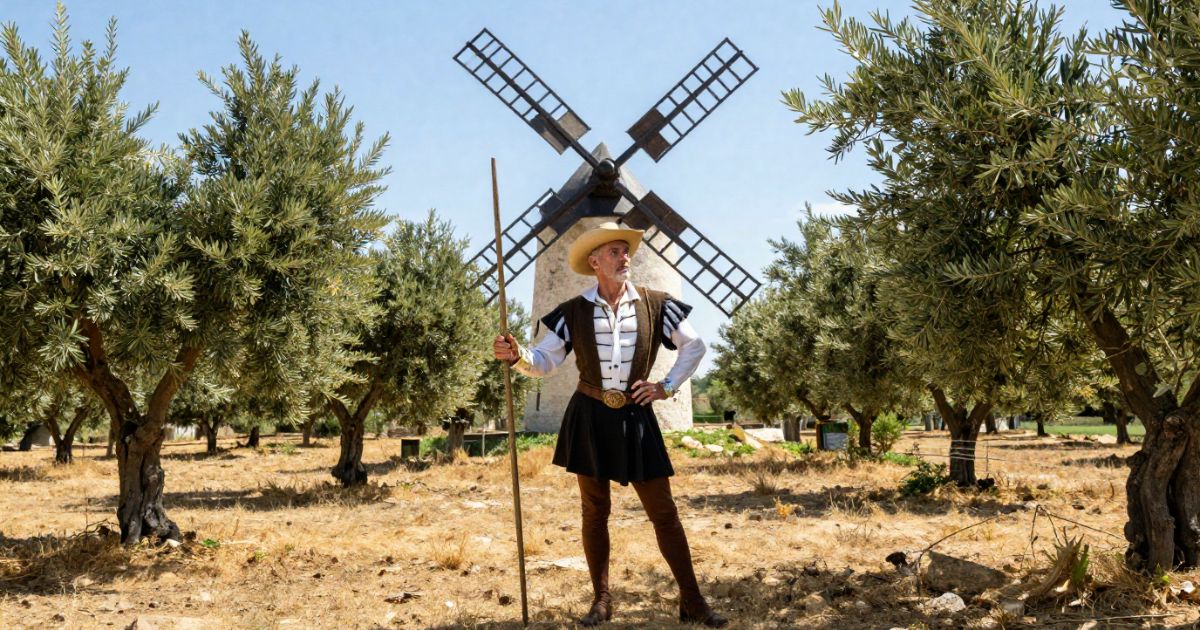
An excerpt from the original text.(complete · 3108 words)
WHEREIN IS RELATED THE GRAND ADVENTURE OF THE CAVE OF MONTESINOS IN THE
HEART OF LA MANCHA, WHICH THE VALIANT DON QUIXOTE BROUGHT TO A HAPPY
TERMINATION
Many and great were the attentions shown to Don Quixote by the newly
married couple, who felt themselves under an obligation to him for
coming forward in defence of their cause; and they exalted his wisdom
to the same level with his courage, rating him as a Cid in arms, and a
Cicero in eloquence. Worthy Sancho enjoyed himself for three days at
the expense of the pair, from whom they learned that the sham wound was
not a scheme arranged with the fair Quiteria, but a device of
Basilio’s, who counted on exactly the result they had seen; he
confessed, it is true, that he had confided his idea to some of his
friends, so that at the proper time they might aid him in his purpose
and insure the success of the deception.
“That,” said Don Quixote, “is not and ought not to be called deception
which aims at virtuous ends;” and the marriage of lovers he maintained
to be a most excellent end, reminding them, however, that love has no
greater enemy than hunger and constant want; for love is all gaiety,
enjoyment, and happiness, especially when the lover is in the
possession of the object of his love, and poverty and want are the
declared enemies of all these; which he said to urge Señor Basilio to
abandon the practice of those accomplishments he was skilled in, for
though they brought him fame, they brought him no money, and apply
himself to the acquisition of wealth by legitimate industry, which will
never fail those who are prudent and persevering. The poor man who is a
man of honour (if indeed a poor man can be a man of honour) has a jewel
when he has a fair wife, and if she is taken from him, his honour is
taken from him and slain. The fair woman who is a woman of honour, and
whose husband is poor, deserves to be crowned with the laurels and
crowns of victory and triumph. Beauty by itself attracts the desires of
all who behold it, and the royal eagles and birds of towering flight
stoop on it as on a dainty lure; but if beauty be accompanied by want
and penury, then the ravens and the kites and other birds of prey
assail it, and she who stands firm against such attacks well deserves
to be called the crown of her husband. “Remember, O prudent Basilio,”
added Don Quixote, “it was the opinion of a certain sage, I know not
whom, that there was not more than one good woman in the whole world;
and his advice was that each one should think and believe that this one
good woman was his own wife, and in this way he would live happy. I
myself am not married, nor, so far, has it ever entered my thoughts to
be so; nevertheless I would venture to give advice to anyone who might
ask it, as to the mode in which he should seek a wife such as he would
be content to marry. The first thing I would recommend him, would be to
look to good name rather than to wealth, for a good woman does not win
a good name merely by being good, but by letting it be seen that she is
so, and open looseness and freedom do much more damage to a woman’s
honour than secret depravity. If you take a good woman into your house
it will be an easy matter to keep her good, and even to make her still
better; but if you take a bad one you will find it hard work to mend
her, for it is no very easy matter to pass from one extreme to another.
I do not say it is impossible, but I look upon it as difficult.”
Sancho, listening to all this, said to himself, “This master of mine,
when I say anything that has weight and substance, says I might take a
pulpit in hand, and go about the world preaching fine sermons; but I
say of him that, when he begins stringing maxims together and giving
advice not only might he take a pulpit in hand, but two on each finger,
and go into the market-places to his heart’s content. Devil take you
for a knight-errant, what a lot of things you know! I used to think in
my heart that the only thing he knew was what belonged to his chivalry;
but there is nothing he won’t have a finger in.”
Sancho muttered this somewhat aloud, and his master overheard him, and
asked, “What art thou muttering there, Sancho?”
“I’m not saying anything or muttering anything,” said Sancho; “I was
only saying to myself that I wish I had heard what your worship has
said just now before I married; perhaps I’d say now, ‘The ox that’s
loose licks himself well.’”
“Is thy Teresa so bad then, Sancho?”
“She is not very bad,” replied Sancho; “but she is not very good; at
least she is not as good as I could wish.”
“Thou dost wrong, Sancho,” said Don Quixote, “to speak ill of thy wife;
for after all she is the mother of thy children.” “We are quits,”
returned Sancho; “for she speaks ill of me whenever she takes it into
her head, especially when she is jealous; and Satan himself could not
put up with her then.”
In fine, they remained three days with the newly married couple, by
whom they were entertained and treated like kings. Don Quixote begged
the fencing licentiate to find him a guide to show him the way to the
cave of Montesinos, as he had a great desire to enter it and see with
his own eyes if the wonderful tales that were told of it all over the
country were true. The licentiate said he would get him a cousin of his
own, a famous scholar, and one very much given to reading books of
chivalry, who would have great pleasure in conducting him to the mouth
of the very cave, and would show him the lakes of Ruidera, which were
likewise famous all over La Mancha, and even all over Spain; and he
assured him he would find him entertaining, for he was a youth who
could write books good enough to be printed and dedicated to princes.
The cousin arrived at last, leading an ass in foal, with a pack-saddle
covered with a parti-coloured carpet or sackcloth; Sancho saddled
Rocinante, got Dapple ready, and stocked his alforjas, along with which
went those of the cousin, likewise well filled; and so, commending
themselves to God and bidding farewell to all, they set out, taking the
road for the famous cave of Montesinos.
On the way Don Quixote asked the cousin of what sort and character his
pursuits, avocations, and studies were, to which he replied that he was
by profession a humanist, and that his pursuits and studies were making
books for the press, all of great utility and no less entertainment to
the nation. One was called “The Book of Liveries,” in which he
described seven hundred and three liveries, with their colours,
mottoes, and ciphers, from which gentlemen of the court might pick and
choose any they fancied for festivals and revels, without having to go
a-begging for them from anyone, or puzzling their brains, as the saying
is, to have them appropriate to their objects and purposes; “for,” said
he, “I give the jealous, the rejected, the forgotten, the absent, what
will suit them, and fit them without fail. I have another book, too,
which I shall call ‘Metamorphoses, or the Spanish Ovid,’ one of rare
and original invention, for imitating Ovid in burlesque style, I show
in it who the Giralda of Seville and the Angel of the Magdalena were,
what the sewer of Vecinguerra at Cordova was, what the bulls of
Guisando, the Sierra Morena, the Leganitos and Lavapies fountains at
Madrid, not forgetting those of the Piojo, of the Cano Dorado, and of
the Priora; and all with their allegories, metaphors, and changes, so
that they are amusing, interesting, and instructive, all at once.
Another book I have which I call ‘The Supplement to Polydore Vergil,’
which treats of the invention of things, and is a work of great
erudition and research, for I establish and elucidate elegantly some
things of great importance which Polydore omitted to mention. He forgot
to tell us who was the first man in the world that had a cold in his
head, and who was the first to try salivation for the French disease,
but I give it accurately set forth, and quote more than five-and-twenty
authors in proof of it, so you may perceive I have laboured to good
purpose and that the book will be of service to the whole world.”
Sancho, who had been very attentive to the cousin’s words, said to him,
“Tell me, señor—and God give you luck in printing your books—can you
tell me (for of course you know, as you know everything) who was the
first man that scratched his head? For to my thinking it must have been
our father Adam.”
“So it must,” replied the cousin; “for there is no doubt but Adam had a
head and hair; and being the first man in the world he would have
scratched himself sometimes.”
“So I think,” said Sancho; “but now tell me, who was the first tumbler
in the world?”
“Really, brother,” answered the cousin, “I could not at this moment say
positively without having investigated it; I will look it up when I go
back to where I have my books, and will satisfy you the next time we
meet, for this will not be the last time.”
“Look here, señor,” said Sancho, “don’t give yourself any trouble about
it, for I have just this minute hit upon what I asked you. The first
tumbler in the world, you must know, was Lucifer, when they cast or
pitched him out of heaven; for he came tumbling into the bottomless
pit.”
“You are right, friend,” said the cousin; and said Don Quixote,
“Sancho, that question and answer are not thine own; thou hast heard
them from someone else.”
“Hold your peace, señor,” said Sancho; “faith, if I take to asking
questions and answering, I’ll go on from this till to-morrow morning.
Nay! to ask foolish things and answer nonsense I needn’t go looking for
help from my neighbours.”
“Thou hast said more than thou art aware of, Sancho,” said Don Quixote;
“for there are some who weary themselves out in learning and proving
things that, after they are known and proved, are not worth a farthing
to the understanding or memory.”
In this and other pleasant conversation the day went by, and that night
they put up at a small hamlet whence it was not more than two leagues
to the cave of Montesinos, so the cousin told Don Quixote, adding, that
if he was bent upon entering it, it would be requisite for him to
provide himself with ropes, so that he might be tied and lowered into
its depths. Don Quixote said that even if it reached to the bottomless
pit he meant to see where it went to; so they bought about a hundred
fathoms of rope, and next day at two in the afternoon they arrived at
the cave, the mouth of which is spacious and wide, but full of thorn
and wild-fig bushes and brambles and briars, so thick and matted that
they completely close it up and cover it over.
On coming within sight of it the cousin, Sancho, and Don Quixote
dismounted, and the first two immediately tied the latter very firmly
with the ropes, and as they were girding and swathing him Sancho said
to him, “Mind what you are about, master mine; don’t go burying
yourself alive, or putting yourself where you’ll be like a bottle put
to cool in a well; it’s no affair or business of your worship’s to
become the explorer of this, which must be worse than a Moorish
dungeon.”
“Tie me and hold thy peace,” said Don Quixote, “for an emprise like
this, friend Sancho, was reserved for me;” and said the guide, “I beg
of you, Señor Don Quixote, to observe carefully and examine with a
hundred eyes everything that is within there; perhaps there may be some
things for me to put into my book of ‘Transformations.’”
“The drum is in hands that will know how to beat it well enough,” said
Sancho Panza.
When he had said this and finished the tying (which was not over the
armour but only over the doublet) Don Quixote observed, “It was
careless of us not to have provided ourselves with a small cattle-bell
to be tied on the rope close to me, the sound of which would show that
I was still descending and alive; but as that is out of the question
now, in God’s hand be it to guide me;” and forthwith he fell on his
knees and in a low voice offered up a prayer to heaven, imploring God
to aid him and grant him success in this to all appearance perilous and
untried adventure, and then exclaimed aloud, “O mistress of my actions
and movements, illustrious and peerless Dulcinea del Toboso, if so be
the prayers and supplications of this fortunate lover can reach thy
ears, by thy incomparable beauty I entreat thee to listen to them, for
they but ask thee not to refuse me thy favour and protection now that I
stand in such need of them. I am about to precipitate, to sink, to
plunge myself into the abyss that is here before me, only to let the
world know that while thou dost favour me there is no impossibility I
will not attempt and accomplish.” With these words he approached the
cavern, and perceived that it was impossible to let himself down or
effect an entrance except by sheer force or cleaving a passage; so
drawing his sword he began to demolish and cut away the brambles at the
mouth of the cave, at the noise of which a vast multitude of crows and
choughs flew out of it so thick and so fast that they knocked Don
Quixote down; and if he had been as much of a believer in augury as he
was a Catholic Christian he would have taken it as a bad omen and
declined to bury himself in such a place. He got up, however, and as
there came no more crows, or night-birds like the bats that flew out at
the same time with the crows, the cousin and Sancho giving him rope, he
lowered himself into the depths of the dread cavern; and as he entered
it Sancho sent his blessing after him, making a thousand crosses over
him and saying, “God, and the Peña de Francia, and the Trinity of Gaeta
guide thee, flower and cream of knights-errant. There thou goest, thou
dare-devil of the earth, heart of steel, arm of brass; once more, God
guide thee and send thee back safe, sound, and unhurt to the light of
this world thou art leaving to bury thyself in the darkness thou art
seeking there;” and the cousin offered up almost the same prayers and
supplications.
Don Quixote kept calling to them to give him rope and more rope, and
they gave it out little by little, and by the time the calls, which
came out of the cave as out of a pipe, ceased to be heard they had let
down the hundred fathoms of rope. They were inclined to pull Don
Quixote up again, as they could give him no more rope; however, they
waited about half an hour, at the end of which time they began to
gather in the rope again with great ease and without feeling any
weight, which made them fancy Don Quixote was remaining below; and
persuaded that it was so, Sancho wept bitterly, and hauled away in
great haste in order to settle the question. When, however, they had
come to, as it seemed, rather more than eighty fathoms they felt a
weight, at which they were greatly delighted; and at last, at ten
fathoms more, they saw Don Quixote distinctly, and Sancho called out to
him, saying, “Welcome back, señor, for we had begun to think you were
going to stop there to found a family.” But Don Quixote answered not a
word, and drawing him out entirely they perceived he had his eyes shut
and every appearance of being fast asleep.
They stretched him on the ground and untied him, but still he did not
awake; however, they rolled him back and forwards and shook and pulled
him about, so that after some time he came to himself, stretching
himself just as if he were waking up from a deep and sound sleep, and
looking about him he said, “God forgive you, friends; ye have taken me
away from the sweetest and most delightful existence and spectacle that
ever human being enjoyed or beheld. Now indeed do I know that all the
pleasures of this life pass away like a shadow and a dream, or fade
like the flower of the field. O ill-fated Montesinos! O sore-wounded
Durandarte! O unhappy Belerma! O tearful Guadiana, and ye O hapless
daughters of Ruidera who show in your waves the tears that flowed from
your beauteous eyes!”
The cousin and Sancho Panza listened with deep attention to the words
of Don Quixote, who uttered them as though with immense pain he drew
them up from his very bowels. They begged of him to explain himself,
and tell them what he had seen in that hell down there.
“Hell do you call it?” said Don Quixote; “call it by no such name, for
it does not deserve it, as ye shall soon see.”
He then begged them to give him something to eat, as he was very
hungry. They spread the cousin’s sackcloth on the grass, and put the
stores of the alforjas into requisition, and all three sitting down
lovingly and sociably, they made a luncheon and a supper of it all in
one; and when the sackcloth was removed, Don Quixote of La Mancha said,
“Let no one rise, and attend to me, my sons, both of you.”
p22e.jpg (48K)
Master this chapter. Complete your experience
Purchase the complete book to access all chapters and support classic literature
As an Amazon Associate, we earn a small commission from qualifying purchases at no additional cost to you.
Available in paperback, hardcover, and e-book formats
Let's Analyse the Pattern
Strategic rule-breaking that serves a higher moral purpose when conventional systems create unfair barriers.
Why This Matters
Connect literature to life
This chapter teaches how to recognize when bending rules serves justice versus serving selfishness, a crucial skill for navigating unfair systems.
Practice This Today
This week, notice when someone breaks minor rules—ask yourself whether they're serving something bigger than themselves or just gaming the system for personal gain.
Now let's explore the literary elements.
Key Quotes & Analysis
"That is not and ought not to be called deception which aims at virtuous ends"
Context: When defending Basilio's fake suicide trick to win his true love
This shows Don Quixote's complex morality - he's not just a simple dreamer but someone who thinks deeply about right and wrong. He argues that the motive matters more than the method.
In Today's Words:
It's not really lying if you're doing it for the right reasons
"Love has no greater enemy than hunger and constant want"
Context: Advising the newlyweds about marriage and practical concerns
One of Don Quixote's most realistic observations. Despite his idealistic nature, he understands that financial stress destroys relationships and that love alone isn't enough.
In Today's Words:
You can't live on love alone - money problems will kill even the strongest relationship
"My master knows more than just knight-errantry"
Context: Commenting on Don Quixote's surprisingly wise marriage advice
Sancho recognizes that beneath his master's delusions lies real wisdom and intelligence. This shows how even the most foolish-seeming people can have valuable insights.
In Today's Words:
He's crazy, but he's not stupid
Thematic Threads
Class
In This Chapter
Basilio overcomes class barriers through cunning rather than accepting defeat to Camacho's wealth
Development
Evolved from earlier themes of social mobility—now showing active resistance to class limitations
In Your Life:
You might face situations where your background or resources put you at a disadvantage in supposedly fair competitions
Deception
In This Chapter
Basilio's fake suicide is praised rather than condemned because it served true love
Development
Introduced here as morally complex—deception can be noble when serving higher purposes
In Your Life:
You might need to consider when bending rules serves justice better than rigid honesty
Reality
In This Chapter
Don Quixote's cave vision blurs the line between delusion and mystical experience
Development
Continuing evolution—reality becomes increasingly subjective and possibly magical
In Your Life:
You might question whether your deepest insights come from logic or intuition that others can't verify
Marriage
In This Chapter
Don Quixote gives practical advice about money and relationships, while Sancho hints at marital problems
Development
Developing from abstract ideals to practical realities of maintaining relationships
In Your Life:
You might find that romantic ideals clash with the daily work required to maintain partnerships
Wisdom
In This Chapter
Don Quixote shows surprising practical knowledge about marriage and money management
Development
Evolved from pure fantasy—now demonstrating real-world insight alongside delusions
In Your Life:
You might discover that people you consider unrealistic actually possess valuable practical wisdom
You now have the context. Time to form your own thoughts.
Discussion Questions
- 1
What was Basilio's plan, and why did everyone end up praising him instead of condemning him for lying?
analysis • surface - 2
Don Quixote says poverty destroys even the strongest relationships. What makes him suddenly sound so practical about money and marriage?
analysis • medium - 3
Where do you see people today using creative 'rule-bending' to overcome unfair systems or gatekeepers?
application • medium - 4
When is deception justified to achieve a good outcome? How do you tell the difference between clever strategy and harmful manipulation?
application • deep - 5
What does Basilio's success teach us about the difference between playing by the rules and playing to win?
reflection • deep
Critical Thinking Exercise
Map the Power Dynamic
Think of a situation where you felt blocked by unfair rules or gatekeepers. Draw a simple diagram showing who had the real power, what they actually wanted, and what creative approach might have changed the outcome. Consider how Basilio identified what Quiteria and her father truly valued beyond just following social expectations.
Consider:
- •Focus on the decision-makers' real motivations, not just their stated rules
- •Look for emotional or practical needs that conventional approaches miss
- •Consider what you're willing to risk and what ethical lines you won't cross
Journaling Prompt
Write about a time when you followed the 'proper' process but got nowhere. What would a Basilio-style approach have looked like in that situation?
Coming Up Next...
Chapter 95: Don Quixote's Impossible Cave Vision
Don Quixote prepares to reveal the incredible wonders he witnessed in the cave's depths - visions so extraordinary that even his companions will question whether they're truth or the product of an increasingly unhinged imagination. What he describes will challenge everything we think we know about reality and fantasy.