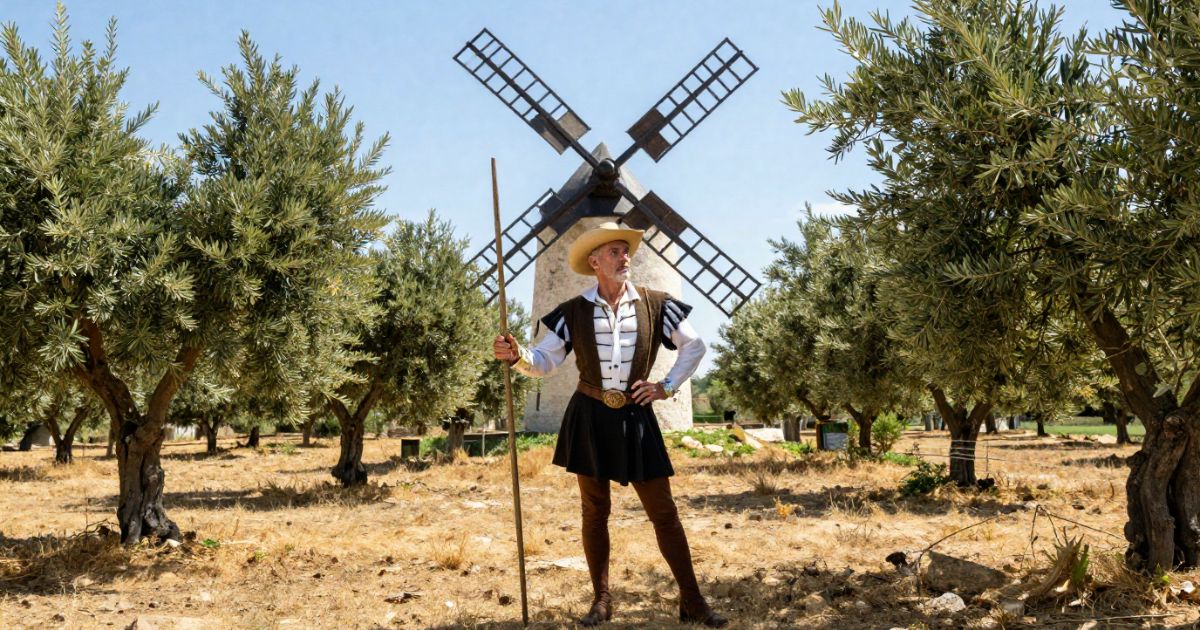
An excerpt from the original text.(complete · 2498 words)
WHICH CAMACHO’S WEDDING IS CONTINUED, WITH OTHER DELIGHTFUL
INCIDENTS
While Don Quixote and Sancho were engaged in the discussion set forth
the last chapter, they heard loud shouts and a great noise, which were
uttered and made by the men on the mares as they went at full gallop,
shouting, to receive the bride and bridegroom, who were approaching
with musical instruments and pageantry of all sorts around them, and
accompanied by the priest and the relatives of both, and all the most
distinguished people of the surrounding villages. When Sancho saw the
bride, he exclaimed, “By my faith, she is not dressed like a country
girl, but like some fine court lady; egad, as well as I can make out,
the patena she wears rich coral, and her green Cuenca stuff is
thirty-pile velvet; and then the white linen trimming—by my oath, but
it’s satin! Look at her hands—jet rings on them! May I never have luck
if they’re not gold rings, and real gold, and set with pearls as white
as a curdled milk, and every one of them worth an eye of one’s head!
Whoreson baggage, what hair she has! if it’s not a wig, I never saw
longer or fairer all the days of my life. See how bravely she bears
herself—and her shape! Wouldn’t you say she was like a walking palm
tree loaded with clusters of dates? for the trinkets she has hanging
from her hair and neck look just like them. I swear in my heart she is
a brave lass, and fit ‘to pass over the banks of Flanders.’”
Don Quixote laughed at Sancho’s boorish eulogies and thought that,
saving his lady Dulcinea del Toboso, he had never seen a more beautiful
woman. The fair Quiteria appeared somewhat pale, which was, no doubt,
because of the bad night brides always pass dressing themselves out for
their wedding on the morrow. They advanced towards a theatre that stood
on one side of the meadow decked with carpets and boughs, where they
were to plight their troth, and from which they were to behold the
dances and plays; but at the moment of their arrival at the spot they
heard a loud outcry behind them, and a voice exclaiming, “Wait a
little, ye, as inconsiderate as ye are hasty!” At these words all
turned round, and perceived that the speaker was a man clad in what
seemed to be a loose black coat garnished with crimson patches like
flames. He was crowned (as was presently seen) with a crown of gloomy
cypress, and in his hand he held a long staff. As he approached he was
recognised by everyone as the gay Basilio, and all waited anxiously to
see what would come of his words, in dread of some catastrophe in
consequence of his appearance at such a moment. He came up at last
weary and breathless, and planting himself in front of the bridal pair,
drove his staff, which had a steel spike at the end, into the ground,
and, with a pale face and eyes fixed on Quiteria, he thus addressed her
in a hoarse, trembling voice:
“Well dost thou know, ungrateful Quiteria, that according to the holy
law we acknowledge, so long as live thou canst take no husband; nor art
thou ignorant either that, in my hopes that time and my own exertions
would improve my fortunes, I have never failed to observe the respect
due to thy honour; but thou, casting behind thee all thou owest to my
true love, wouldst surrender what is mine to another whose wealth
serves to bring him not only good fortune but supreme happiness; and
now to complete it (not that I think he deserves it, but inasmuch as
heaven is pleased to bestow it upon him), I will, with my own hands, do
away with the obstacle that may interfere with it, and remove myself
from between you. Long live the rich Camacho! many a happy year may he
live with the ungrateful Quiteria! and let the poor Basilio die,
Basilio whose poverty clipped the wings of his happiness, and brought
him to the grave!”
And so saying, he seized the staff he had driven into the ground, and
leaving one half of it fixed there, showed it to be a sheath that
concealed a tolerably long rapier; and, what may be called its hilt
being planted in the ground, he swiftly, coolly, and deliberately threw
himself upon it, and in an instant the bloody point and half the steel
blade appeared at his back, the unhappy man falling to the earth bathed
in his blood, and transfixed by his own weapon.
His friends at once ran to his aid, filled with grief at his misery and
sad fate, and Don Quixote, dismounting from Rocinante, hastened to
support him, and took him in his arms, and found he had not yet ceased
to breathe. They were about to draw out the rapier, but the priest who
was standing by objected to its being withdrawn before he had confessed
him, as the instant of its withdrawal would be that of this death.
Basilio, however, reviving slightly, said in a weak voice, as though in
pain, “If thou wouldst consent, cruel Quiteria, to give me thy hand as
my bride in this last fatal moment, I might still hope that my rashness
would find pardon, as by its means I attained the bliss of being
thine.”
Hearing this the priest bade him think of the welfare of his soul
rather than of the cravings of the body, and in all earnestness implore
God’s pardon for his sins and for his rash resolve; to which Basilio
replied that he was determined not to confess unless Quiteria first
gave him her hand in marriage, for that happiness would compose his
mind and give him courage to make his confession.
Don Quixote hearing the wounded man’s entreaty, exclaimed aloud that
what Basilio asked was just and reasonable, and moreover a request that
might be easily complied with; and that it would be as much to Señor
Camacho’s honour to receive the lady Quiteria as the widow of the brave
Basilio as if he received her direct from her father.
“In this case,” said he, “it will be only to say ‘yes,’ and no
consequences can follow the utterance of the word, for the nuptial
couch of this marriage must be the grave.”
Camacho was listening to all this, perplexed and bewildered and not
knowing what to say or do; but so urgent were the entreaties of
Basilio’s friends, imploring him to allow Quiteria to give him her
hand, so that his soul, quitting this life in despair, should not be
lost, that they moved, nay, forced him, to say that if Quiteria were
willing to give it he was satisfied, as it was only putting off the
fulfillment of his wishes for a moment. At once all assailed Quiteria
and pressed her, some with prayers, and others with tears, and others
with persuasive arguments, to give her hand to poor Basilio; but she,
harder than marble and more unmoved than any statue, seemed unable or
unwilling to utter a word, nor would she have given any reply had not
the priest bade her decide quickly what she meant to do, as Basilio now
had his soul at his teeth, and there was no time for hesitation.
On this the fair Quiteria, to all appearance distressed, grieved, and
repentant, advanced without a word to where Basilio lay, his eyes
already turned in his head, his breathing short and painful, murmuring
the name of Quiteria between his teeth, and apparently about to die
like a heathen and not like a Christian. Quiteria approached him, and
kneeling, demanded his hand by signs without speaking. Basilio opened
his eyes and gazing fixedly at her, said, “O Quiteria, why hast thou
turned compassionate at a moment when thy compassion will serve as a
dagger to rob me of life, for I have not now the strength left either
to bear the happiness thou givest me in accepting me as thine, or to
suppress the pain that is rapidly drawing the dread shadow of death
over my eyes? What I entreat of thee, O thou fatal star to me, is that
the hand thou demandest of me and wouldst give me, be not given out of
complaisance or to deceive me afresh, but that thou confess and declare
that without any constraint upon thy will thou givest it to me as to
thy lawful husband; for it is not meet that thou shouldst trifle with
me at such a moment as this, or have recourse to falsehoods with one
who has dealt so truly by thee.”
While uttering these words he showed such weakness that the bystanders
expected each return of faintness would take his life with it. Then
Quiteria, overcome with modesty and shame, holding in her right hand
the hand of Basilio, said, “No force would bend my will; as freely,
therefore, as it is possible for me to do so, I give thee the hand of a
lawful wife, and take thine if thou givest it to me of thine own free
will, untroubled and unaffected by the calamity thy hasty act has
brought upon thee.”
“Yes, I give it,” said Basilio, “not agitated or distracted, but with
unclouded reason that heaven is pleased to grant me, thus do I give
myself to be thy husband.”
“And I give myself to be thy wife,” said Quiteria, “whether thou livest
many years, or they carry thee from my arms to the grave.”
“For one so badly wounded,” observed Sancho at this point, “this young
man has a great deal to say; they should make him leave off billing and
cooing, and attend to his soul; for to my thinking he has it more on
his tongue than at his teeth.”
Basilio and Quiteria having thus joined hands, the priest, deeply moved
and with tears in his eyes, pronounced the blessing upon them, and
implored heaven to grant an easy passage to the soul of the newly
wedded man, who, the instant he received the blessing, started nimbly
to his feet and with unparalleled effrontery pulled out the rapier that
had been sheathed in his body. All the bystanders were astounded, and
some, more simple than inquiring, began shouting, “A miracle, a
miracle!” But Basilio replied, “No miracle, no miracle; only a trick, a
trick!” The priest, perplexed and amazed, made haste to examine the
wound with both hands, and found that the blade had passed, not through
Basilio’s flesh and ribs, but through a hollow iron tube full of blood,
which he had adroitly fixed at the place, the blood, as was afterwards
ascertained, having been so prepared as not to congeal. In short, the
priest and Camacho and most of those present saw they were tricked and
made fools of. The bride showed no signs of displeasure at the
deception; on the contrary, hearing them say that the marriage, being
fraudulent, would not be valid, she said that she confirmed it afresh,
whence they all concluded that the affair had been planned by agreement
and understanding between the pair, whereat Camacho and his supporters
were so mortified that they proceeded to revenge themselves by
violence, and a great number of them drawing their swords attacked
Basilio, in whose protection as many more swords were in an instant
unsheathed, while Don Quixote taking the lead on horseback, with his
lance over his arm and well covered with his shield, made all give way
before him. Sancho, who never found any pleasure or enjoyment in such
doings, retreated to the wine-jars from which he had taken his
delectable skimmings, considering that, as a holy place, that spot
would be respected.
“Hold, sirs, hold!” cried Don Quixote in a loud voice; “we have no
right to take vengeance for wrongs that love may do to us: remember
love and war are the same thing, and as in war it is allowable and
common to make use of wiles and stratagems to overcome the enemy, so in
the contests and rivalries of love the tricks and devices employed to
attain the desired end are justifiable, provided they be not to the
discredit or dishonour of the loved object. Quiteria belonged to
Basilio and Basilio to Quiteria by the just and beneficent disposal of
heaven. Camacho is rich, and can purchase his pleasure when, where, and
as it pleases him. Basilio has but this ewe-lamb, and no one, however
powerful he may be, shall take her from him; these two whom God hath
joined man cannot separate; and he who attempts it must first pass the
point of this lance;” and so saying he brandished it so stoutly and
dexterously that he overawed all who did not know him.
But so deep an impression had the rejection of Quiteria made on
Camacho’s mind that it banished her at once from his thoughts; and so
the counsels of the priest, who was a wise and kindly disposed man,
prevailed with him, and by their means he and his partisans were
pacified and tranquillised, and to prove it put up their swords again,
inveighing against the pliancy of Quiteria rather than the craftiness
of Basilio; Camacho maintaining that, if Quiteria as a maiden had such
a love for Basilio, she would have loved him too as a married woman,
and that he ought to thank heaven more for having taken her than for
having given her.
Camacho and those of his following, therefore, being consoled and
pacified, those on Basilio’s side were appeased; and the rich Camacho,
to show that he felt no resentment for the trick, and did not care
about it, desired the festival to go on just as if he were married in
reality. Neither Basilio, however, nor his bride, nor their followers
would take any part in it, and they withdrew to Basilio’s village; for
the poor, if they are persons of virtue and good sense, have those who
follow, honour, and uphold them, just as the rich have those who
flatter and dance attendance on them. With them they carried Don
Quixote, regarding him as a man of worth and a stout one. Sancho alone
had a cloud on his soul, for he found himself debarred from waiting for
Camacho’s splendid feast and festival, which lasted until night; and
thus dragged away, he moodily followed his master, who accompanied
Basilio’s party, and left behind him the flesh-pots of Egypt; though in
his heart he took them with him, and their now nearly finished
skimmings that he carried in the bucket conjured up visions before his
eyes of the glory and abundance of the good cheer he was losing. And
so, vexed and dejected though not hungry, without dismounting from
Dapple he followed in the footsteps of Rocinante.
p21e.jpg (49K)
Master this chapter. Complete your experience
Purchase the complete book to access all chapters and support classic literature
As an Amazon Associate, we earn a small commission from qualifying purchases at no additional cost to you.
Available in paperback, hardcover, and e-book formats
Let's Analyse the Pattern
Using manufactured drama and emotional manipulation to bypass normal decision-making processes and social rules.
Why This Matters
Connect literature to life
This chapter teaches how to recognize when someone creates artificial urgency or crisis to bypass normal decision-making processes.
Practice This Today
This week, notice when someone suddenly develops a 'crisis' right when you're about to say no to them, or when dramatic timing seems too convenient.
Now let's explore the literary elements.
Key Quotes & Analysis
"By my faith, she is not dressed like a country girl, but like some fine court lady"
Context: When he first sees the bride Quiteria in her wedding finery
Shows how Sancho immediately notices class markers and wealth displays. His detailed inventory of her expensive clothes reveals his practical, materialistic worldview and how weddings were displays of family status.
In Today's Words:
Damn, she's not dressed like she's from around here - she looks like money
"I cannot marry while I live; but if you will marry me now I am dying, I shall be content"
Context: When he's supposedly dying and begging Quiteria to marry him to save his soul
The key line in Basilio's deception. He's technically telling the truth - he can't marry while living because she's promised to Camacho, but he's manipulating everyone's emotions and religious beliefs.
In Today's Words:
I can't have you while I'm alive, but if you'll be mine as I die, that's enough
"Love and war are the same thing, and stratagems and policy are as allowable in the one as in the other"
Context: Defending Basilio's trickery when Camacho's supporters want to fight
Don Quixote shows surprising wisdom here, recognizing that desperate love justifies deception just like war does. He's learning to see the world more realistically while maintaining his idealistic nature.
In Today's Words:
Look, love is war, and in war you do whatever it takes to win
Thematic Threads
Class
In This Chapter
Basilio uses cunning to overcome Camacho's wealth advantage, showing how intelligence can compete with resources
Development
Continues the book's exploration of how social class shapes but doesn't determine outcomes
In Your Life:
When you can't outspend competitors, you might need to outthink them instead
Deception
In This Chapter
Elaborate fake suicide scheme that fools everyone except possibly Quiteria
Development
Builds on earlier themes of illusion versus reality, but here deception serves love rather than fantasy
In Your Life:
Sometimes the line between creative problem-solving and manipulation is thinner than we'd like to admit
Social Expectations
In This Chapter
Crowd pressure forces Quiteria into deathbed marriage, showing how public opinion can override individual choice
Development
Deepens exploration of how society shapes personal decisions
In Your Life:
Group pressure can make you agree to things you'd never consider in private
Love
In This Chapter
Basilio's desperate scheme reveals both the power and potential toxicity of passionate love
Development
Contrasts with earlier idealized notions of romance in the book
In Your Life:
Love can inspire both beautiful devotion and manipulative behavior
Performance
In This Chapter
Basilio's theatrical fake death demonstrates how performance can become reality when others believe it
Development
Parallels Don Quixote's own relationship between performance and identity
In Your Life:
Sometimes acting like something is true can make it become true through others' responses
You now have the context. Time to form your own thoughts.
Discussion Questions
- 1
What exactly did Basilio do to win Quiteria, and how did his plan work step by step?
analysis • surface - 2
Why did Basilio's fake death scene work so well on the crowd? What emotions was he targeting?
analysis • medium - 3
Where do you see people using manufactured crises or dramatic scenes to get their way in modern life?
application • medium - 4
How would you respond if someone in your life consistently created emergencies to control situations or avoid accountability?
application • deep - 5
What does this chapter reveal about the difference between having resources and knowing how to use strategic thinking?
reflection • deep
Critical Thinking Exercise
Spot the Strategic Theater
Think of a recent situation where someone created drama or urgency to get their way. Write down what actually happened versus what they claimed was happening. Then identify what they really wanted and how the drama helped them get it. Finally, brainstorm how you might respond differently if this pattern repeats.
Consider:
- •Look for timing - do crises always happen when this person faces consequences or difficult conversations?
- •Notice who benefits from the chaos and confusion the drama creates
- •Consider what this person would have to do if they asked directly for what they wanted
Journaling Prompt
Write about a time when you felt manipulated by someone's dramatic behavior. What did you learn about setting boundaries with people who use emotional theater as a strategy?
Coming Up Next...
Chapter 94: The Cave of Montesinos Adventure
Don Quixote's reputation as a wise defender has earned him new admirers, but his next adventure will take him deep underground into the mysterious Cave of Montesinos, where reality and fantasy will blur in ways that challenge even his own grip on truth.