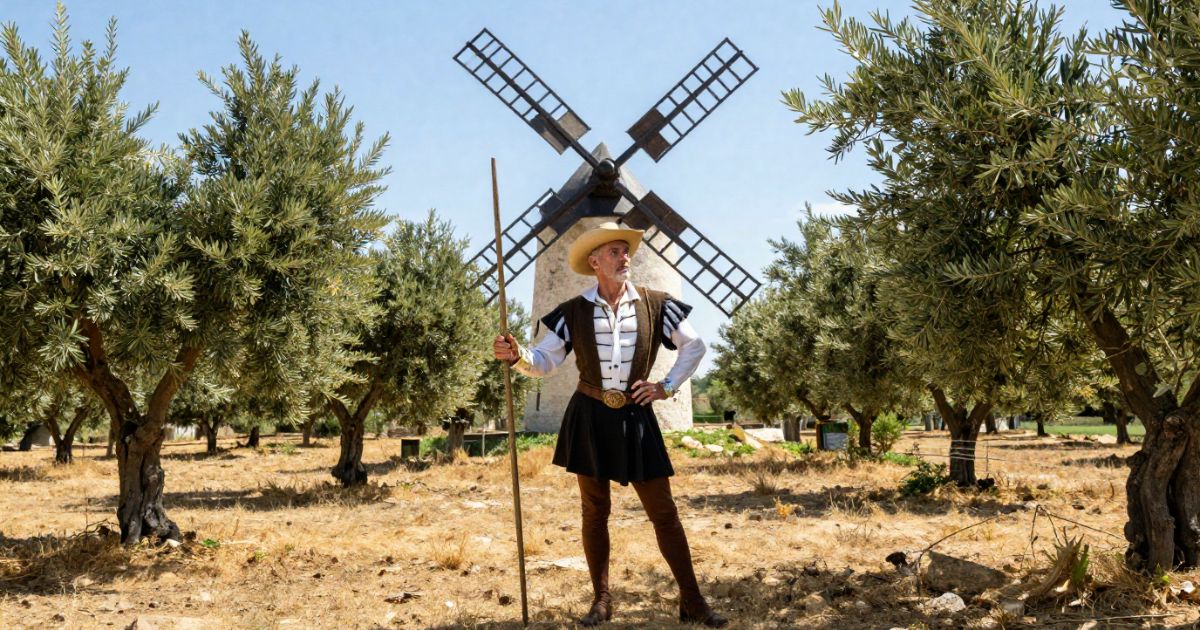
An excerpt from the original text.(complete · 3307 words)
HEREIN AN ACCOUNT IS GIVEN OF THE WEDDING OF CAMACHO THE RICH,
TOGETHER WITH THE INCIDENT OF BASILIO THE POOR
Scarce had the fair Aurora given bright Phœbus time to dry the liquid
pearls upon her golden locks with the heat of his fervent rays, when
Don Quixote, shaking off sloth from his limbs, sprang to his feet and
called to his squire Sancho, who was still snoring; seeing which Don
Quixote ere he roused him thus addressed him: “Happy thou, above all
the dwellers on the face of the earth, that, without envying or being
envied, sleepest with tranquil mind, and that neither enchanters
persecute nor enchantments affright. Sleep, I say, and will say a
hundred times, without any jealous thoughts of thy mistress to make
thee keep ceaseless vigils, or any cares as to how thou art to pay the
debts thou owest, or find to-morrow’s food for thyself and thy needy
little family, to interfere with thy repose. Ambition breaks not thy
rest, nor doth this world’s empty pomp disturb thee, for the utmost
reach of thy anxiety is to provide for thy ass, since upon my shoulders
thou hast laid the support of thyself, the counterpoise and burden that
nature and custom have imposed upon masters. The servant sleeps and the
master lies awake thinking how he is to feed him, advance him, and
reward him. The distress of seeing the sky turn brazen, and withhold
its needful moisture from the earth, is not felt by the servant but by
the master, who in time of scarcity and famine must support him who has
served him in times of plenty and abundance.”
To all this Sancho made no reply because he was asleep, nor would he
have wakened up so soon as he did had not Don Quixote brought him to
his senses with the butt of his lance. He awoke at last, drowsy and
lazy, and casting his eyes about in every direction, observed, “There
comes, if I don’t mistake, from the quarter of that arcade a steam and
a smell a great deal more like fried rashers than galingale or thyme; a
wedding that begins with smells like that, by my faith, ought to be
plentiful and unstinting.”
“Have done, thou glutton,” said Don Quixote; “come, let us go and
witness this bridal, and see what the rejected Basilio does.”
“Let him do what he likes,” returned Sancho; “be he not poor, he would
marry Quiteria. To make a grand match for himself, and he without a
farthing; is there nothing else? Faith, señor, it’s my opinion the poor
man should be content with what he can get, and not go looking for
dainties in the bottom of the sea. I will bet my arm that Camacho could
bury Basilio in reals; and if that be so, as no doubt it is, what a
fool Quiteria would be to refuse the fine dresses and jewels Camacho
must have given her and will give her, and take Basilio’s bar-throwing
and sword-play. They won’t give a pint of wine at the tavern for a good
cast of the bar or a neat thrust of the sword. Talents and
accomplishments that can’t be turned into money, let Count Dirlos have
them; but when such gifts fall to one that has hard cash, I wish my
condition of life was as becoming as they are. On a good foundation you
can raise a good building, and the best foundation in the world is
money.”
“For God’s sake, Sancho,” said Don Quixote here, “stop that harangue;
it is my belief, if thou wert allowed to continue all thou beginnest
every instant, thou wouldst have no time left for eating or sleeping;
for thou wouldst spend it all in talking.”
“If your worship had a good memory,” replied Sancho, “you would
remember the articles of our agreement before we started from home this
last time; one of them was that I was to be let say all I liked, so
long as it was not against my neighbour or your worship’s authority;
and so far, it seems to me, I have not broken the said article.”
“I remember no such article, Sancho,” said Don Quixote; “and even if it
were so, I desire you to hold your tongue and come along; for the
instruments we heard last night are already beginning to enliven the
valleys again, and no doubt the marriage will take place in the cool of
the morning, and not in the heat of the afternoon.”
Sancho did as his master bade him, and putting the saddle on Rocinante
and the pack-saddle on Dapple, they both mounted and at a leisurely
pace entered the arcade. The first thing that presented itself to
Sancho’s eyes was a whole ox spitted on a whole elm tree, and in the
fire at which it was to be roasted there was burning a middling-sized
mountain of faggots, and six stewpots that stood round the blaze had
not been made in the ordinary mould of common pots, for they were six
half wine-jars, each fit to hold the contents of a slaughter-house;
they swallowed up whole sheep and hid them away in their insides
without showing any more sign of them than if they were pigeons.
Countless were the hares ready skinned and the plucked fowls that hung
on the trees for burial in the pots, numberless the wildfowl and game
of various sorts suspended from the branches that the air might keep
them cool. Sancho counted more than sixty wine skins of over six
gallons each, and all filled, as it proved afterwards, with generous
wines. There were, besides, piles of the whitest bread, like the heaps
of corn one sees on the threshing-floors. There was a wall made of
cheeses arranged like open brick-work, and two cauldrons full of oil,
bigger than those of a dyer’s shop, served for cooking fritters, which
when fried were taken out with two mighty shovels, and plunged into
another cauldron of prepared honey that stood close by. Of cooks and
cook-maids there were over fifty, all clean, brisk, and blithe. In the
capacious belly of the ox were a dozen soft little sucking-pigs, which,
sewn up there, served to give it tenderness and flavour. The spices of
different kinds did not seem to have been bought by the pound but by
the quarter, and all lay open to view in a great chest. In short, all
the preparations made for the wedding were in rustic style, but
abundant enough to feed an army.
Sancho observed all, contemplated all, and everything won his heart.
The first to captivate and take his fancy were the pots, out of which
he would have very gladly helped himself to a moderate pipkinful; then
the wine skins secured his affections; and lastly, the produce of the
frying-pans, if, indeed, such imposing cauldrons may be called
frying-pans; and unable to control himself or bear it any longer, he
approached one of the busy cooks and civilly but hungrily begged
permission to soak a scrap of bread in one of the pots; to which the
cook made answer, “Brother, this is not a day on which hunger is to
have any sway, thanks to the rich Camacho; get down and look about for
a ladle and skim off a hen or two, and much good may they do you.”
“I don’t see one,” said Sancho.
“Wait a bit,” said the cook; “sinner that I am! how particular and
bashful you are!” and so saying, he seized a bucket and plunging it
into one of the half jars took up three hens and a couple of geese, and
said to Sancho, “Fall to, friend, and take the edge off your appetite
with these skimmings until dinner-time comes.”
“I have nothing to put them in,” said Sancho.
“Well then,” said the cook, “take spoon and all; for Camacho’s wealth
and happiness furnish everything.”
While Sancho fared thus, Don Quixote was watching the entrance, at one
end of the arcade, of some twelve peasants, all in holiday and gala
dress, mounted on twelve beautiful mares with rich handsome field
trappings and a number of little bells attached to their petrals, who,
marshalled in regular order, ran not one but several courses over the
meadow, with jubilant shouts and cries of “Long live Camacho and
Quiteria! he as rich as she is fair; and she the fairest on earth!”
Hearing this, Don Quixote said to himself, “It is easy to see these
folk have never seen my Dulcinea del Toboso; for if they had they would
be more moderate in their praises of this Quiteria of theirs.”
Shortly after this, several bands of dancers of various sorts began to
enter the arcade at different points, and among them one of
sword-dancers composed of some four-and-twenty lads of gallant and
high-spirited mien, clad in the finest and whitest of linen, and with
handkerchiefs embroidered in various colours with fine silk; and one of
those on the mares asked an active youth who led them if any of the
dancers had been wounded. “As yet, thank God, no one has been wounded,”
said he, “we are all safe and sound;” and he at once began to execute
complicated figures with the rest of his comrades, with so many turns
and so great dexterity, that although Don Quixote was well used to see
dances of the same kind, he thought he had never seen any so good as
this. He also admired another that came in composed of fair young
maidens, none of whom seemed to be under fourteen or over eighteen
years of age, all clad in green stuff, with their locks partly braided,
partly flowing loose, but all of such bright gold as to vie with the
sunbeams, and over them they wore garlands of jessamine, roses,
amaranth, and honeysuckle. At their head were a venerable old man and
an ancient dame, more brisk and active, however, than might have been
expected from their years. The notes of a Zamora bagpipe accompanied
them, and with modesty in their countenances and in their eyes, and
lightness in their feet, they looked the best dancers in the world.
Following these there came an artistic dance of the sort they call
“speaking dances.” It was composed of eight nymphs in two files, with
the god Cupid leading one and Interest the other, the former furnished
with wings, bow, quiver and arrows, the latter in a rich dress of gold
and silk of divers colours. The nymphs that followed Love bore their
names written on white parchment in large letters on their backs.
“Poetry” was the name of the first, “Wit” of the second, “Birth” of the
third, and “Valour” of the fourth. Those that followed Interest were
distinguished in the same way; the badge of the first announced
“Liberality,” that of the second “Largess,” the third “Treasure,” and
the fourth “Peaceful Possession.” In front of them all came a wooden
castle drawn by four wild men, all clad in ivy and hemp stained green,
and looking so natural that they nearly terrified Sancho. On the front
of the castle and on each of the four sides of its frame it bore the
inscription “Castle of Caution.” Four skillful tabor and flute players
accompanied them, and the dance having been opened, Cupid, after
executing two figures, raised his eyes and bent his bow against a
damsel who stood between the turrets of the castle, and thus addressed
her:
I am the mighty God whose sway
Is potent over land and sea.
The heavens above us own me; nay,
The shades below acknowledge me.
I know not fear, I have my will,
Whate’er my whim or fancy be;
For me there’s no impossible,
I order, bind, forbid, set free.
Having concluded the stanza he discharged an arrow at the top of the
castle, and went back to his place. Interest then came forward and went
through two more figures, and as soon as the tabors ceased, he said:
But mightier than Love am I,
Though Love it be that leads me on,
Than mine no lineage is more high,
Or older, underneath the sun.
To use me rightly few know how,
To act without me fewer still,
For I am Interest, and I vow
For evermore to do thy will.
Interest retired, and Poetry came forward, and when she had gone
through her figures like the others, fixing her eyes on the damsel of
the castle, she said:
With many a fanciful conceit,
Fair Lady, winsome Poesy
Her soul, an offering at thy feet,
Presents in sonnets unto thee.
If thou my homage wilt not scorn,
Thy fortune, watched by envious eyes,
On wings of poesy upborne
Shall be exalted to the skies.
Poetry withdrew, and on the side of Interest Liberality advanced, and
after having gone through her figures, said:
To give, while shunning each extreme,
The sparing hand, the over-free,
Therein consists, so wise men deem,
The virtue Liberality.
But thee, fair lady, to enrich,
Myself a prodigal I’ll prove,
A vice not wholly shameful, which
May find its fair excuse in love.
In the same manner all the characters of the two bands advanced and
retired, and each executed its figures, and delivered its verses, some
of them graceful, some burlesque, but Don Quixote’s memory (though he
had an excellent one) only carried away those that have been just
quoted. All then mingled together, forming chains and breaking off
again with graceful, unconstrained gaiety; and whenever Love passed in
front of the castle he shot his arrows up at it, while Interest broke
gilded pellets against it. At length, after they had danced a good
while, Interest drew out a great purse, made of the skin of a large
brindled cat and to all appearance full of money, and flung it at the
castle, and with the force of the blow the boards fell asunder and
tumbled down, leaving the damsel exposed and unprotected. Interest and
the characters of his band advanced, and throwing a great chain of gold
over her neck pretended to take her and lead her away captive, on
seeing which, Love and his supporters made as though they would release
her, the whole action being to the accompaniment of the tabors and in
the form of a regular dance. The wild men made peace between them, and
with great dexterity readjusted and fixed the boards of the castle, and
the damsel once more ensconced herself within; and with this the dance
wound up, to the great enjoyment of the beholders.
Don Quixote asked one of the nymphs who it was that had composed and
arranged it. She replied that it was a beneficiary of the town who had
a nice taste in devising things of the sort. “I will lay a wager,” said
Don Quixote, “that the same bachelor or beneficiary is a greater friend
of Camacho’s than of Basilio’s, and that he is better at satire than at
vespers; he has introduced the accomplishments of Basilio and the
riches of Camacho very neatly into the dance.” Sancho Panza, who was
listening to all this, exclaimed, “The king is my cock; I stick to
Camacho.” “It is easy to see thou art a clown, Sancho,” said Don
Quixote, “and one of that sort that cry ‘Long life to the conqueror.’”
“I don’t know of what sort I am,” returned Sancho, “but I know very
well I’ll never get such elegant skimmings off Basilio’s pots as these
I have got off Camacho’s;” and he showed him the bucketful of geese and
hens, and seizing one began to eat with great gaiety and appetite,
saying, “A fig for the accomplishments of Basilio! As much as thou hast
so much art thou worth, and as much as thou art worth so much hast
thou. As a grandmother of mine used to say, there are only two families
in the world, the Haves and the Haven’ts; and she stuck to the Haves;
and to this day, Señor Don Quixote, people would sooner feel the pulse
of ‘Have,’ than of ‘Know;’ an ass covered with gold looks better than a
horse with a pack-saddle. So once more I say I stick to Camacho, the
bountiful skimmings of whose pots are geese and hens, hares and
rabbits; but of Basilio’s, if any ever come to hand, or even to foot,
they’ll be only rinsings.”
“Hast thou finished thy harangue, Sancho?” said Don Quixote. “Of course
I have finished it,” replied Sancho, “because I see your worship takes
offence at it; but if it was not for that, there was work enough cut
out for three days.”
“God grant I may see thee dumb before I die, Sancho,” said Don Quixote.
“At the rate we are going,” said Sancho, “I’ll be chewing clay before
your worship dies; and then, maybe, I’ll be so dumb that I’ll not say a
word until the end of the world, or, at least, till the day of
judgment.”
“Even should that happen, O Sancho,” said Don Quixote, “thy silence
will never come up to all thou hast talked, art talking, and wilt talk
all thy life; moreover, it naturally stands to reason, that my death
will come before thine; so I never expect to see thee dumb, not even
when thou art drinking or sleeping, and that is the utmost I can say.”
“In good faith, señor,” replied Sancho, “there’s no trusting that
fleshless one, I mean Death, who devours the lamb as soon as the sheep,
and, as I have heard our curate say, treads with equal foot upon the
lofty towers of kings and the lowly huts of the poor. That lady is more
mighty than dainty, she is in no way squeamish, she devours all and is
ready for all, and fills her alforjas with people of all sorts, ages,
and ranks. She is no reaper that sleeps out the noontide; at all times
she is reaping and cutting down, as well the dry grass as the green;
she never seems to chew, but bolts and swallows all that is put before
her, for she has a canine appetite that is never satisfied; and though
she has no belly, she shows she has a dropsy and is athirst to drink
the lives of all that live, as one would drink a jug of cold water.”
“Say no more, Sancho,” said Don Quixote at this; “don’t try to better
it, and risk a fall; for in truth what thou hast said about death in
thy rustic phrase is what a good preacher might have said. I tell thee,
Sancho, if thou hadst discretion equal to thy mother wit, thou mightst
take a pulpit in hand, and go about the world preaching fine sermons.”
“He preaches well who lives well,” said Sancho, “and I know no more
theology than that.”
“Nor needst thou,” said Don Quixote, “but I cannot conceive or make out
how it is that, the fear of God being the beginning of wisdom, thou,
who art more afraid of a lizard than of him, knowest so much.”
“Pass judgment on your chivalries, señor,” returned Sancho, “and don’t
set yourself up to judge of other men’s fears or braveries, for I am as
good a fearer of God as my neighbours; but leave me to despatch these
skimmings, for all the rest is only idle talk that we shall be called
to account for in the other world;” and so saying, he began a fresh
attack on the bucket, with such a hearty appetite that he aroused Don
Quixote’s, who no doubt would have helped him had he not been prevented
by what must be told farther on.
p20f.jpg (41K)
Master this chapter. Complete your experience
Purchase the complete book to access all chapters and support classic literature
As an Amazon Associate, we earn a small commission from qualifying purchases at no additional cost to you.
Available in paperback, hardcover, and e-book formats
Let's Analyse the Pattern
The moment when economic reality forces abandonment of ideals in favor of survival and security.
Why This Matters
Connect literature to life
This chapter teaches how to recognize when financial constraints are driving relationship and life decisions, both in yourself and others.
Practice This Today
This week, notice when someone makes a choice that seems to contradict their values—look for the economic pressure underneath before judging.
Now let's explore the literary elements.
Key Quotes & Analysis
"There are only two families in the world, the Haves and the Haven'ts"
Context: Sancho says this while enjoying Camacho's feast, defending the choice to marry for money
This brutally honest assessment cuts through romantic idealism to economic reality. Sancho recognizes that social class ultimately determines life opportunities and choices, including who you can marry.
In Today's Words:
At the end of the day, you're either rich or you're not, and that's what really matters
"The servant sleeps and the master lies awake thinking how he is to feed him, advance him, and reward him"
Context: Don Quixote reflects on responsibility while watching Sancho sleep peacefully
This reveals the hidden burden of leadership - those in charge carry the stress of providing for others. It shows Don Quixote's genuine care for Sancho despite their class difference.
In Today's Words:
The boss stays up worrying about payroll while the employees sleep soundly
"Ambition breaks not thy rest, nor doth this world's empty pomp disturb thee"
Context: Don Quixote envies Sancho's ability to sleep without worry
Don Quixote recognizes that having fewer expectations can mean less anxiety. Sancho's simpler goals allow him peace that Don Quixote's grand ambitions deny him.
In Today's Words:
You sleep better when you're not trying to impress anyone or chase the American Dream
Thematic Threads
Class
In This Chapter
Sancho's blunt assessment that wealth determines life outcomes, while Don Quixote maintains aristocratic idealism
Development
Evolution from earlier class observations to stark economic realism
In Your Life:
You might recognize this when choosing jobs based on pay rather than passion, or dating for stability over excitement.
Identity
In This Chapter
Don Quixote struggles to maintain his idealistic worldview against Sancho's working-class pragmatism
Development
Continued tension between aspirational and practical identities
In Your Life:
You might feel this conflict between who you want to be and who circumstances force you to become.
Social Expectations
In This Chapter
The wedding ceremony as public performance of economic status and social positioning
Development
Deepening exploration of how society enforces class boundaries through ritual
In Your Life:
You might notice this pressure at weddings, graduations, or family gatherings where your economic status feels exposed.
Human Relationships
In This Chapter
Quiteria's choice between love and security, mediated by the stark inequality between suitors
Development
Progression from abstract ideas about love to concrete economic pressures
In Your Life:
You might face similar choices in dating, friendship, or family relationships where money creates impossible decisions.
Personal Growth
In This Chapter
Sancho's increasingly sophisticated understanding of economic reality versus Don Quixote's resistance to change
Development
Sancho's evolution from simple to wise, while Don Quixote remains static
In Your Life:
You might recognize moments when life experience forces you to abandon naive beliefs about how the world works.
You now have the context. Time to form your own thoughts.
Discussion Questions
- 1
What does Sancho mean when he says 'there are only two families in the world, the Haves and the Haven'ts'? How does the wedding feast prove his point?
analysis • surface - 2
Why does Quiteria choose to marry Camacho instead of Basilio, even though she loves Basilio? What forces are really making this decision for her?
analysis • medium - 3
Where do you see people today making 'practical surrender' choices—picking security over passion because they can't afford to follow their heart?
application • medium - 4
If you were advising someone facing Quiteria's dilemma—love without money versus security without love—what questions would you help them ask themselves?
application • deep - 5
Don Quixote believes love should conquer all, while Sancho says money wins every time. What does this chapter suggest about which view better prepares you for real life?
reflection • deep
Critical Thinking Exercise
Map Your Own Practical Surrender Moments
Think about a time when you had to choose practical security over something you really wanted—a job, relationship, living situation, or major decision. Draw a simple chart with 'Heart Choice' on one side and 'Head Choice' on the other. List what each option offered and what it cost. Then identify what economic or practical pressures pushed you toward the 'head' choice.
Consider:
- •What invisible forces (family expectations, bills, health insurance) influenced your decision?
- •Did you find any creative third options, or did it feel like a strict either/or choice?
- •How do you feel about that choice now—was it the right call for that moment in your life?
Journaling Prompt
Write about how you want to handle future practical surrender moments. What would help you navigate these choices with less resentment and more intentional decision-making?
Coming Up Next...
Chapter 93: The Wedding Trick That Changed Everything
The wedding festivities continue as the bride and groom approach with great fanfare, but the celebration may not go as smoothly as Camacho planned. The tension between wealth and true love is about to reach its dramatic climax.