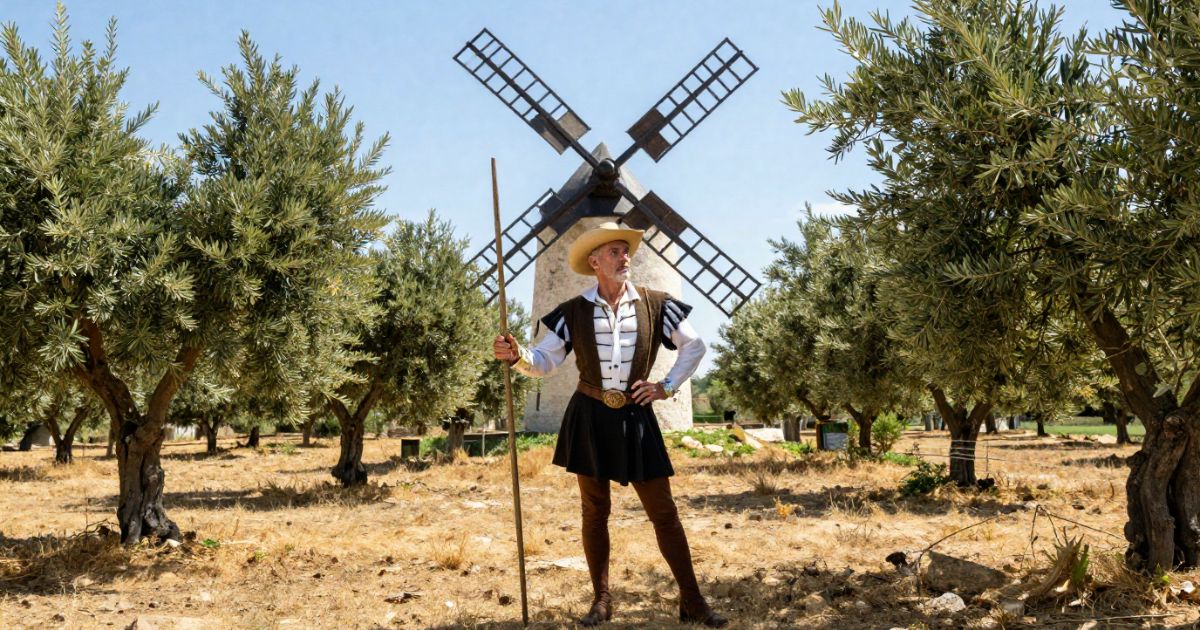
An excerpt from the original text.(complete · 2971 words)
WHICH IS RELATED THE ADVENTURE OF THE ENAMOURED SHEPHERD, TOGETHER
WITH OTHER TRULY DROLL INCIDENTS
Don Quixote had gone but a short distance beyond Don Diego’s village,
when he fell in with a couple of either priests or students, and a
couple of peasants, mounted on four beasts of the ass kind. One of the
students carried, wrapped up in a piece of green buckram by way of a
portmanteau, what seemed to be a little linen and a couple of pairs of
ribbed stockings; the other carried nothing but a pair of new
fencing-foils with buttons. The peasants carried divers articles that
showed they were on their way from some large town where they had
bought them, and were taking them home to their village; and both
students and peasants were struck with the same amazement that
everybody felt who saw Don Quixote for the first time, and were dying
to know who this man, so different from ordinary men, could be. Don
Quixote saluted them, and after ascertaining that their road was the
same as his, made them an offer of his company, and begged them to
slacken their pace, as their young asses travelled faster than his
horse; and then, to gratify them, he told them in a few words who he
was and the calling and profession he followed, which was that of a
knight-errant seeking adventures in all parts of the world. He informed
them that his own name was Don Quixote of La Mancha, and that he was
called, by way of surname, the Knight of the Lions.
All this was Greek or gibberish to the peasants, but not so to the
students, who very soon perceived the crack in Don Quixote’s pate; for
all that, however, they regarded him with admiration and respect, and
one of them said to him, “If you, sir knight, have no fixed road, as it
is the way with those who seek adventures not to have any, let your
worship come with us; you will see one of the finest and richest
weddings that up to this day have ever been celebrated in La Mancha, or
for many a league round.”
Don Quixote asked him if it was some prince’s, that he spoke of it in
this way. “Not at all,” said the student; “it is the wedding of a
farmer and a farmer’s daughter, he the richest in all this country, and
she the fairest mortal ever set eyes on. The display with which it is
to be attended will be something rare and out of the common, for it
will be celebrated in a meadow adjoining the town of the bride, who is
called, par excellence, Quiteria the fair, as the bridegroom is
called Camacho the rich. She is eighteen, and he twenty-two, and they
are fairly matched, though some knowing ones, who have all the
pedigrees in the world by heart, will have it that the family of the
fair Quiteria is better than Camacho’s; but no one minds that
now-a-days, for wealth can solder a great many flaws. At any rate,
Camacho is free-handed, and it is his fancy to screen the whole meadow
with boughs and cover it in overhead, so that the sun will have hard
work if he tries to get in to reach the grass that covers the soil. He
has provided dancers too, not only sword but also bell-dancers, for in
his own town there are those who ring the changes and jingle the bells
to perfection; of shoe-dancers I say nothing, for of them he has
engaged a host. But none of these things, nor of the many others I have
omitted to mention, will do more to make this a memorable wedding than
the part which I suspect the despairing Basilio will play in it. This
Basilio is a youth of the same village as Quiteria, and he lived in the
house next door to that of her parents, of which circumstance Love took
advantage to reproduce to the word the long-forgotten loves of Pyramus
and Thisbe; for Basilio loved Quiteria from his earliest years, and she
responded to his passion with countless modest proofs of affection, so
that the loves of the two children, Basilio and Quiteria, were the talk
and the amusement of the town. As they grew up, the father of Quiteria
made up his mind to refuse Basilio his wonted freedom of access to the
house, and to relieve himself of constant doubts and suspicions, he
arranged a match for his daughter with the rich Camacho, as he did not
approve of marrying her to Basilio, who had not so large a share of the
gifts of fortune as of nature; for if the truth be told ungrudgingly,
he is the most agile youth we know, a mighty thrower of the bar, a
first-rate wrestler, and a great ball-player; he runs like a deer, and
leaps better than a goat, bowls over the nine-pins as if by magic,
sings like a lark, plays the guitar so as to make it speak, and, above
all, handles a sword as well as the best.”
“For that excellence alone,” said Don Quixote at this, “the youth
deserves to marry, not merely the fair Quiteria, but Queen Guinevere
herself, were she alive now, in spite of Launcelot and all who would
try to prevent it.”
“Say that to my wife,” said Sancho, who had until now listened in
silence, “for she won’t hear of anything but each one marrying his
equal, holding with the proverb ‘each ewe to her like.’ What I would
like is that this good Basilio (for I am beginning to take a fancy to
him already) should marry this lady Quiteria; and a blessing and good
luck—I meant to say the opposite—on people who would prevent those who
love one another from marrying.”
“If all those who love one another were to marry,” said Don Quixote,
“it would deprive parents of the right to choose, and marry their
children to the proper person and at the proper time; and if it was
left to daughters to choose husbands as they pleased, one would be for
choosing her father’s servant, and another, someone she has seen
passing in the street and fancies gallant and dashing, though he may be
a drunken bully; for love and fancy easily blind the eyes of the
judgment, so much wanted in choosing one’s way of life; and the
matrimonial choice is very liable to error, and it needs great caution
and the special favour of heaven to make it a good one. He who has to
make a long journey, will, if he is wise, look out for some trusty and
pleasant companion to accompany him before he sets out. Why, then,
should not he do the same who has to make the whole journey of life
down to the final halting-place of death, more especially when the
companion has to be his companion in bed, at board, and everywhere, as
the wife is to her husband? The companionship of one’s wife is no
article of merchandise, that, after it has been bought, may be
returned, or bartered, or changed; for it is an inseparable accident
that lasts as long as life lasts; it is a noose that, once you put it
round your neck, turns into a Gordian knot, which, if the scythe of
Death does not cut it, there is no untying. I could say a great deal
more on this subject, were I not prevented by the anxiety I feel to
know if the señor licentiate has anything more to tell about the story
of Basilio.”
To this the student, bachelor, or, as Don Quixote called him,
licentiate, replied, “I have nothing whatever to say further, but that
from the moment Basilio learned that the fair Quiteria was to be
married to Camacho the rich, he has never been seen to smile, or heard
to utter rational word, and he always goes about moody and dejected,
talking to himself in a way that shows plainly he is out of his senses.
He eats little and sleeps little, and all he eats is fruit, and when he
sleeps, if he sleeps at all, it is in the field on the hard earth like
a brute beast. Sometimes he gazes at the sky, at other times he fixes
his eyes on the earth in such an abstracted way that he might be taken
for a clothed statue, with its drapery stirred by the wind. In short,
he shows such signs of a heart crushed by suffering, that all we who
know him believe that when to-morrow the fair Quiteria says ‘yes,’ it
will be his sentence of death.”
“God will guide it better,” said Sancho, “for God who gives the wound
gives the salve; nobody knows what will happen; there are a good many
hours between this and to-morrow, and any one of them, or any moment,
the house may fall; I have seen the rain coming down and the sun
shining all at one time; many a one goes to bed in good health who
can’t stir the next day. And tell me, is there anyone who can boast of
having driven a nail into the wheel of fortune? No, faith; and between
a woman’s ‘yes’ and ‘no’ I wouldn’t venture to put the point of a pin,
for there would not be room for it; if you tell me Quiteria loves
Basilio heart and soul, then I’ll give him a bag of good luck; for
love, I have heard say, looks through spectacles that make copper seem
gold, poverty wealth, and bleary eyes pearls.”
“What art thou driving at, Sancho? curses on thee!” said Don Quixote;
“for when thou takest to stringing proverbs and sayings together, no
one can understand thee but Judas himself, and I wish he had thee. Tell
me, thou animal, what dost thou know about nails or wheels, or anything
else?”
“Oh, if you don’t understand me,” replied Sancho, “it is no wonder my
words are taken for nonsense; but no matter; I understand myself, and I
know I have not said anything very foolish in what I have said; only
your worship, señor, is always gravelling at everything I say, nay,
everything I do.”
“Cavilling, not gravelling,” said Don Quixote, “thou prevaricator of
honest language, God confound thee!”
“Don’t find fault with me, your worship,” returned Sancho, “for you
know I have not been bred up at court or trained at Salamanca, to know
whether I am adding or dropping a letter or so in my words. Why! God
bless me, it’s not fair to force a Sayago-man to speak like a Toledan;
maybe there are Toledans who do not hit it off when it comes to
polished talk.”
“That is true,” said the licentiate, “for those who have been bred up
in the Tanneries and the Zocodover cannot talk like those who are
almost all day pacing the cathedral cloisters, and yet they are all
Toledans. Pure, correct, elegant and lucid language will be met with in
men of courtly breeding and discrimination, though they may have been
born in Majalahonda; I say of discrimination, because there are many
who are not so, and discrimination is the grammar of good language, if
it be accompanied by practice. I, sirs, for my sins have studied canon
law at Salamanca, and I rather pique myself on expressing my meaning in
clear, plain, and intelligible language.”
“If you did not pique yourself more on your dexterity with those foils
you carry than on dexterity of tongue,” said the other student, “you
would have been head of the degrees, where you are now tail.”
“Look here, bachelor Corchuelo,” returned the licentiate, “you have the
most mistaken idea in the world about skill with the sword, if you
think it useless.”
“It is no idea on my part, but an established truth,” replied
Corchuelo; “and if you wish me to prove it to you by experiment, you
have swords there, and it is a good opportunity; I have a steady hand
and a strong arm, and these joined with my resolution, which is not
small, will make you confess that I am not mistaken. Dismount and put
in practice your positions and circles and angles and science, for I
hope to make you see stars at noonday with my rude raw swordsmanship,
in which, next to God, I place my trust that the man is yet to be born
who will make me turn my back, and that there is not one in the world I
will not compel to give ground.”
“As to whether you turn your back or not, I do not concern myself,”
replied the master of fence; “though it might be that your grave would
be dug on the spot where you planted your foot the first time; I mean
that you would be stretched dead there for despising skill with the
sword.”
“We shall soon see,” replied Corchuelo, and getting off his ass
briskly, he drew out furiously one of the swords the licentiate carried
on his beast.
“It must not be that way,” said Don Quixote at this point; “I will be
the director of this fencing match, and judge of this often disputed
question;” and dismounting from Rocinante and grasping his lance, he
planted himself in the middle of the road, just as the licentiate, with
an easy, graceful bearing and step, advanced towards Corchuelo, who
came on against him, darting fire from his eyes, as the saying is. The
other two of the company, the peasants, without dismounting from their
asses, served as spectators of the mortal tragedy. The cuts, thrusts,
down strokes, back strokes and doubles, that Corchuelo delivered were
past counting, and came thicker than hops or hail. He attacked like an
angry lion, but he was met by a tap on the mouth from the button of the
licentiate’s sword that checked him in the midst of his furious onset,
and made him kiss it as if it were a relic, though not as devoutly as
relics are and ought to be kissed. The end of it was that the
licentiate reckoned up for him by thrusts every one of the buttons of
the short cassock he wore, tore the skirts into strips, like the tails
of a cuttlefish, knocked off his hat twice, and so completely tired him
out, that in vexation, anger, and rage, he took the sword by the hilt
and flung it away with such force, that one of the peasants that were
there, who was a notary, and who went for it, made an affidavit
afterwards that he sent it nearly three-quarters of a league, which
testimony will serve, and has served, to show and establish with all
certainty that strength is overcome by skill.
Corchuelo sat down wearied, and Sancho approaching him said, “By my
faith, señor bachelor, if your worship takes my advice, you will never
challenge anyone to fence again, only to wrestle and throw the bar, for
you have the youth and strength for that; but as for these fencers as
they call them, I have heard say they can put the point of a sword
through the eye of a needle.”
“I am satisfied with having tumbled off my donkey,” said Corchuelo,
“and with having had the truth I was so ignorant of proved to me by
experience;” and getting up he embraced the licentiate, and they were
better friends than ever; and not caring to wait for the notary who had
gone for the sword, as they saw he would be a long time about it, they
resolved to push on so as to reach the village of Quiteria, to which
they all belonged, in good time.
During the remainder of the journey the licentiate held forth to them
on the excellences of the sword, with such conclusive arguments, and
such figures and mathematical proofs, that all were convinced of the
value of the science, and Corchuelo cured of his dogmatism.
It grew dark; but before they reached the town it seemed to them all as
if there was a heaven full of countless glittering stars in front of
it. They heard, too, the pleasant mingled notes of a variety of
instruments, flutes, drums, psalteries, pipes, tabors, and timbrels,
and as they drew near they perceived that the trees of a leafy arcade
that had been constructed at the entrance of the town were filled with
lights unaffected by the wind, for the breeze at the time was so gentle
that it had not power to stir the leaves on the trees. The musicians
were the life of the wedding, wandering through the pleasant grounds in
separate bands, some dancing, others singing, others playing the
various instruments already mentioned. In short, it seemed as though
mirth and gaiety were frisking and gambolling all over the meadow.
Several other persons were engaged in erecting raised benches from
which people might conveniently see the plays and dances that were to
be performed the next day on the spot dedicated to the celebration of
the marriage of Camacho the rich and the obsequies of Basilio. Don
Quixote would not enter the village, although the peasant as well as
the bachelor pressed him; he excused himself, however, on the grounds,
amply sufficient in his opinion, that it was the custom of
knights-errant to sleep in the fields and woods in preference to towns,
even were it under gilded ceilings; and so turned aside a little out of
the road, very much against Sancho’s will, as the good quarters he had
enjoyed in the castle or house of Don Diego came back to his mind.
p19e.jpg (29K)
Master this chapter. Complete your experience
Purchase the complete book to access all chapters and support classic literature
As an Amazon Associate, we earn a small commission from qualifying purchases at no additional cost to you.
Available in paperback, hardcover, and e-book formats
Let's Analyse the Pattern
Society systematically rewards wealth and connections over talent and character, creating cycles where the deserving get crushed.
Why This Matters
Connect literature to life
This chapter teaches how to identify when decisions are really being made by hidden financial interests rather than stated criteria.
Practice This Today
This week, notice when someone gets chosen despite obvious better alternatives - ask yourself what money or connections might be invisible factors.
Now let's explore the literary elements.
Key Quotes & Analysis
"Marriage is a lifelong partnership that requires careful consideration, for it is easier to enter than to exit."
Context: When advising the group about Quiteria's upcoming wedding
Shows Don Quixote's occasional moments of genuine wisdom despite his delusions. He understands that marriage is permanent and serious, requiring more thought than people usually give it. This contrasts with his own impulsive nature in other areas.
In Today's Words:
Marriage isn't something you can just try out - you better be sure before you say 'I do' because divorce is messy and expensive.
"Skill developed through study will always defeat raw talent without discipline."
Context: After systematically defeating his more aggressive opponent in their duel
Demonstrates a key theme about the value of education and proper training. The student's victory proves that knowledge and technique matter more than natural ability or confidence. This applies beyond sword fighting to any skill.
In Today's Words:
The person who actually studies and practices will beat the person who just thinks they're naturally good at something.
"Love and a crust of bread - that's all very romantic until your stomach starts growling."
Context: Commenting on Basilio's romantic situation with typical earthiness
Sancho's practical wisdom cuts through romantic idealism to address real-world concerns. While love is important, poverty makes everything harder. His comment acknowledges both the beauty and the limitations of pure romance.
In Today's Words:
Love doesn't pay the bills - you can't eat feelings when the rent is due.
Thematic Threads
Class
In This Chapter
Basilio's talent means nothing against Camacho's wealth in the marriage competition
Development
Deepening from earlier episodes about social hierarchies and Don Quixote's noble pretensions
In Your Life:
You might see this when qualified coworkers get passed over for promotions given to less capable people with better connections
Love
In This Chapter
True love between Basilio and Quiteria is sacrificed for economic security through arranged marriage
Development
Contrasts with Don Quixote's idealized love for Dulcinea by showing love's real-world obstacles
In Your Life:
You might face pressure to choose a 'practical' partner over someone you truly connect with
Skill
In This Chapter
The scholarly fencer defeats the aggressive opponent through technique and study, not brute force
Development
Reinforces ongoing theme that knowledge and practice triumph over raw talent or aggression
In Your Life:
You might find that learning proper techniques at work or in relationships works better than just trying harder
Social Expectations
In This Chapter
Quiteria's father chooses the socially acceptable wealthy suitor despite his daughter's preferences
Development
Continues exploration of how society's rules often conflict with individual desires and merit
In Your Life:
You might feel pressure to make choices based on what others expect rather than what's right for you
Justice
In This Chapter
Don Quixote referees the duel fairly, showing his ability to be just when not clouded by delusions
Development
Reveals that beneath his madness, Don Quixote maintains a strong moral compass
In Your Life:
You might find that even when struggling with your own issues, you can still help others navigate theirs fairly
You now have the context. Time to form your own thoughts.
Discussion Questions
- 1
Why does Quiteria's father choose Camacho over Basilio, even though Basilio clearly loves his daughter more?
analysis • surface - 2
What does the sword fighting scene teach us about the difference between raw aggression and trained skill?
analysis • medium - 3
Where do you see this 'money beats merit' pattern playing out in your workplace, school, or community?
application • medium - 4
If you were advising Basilio, what strategies would you suggest for competing against someone with more money but less talent?
application • deep - 5
What does this chapter reveal about how fear of poverty affects the decisions parents make for their children?
reflection • deep
Critical Thinking Exercise
Map Your Merit vs. Money Moments
Think of three situations where you've seen wealth or connections win over talent and hard work. For each situation, identify who had the real power to make decisions, what they were afraid of losing, and what someone with merit could have done differently to compete. This helps you recognize the pattern before you get caught in it.
Consider:
- •Look for the hidden fears driving the decision-makers - usually fear of financial loss or social embarrassment
- •Notice how the 'merit' person might have been playing by the wrong rules entirely
- •Consider whether changing the game might work better than playing the existing game
Journaling Prompt
Write about a time when you had to choose between what was right and what was financially smart. What factors influenced your decision, and how do you feel about that choice now?
Coming Up Next...
Chapter 92: Rich Man's Feast vs Poor Man's Dreams
The wedding day arrives with all its splendor, but Basilio's heartbreak threatens to turn celebration into tragedy. Don Quixote will witness firsthand how desperate love can drive someone to extraordinary measures.