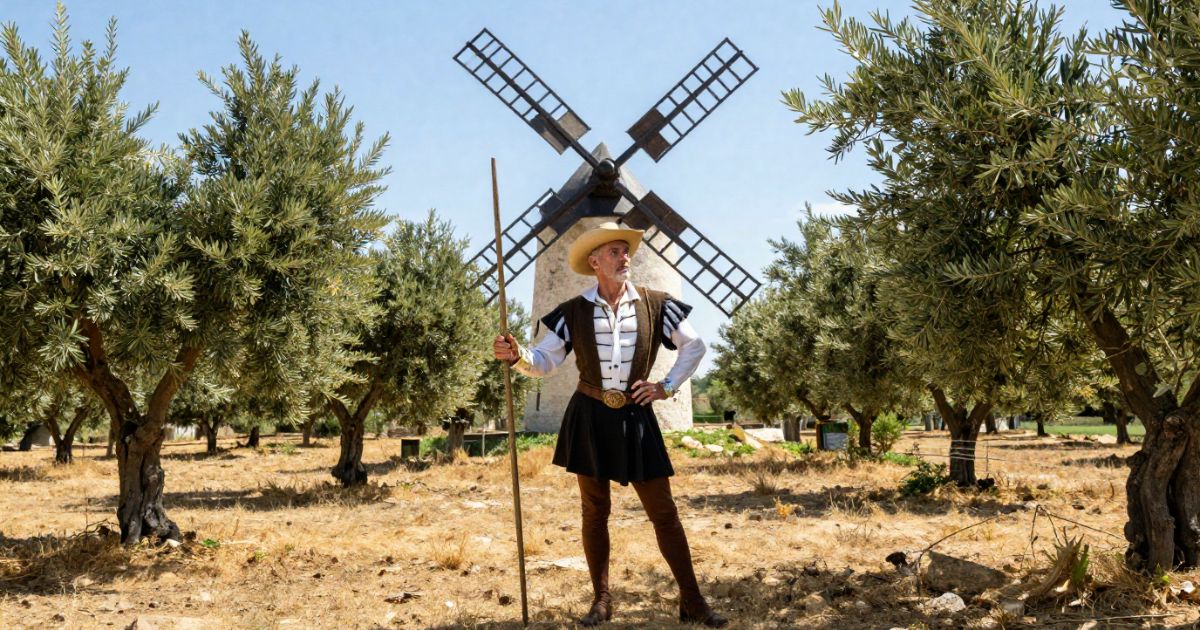
An excerpt from the original text.(complete · 549 words)
: N WHICH IS CONCLUDED AND FINISHED THE TERRIFIC BATTLE BETWEEN THE GALLANT BISCAYAN AND THE VALIANT MANCHEGAN
The narrator interrupts: "In the First Part of this history we left the valiant Biscayan and renowned Don Quixote with drawn swords uplifted, ready to deliver two such furious slashing blows that if they had fallen full and fair they would have split them asunder from top to toe—and at this so critical point the delightful history came to a stop and stood cut short without any intimation from the author where what was missing was to be found."
This distressed the narrator greatly! He couldn't believe such a good knight would lack a sage to write his achievements. He blamed Time, the devourer of all things. But he realized that since modern books were found in Quixote's library, his story must also be modern and might exist in the memory of his village.
One day in Toledo, a boy was selling pamphlets and old papers. The narrator, fond of reading even scraps, picked one up. It was in Arabic. He found a Spanish-speaking Morisco to translate. The translator opened it in the middle and laughed. In the margin was written: "This Dulcinea del Toboso, so often mentioned in this history, had, they say, the best hand of any woman in all La Mancha for salting pigs."
The narrator was struck with amazement! He had the translator read the beginning: "History of Don Quixote of La Mancha, written by Cid Hamete Benengeli, an Arab historian." The narrator bought all the papers for half a real, took the Morisco home, and paid him two bushels of wheat and two arrobas of raisins to translate the whole manuscript within a month and a half.
The first pamphlet showed the battle drawn to life—both combatants with swords raised, one with buckler, one with cushion. Under the Biscayan's feet: "Don Sancho de Azpeitia." At Rocinante's feet: "Don Quixote." Near him, Sancho Panza holding his ass's halter, labeled "Sancho Zancas" (big belly, short body, long shanks).
The Second Part began: The Biscayan struck first—such force that if his sword hadn't turned aside, it would have ended everything. But fortune turned the blow so it only stripped Quixote's left shoulder of armor and carried away half his ear. Quixote, filled with rage, raised himself in his stirrups and came down on the Biscayan with such fury over cushion and head that blood poured from nose, mouth, and ears. The Biscayan's mule bolted and flung its master to the ground.
Don Quixote leaped from his horse, ran to him, and put his sword to the Biscayan's eyes, demanding surrender or death. The Biscayan was too bewildered to answer. It would have gone hard with him had the ladies in the coach not rushed over and begged Quixote for mercy. Quixote granted it on condition that the Biscayan go to El Toboso and present himself before Dulcinea to tell her what Don Quixote had done.
The terrified ladies agreed to anything. Quixote left the Biscayan and went to see about Sancho, who had been badly beaten by the friars' muleteers while trying to strip one friar of his robes as "spoils of war." Quixote thought it best to leave, in case the friars reported them to the Holy Brotherhood.
Master this chapter. Complete your experience
Purchase the complete book to access all chapters and support classic literature
As an Amazon Associate, we earn a small commission from qualifying purchases at no additional cost to you.
Available in paperback, hardcover, and e-book formats
Let's Analyse the Pattern
Every story comes through layers of interpretation, translation, and bias. Recognizing these layers lets you compensate for perspective and assess reliability.
Why This Matters
Connect literature to life
This chapter teaches you to ask who's telling the story and what their angle might be. No narrative is purely objective—all come through someone's perspective with their biases and goals.
Practice This Today
This week, when you encounter a compelling story (news, social media, someone's account of an argument), ask: Who's telling this? What perspective am I not hearing? What might the other parties say happened?
Now let's explore the literary elements.
Key Quotes & Analysis
"At this so critical point the delightful history came to a stop and stood cut short without any intimation from the author where what was missing was to be found."
Context: Breaking the story at the cliffhanger
Cervantes inventing the literary cliffhanger, then immediately making you aware he's doing it deliberately. It's both genuine suspense and commentary on suspense as a technique. He's showing you how stories manipulate you while manipulating you.
In Today's Words:
And right at the most exciting part, the story just... stopped. No warning. No hint where the rest was.
"This Dulcinea del Toboso, so often mentioned in this history, had, they say, the best hand of any woman in all La Mancha for salting pigs."
Context: What makes the translator laugh
The perfect princess, the lady whose beauty requires no proof, the muse of Quixote's devotion... was really good at salting pork. The manuscript undercuts the romance with practical detail. This is truth interrupting fantasy.
In Today's Words:
That Dulcinea everyone keeps talking about? Apparently she was really skilled at preserving pork.
"If against the present one any objection be raised on the score of its truth, it can only be that its author was an Arab, as lying is a very common propensity with those of that nation."
Context: Discussing the manuscript's reliability
Cervantes satirizing Spanish prejudice while using it as narrative device. He's saying 'Arabs lie' while entrusting his whole story to an Arab historian—forcing readers to question both their prejudices and the text's reliability.
In Today's Words:
The only reason to doubt this story is that it was written by an Arab, and everyone knows Arabs are liars. (But also, I'm using this Arab's manuscript as my source, so...?)
"Good God! Who is there that could properly describe the rage that filled the heart of our Manchegan when he saw himself dealt with in this fashion?"
Context: After the Biscayan's first blow
The narrator/historian claiming the rage is indescribable, then describing it in detail. It's a rhetorical device that draws attention to itself—making you aware you're reading crafted prose, not witnessing reality.
In Today's Words:
There are no words to describe his rage! (Here, let me spend several sentences describing his rage.)
Thematic Threads
Identity
In This Chapter
The manuscript device creates identity questions: Is Quixote who Cid Hamete says he is? Who Cervantes says he is? Who he thinks he is? All three versions exist simultaneously.
Development
Adding the layer that identity is always filtered through whoever's telling the story
In Your Life:
You might realize that who you are depends partly on who's narrating your story—your version, others' versions, all different
Class
In This Chapter
The Biscayan squire fights to protect his lady's honor against a madman, showing how class loyalty creates real violence based on fantasy grievances
Development
Demonstrating how class conflicts can be deadly when filtered through delusion
In Your Life:
You might notice how class assumptions can escalate minor situations into serious conflicts
Social Expectations
In This Chapter
Sancho tries to claim spoils because that's what squires do, but the muleteers beat him for it—showing the gap between storybook rules and real-world consequences
Development
Expanding: following fantasy rules in reality gets you hurt
In Your Life:
You might recognize times when you followed social rules from one context and got punished because you were in a different context
Personal Growth
In This Chapter
Quixote's 'victory' requires fleeing before authorities arrive—suggesting some awareness of consequences, but still no recognition of wrongdoing
Development
Slight movement: he knows to run, even if he won't admit why
In Your Life:
You might notice times when you knew on some level you were wrong but couldn't consciously admit it
You now have the context. Time to form your own thoughts.
Discussion Questions
- 1
Why does Cervantes interrupt the battle to tell us about finding the manuscript?
analysis • surface - 2
What effect does making the historian an Arab have on how we read the story?
analysis • medium - 3
How does the margin note about Dulcinea salting pigs undercut Don Quixote's romantic fantasy?
analysis • medium - 4
When you hear a story about a conflict or controversy, do you usually assume you're getting the objective truth or one person's version? Why?
reflection • deep - 5
How can you tell when you're reading someone's narrative versus objective facts? What signals should you look for?
application • deep
Critical Thinking Exercise
Narrative Layer Analysis
Take a news story or viral social media post about something controversial. Map the layers: 1) What actually happened (if knowable), 2) Who witnessed it and what their perspective/bias might be, 3) Who reported it and what they selected/emphasized, 4) Who amplified it and why, 5) How it reached you and through what filters. For each layer, note what might have been added, omitted, or transformed. Then ask: What would this story look like from the other side?
Consider:
- •Notice how much interpretation happens between events and your awareness of them
- •Consider what makes you trust certain sources more than others
- •Ask whether you're accepting this version because it confirms what you already believe
Journaling Prompt
Write about a time when you heard a story, believed it completely, then later discovered it was significantly different from another perspective. What layers of interpretation had distorted it? How did discovering the other version change your understanding?
Coming Up Next...
Chapter 10: The First Real Conversation
Bruised and fleeing the scene, Don Quixote and Sancho finally have time to talk about what they've just experienced. Their different interpretations of the same events will reveal the fundamental gap between idealism and pragmatism.