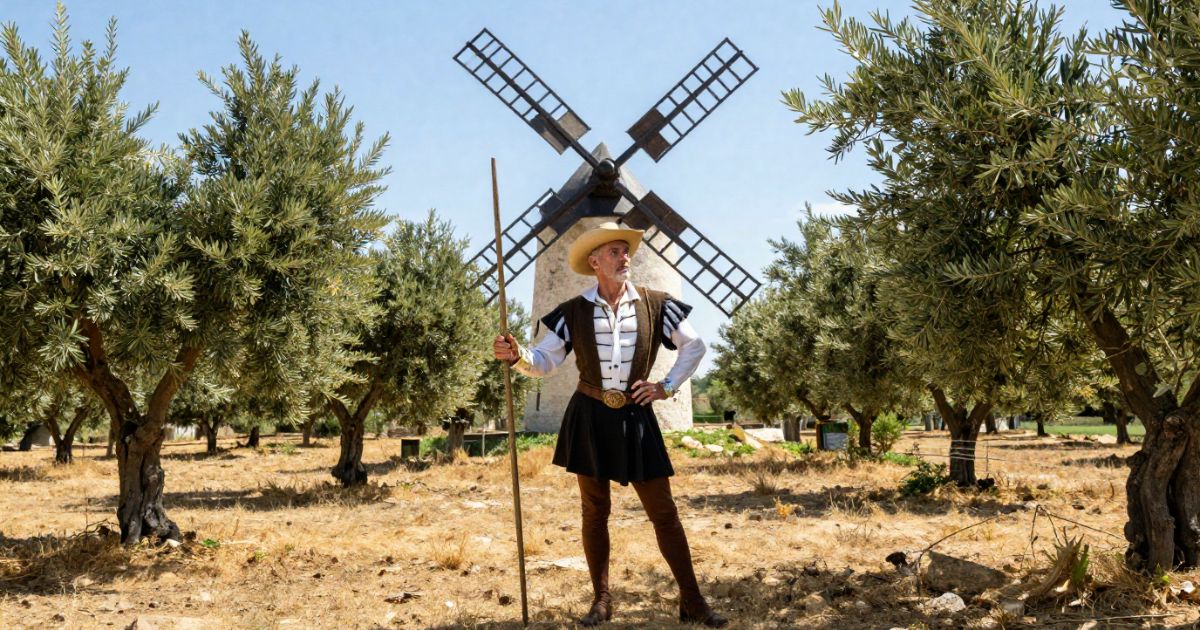
An excerpt from the original text.(complete · 762 words)
: F THE GOOD FORTUNE WHICH THE VALIANT DON QUIXOTE HAD IN THE TERRIBLE AND UNDREAMT-OF ADVENTURE OF THE WINDMILLS
They came in sight of thirty or forty windmills on the plain. Don Quixote saw them and said to Sancho: "Fortune is arranging matters better than we could have shaped our desires ourselves. Look there, friend Sancho Panza, where thirty or more monstrous giants present themselves. I mean to engage them in battle and slay them, and with their spoils we shall begin to make our fortunes. This is righteous warfare—God's good service to sweep so evil a breed from off the face of the earth."
"What giants?" said Sancho Panza.
"Those thou seest there," answered his master, "with the long arms, and some have them nearly two leagues long."
"Look, your worship," said Sancho, "what we see there are not giants but windmills, and what seem to be their arms are the sails that turned by the wind make the millstone go."
"It is easy to see," replied Don Quixote, "that thou art not used to this business of adventures; those are giants; and if thou art afraid, away with thee out of this and betake thyself to prayer while I engage them in fierce and unequal combat."
He spurred Rocinante, heedless of Sancho's cries warning him they were windmills. He was so positive they were giants that he neither heard Sancho's cries nor perceived, near as he was, what they actually were. He shouted: "Fly not, cowards and vile beings, for a single knight attacks you!"
A slight breeze sprang up and the great sails began to move. Don Quixote exclaimed: "Though ye flourish more arms than the giant Briareus, ye have to reckon with me!"
Commending himself to Dulcinea, with lance in rest and covered by his buckler, he charged at fullest gallop at the first mill. As he drove his lance-point into the sail, the wind whirled it round with such force that it shivered the lance to pieces, sweeping horse and rider rolling over on the plain in sorry condition.
Sancho hastened to help. He found Quixote unable to move—Rocinante had fallen so hard. "God bless me!" said Sancho. "Did I not tell your worship to mind what you were about, for they were only windmills? No one could have made any mistake about it but one who had something of the same kind in his head."
"Hush, friend Sancho," replied Don Quixote. "The fortunes of war are liable to frequent fluctuations. Moreover I think—and it is the truth—that same sage Friston who carried off my study and books has turned these giants into mills in order to rob me of the glory of vanquishing them, such is the enmity he bears me. But in the end his wicked arts will avail but little against my good sword."
"God order it as he may," said Sancho. He helped Quixote back onto Rocinante, whose shoulder was half out. They discussed the late adventure and followed the road to Puerto Lapice. Quixote was grieved at losing his lance. He said he'd read of Diego Perez de Vargas, who broke his sword and tore a branch from an oak and did such deeds he got the surname Machuca. Quixote planned to do the same.
"I believe it all as your worship says," said Sancho, "but straighten yourself a little, for you seem all on one side from the shaking of the fall."
"That is the truth," said Don Quixote, "and if I make no complaint of the pain it is because knights-errant are not permitted to complain of any wound, even though their bowels be coming out through it."
Sancho confessed he would complain at the smallest ache. Don Quixote laughed and assured him squires could complain freely.
Sancho reminded him it was dinner-time. Quixote said he needed nothing, but Sancho might eat. Sancho settled comfortably on his ass, taking out his provisions and munching, pulling from his wineskin with great relish. While eating he never gave a thought to any promises his master had made him, nor rated going on adventures as hardship but rather as recreation.
They spent that night among trees. Quixote plucked a dry branch for a makeshift lance. All night he lay awake thinking of Dulcinea, conforming to what he'd read about knights lying sleepless in forests. Sancho, stomach full, made but one sleep of it. When morning came Sancho tried his wineskin and found it less full than before—they didn't seem on the way to remedy the deficiency anytime soon, which grieved his heart.
Master this chapter. Complete your experience
Purchase the complete book to access all chapters and support classic literature
As an Amazon Associate, we earn a small commission from qualifying purchases at no additional cost to you.
Available in paperback, hardcover, and e-book formats
Let's Analyse the Pattern
When beliefs are structured so that any contradictory evidence gets explained away, making the belief immune to reality testing.
Why This Matters
Connect literature to life
This chapter teaches you to recognize when a belief has been structured so that no evidence can disprove it. If every challenge gets explained away, you're dealing with faith, not reason.
Practice This Today
This week, test your strong beliefs by asking: What evidence would prove me wrong? If the answer is 'nothing could change my mind' or 'any evidence against me is fake/corrupted,' you've made your belief unfalsifiable.
Now let's explore the literary elements.
Key Quotes & Analysis
"What giants?"
Context: Responding to Quixote's announcement about giants
Two words that encapsulate the entire novel. The perfect question from practical reality to pure delusion. Sancho isn't arguing or explaining—he's just asking for clarity about what Quixote claims to see. The question hangs in the air, unanswered in any meaningful way.
In Today's Words:
What are you even talking about?
"He was so positive they were giants that he neither heard the cries of Sancho, nor perceived, near as he was, what they were."
Context: Quixote charging the windmills despite warnings
This is the mechanism of closed-system belief. Not 'he disagreed with Sancho'—he literally couldn't hear him or perceive reality. When conviction is complete, contradictory information doesn't register at all. The brain blocks input that would challenge the belief.
In Today's Words:
He believed so strongly that he couldn't hear anyone telling him otherwise or see what was actually there.
"Did I not tell your worship to mind what you were about, for they were only windmills? And no one could have made any mistake about it but one who had something of the same kind in his head."
Context: After Quixote crashes
Sancho delivers perfect diagnosis: you have windmills in your head, so you see windmills as giants. The internal state determines external perception. And he's saying this to someone lying injured on the ground as a direct consequence of that perceptual error. You'd think evidence this immediate would penetrate.
In Today's Words:
I warned you! They were obviously windmills! Only someone crazy would mistake them for giants!
"That same sage Friston who carried off my study and books, has turned these giants into mills in order to rob me of the glory of vanquishing them, such is the enmity he bears me."
Context: Explaining the windmill disaster
Instant narrative protection. Not 'I was wrong about the giants'—they WERE giants, but an enchanter transformed them. This explanation is genius because it's unfalsifiable: any evidence you were wrong becomes proof of magical opposition. Perfect delusion defense.
In Today's Words:
They WERE giants, but my magical enemy transformed them into windmills at the last second to make me look bad!
Thematic Threads
Identity
In This Chapter
Quixote's identity as knight requires him to see giants and charge them—the identity determines perception, not the other way around
Development
Reaching the point where identity completely overrides sensory input
In Your Life:
You might notice times when your identity (activist, victim, winner) determines what you see rather than what you see determining your identity
Class
In This Chapter
Sancho's practical peasant wisdom (they're windmills) versus Quixote's noble idealism (they're giants)—class shapes how you see the world
Development
The dynamic of practical lower-class realism versus upper-class fantasy
In Your Life:
You might notice how people from different economic backgrounds see the same situation completely differently
Social Expectations
In This Chapter
Quixote follows the expected knight script (charge at giants) even when all evidence says it's wrong—social role overrides individual judgment
Development
Showing how role expectations can make you act against your own interests
In Your Life:
You might recognize times when you did something stupid because your role/identity 'required' it
Personal Growth
In This Chapter
Zero learning—Quixote is injured charging windmills, blamed enchantment, and continues on ready for more adventures. The pattern is set.
Development
Demonstrating how unfalsifiable beliefs prevent any learning from experience
In Your Life:
You might notice patterns where you keep making the same mistake because you've built an explanation system that prevents you from seeing it as a mistake
You now have the context. Time to form your own thoughts.
Discussion Questions
- 1
What exactly does Don Quixote see when he looks at the windmills, according to the text?
analysis • surface - 2
Why can't Quixote hear Sancho's warnings even though Sancho is right next to him shouting?
analysis • medium - 3
How does Quixote's enchanter explanation make his belief unfalsifiable—impossible to disprove?
analysis • deep - 4
Have you ever been in Sancho's position—clearly seeing what's coming and unable to stop someone from doing it anyway?
reflection • medium - 5
How do you know if you're fighting real giants or just tilting at windmills? What's the test?
application • deep
Critical Thinking Exercise
Falsifiability Test
Choose a belief you hold strongly—political, personal, professional, or spiritual. Write it down clearly. Then write: 'I would know this belief is wrong if I observed: ___________.' Fill in the blank with specific, observable evidence that would disprove your belief. If you can't think of anything, or if every example you think of can be explained away, your belief is unfalsifiable. That doesn't make it wrong—but it means you're not reasoning about it, you're having faith in it.
Consider:
- •Be specific—'evidence would have to show X' not vague 'if it turned out to be wrong'
- •Notice if you immediately think of reasons why that evidence would be fake or manipulated
- •Ask whether you're actually open to being wrong or just going through this exercise
Journaling Prompt
Write about a time when you realized you were wrong about something you'd defended strongly. What evidence finally got through? What made you able to admit error? What would have had to be different for you to recognize it sooner?
Coming Up Next...
Chapter 9: The Manuscript Trick
From imaginary giants to a real opponent: Don Quixote will challenge a Biscayan squire to combat. This time his enemy has an actual sword and isn't playing along. And Cervantes will interrupt the battle with one of literature's most clever narrative devices.