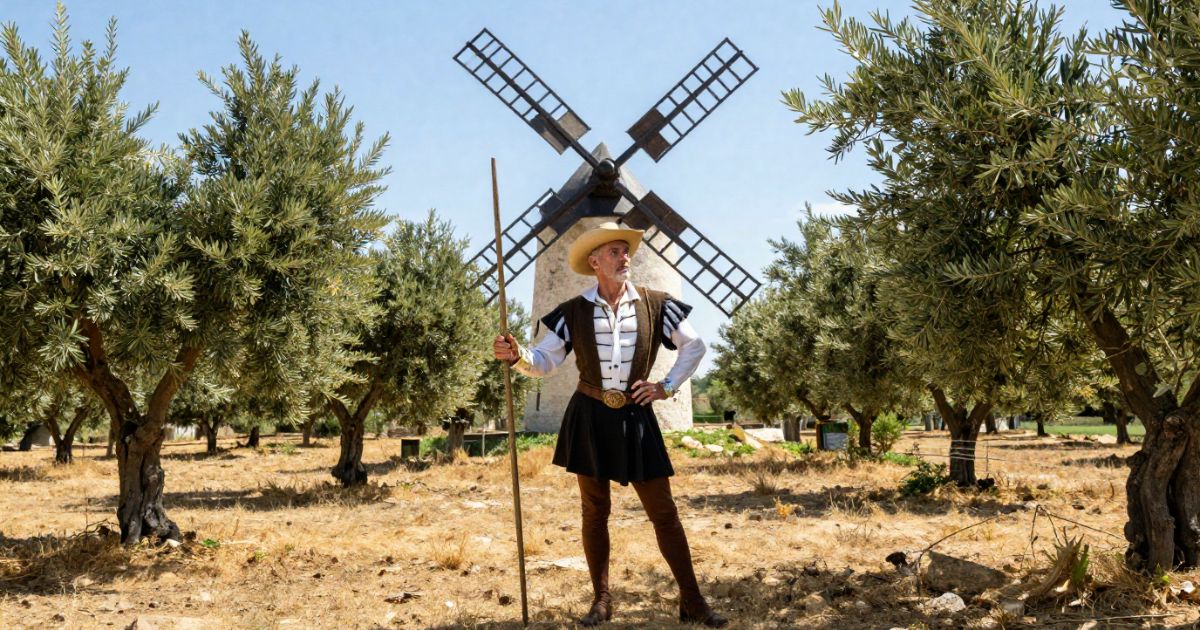
An excerpt from the original text.(complete · 932 words)
: F THE PLEASANT DISCOURSE THAT PASSED BETWEEN DON QUIXOTE AND HIS SQUIRE SANCHO PANZA
Sancho had been beaten by the friars' muleteers while trying to claim spoils. He watched his master's battle with the Biscayan, praying Don Quixote would win an island. When the struggle ended, Sancho approached, went on his knees, kissed Quixote's hand and said: "May it please your worship, Señor Don Quixote, to give me the government of that island which has been won in this hard fight, for be it ever so big I feel myself in sufficient force to govern it as well as anyone in the world who has ever governed islands."
Quixote replied: "Thou must take notice, brother Sancho, that this adventure and those like it are not adventures of islands, but of cross-roads, in which nothing is got except a broken head or an ear the less. Have patience, for adventures will present themselves from which I may make you, not only a governor, but something more."
Sancho thanked him and kissed his hand again. They left without saying goodbye to the ladies and entered a wood. Rocinante stepped out so briskly that Sancho had to call for his master to wait.
When Sancho caught up, he said: "It seems to me, señor, it would be prudent to take refuge in some church, for seeing how mauled he with whom you fought has been left, it will be no wonder if they give information to the Holy Brotherhood and arrest us."
"Peace," said Don Quixote. "Where hast thou ever seen or heard that a knight-errant has been arraigned before a court of justice, however many homicides he may have committed?"
"I know nothing about omecils," answered Sancho, "nor in my life have had anything to do with one. I only know that the Holy Brotherhood looks after those who fight in the fields."
"Then thou needst have no uneasiness, my friend," said Don Quixote. "But tell me, as thou livest, hast thou seen a more valiant knight than I in all the known world? Hast thou read in history of any who has or had higher mettle in attack?"
"The truth is," answered Sancho, "that I have never read any history, for I can neither read nor write. But what I will venture to bet is that a more daring master than your worship I have never served in all the days of my life, and God grant that this daring be not paid for where I have said. What I beg of your worship is to dress your wound, for a great deal of blood flows from that ear."
Don Quixote said all could be dispensed with if he'd remembered to make the balsam of Fierabras: "Time and medicine are saved by one single drop."
"What balsam is that?" asked Sancho.
"It is a balsam the receipt of which I have in my memory, with which one need have no fear of death. So when I make it and give it to thee, when in some battle thou seest they have cut me in half through the middle of the body, thou must neatly place the portion that has fallen to the ground upon the other half still in the saddle, taking care to fit it on evenly. Then give me to drink but two drops, and thou shalt see me become sounder than an apple."
"If that be so," said Sancho, "I renounce the government of the promised island and desire nothing more than the receipt of this supreme liquor. It will be worth more than two reals an ounce anywhere."
"With less than three reals, six quarts may be made," said Don Quixote.
"Sinner that I am! Then why does your worship put off making it?"
"Peace, friend. Greater secrets I mean to teach thee. For the present let us dress this ear."
Sancho took out lint and ointment. But when Don Quixote saw his shattered helmet, he nearly lost his senses. Clapping his hand on his sword and raising eyes to heaven, he swore by the four Gospels to take no ease until he'd taken vengeance—not eating bread from a tablecloth, not embracing his wife, and other points—like the Marquis of Mantua avenging Baldwin.
Sancho reminded him the Biscayan knight had obeyed by agreeing to see Dulcinea, so no further punishment was needed. Don Quixote agreed to recall that part of the oath, but swore to lead a harsh life until he took by force another helmet as good. Sancho begged him to send such oaths to the devil: "They are very pernicious to salvation. What if we don't meet anyone with a helmet for days? Must you sleep in your clothes and not sleep in houses?" He pointed out there are no armored men on these roads, just carriers and carters.
"Thou art wrong," said Quixote. "We shall not be above two hours among these crossroads before we see more men in armour than came to Albraca."
They discussed food. Sancho offered onion, cheese, and bread scraps, but apologized they weren't fit for a valiant knight. Quixote explained knights-errant go without eating for a month, and when they eat, it's whatever comes to hand. Their usual fare would be rustic food like Sancho offered. Sancho promised to stock better provisions.
They made their meal peacefully. Anxious to find lodging, they hurried to finish and tried to reach some habitation before dark. But daylight and hope failed them near goatherd huts. It was Sancho's discontent not to reach a house, but Quixote's satisfaction—sleeping under open heaven proved his chivalry.
Master this chapter. Complete your experience
Purchase the complete book to access all chapters and support classic literature
As an Amazon Associate, we earn a small commission from qualifying purchases at no additional cost to you.
Available in paperback, hardcover, and e-book formats
Let's Analyse the Pattern
When people use the same vocabulary but mean fundamentally different things based on their worldview, creating illusion of agreement that hides deep misalignment.
Why This Matters
Connect literature to life
This chapter teaches you to recognize when you're using the same words as someone but meaning completely different things. Before assuming you agree, explicitly define what you each mean by key terms.
Practice This Today
This week, in an important conversation, when someone uses a word like 'success,' 'priority,' or 'commitment,' ask: 'What specifically does that mean to you?' Notice if their definition matches yours.
Now let's explore the literary elements.
Key Quotes & Analysis
"This adventure and those like it are not adventures of islands, but of cross-roads, in which nothing is got except a broken head or an ear the less."
Context: Explaining to Sancho why he's not getting an island
Even within his delusional system, Quixote has categories and hierarchies. Not all adventures pay out the same. This is actually sophisticated: he's managing Sancho's expectations with fantasy economics. There's a tier system in his madness.
In Today's Words:
This was just a minor quest. You don't get major rewards from minor quests—just injuries.
"I know nothing about omecils, nor in my life have had anything to do with one."
Context: Mispronouncing 'homicides'
Sancho's illiteracy revealed through mispronunciation. He's never seen the word written, only heard it spoken (probably wrong), so he mangles it. This isn't stupidity—it's the result of being excluded from literacy education.
In Today's Words:
I don't know what an 'omecil' is and I've never dealt with one.
"When in some battle thou seest they have cut me in half through the middle of the body...neatly place that portion which shall have fallen to the ground upon the other half which remains in the saddle, taking care to fit it on evenly and exactly."
Context: Describing the magical balsam's use
The casualness of describing being cut in half, plus the fussy detail about fitting the pieces 'evenly and exactly,' makes this absurdly funny. He's giving practical instructions for an impossible situation with the tone of a recipe.
In Today's Words:
When they cut me in half, just carefully line up the pieces and glue me back together with this magic potion.
"I can eat it as well, or better, standing, and by myself, than seated alongside of an emperor...what I eat in my corner without form or fuss has much more relish for me."
Context: Refusing Quixote's offer to dine as equals
Sancho rejecting aristocratic 'honor' for actual freedom. Dining with nobility means behavioral restriction. Eating alone in a corner means he can sneeze, cough, and eat messily. He's choosing substance over status, comfort over ceremony.
In Today's Words:
I'd rather eat alone where I can relax than eat with fancy people where I have to watch my manners constantly.
Thematic Threads
Identity
In This Chapter
Quixote's identity requires specific behaviors (oaths, deprivation, glory-seeking) while Sancho's identity prioritizes comfort and survival—their identities are fundamentally incompatible
Development
Introducing the identity clash between master and servant that will drive their entire relationship
In Your Life:
You might notice partnerships where you and another person have incompatible definitions of what you're trying to accomplish
Class
In This Chapter
Sancho's rejection of 'equality' with his master reveals how class-based freedom differs from class-based honor—he'd rather have the freedom to be unobserved than the honor of dining with nobles
Development
Deepening the class analysis: sometimes lower classes refuse upper-class 'privileges' because they're actually restrictions
In Your Life:
You might recognize times when you refused 'opportunities' that others saw as honors because you understood the hidden costs
Social Expectations
In This Chapter
Quixote tries to impose chivalric social rules (don't complain about wounds, eat simply, take oaths) while Sancho wants to just live normally
Development
The clash between fantasy social rules and practical social needs
In Your Life:
You might notice times when someone's idealistic rules conflict with your practical needs to function
Personal Growth
In This Chapter
First signs of relationship negotiation—Quixote adjusts some expectations, Sancho learns some rules—showing growth happens through compromise, not conversion
Development
Introducing the possibility that these incompatible people might figure out how to work together
In Your Life:
You might be in relationships where growth means learning to accommodate differences, not fixing the other person
You now have the context. Time to form your own thoughts.
Discussion Questions
- 1
What does Sancho expect to get from the battle, and what does Don Quixote say he'll actually receive from crossroads adventures?
analysis • surface - 2
Why does Sancho immediately calculate the market value of the magical balsam rather than just accepting it as miraculous?
analysis • medium - 3
What does Sancho's refusal to dine with Quixote as equals reveal about the difference between aristocratic 'honor' and working-class freedom?
analysis • deep - 4
Have you ever been in a partnership where you realized you and the other person had completely different ideas of what you were trying to accomplish?
reflection • medium - 5
How can you tell if you and someone else actually mean the same thing when you use words like 'success,' 'commitment,' or 'partnership'?
application • deep
Critical Thinking Exercise
Shared Vocabulary Audit
Think of an important relationship or partnership (work, personal, creative). List 5 key words you both use regularly: success, priority, commitment, respect, quality, etc. For each word, write what it specifically means to you in concrete terms. Then imagine what it might mean to the other person based on their behavior and decisions. Notice any gaps between your definitions. Finally, consider: have you ever explicitly confirmed you mean the same things?
Consider:
- •Notice if you've been assuming agreement because you use the same language
- •Consider whether misaligned definitions explain past conflicts or misunderstandings
- •Think about which definitions need to be explicitly negotiated versus which differences are manageable
Journaling Prompt
Write about a time when you discovered you and someone else had been using the same word to mean very different things. What happened when you realized the misalignment? How did you handle it?
Coming Up Next...
Chapter 11: The Golden Age Speech
Sharing a meal with goatherds under the stars, Don Quixote will launch into a passionate speech about the lost Golden Age when people lived in harmony and there was no need for knights. His companions will have no idea what he's talking about.