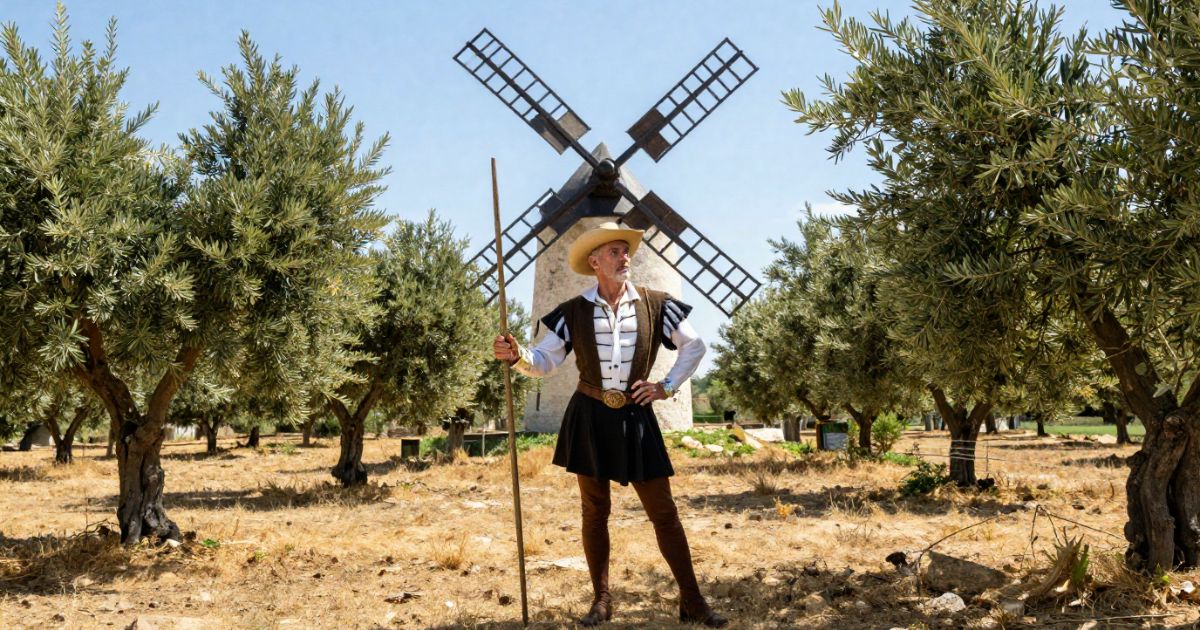
An excerpt from the original text.(complete · 3839 words)
OF WHAT BEFELL DON QUIXOTE WITH A DISCREET GENTLEMAN OF LA MANCHA
Don Quixote pursued his journey in the high spirits, satisfaction, and
self-complacency already described, fancying himself the most valorous
knight-errant of the age in the world because of his late victory. All
the adventures that could befall him from that time forth he regarded
as already done and brought to a happy issue; he made light of
enchantments and enchanters; he thought no more of the countless
drubbings that had been administered to him in the course of his
knight-errantry, nor of the volley of stones that had levelled half his
teeth, nor of the ingratitude of the galley slaves, nor of the audacity
of the Yanguesans and the shower of stakes that fell upon him; in
short, he said to himself that could he discover any means, mode, or
way of disenchanting his lady Dulcinea, he would not envy the highest
fortune that the most fortunate knight-errant of yore ever reached or
could reach.
He was going along entirely absorbed in these fancies, when Sancho said
to him, “Isn’t it odd, señor, that I have still before my eyes that
monstrous enormous nose of my gossip, Tom Cecial?”
“And dost thou, then, believe, Sancho,” said Don Quixote, “that the
Knight of the Mirrors was the bachelor Carrasco, and his squire Tom
Cecial thy gossip?”
“I don’t know what to say to that,” replied Sancho; “all I know is that
the tokens he gave me about my own house, wife and children, nobody
else but himself could have given me; and the face, once the nose was
off, was the very face of Tom Cecial, as I have seen it many a time in
my town and next door to my own house; and the sound of the voice was
just the same.”
“Let us reason the matter, Sancho,” said Don Quixote. “Come now, by
what process of thinking can it be supposed that the bachelor Samson
Carrasco would come as a knight-errant, in arms offensive and
defensive, to fight with me? Have I ever been by any chance his enemy?
Have I ever given him any occasion to owe me a grudge? Am I his rival,
or does he profess arms, that he should envy the fame I have acquired
in them?”
“Well, but what are we to say, señor,” returned Sancho, “about that
knight, whoever he is, being so like the bachelor Carrasco, and his
squire so like my gossip, Tom Cecial? And if that be enchantment, as
your worship says, was there no other pair in the world for them to
take the likeness of?”
“It is all,” said Don Quixote, “a scheme and plot of the malignant
magicians that persecute me, who, foreseeing that I was to be
victorious in the conflict, arranged that the vanquished knight should
display the countenance of my friend the bachelor, in order that the
friendship I bear him should interpose to stay the edge of my sword and
might of my arm, and temper the just wrath of my heart; so that he who
sought to take my life by fraud and falsehood should save his own. And
to prove it, thou knowest already, Sancho, by experience which cannot
lie or deceive, how easy it is for enchanters to change one countenance
into another, turning fair into foul, and foul into fair; for it is not
two days since thou sawest with thine own eyes the beauty and elegance
of the peerless Dulcinea in all its perfection and natural harmony,
while I saw her in the repulsive and mean form of a coarse country
wench, with cataracts in her eyes and a foul smell in her mouth; and
when the perverse enchanter ventured to effect so wicked a
transformation, it is no wonder if he effected that of Samson Carrasco
and thy gossip in order to snatch the glory of victory out of my grasp.
For all that, however, I console myself, because, after all, in
whatever shape he may have been, I have been victorious over my enemy.”
“God knows what’s the truth of it all,” said Sancho; and knowing as he
did that the transformation of Dulcinea had been a device and
imposition of his own, his master’s illusions were not satisfactory to
him; but he did not like to reply lest he should say something that
might disclose his trickery.
As they were engaged in this conversation they were overtaken by a man
who was following the same road behind them, mounted on a very handsome
flea-bitten mare, and dressed in a gaban of fine green cloth, with
tawny velvet facings, and a montera of the same velvet. The trappings
of the mare were of the field and jineta fashion, and of mulberry
colour and green. He carried a Moorish cutlass hanging from a broad
green and gold baldric; the buskins were of the same make as the
baldric; the spurs were not gilt, but lacquered green, and so brightly
polished that, matching as they did the rest of his apparel, they
looked better than if they had been of pure gold.
When the traveller came up with them he saluted them courteously, and
spurring his mare was passing them without stopping, but Don Quixote
called out to him, “Gallant sir, if so be your worship is going our
road, and has no occasion for speed, it would be a pleasure to me if we
were to join company.”
“In truth,” replied he on the mare, “I would not pass you so hastily
but for fear that horse might turn restive in the company of my mare.”
“You may safely hold in your mare, señor,” said Sancho in reply to
this, “for our horse is the most virtuous and well-behaved horse in the
world; he never does anything wrong on such occasions, and the only
time he misbehaved, my master and I suffered for it sevenfold; I say
again your worship may pull up if you like; for if she was offered to
him between two plates the horse would not hanker after her.”
The traveller drew rein, amazed at the trim and features of Don
Quixote, who rode without his helmet, which Sancho carried like a
valise in front of Dapple’s pack-saddle; and if the man in green
examined Don Quixote closely, still more closely did Don Quixote
examine the man in green, who struck him as being a man of
intelligence. In appearance he was about fifty years of age, with but
few grey hairs, an aquiline cast of features, and an expression between
grave and gay; and his dress and accoutrements showed him to be a man
of good condition. What he in green thought of Don Quixote of La Mancha
was that a man of that sort and shape he had never yet seen; he
marvelled at the length of his hair, his lofty stature, the lankness
and sallowness of his countenance, his armour, his bearing and his
gravity—a figure and picture such as had not been seen in those regions
for many a long day.
Don Quixote saw very plainly the attention with which the traveller was
regarding him, and read his curiosity in his astonishment; and
courteous as he was and ready to please everybody, before the other
could ask him any question he anticipated him by saying, “The
appearance I present to your worship being so strange and so out of the
common, I should not be surprised if it filled you with wonder; but you
will cease to wonder when I tell you, as I do, that I am one of those
knights who, as people say, go seeking adventures. I have left my home,
I have mortgaged my estate, I have given up my comforts, and committed
myself to the arms of Fortune, to bear me whithersoever she may please.
My desire was to bring to life again knight-errantry, now dead, and for
some time past, stumbling here, falling there, now coming down
headlong, now raising myself up again, I have carried out a great
portion of my design, succouring widows, protecting maidens, and giving
aid to wives, orphans, and minors, the proper and natural duty of
knights-errant; and, therefore, because of my many valiant and
Christian achievements, I have been already found worthy to make my way
in print to well-nigh all, or most, of the nations of the earth. Thirty
thousand volumes of my history have been printed, and it is on the
high-road to be printed thirty thousand thousands of times, if heaven
does not put a stop to it. In short, to sum up all in a few words, or
in a single one, I may tell you I am Don Quixote of La Mancha,
otherwise called ‘The Knight of the Rueful Countenance;’ for though
self-praise is degrading, I must perforce sound my own sometimes, that
is to say, when there is no one at hand to do it for me. So that,
gentle sir, neither this horse, nor this lance, nor this shield, nor
this squire, nor all these arms put together, nor the sallowness of my
countenance, nor my gaunt leanness, will henceforth astonish you, now
that you know who I am and what profession I follow.”
With these words Don Quixote held his peace, and, from the time he took
to answer, the man in green seemed to be at a loss for a reply; after a
long pause, however, he said to him, “You were right when you saw
curiosity in my amazement, sir knight; but you have not succeeded in
removing the astonishment I feel at seeing you; for although you say,
señor, that knowing who you are ought to remove it, it has not done so;
on the contrary, now that I know, I am left more amazed and astonished
than before. What! is it possible that there are knights-errant in the
world in these days, and histories of real chivalry printed? I cannot
realise the fact that there can be anyone on earth now-a-days who aids
widows, or protects maidens, or defends wives, or succours orphans; nor
should I believe it had I not seen it in your worship with my own eyes.
Blessed be heaven! for by means of this history of your noble and
genuine chivalrous deeds, which you say has been printed, the countless
stories of fictitious knights-errant with which the world is filled, so
much to the injury of morality and the prejudice and discredit of good
histories, will have been driven into oblivion.”
“There is a good deal to be said on that point,” said Don Quixote, “as
to whether the histories of the knights-errant are fiction or not.”
“Why, is there anyone who doubts that those histories are false?” said
the man in green.
“I doubt it,” said Don Quixote, “but never mind that just now; if our
journey lasts long enough, I trust in God I shall show your worship
that you do wrong in going with the stream of those who regard it as a
matter of certainty that they are not true.”
From this last observation of Don Quixote’s, the traveller began to
have a suspicion that he was some crazy being, and was waiting for him
to confirm it by something further; but before they could turn to any
new subject Don Quixote begged him to tell him who he was, since he
himself had rendered account of his station and life. To this, he in
the green gaban replied “I, Sir Knight of the Rueful Countenance, am a
gentleman by birth, native of the village where, please God, we are
going to dine to-day; I am more than fairly well off, and my name is
Don Diego de Miranda. I pass my life with my wife, children, and
friends; my pursuits are hunting and fishing, but I keep neither hawks
nor greyhounds, nothing but a tame partridge or a bold ferret or two; I
have six dozen or so of books, some in our mother tongue, some Latin,
some of them history, others devotional; those of chivalry have not as
yet crossed the threshold of my door; I am more given to turning over
the profane than the devotional, so long as they are books of honest
entertainment that charm by their style and attract and interest by the
invention they display, though of these there are very few in Spain.
Sometimes I dine with my neighbours and friends, and often invite them;
my entertainments are neat and well served without stint of anything. I
have no taste for tattle, nor do I allow tattling in my presence; I pry
not into my neighbours’ lives, nor have I lynx-eyes for what others do.
I hear mass every day; I share my substance with the poor, making no
display of good works, lest I let hypocrisy and vainglory, those
enemies that subtly take possession of the most watchful heart, find an
entrance into mine. I strive to make peace between those whom I know to
be at variance; I am the devoted servant of Our Lady, and my trust is
ever in the infinite mercy of God our Lord.”
Sancho listened with the greatest attention to the account of the
gentleman’s life and occupation; and thinking it a good and a holy
life, and that he who led it ought to work miracles, he threw himself
off Dapple, and running in haste seized his right stirrup and kissed
his foot again and again with a devout heart and almost with tears.
Seeing this the gentleman asked him, “What are you about, brother? What
are these kisses for?”
“Let me kiss,” said Sancho, “for I think your worship is the first
saint in the saddle I ever saw all the days of my life.”
“I am no saint,” replied the gentleman, “but a great sinner; but you
are, brother, for you must be a good fellow, as your simplicity shows.”
Sancho went back and regained his pack-saddle, having extracted a laugh
from his master’s profound melancholy, and excited fresh amazement in
Don Diego. Don Quixote then asked him how many children he had, and
observed that one of the things wherein the ancient philosophers, who
were without the true knowledge of God, placed the summum bonum was
in the gifts of nature, in those of fortune, in having many friends,
and many and good children.
“I, Señor Don Quixote,” answered the gentleman, “have one son, without
whom, perhaps, I should count myself happier than I am, not because he
is a bad son, but because he is not so good as I could wish. He is
eighteen years of age; he has been for six at Salamanca studying Latin
and Greek, and when I wished him to turn to the study of other sciences
I found him so wrapped up in that of poetry (if that can be called a
science) that there is no getting him to take kindly to the law, which
I wished him to study, or to theology, the queen of them all. I would
like him to be an honour to his family, as we live in days when our
kings liberally reward learning that is virtuous and worthy; for
learning without virtue is a pearl on a dunghill. He spends the whole
day in settling whether Homer expressed himself correctly or not in
such and such a line of the Iliad, whether Martial was indecent or not
in such and such an epigram, whether such and such lines of Virgil are
to be understood in this way or in that; in short, all his talk is of
the works of these poets, and those of Horace, Perseus, Juvenal, and
Tibullus; for of the moderns in our own language he makes no great
account; but with all his seeming indifference to Spanish poetry, just
now his thoughts are absorbed in making a gloss on four lines that have
been sent him from Salamanca, which I suspect are for some poetical
tournament.”
To all this Don Quixote said in reply, “Children, señor, are portions
of their parents’ bowels, and therefore, be they good or bad, are to be
loved as we love the souls that give us life; it is for the parents to
guide them from infancy in the ways of virtue, propriety, and worthy
Christian conduct, so that when grown up they may be the staff of their
parents’ old age, and the glory of their posterity; and to force them
to study this or that science I do not think wise, though it may be no
harm to persuade them; and when there is no need to study for the sake
of pane lucrando, and it is the student’s good fortune that heaven
has given him parents who provide him with it, it would be my advice to
them to let him pursue whatever science they may see him most inclined
to; and though that of poetry is less useful than pleasurable, it is
not one of those that bring discredit upon the possessor. Poetry,
gentle sir, is, as I take it, like a tender young maiden of supreme
beauty, to array, bedeck, and adorn whom is the task of several other
maidens, who are all the rest of the sciences; and she must avail
herself of the help of all, and all derive their lustre from her. But
this maiden will not bear to be handled, nor dragged through the
streets, nor exposed either at the corners of the market-places, or in
the closets of palaces. She is the product of an Alchemy of such virtue
that he who is able to practise it, will turn her into pure gold of
inestimable worth. He that possesses her must keep her within bounds,
not permitting her to break out in ribald satires or soulless sonnets.
She must on no account be offered for sale, unless, indeed, it be in
heroic poems, moving tragedies, or sprightly and ingenious comedies.
She must not be touched by the buffoons, nor by the ignorant vulgar,
incapable of comprehending or appreciating her hidden treasures. And do
not suppose, señor, that I apply the term vulgar here merely to
plebeians and the lower orders; for everyone who is ignorant, be he
lord or prince, may and should be included among the vulgar. He, then,
who shall embrace and cultivate poetry under the conditions I have
named, shall become famous, and his name honoured throughout all the
civilised nations of the earth. And with regard to what you say, señor,
of your son having no great opinion of Spanish poetry, I am inclined to
think that he is not quite right there, and for this reason: the great
poet Homer did not write in Latin, because he was a Greek, nor did
Virgil write in Greek, because he was a Latin; in short, all the
ancient poets wrote in the language they imbibed with their mother’s
milk, and never went in quest of foreign ones to express their sublime
conceptions; and that being so, the usage should in justice extend to
all nations, and the German poet should not be undervalued because he
writes in his own language, nor the Castilian, nor even the Biscayan,
for writing in his. But your son, señor, I suspect, is not prejudiced
against Spanish poetry, but against those poets who are mere Spanish
verse writers, without any knowledge of other languages or sciences to
adorn and give life and vigour to their natural inspiration; and yet
even in this he may be wrong; for, according to a true belief, a poet
is born one; that is to say, the poet by nature comes forth a poet from
his mother’s womb; and following the bent that heaven has bestowed upon
him, without the aid of study or art, he produces things that show how
truly he spoke who said, ‘Est Deus in nobis,’ etc. At the same time,
I say that the poet by nature who calls in art to his aid will be a far
better poet, and will surpass him who tries to be one relying upon his
knowledge of art alone. The reason is, that art does not surpass
nature, but only brings it to perfection; and thus, nature combined
with art, and art with nature, will produce a perfect poet. To bring my
argument to a close, I would say then, gentle sir, let your son go on
as his star leads him, for being so studious as he seems to be, and
having already successfully surmounted the first step of the sciences,
which is that of the languages, with their help he will by his own
exertions reach the summit of polite literature, which so well becomes
an independent gentleman, and adorns, honours, and distinguishes him,
as much as the mitre does the bishop, or the gown the learned
counsellor. If your son write satires reflecting on the honour of
others, chide and correct him, and tear them up; but if he compose
discourses in which he rebukes vice in general, in the style of Horace,
and with elegance like his, commend him; for it is legitimate for a
poet to write against envy and lash the envious in his verse, and the
other vices too, provided he does not single out individuals; there
are, however, poets who, for the sake of saying something spiteful,
would run the risk of being banished to the coast of Pontus. If the
poet be pure in his morals, he will be pure in his verses too; the pen
is the tongue of the mind, and as the thought engendered there, so will
be the things that it writes down. And when kings and princes observe
this marvellous science of poetry in wise, virtuous, and thoughtful
subjects, they honour, value, exalt them, and even crown them with the
leaves of that tree which the thunderbolt strikes not, as if to show
that they whose brows are honoured and adorned with such a crown are
not to be assailed by anyone.”
He of the green gaban was filled with astonishment at Don Quixote’s
argument, so much so that he began to abandon the notion he had taken
up about his being crazy. But in the middle of the discourse, it being
not very much to his taste, Sancho had turned aside out of the road to
beg a little milk from some shepherds, who were milking their ewes hard
by; and just as the gentleman, highly pleased, was about to renew the
conversation, Don Quixote, raising his head, perceived a cart covered
with royal flags coming along the road they were travelling; and
persuaded that this must be some new adventure, he called aloud to
Sancho to come and bring him his helmet. Sancho, hearing himself
called, quitted the shepherds, and, prodding Dapple vigorously, came up
to his master, to whom there fell a terrific and desperate adventure.
p16e.jpg (49K)
Master this chapter. Complete your experience
Purchase the complete book to access all chapters and support classic literature
As an Amazon Associate, we earn a small commission from qualifying purchases at no additional cost to you.
Available in paperback, hardcover, and e-book formats
Let's Analyse the Pattern
Genuine passion and authentic conviction can earn respect and reconsideration even from those who initially dismiss the passionate person as impractical or deluded.
Why This Matters
Connect literature to life
This chapter teaches how to recognize when someone's 'crazy' dream actually contains wisdom worth respecting.
Practice This Today
This week, notice when someone shares an unconventional goal—listen for whether they can explain their reasoning and demonstrate genuine knowledge, not just wishful thinking.
Now let's explore the literary elements.
Key Quotes & Analysis
"Poetry is like a tender young and beautiful maiden, whom divers other maidens, which are all the other sciences, try to deck, and polish, and adorn, and she must avail herself of them all, and they in return are all ennobled by her."
Context: Defending poetry to the practical Don Diego who worries about his son's artistic pursuits
This shows Don Quixote at his most eloquent and wise. He's arguing that poetry and art aren't frivolous but actually enhance and give meaning to all other knowledge and pursuits.
In Today's Words:
Art isn't a waste of time - it's what makes everything else in life worth learning about and gives it deeper meaning.
"The first saint in the saddle I have ever seen in all the days of my life."
Context: Describing Don Diego after being impressed by his moderate, virtuous lifestyle
Sancho is so starved for normalcy and respectability that he's amazed to meet someone who actually lives a genuinely good life without drama or delusions.
In Today's Words:
Finally, someone who has their act together and isn't completely crazy.
"I am a gentleman by birth, fond of peace and not of war, devoted to my wife and children, and to the honest pleasures of life."
Context: Describing his philosophy of life to Don Quixote
This represents the ideal of moderate, conventional happiness that most people aspire to - family, security, simple pleasures. It's the opposite of Don Quixote's grand but chaotic quest.
In Today's Words:
I keep things simple - family first, avoid drama, enjoy the small things in life.
Thematic Threads
Class
In This Chapter
Don Diego represents established genteel class while Don Quixote embodies noble ideals without wealth or status
Development
Continues exploration of how true nobility relates to birth versus behavior
In Your Life:
You might see this when educated professionals dismiss your insights because you lack their credentials
Identity
In This Chapter
Two men with completely different approaches to life find unexpected common ground in their conversation
Development
Develops theme of how identity can be both fixed and fluid depending on context
In Your Life:
You might discover that someone you thought was your opposite actually shares your deeper values
Social Expectations
In This Chapter
Don Diego expects to dismiss the mad knight but finds himself impressed and questioning his assumptions
Development
Continues theme of how social categories can blind us to individual worth
In Your Life:
You might find yourself respecting someone whose lifestyle you initially judged as wrong or foolish
Personal Growth
In This Chapter
Don Diego's encounter forces him to reconsider what constitutes wisdom versus madness
Development
Shows how growth can come from unexpected encounters that challenge our assumptions
In Your Life:
You might grow by seriously listening to someone whose approach to life differs radically from yours
Human Relationships
In This Chapter
Two very different men find mutual respect through honest conversation about art and purpose
Development
Demonstrates how authentic dialogue can bridge seemingly unbridgeable differences
In Your Life:
You might build unexpected connections by sharing your genuine passions with people who seem incompatible
You now have the context. Time to form your own thoughts.
Discussion Questions
- 1
What makes Don Diego so different from Don Quixote, and why does Sancho call him 'the first saint in the saddle'?
analysis • surface - 2
Why does Don Diego end up impressed by Don Quixote's defense of poetry, even though he thinks the knight is mad?
analysis • medium - 3
When have you seen someone's passionate commitment to their dreams earn respect from people who initially thought they were foolish?
application • medium - 4
If you had to choose between Don Diego's safe, reasonable life and Don Quixote's passionate but risky path, which would you pick and why?
application • deep - 5
What does this chapter suggest about the relationship between being 'crazy' and being right about what matters in life?
reflection • deep
Critical Thinking Exercise
Map Your Own Don Diego Moment
Think of someone in your life whose dreams or passions you initially dismissed as impractical or unrealistic. Write about what they were pursuing and why you thought they were being foolish. Then consider: what would it take for them to change your mind, the way Don Quixote changed Don Diego's?
Consider:
- •Focus on someone whose passion seemed genuine, not just wishful thinking
- •Consider what made you skeptical - was it fear, practicality, or protecting yourself from disappointment?
- •Think about whether your dismissal was really about them or about your own choices
Journaling Prompt
Write about a dream or passion you've been told is impractical. How would you defend it with Don Quixote's eloquence? What would you say to convince a skeptical Don Diego that your vision has value?
Coming Up Next...
Chapter 89: The Knight of the Lions
Don Quixote spots a cart with royal flags approaching and calls for his helmet, convinced another grand adventure awaits. What he's about to face will test his courage like never before—and Sancho's quick thinking with some shepherd's curds will play an unexpected role in the chaos to come.