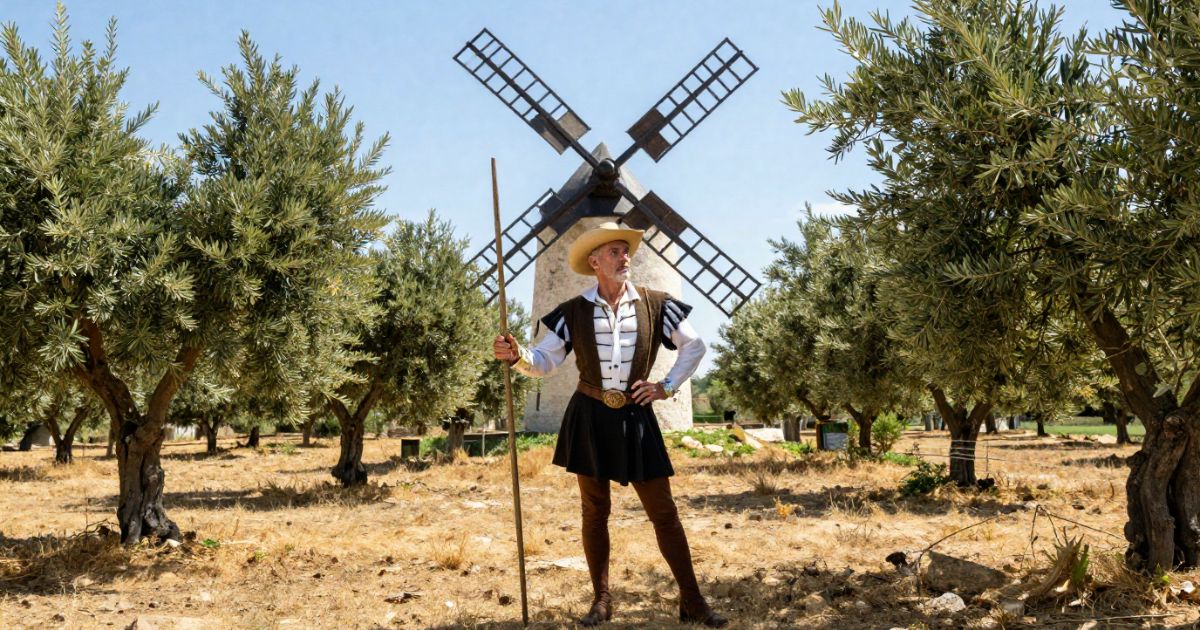
An excerpt from the original text.(complete · 4095 words)
WHEREIN IS SHOWN THE FURTHEST AND HIGHEST POINT WHICH THE UNEXAMPLED
COURAGE OF DON QUIXOTE REACHED OR COULD REACH; TOGETHER WITH THE
HAPPILY ACHIEVED ADVENTURE OF THE LIONS
The history tells that when Don Quixote called out to Sancho to bring
him his helmet, Sancho was buying some curds the shepherds agreed to
sell him, and flurried by the great haste his master was in did not
know what to do with them or what to carry them in; so, not to lose
them, for he had already paid for them, he thought it best to throw
them into his master’s helmet, and acting on this bright idea he went
to see what his master wanted with him. He, as he approached, exclaimed
to him:
“Give me that helmet, my friend, for either I know little of
adventures, or what I observe yonder is one that will, and does, call
upon me to arm myself.”
He of the green gaban, on hearing this, looked in all directions, but
could perceive nothing, except a cart coming towards them with two or
three small flags, which led him to conclude it must be carrying
treasure of the King’s, and he said so to Don Quixote. He, however,
would not believe him, being always persuaded and convinced that all
that happened to him must be adventures and still more adventures; so
he replied to the gentleman, “He who is prepared has his battle half
fought; nothing is lost by my preparing myself, for I know by
experience that I have enemies, visible and invisible, and I know not
when, or where, or at what moment, or in what shapes they will attack
me;” and turning to Sancho, he called for his helmet; and Sancho, as he
had no time to take out the curds, had to give it just as it was. Don
Quixote took it, and without perceiving what was in it thrust it down
in hot haste upon his head; but as the curds were pressed and squeezed
the whey began to run all over his face and beard, whereat he was so
startled that he cried out to Sancho:
“Sancho, what’s this? I think my head is softening, or my brains are
melting, or I am sweating from head to foot! If I am sweating it is not
indeed from fear. I am convinced beyond a doubt that the adventure
which is about to befall me is a terrible one. Give me something to
wipe myself with, if thou hast it, for this profuse sweat is blinding
me.”
Sancho held his tongue, and gave him a cloth, and gave thanks to God at
the same time that his master had not found out what was the matter.
Don Quixote then wiped himself, and took off his helmet to see what it
was that made his head feel so cool, and seeing all that white mash
inside his helmet he put it to his nose, and as soon as he had smelt it
he exclaimed:
“By the life of my lady Dulcinea del Toboso, but it is curds thou hast
put here, thou treacherous, impudent, ill-mannered squire!”
To which, with great composure and pretended innocence, Sancho replied,
“If they are curds let me have them, your worship, and I’ll eat them;
but let the devil eat them, for it must have been he who put them
there. I dare to dirty your helmet! You have guessed the offender
finely! Faith, sir, by the light God gives me, it seems I must have
enchanters too, that persecute me as a creature and limb of your
worship, and they must have put that nastiness there in order to
provoke your patience to anger, and make you baste my ribs as you are
wont to do. Well, this time, indeed, they have missed their aim, for I
trust to my master’s good sense to see that I have got no curds or
milk, or anything of the sort; and that if I had it is in my stomach I
would put it and not in the helmet.”
“May be so,” said Don Quixote. All this the gentleman was observing,
and with astonishment, more especially when, after having wiped himself
clean, his head, face, beard, and helmet, Don Quixote put it on, and
settling himself firmly in his stirrups, easing his sword in the
scabbard, and grasping his lance, he cried, “Now, come who will, here
am I, ready to try conclusions with Satan himself in person!”
By this time the cart with the flags had come up, unattended by anyone
except the carter on a mule, and a man sitting in front. Don Quixote
planted himself before it and said, “Whither are you going, brothers?
What cart is this? What have you got in it? What flags are those?”
To this the carter replied, “The cart is mine; what is in it is a pair
of wild caged lions, which the governor of Oran is sending to court as
a present to his Majesty; and the flags are our lord the King’s, to
show that what is here is his property.”
“And are the lions large?” asked Don Quixote.
“So large,” replied the man who sat at the door of the cart, “that
larger, or as large, have never crossed from Africa to Spain; I am the
keeper, and I have brought over others, but never any like these. They
are male and female; the male is in that first cage and the female in
the one behind, and they are hungry now, for they have eaten nothing
to-day, so let your worship stand aside, for we must make haste to the
place where we are to feed them.”
Hereupon, smiling slightly, Don Quixote exclaimed, “Lion-whelps to me!
to me whelps of lions, and at such a time! Then, by God! those
gentlemen who send them here shall see if I am a man to be frightened
by lions. Get down, my good fellow, and as you are the keeper open the
cages, and turn me out those beasts, and in the midst of this plain I
will let them know who Don Quixote of La Mancha is, in spite and in the
teeth of the enchanters who send them to me.”
“So, so,” said the gentleman to himself at this; “our worthy knight has
shown of what sort he is; the curds, no doubt, have softened his skull
and brought his brains to a head.”
At this instant Sancho came up to him, saying, “Señor, for God’s sake
do something to keep my master, Don Quixote, from tackling these lions;
for if he does they’ll tear us all to pieces here.”
“Is your master then so mad,” asked the gentleman, “that you believe
and are afraid he will engage such fierce animals?”
“He is not mad,” said Sancho, “but he is venturesome.”
“I will prevent it,” said the gentleman; and going over to Don Quixote,
who was insisting upon the keeper’s opening the cages, he said to him,
“Sir knight, knights-errant should attempt adventures which encourage
the hope of a successful issue, not those which entirely withhold it;
for valour that trenches upon temerity savours rather of madness than
of courage; moreover, these lions do not come to oppose you, nor do
they dream of such a thing; they are going as presents to his Majesty,
and it will not be right to stop them or delay their journey.”
“Gentle sir,” replied Don Quixote, “you go and mind your tame partridge
and your bold ferret, and leave everyone to manage his own business;
this is mine, and I know whether these gentlemen the lions come to me
or not;” and then turning to the keeper he exclaimed, “By all that’s
good, sir scoundrel, if you don’t open the cages this very instant,
I’ll pin you to the cart with this lance.”
The carter, seeing the determination of this apparition in armour, said
to him, “Please your worship, for charity’s sake, señor, let me unyoke
the mules and place myself in safety along with them before the lions
are turned out; for if they kill them on me I am ruined for life, for
all I possess is this cart and mules.”
“O man of little faith,” replied Don Quixote, “get down and unyoke; you
will soon see that you are exerting yourself for nothing, and that you
might have spared yourself the trouble.”
The carter got down and with all speed unyoked the mules, and the
keeper called out at the top of his voice, “I call all here to witness
that against my will and under compulsion I open the cages and let the
lions loose, and that I warn this gentleman that he will be accountable
for all the harm and mischief which these beasts may do, and for my
salary and dues as well. You, gentlemen, place yourselves in safety
before I open, for I know they will do me no harm.”
Once more the gentleman strove to persuade Don Quixote not to do such a
mad thing, as it was tempting God to engage in such a piece of folly.
To this, Don Quixote replied that he knew what he was about. The
gentleman in return entreated him to reflect, for he knew he was under
a delusion.
“Well, señor,” answered Don Quixote, “if you do not like to be a
spectator of this tragedy, as in your opinion it will be, spur your
flea-bitten mare, and place yourself in safety.”
Hearing this, Sancho with tears in his eyes entreated him to give up an
enterprise compared with which the one of the windmills, and the awful
one of the fulling mills, and, in fact, all the feats he had attempted
in the whole course of his life, were cakes and fancy bread. “Look ye,
señor,” said Sancho, “there’s no enchantment here, nor anything of the
sort, for between the bars and chinks of the cage I have seen the paw
of a real lion, and judging by that I reckon the lion such a paw could
belong to must be bigger than a mountain.”
“Fear at any rate,” replied Don Quixote, “will make him look bigger to
thee than half the world. Retire, Sancho, and leave me; and if I die
here thou knowest our old compact; thou wilt repair to Dulcinea—I say
no more.” To these he added some further words that banished all hope
of his giving up his insane project. He of the green gaban would have
offered resistance, but he found himself ill-matched as to arms, and
did not think it prudent to come to blows with a madman, for such Don
Quixote now showed himself to be in every respect; and the latter,
renewing his commands to the keeper and repeating his threats, gave
warning to the gentleman to spur his mare, Sancho his Dapple, and the
carter his mules, all striving to get away from the cart as far as they
could before the lions broke loose. Sancho was weeping over his
master’s death, for this time he firmly believed it was in store for
him from the claws of the lions; and he cursed his fate and called it
an unlucky hour when he thought of taking service with him again; but
with all his tears and lamentations he did not forget to thrash Dapple
so as to put a good space between himself and the cart. The keeper,
seeing that the fugitives were now some distance off, once more
entreated and warned him as before; but he replied that he heard him,
and that he need not trouble himself with any further warnings or
entreaties, as they would be fruitless, and bade him make haste.
During the delay that occurred while the keeper was opening the first
cage, Don Quixote was considering whether it would not be well to do
battle on foot, instead of on horseback, and finally resolved to fight
on foot, fearing that Rocinante might take fright at the sight of the
lions; he therefore sprang off his horse, flung his lance aside, braced
his buckler on his arm, and drawing his sword, advanced slowly with
marvellous intrepidity and resolute courage, to plant himself in front
of the cart, commending himself with all his heart to God and to his
lady Dulcinea.
It is to be observed, that on coming to this passage, the author of
this veracious history breaks out into exclamations. “O doughty Don
Quixote! high-mettled past extolling! Mirror, wherein all the heroes of
the world may see themselves! Second modern Don Manuel de Leon, once
the glory and honour of Spanish knighthood! In what words shall I
describe this dread exploit, by what language shall I make it credible
to ages to come, what eulogies are there unmeet for thee, though they
be hyperboles piled on hyperboles! On foot, alone, undaunted,
high-souled, with but a simple sword, and that no trenchant blade of
the Perrillo brand, a shield, but no bright polished steel one, there
stoodst thou, biding and awaiting the two fiercest lions that Africa’s
forests ever bred! Thy own deeds be thy praise, valiant Manchegan, and
here I leave them as they stand, wanting the words wherewith to glorify
them!”
Here the author’s outburst came to an end, and he proceeded to take up
the thread of his story, saying that the keeper, seeing that Don
Quixote had taken up his position, and that it was impossible for him
to avoid letting out the male without incurring the enmity of the fiery
and daring knight, flung open the doors of the first cage, containing,
as has been said, the lion, which was now seen to be of enormous size,
and grim and hideous mien. The first thing he did was to turn round in
the cage in which he lay, and protrude his claws, and stretch himself
thoroughly; he next opened his mouth, and yawned very leisurely, and
with near two palms’ length of tongue that he had thrust forth, he
licked the dust out of his eyes and washed his face; having done this,
he put his head out of the cage and looked all round with eyes like
glowing coals, a spectacle and demeanour to strike terror into temerity
itself. Don Quixote merely observed him steadily, longing for him to
leap from the cart and come to close quarters with him, when he hoped
to hew him in pieces.
So far did his unparalleled madness go; but the noble lion, more
courteous than arrogant, not troubling himself about silly bravado,
after having looked all round, as has been said, turned about and
presented his hind-quarters to Don Quixote, and very coolly and
tranquilly lay down again in the cage. Seeing this, Don Quixote ordered
the keeper to take a stick to him and provoke him to make him come out.
“That I won’t,” said the keeper; “for if I anger him, the first he’ll
tear in pieces will be myself. Be satisfied, sir knight, with what you
have done, which leaves nothing more to be said on the score of
courage, and do not seek to tempt fortune a second time. The lion has
the door open; he is free to come out or not to come out; but as he has
not come out so far, he will not come out to-day. Your worship’s great
courage has been fully manifested already; no brave champion, so it
strikes me, is bound to do more than challenge his enemy and wait for
him on the field; if his adversary does not come, on him lies the
disgrace, and he who waits for him carries off the crown of victory.”
“That is true,” said Don Quixote; “close the door, my friend, and let
me have, in the best form thou canst, what thou hast seen me do, by way
of certificate; to wit, that thou didst open for the lion, that I
waited for him, that he did not come out, that I still waited for him,
and that still he did not come out, and lay down again. I am not bound
to do more; enchantments avaunt, and God uphold the right, the truth,
and true chivalry! Close the door as I bade thee, while I make signals
to the fugitives that have left us, that they may learn this exploit
from thy lips.”
The keeper obeyed, and Don Quixote, fixing on the point of his lance
the cloth he had wiped his face with after the deluge of curds,
proceeded to recall the others, who still continued to fly, looking
back at every step, all in a body, the gentleman bringing up the rear.
Sancho, however, happening to observe the signal of the white cloth,
exclaimed, “May I die, if my master has not overcome the wild beasts,
for he is calling to us.”
They all stopped, and perceived that it was Don Quixote who was making
signals, and shaking off their fears to some extent, they approached
slowly until they were near enough to hear distinctly Don Quixote’s
voice calling to them. They returned at length to the cart, and as they
came up, Don Quixote said to the carter, “Put your mules to once more,
brother, and continue your journey; and do thou, Sancho, give him two
gold crowns for himself and the keeper, to compensate for the delay
they have incurred through me.”
“That will I give with all my heart,” said Sancho; “but what has become
of the lions? Are they dead or alive?”
The keeper, then, in full detail, and bit by bit, described the end of
the contest, exalting to the best of his power and ability the valour
of Don Quixote, at the sight of whom the lion quailed, and would not
and dared not come out of the cage, although he had held the door open
ever so long; and showing how, in consequence of his having represented
to the knight that it was tempting God to provoke the lion in order to
force him out, which he wished to have done, he very reluctantly, and
altogether against his will, had allowed the door to be closed.
“What dost thou think of this, Sancho?” said Don Quixote. “Are there
any enchantments that can prevail against true valour? The enchanters
may be able to rob me of good fortune, but of fortitude and courage
they cannot.”
Sancho paid the crowns, the carter put to, the keeper kissed Don
Quixote’s hands for the bounty bestowed upon him, and promised to give
an account of the valiant exploit to the King himself, as soon as he
saw him at court.
“Then,” said Don Quixote, “if his Majesty should happen to ask who
performed it, you must say THE KNIGHT OF THE LIONS; for it is my desire
that into this the name I have hitherto borne of Knight of the Rueful
Countenance be from this time forward changed, altered, transformed,
and turned; and in this I follow the ancient usage of knights-errant,
who changed their names when they pleased, or when it suited their
purpose.”
The cart went its way, and Don Quixote, Sancho, and he of the green
gaban went theirs. All this time, Don Diego de Miranda had not spoken a
word, being entirely taken up with observing and noting all that Don
Quixote did and said, and the opinion he formed was that he was a man
of brains gone mad, and a madman on the verge of rationality. The first
part of his history had not yet reached him, for, had he read it, the
amazement with which his words and deeds filled him would have
vanished, as he would then have understood the nature of his madness;
but knowing nothing of it, he took him to be rational one moment, and
crazy the next, for what he said was sensible, elegant, and well
expressed, and what he did, absurd, rash, and foolish; and said he to
himself, “What could be madder than putting on a helmet full of curds,
and then persuading oneself that enchanters are softening one’s skull;
or what could be greater rashness and folly than wanting to fight lions
tooth and nail?”
Don Quixote roused him from these reflections and this soliloquy by
saying, “No doubt, Señor Don Diego de Miranda, you set me down in your
mind as a fool and a madman, and it would be no wonder if you did, for
my deeds do not argue anything else. But for all that, I would have you
take notice that I am neither so mad nor so foolish as I must have
seemed to you. A gallant knight shows to advantage bringing his lance
to bear adroitly upon a fierce bull under the eyes of his sovereign, in
the midst of a spacious plaza; a knight shows to advantage arrayed in
glittering armour, pacing the lists before the ladies in some joyous
tournament, and all those knights show to advantage that entertain,
divert, and, if we may say so, honour the courts of their princes by
warlike exercises, or what resemble them; but to greater advantage than
all these does a knight-errant show when he traverses deserts,
solitudes, cross-roads, forests, and mountains, in quest of perilous
adventures, bent on bringing them to a happy and successful issue, all
to win a glorious and lasting renown. To greater advantage, I maintain,
does the knight-errant show bringing aid to some widow in some lonely
waste, than the court knight dallying with some city damsel. All
knights have their own special parts to play; let the courtier devote
himself to the ladies, let him add lustre to his sovereign’s court by
his liveries, let him entertain poor gentlemen with the sumptuous fare
of his table, let him arrange joustings, marshal tournaments, and prove
himself noble, generous, and magnificent, and above all a good
Christian, and so doing he will fulfil the duties that are especially
his; but let the knight-errant explore the corners of the earth and
penetrate the most intricate labyrinths, at each step let him attempt
impossibilities, on desolate heaths let him endure the burning rays of
the midsummer sun, and the bitter inclemency of the winter winds and
frosts; let no lions daunt him, no monsters terrify him, no dragons
make him quail; for to seek these, to attack those, and to vanquish
all, are in truth his main duties. I, then, as it has fallen to my lot
to be a member of knight-errantry, cannot avoid attempting all that to
me seems to come within the sphere of my duties; thus it was my bounden
duty to attack those lions that I just now attacked, although I knew it
to be the height of rashness; for I know well what valour is, that it
is a virtue that occupies a place between two vicious extremes,
cowardice and temerity; but it will be a lesser evil for him who is
valiant to rise till he reaches the point of rashness, than to sink
until he reaches the point of cowardice; for, as it is easier for the
prodigal than for the miser to become generous, so it is easier for a
rash man to prove truly valiant than for a coward to rise to true
valour; and believe me, Señor Don Diego, in attempting adventures it is
better to lose by a card too many than by a card too few; for to hear
it said, ‘such a knight is rash and daring,’ sounds better than ‘such a
knight is timid and cowardly.’”
“I protest, Señor Don Quixote,” said Don Diego, “everything you have
said and done is proved correct by the test of reason itself; and I
believe, if the laws and ordinances of knight-errantry should be lost,
they might be found in your worship’s breast as in their own proper
depository and muniment-house; but let us make haste, and reach my
village, where you shall take rest after your late exertions; for if
they have not been of the body they have been of the spirit, and these
sometimes tend to produce bodily fatigue.”
“I take the invitation as a great favour and honour, Señor Don Diego,”
replied Don Quixote; and pressing forward at a better pace than before,
at about two in the afternoon they reached the village and house of Don
Diego, or, as Don Quixote called him, “The Knight of the Green Gaban.”
p17e.jpg (76K)
Master this chapter. Complete your experience
Purchase the complete book to access all chapters and support classic literature
As an Amazon Associate, we earn a small commission from qualifying purchases at no additional cost to you.
Available in paperback, hardcover, and e-book formats
Let's Analyse the Pattern
When someone creates drama specifically to provoke your response and validate their narrative, dignified disengagement is often more powerful than any argument.
Why This Matters
Connect literature to life
This chapter teaches how to distinguish between genuine feedback and polite dismissal, and when to stop pushing for engagement.
Practice This Today
This week, notice when someone gives you brief, polite responses—they might be signaling disinterest rather than playing hard to get.
Now let's explore the literary elements.
Key Quotes & Analysis
"Give me that helmet, my friend, for either I know little of adventures, or what I observe yonder is one that will, and does, call upon me to arm myself."
Context: He demands his helmet from Sancho, not knowing it's full of curds
This shows how Don Quixote sees adventure everywhere and always assumes he's needed to save the day. His confidence is absolute, even when he's about to look ridiculous.
In Today's Words:
Hand me my gear - I can spot trouble coming from a mile away and I need to get ready for action.
"He who is prepared has his battle half fought; nothing is lost by my preparing myself."
Context: Justifying his need to arm himself for the approaching cart
Don Quixote believes in being ready for anything, but his preparation is based on fantasy rather than reality. He mistakes readiness for actual competence.
In Today's Words:
Better safe than sorry - there's no harm in being prepared for whatever's coming.
"The lion stretched himself, opened his mouth, yawned very leisurely, then put out his tongue and licked his whiskers, and lay down again in the cage."
Context: Describing the lion's complete lack of interest in fighting Don Quixote
This moment perfectly captures how reality often deflates our grand expectations. The lion's casual indifference makes Don Quixote's heroic posturing look absurd.
In Today's Words:
The lion basically said 'not interested' and went back to his nap.
Thematic Threads
Identity
In This Chapter
Don Quixote transforms the lion's indifference into proof of his heroic identity, showing how we can reframe any outcome to protect our self-image
Development
Evolved from earlier delusions—now he's learned to spin even non-events into victories
In Your Life:
You might catch yourself explaining away rejections or setbacks in ways that protect your ego rather than help you learn
Social Expectations
In This Chapter
Everyone expects the lion to either attack or flee, but it chooses a third option that breaks the expected script entirely
Development
Builds on recurring theme of reality refusing to follow social scripts
In Your Life:
You might find power in refusing to play the role others expect from you in conflicts or confrontations
Class
In This Chapter
Don Quixote rewards the lion keeper for 'witnessing his triumph,' using his social position to create his own version of events
Development
Continues pattern of using class privilege to reshape narrative reality
In Your Life:
You might notice how people with more power can make their version of events stick, regardless of what actually happened
Personal Growth
In This Chapter
The lion demonstrates mature restraint—it has the power to destroy but chooses not to engage with foolishness
Development
Introduced here as counterpoint to Don Quixote's arrested development
In Your Life:
You might recognize moments when walking away from a fight shows more strength than engaging
Human Relationships
In This Chapter
Don Diego watches in bewilderment, representing how exhausting it is to maintain relationships with people who operate by different rules than everyone else
Development
Develops ongoing theme of how Don Quixote's delusions strain his relationships
In Your Life:
You might find yourself in Don Diego's position, trying to understand someone whose behavior makes no sense to you
You now have the context. Time to form your own thoughts.
Discussion Questions
- 1
What does the lion's response to Don Quixote's challenge reveal about the difference between seeking conflict and actually being dangerous?
analysis • surface - 2
Why does Don Quixote interpret the lion's indifference as his own victory, and what does this tell us about how people create their own narratives?
analysis • medium - 3
Think of someone in your life who seems to create drama or pick fights. How do they react when others refuse to engage with their chaos?
application • medium - 4
When someone is trying to pull you into their drama or crisis, what's the difference between being helpful and being manipulated into playing a role in their story?
application • deep - 5
What does this chapter suggest about the relationship between dignity and power, especially when dealing with unreasonable people?
reflection • deep
Critical Thinking Exercise
Practice the Lion Response
Think of a recent situation where someone tried to pull you into drama, conflict, or their emotional crisis. Write out what happened, then rewrite your response using the lion's approach: acknowledge the situation calmly, but refuse to provide the emotional reaction they were seeking. Focus on maintaining your dignity while not feeding their narrative.
Consider:
- •The difference between ignoring someone completely and disengaging with dignity
- •How to respond to practical needs without getting sucked into emotional manipulation
- •Why some people need your reaction to validate their version of events
Journaling Prompt
Write about a time when you successfully refused to engage with someone's drama. What did you do differently than usual, and how did the situation change when you stopped feeding their need for reaction?
Coming Up Next...
Chapter 90: The Knight Among Civilized Folk
Don Quixote accepts an invitation to Don Diego's home, where he'll encounter a different kind of challenge - domestic tranquility and the question of whether a knight-errant can ever truly fit into normal society.