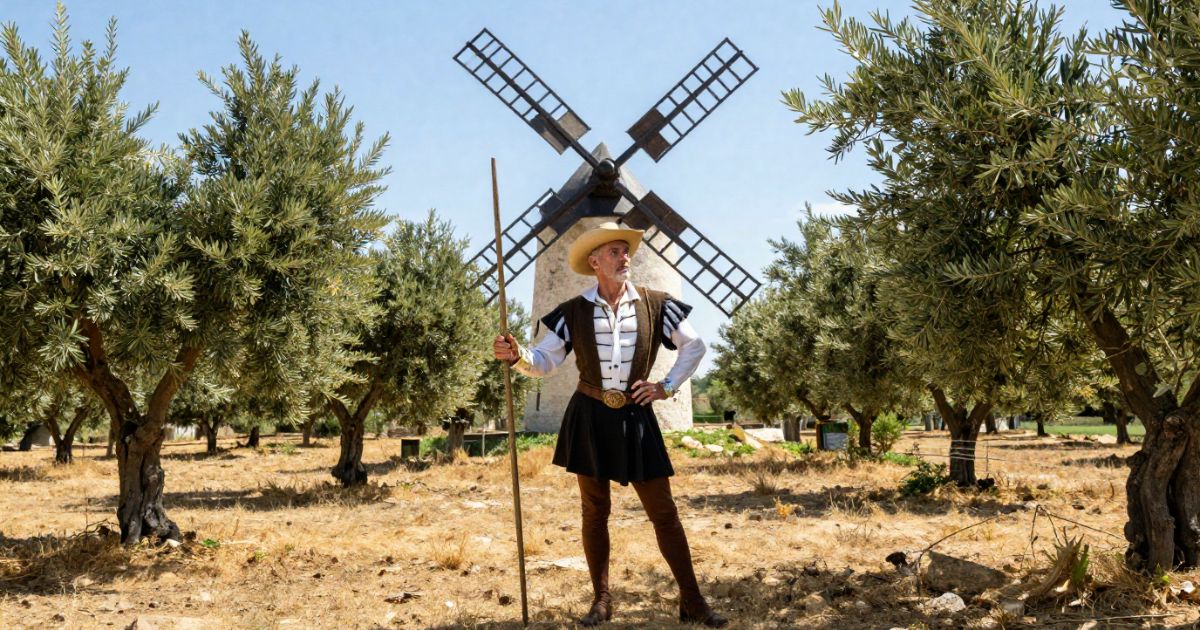
An excerpt from the original text.(complete · 2458 words)
OF THE STRANGE ADVENTURE WHICH BEFELL THE VALIANT DON QUIXOTE WITH THE
BOLD KNIGHT OF THE MIRRORS
The night succeeding the day of the encounter with Death, Don Quixote
and his squire passed under some tall shady trees, and Don Quixote at
Sancho’s persuasion ate a little from the store carried by Dapple, and
over their supper Sancho said to his master, “Señor, what a fool I
should have looked if I had chosen for my reward the spoils of the
first adventure your worship achieved, instead of the foals of the
three mares. After all, ‘a sparrow in the hand is better than a vulture
on the wing.’”
“At the same time, Sancho,” replied Don Quixote, “if thou hadst let me
attack them as I wanted, at the very least the emperor’s gold crown and
Cupid’s painted wings would have fallen to thee as spoils, for I should
have taken them by force and given them into thy hands.”
“The sceptres and crowns of those play-actor emperors,” said Sancho,
“were never yet pure gold, but only brass foil or tin.”
“That is true,” said Don Quixote, “for it would not be right that the
accessories of the drama should be real, instead of being mere fictions
and semblances, like the drama itself; towards which, Sancho—and, as a
necessary consequence, towards those who represent and produce it—I
would that thou wert favourably disposed, for they are all instruments
of great good to the State, placing before us at every step a mirror in
which we may see vividly displayed what goes on in human life; nor is
there any similitude that shows us more faithfully what we are and
ought to be than the play and the players. Come, tell me, hast thou not
seen a play acted in which kings, emperors, pontiffs, knights, ladies,
and divers other personages were introduced? One plays the villain,
another the knave, this one the merchant, that the soldier, one the
sharp-witted fool, another the foolish lover; and when the play is
over, and they have put off the dresses they wore in it, all the actors
become equal.”
“Yes, I have seen that,” said Sancho.
“Well then,” said Don Quixote, “the same thing happens in the comedy
and life of this world, where some play emperors, others popes, and, in
short, all the characters that can be brought into a play; but when it
is over, that is to say when life ends, death strips them all of the
garments that distinguish one from the other, and all are equal in the
grave.”
“A fine comparison!” said Sancho; “though not so new but that I have
heard it many and many a time, as well as that other one of the game of
chess; how, so long as the game lasts, each piece has its own
particular office, and when the game is finished they are all mixed,
jumbled up and shaken together, and stowed away in the bag, which is
much like ending life in the grave.”
“Thou art growing less doltish and more shrewd every day, Sancho,” said
Don Quixote.
“Ay,” said Sancho; “it must be that some of your worship’s shrewdness
sticks to me; land that, of itself, is barren and dry, will come to
yield good fruit if you dung it and till it; what I mean is that your
worship’s conversation has been the dung that has fallen on the barren
soil of my dry wit, and the time I have been in your service and
society has been the tillage; and with the help of this I hope to yield
fruit in abundance that will not fall away or slide from those paths of
good breeding that your worship has made in my parched understanding.”
Don Quixote laughed at Sancho’s affected phraseology, and perceived
that what he said about his improvement was true, for now and then he
spoke in a way that surprised him; though always, or mostly, when
Sancho tried to talk fine and attempted polite language, he wound up by
toppling over from the summit of his simplicity into the abyss of his
ignorance; and where he showed his culture and his memory to the
greatest advantage was in dragging in proverbs, no matter whether they
had any bearing or not upon the subject in hand, as may have been seen
already and will be noticed in the course of this history.
In conversation of this kind they passed a good part of the night, but
Sancho felt a desire to let down the curtains of his eyes, as he used
to say when he wanted to go to sleep; and stripping Dapple he left him
at liberty to graze his fill. He did not remove Rocinante’s saddle, as
his master’s express orders were, that so long as they were in the
field or not sleeping under a roof Rocinante was not to be stripped—the
ancient usage established and observed by knights-errant being to take
off the bridle and hang it on the saddle-bow, but to remove the saddle
from the horse—never! Sancho acted accordingly, and gave him the same
liberty he had given Dapple, between whom and Rocinante there was a
friendship so unequalled and so strong, that it is handed down by
tradition from father to son, that the author of this veracious history
devoted some special chapters to it, which, in order to preserve the
propriety and decorum due to a history so heroic, he did not insert
therein; although at times he forgets this resolution of his and
describes how eagerly the two beasts would scratch one another when
they were together and how, when they were tired or full, Rocinante
would lay his neck across Dapple’s, stretching half a yard or more on
the other side, and the pair would stand thus, gazing thoughtfully on
the ground, for three days, or at least so long as they were left
alone, or hunger did not drive them to go and look for food. I may add
that they say the author left it on record that he likened their
friendship to that of Nisus and Euryalus, and Pylades and Orestes; and
if that be so, it may be perceived, to the admiration of mankind, how
firm the friendship must have been between these two peaceful animals,
shaming men, who preserve friendships with one another so badly. This
was why it was said-
For friend no longer is there friend;
The reeds turn lances now.
And someone else has sung—
Friend to friend the bug, etc.
and let no one fancy that the author was at all astray when he compared
the friendship of these animals to that of men; for men have received
many lessons from beasts, and learned many important things, as, for
example, the clyster from the stork, vomit and gratitude from the dog,
watchfulness from the crane, foresight from the ant, modesty from the
elephant, and loyalty from the horse.
Sancho at last fell asleep at the foot of a cork tree, while Don
Quixote dozed at that of a sturdy oak; but a short time only had
elapsed when a noise he heard behind him awoke him, and rising up
startled, he listened and looked in the direction the noise came from,
and perceived two men on horseback, one of whom, letting himself drop
from the saddle, said to the other, “Dismount, my friend, and take the
bridles off the horses, for, so far as I can see, this place will
furnish grass for them, and the solitude and silence my love-sick
thoughts need of.” As he said this he stretched himself upon the
ground, and as he flung himself down, the armour in which he was clad
rattled, whereby Don Quixote perceived that he must be a knight-errant;
and going over to Sancho, who was asleep, he shook him by the arm and
with no small difficulty brought him back to his senses, and said in a
low voice to him, “Brother Sancho, we have got an adventure.”
“God send us a good one,” said Sancho; “and where may her ladyship the
adventure be?”
“Where, Sancho?” replied Don Quixote; “turn thine eyes and look, and
thou wilt see stretched there a knight-errant, who, it strikes me, is
not over and above happy, for I saw him fling himself off his horse and
throw himself on the ground with a certain air of dejection, and his
armour rattled as he fell.”
“Well,” said Sancho, “how does your worship make out that to be an
adventure?”
“I do not mean to say,” returned Don Quixote, “that it is a complete
adventure, but that it is the beginning of one, for it is in this way
adventures begin. But listen, for it seems he is tuning a lute or
guitar, and from the way he is spitting and clearing his chest he must
be getting ready to sing something.”
“Faith, you are right,” said Sancho, “and no doubt he is some enamoured
knight.”
“There is no knight-errant that is not,” said Don Quixote; “but let us
listen to him, for, if he sings, by that thread we shall extract the
ball of his thoughts; because out of the abundance of the heart the
mouth speaketh.”
Sancho was about to reply to his master, but the Knight of the Grove’s
voice, which was neither very bad nor very good, stopped him, and
listening attentively the pair heard him sing this
SONNET
Your pleasure, prithee, lady mine, unfold;
Declare the terms that I am to obey;
My will to yours submissively I mould,
And from your law my feet shall never stray.
Would you I die, to silent grief a prey?
Then count me even now as dead and cold;
Would you I tell my woes in some new way?
Then shall my tale by Love itself be told.
The unison of opposites to prove,
Of the soft wax and diamond hard am I;
But still, obedient to the laws of love,
Here, hard or soft, I offer you my breast,
Whate’er you grave or stamp thereon shall rest
Indelible for all eternity.
With an “Ah me!” that seemed to be drawn from the inmost recesses of
his heart, the Knight of the Grove brought his lay to an end, and
shortly afterwards exclaimed in a melancholy and piteous voice, “O
fairest and most ungrateful woman on earth! What! can it be, most
serene Casildea de Vandalia, that thou wilt suffer this thy captive
knight to waste away and perish in ceaseless wanderings and rude and
arduous toils? It is not enough that I have compelled all the knights
of Navarre, all the Leonese, all the Tartesians, all the Castilians,
and finally all the knights of La Mancha, to confess thee the most
beautiful in the world?”
“Not so,” said Don Quixote at this, “for I am of La Mancha, and I have
never confessed anything of the sort, nor could I nor should I confess
a thing so much to the prejudice of my lady’s beauty; thou seest how
this knight is raving, Sancho. But let us listen, perhaps he will tell
us more about himself.”
“That he will,” returned Sancho, “for he seems in a mood to bewail
himself for a month at a stretch.”
But this was not the case, for the Knight of the Grove, hearing voices
near him, instead of continuing his lamentation, stood up and exclaimed
in a distinct but courteous tone, “Who goes there? What are you? Do you
belong to the number of the happy or of the miserable?”
“Of the miserable,” answered Don Quixote.
“Then come to me,” said he of the Grove, “and rest assured that it is
to woe itself and affliction itself you come.”
Don Quixote, finding himself answered in such a soft and courteous
manner, went over to him, and so did Sancho.
The doleful knight took Don Quixote by the arm, saying, “Sit down here,
sir knight; for, that you are one, and of those that profess
knight-errantry, it is to me a sufficient proof to have found you in
this place, where solitude and night, the natural couch and proper
retreat of knights-errant, keep you company.” To which Don made answer,
“A knight I am of the profession you mention, and though sorrows,
misfortunes, and calamities have made my heart their abode, the
compassion I feel for the misfortunes of others has not been thereby
banished from it. From what you have just now sung I gather that yours
spring from love, I mean from the love you bear that fair ingrate you
named in your lament.”
In the meantime, they had seated themselves together on the hard ground
peaceably and sociably, just as if, as soon as day broke, they were not
going to break one another’s heads.
“Are you, sir knight, in love perchance?” asked he of the Grove of Don
Quixote.
“By mischance I am,” replied Don Quixote; “though the ills arising from
well-bestowed affections should be esteemed favours rather than
misfortunes.”
“That is true,” returned he of the Grove, “if scorn did not unsettle
our reason and understanding, for if it be excessive it looks like
revenge.”
“I was never scorned by my lady,” said Don Quixote.
“Certainly not,” said Sancho, who stood close by, “for my lady is as a
lamb, and softer than a roll of butter.”
“Is this your squire?” asked he of the Grove.
“He is,” said Don Quixote.
“I never yet saw a squire,” said he of the Grove, “who ventured to
speak when his master was speaking; at least, there is mine, who is as
big as his father, and it cannot be proved that he has ever opened his
lips when I am speaking.”
“By my faith then,” said Sancho, “I have spoken, and am fit to speak,
in the presence of one as much, or even—but never mind—it only makes it
worse to stir it.”
The squire of the Grove took Sancho by the arm, saying to him, “Let us
two go where we can talk in squire style as much as we please, and
leave these gentlemen our masters to fight it out over the story of
their loves; and, depend upon it, daybreak will find them at it without
having made an end of it.”
“So be it by all means,” said Sancho; “and I will tell your worship who
I am, that you may see whether I am to be reckoned among the number of
the most talkative squires.”
With this the two squires withdrew to one side, and between them there
passed a conversation as droll as that which passed between their
masters was serious.
p12e.jpg (15K)
Master this chapter. Complete your experience
Purchase the complete book to access all chapters and support classic literature
As an Amazon Associate, we earn a small commission from qualifying purchases at no additional cost to you.
Available in paperback, hardcover, and e-book formats
Let's Analyse the Pattern
People rise to meet the intellectual expectations consistently placed on them through respectful dialogue.
Why This Matters
Connect literature to life
This chapter teaches how to identify when someone takes your mind seriously versus when they're just being polite or dismissive.
Practice This Today
This week, notice the difference between someone who asks follow-up questions about your ideas versus someone who just waits for their turn to talk.
Now let's explore the literary elements.
Key Quotes & Analysis
"A sparrow in the hand is better than a vulture on the wing."
Context: Sancho reflects on choosing practical rewards over grand but uncertain promises.
This twist on the familiar proverb shows Sancho's growing wisdom and practical nature. He's learned to value what's real and achievable over spectacular fantasies.
In Today's Words:
I'll take what I can actually get over big promises that might not happen.
"The sceptres and crowns of those play-actor emperors were never yet pure gold, but only brass foil or tin."
Context: Sancho observes that theatrical props aren't real, just as social distinctions are often artificial.
Sancho demonstrates sophisticated thinking about appearance versus reality. He's learning to see through surface glamour to underlying truth.
In Today's Words:
All that glitters isn't gold - most impressive-looking stuff is just cheap imitation.
"They are all instruments of great good to the State, placing before us at every step a mirror in which we may see vividly displayed what the actions of human life are like."
Context: Don Quixote defends the value of theater and actors to society.
Don Quixote reveals his understanding that fiction serves a purpose by reflecting real life back to us. Art helps us understand ourselves and society better.
In Today's Words:
Movies and TV shows matter because they show us what real life is actually like.
Thematic Threads
Class
In This Chapter
Sancho transcends his peasant origins through intellectual engagement, proving that wisdom isn't determined by birth or formal education
Development
Evolved from early comic relief to demonstration that class boundaries are more fluid than society pretends
In Your Life:
You might notice how differently you think and speak depending on whether someone treats you as smart or simple
Identity
In This Chapter
Both the Knight of the Grove and Don Quixote define themselves through their devotion to their ladies, showing how love shapes self-concept
Development
Continued exploration of how people construct identity around their passions and commitments
In Your Life:
You might recognize how your deepest commitments—to family, work, or values—become central to who you think you are
Personal Growth
In This Chapter
Sancho's transformation from 'barren' mind to philosophical insight demonstrates that intellectual capacity can be cultivated
Development
Building on earlier hints that Sancho possesses untapped wisdom, now showing the mechanism of development
In Your Life:
You might see how your own thinking has deepened through conversations with people who challenge and respect you
Human Relationships
In This Chapter
Two knights bond instantly over shared romantic suffering, while their squires form their own connection, showing how common struggles create understanding
Development
Continued theme that authentic connection transcends social boundaries when people recognize shared humanity
In Your Life:
You might notice how quickly you connect with strangers who've faced similar challenges—divorce, illness, job loss, or difficult family situations
Social Expectations
In This Chapter
The theater metaphor reveals how social roles are temporary costumes that death ultimately strips away, making all people equal
Development
Deepened from earlier questioning of social hierarchies to philosophical recognition of fundamental human equality
In Your Life:
You might consider how the roles you play—employee, parent, patient—are temporary masks over your essential humanity
You now have the context. Time to form your own thoughts.
Discussion Questions
- 1
What transformation do we see in Sancho during his evening conversation with Don Quixote, and what does he credit for this change?
analysis • surface - 2
Why does Sancho's mind develop so dramatically under Don Quixote's influence, when he had seemed simple before their travels began?
analysis • medium - 3
Where have you seen someone bloom intellectually when treated with respect, or shrink when constantly corrected or dismissed?
application • medium - 4
How would you apply Don Quixote's approach to developing someone's potential in your own relationships - at work, home, or in your community?
application • deep - 5
What does this chapter reveal about the difference between intelligence and education, and how people's minds can be cultivated through genuine dialogue?
reflection • deep
Critical Thinking Exercise
Map Your Growth Relationships
Draw two columns on paper. In the left column, list people who take your thoughts seriously - who ask your opinion, build on your ideas, or engage with you as an intellectual equal. In the right column, list people whose potential you could develop by treating them this way. For each person, write one specific way you could either learn from them or help them grow.
Consider:
- •Notice who makes you feel smarter versus who makes you feel dismissed
- •Consider how your own communication style affects others' willingness to share ideas
- •Think about missed opportunities where you could have taken someone more seriously
Journaling Prompt
Write about a time when someone's belief in your intelligence changed how you saw yourself. What did they do differently that made you rise to their expectations?
Coming Up Next...
Chapter 85: Two Squires Share Wine and Wisdom
While the knights share tales of their romantic suffering, the squires withdraw for their own revealing conversation. What secrets will these practical men share about their masters and their own lives?