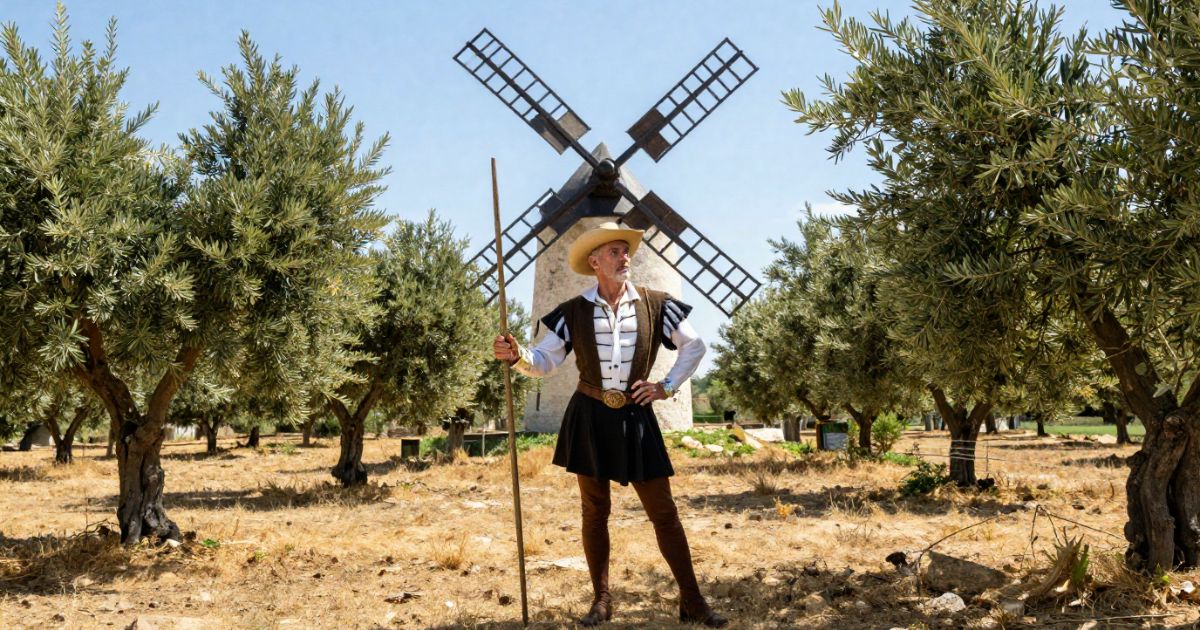
An excerpt from the original text.(complete · 1551 words)
WHEREIN IS RELATED WHAT WILL BE SEEN THERE
’Twas at the very midnight hour—more or less—when Don Quixote and
Sancho quitted the wood and entered El Toboso. The town was in deep
silence, for all the inhabitants were asleep, and stretched on the
broad of their backs, as the saying is. The night was darkish, though
Sancho would have been glad had it been quite dark, so as to find in
the darkness an excuse for his blundering. All over the place nothing
was to be heard except the barking of dogs, which deafened the ears of
Don Quixote and troubled the heart of Sancho. Now and then an ass
brayed, pigs grunted, cats mewed, and the various noises they made
seemed louder in the silence of the night; all which the enamoured
knight took to be of evil omen; nevertheless he said to Sancho,
“Sancho, my son, lead on to the palace of Dulcinea, it may be that we
shall find her awake.”
“Body of the sun! what palace am I to lead to,” said Sancho, “when what
I saw her highness in was only a very little house?”
“Most likely she had then withdrawn into some small apartment of her
palace,” said Don Quixote, “to amuse herself with damsels, as great
ladies and princesses are accustomed to do.”
“Señor,” said Sancho, “if your worship will have it in spite of me that
the house of my lady Dulcinea is a palace, is this an hour, think you,
to find the door open; and will it be right for us to go knocking till
they hear us and open the door; making a disturbance and confusion all
through the household? Are we going, do you fancy, to the house of our
wenches, like gallants who come and knock and go in at any hour,
however late it may be?”
“Let us first of all find out the palace for certain,” replied Don
Quixote, “and then I will tell thee, Sancho, what we had best do; but
look, Sancho, for either I see badly, or that dark mass that one sees
from here should be Dulcinea’s palace.”
“Then let your worship lead the way,” said Sancho, “perhaps it may be
so; though I see it with my eyes and touch it with my hands, I’ll
believe it as much as I believe it is daylight now.”
Don Quixote took the lead, and having gone a matter of two hundred
paces he came upon the mass that produced the shade, and found it was a
great tower, and then he perceived that the building in question was no
palace, but the chief church of the town, and said he, “It’s the church
we have lit upon, Sancho.”
“So I see,” said Sancho, “and God grant we may not light upon our
graves; it is no good sign to find oneself wandering in a graveyard at
this time of night; and that, after my telling your worship, if I don’t
mistake, that the house of this lady will be in an alley without an
outlet.”
“The curse of God on thee for a blockhead!” said Don Quixote; “where
hast thou ever heard of castles and royal palaces being built in alleys
without an outlet?”
“Señor,” replied Sancho, “every country has a way of its own; perhaps
here in El Toboso it is the way to build palaces and grand buildings in
alleys; so I entreat your worship to let me search about among these
streets or alleys before me, and perhaps, in some corner or other, I
may stumble on this palace—and I wish I saw the dogs eating it for
leading us such a dance.”
“Speak respectfully of what belongs to my lady, Sancho,” said Don
Quixote; “let us keep the feast in peace, and not throw the rope after
the bucket.”
“I’ll hold my tongue,” said Sancho, “but how am I to take it patiently
when your worship wants me, with only once seeing the house of our
mistress, to know always, and find it in the middle of the night, when
your worship can’t find it, who must have seen it thousands of times?”
“Thou wilt drive me to desperation, Sancho,” said Don Quixote. “Look
here, heretic, have I not told thee a thousand times that I have never
once in my life seen the peerless Dulcinea or crossed the threshold of
her palace, and that I am enamoured solely by hearsay and by the great
reputation she bears for beauty and discretion?”
“I hear it now,” returned Sancho; “and I may tell you that if you have
not seen her, no more have I.”
“That cannot be,” said Don Quixote, “for, at any rate, thou saidst, on
bringing back the answer to the letter I sent by thee, that thou sawest
her sifting wheat.”
“Don’t mind that, señor,” said Sancho; “I must tell you that my seeing
her and the answer I brought you back were by hearsay too, for I can no
more tell who the lady Dulcinea is than I can hit the sky.”
“Sancho, Sancho,” said Don Quixote, “there are times for jests and
times when jests are out of place; if I tell thee that I have neither
seen nor spoken to the lady of my heart, it is no reason why thou
shouldst say thou hast not spoken to her or seen her, when the contrary
is the case, as thou well knowest.”
While the two were engaged in this conversation, they perceived someone
with a pair of mules approaching the spot where they stood, and from
the noise the plough made, as it dragged along the ground, they guessed
him to be some labourer who had got up before daybreak to go to his
work, and so it proved to be. He came along singing the ballad that
says-
Ill did ye fare, ye men of France,
In Roncesvalles chase—
“May I die, Sancho,” said Don Quixote, when he heard him, “if any good
will come to us to-night! Dost thou not hear what that clown is
singing?”
“I do,” said Sancho, “but what has Roncesvalles chase to do with what
we have in hand? He might just as well be singing the ballad of
Calainos, for any good or ill that can come to us in our business.”
By this time the labourer had come up, and Don Quixote asked him, “Can
you tell me, worthy friend, and God speed you, whereabouts here is the
palace of the peerless princess Doña Dulcinea del Toboso?”
“Señor,” replied the lad, “I am a stranger, and I have been only a few
days in the town, doing farm work for a rich farmer. In that house
opposite there live the curate of the village and the sacristan, and
both or either of them will be able to give your worship some account
of this lady princess, for they have a list of all the people of El
Toboso; though it is my belief there is not a princess living in the
whole of it; many ladies there are, of quality, and in her own house
each of them may be a princess.”
“Well, then, she I am inquiring for will be one of these, my friend,”
said Don Quixote.
“May be so,” replied the lad; “God be with you, for here comes the
daylight;” and without waiting for any more of his questions, he
whipped on his mules.
Sancho, seeing his master downcast and somewhat dissatisfied, said to
him, “Señor, daylight will be here before long, and it will not do for
us to let the sun find us in the street; it will be better for us to
quit the city, and for your worship to hide in some forest in the
neighbourhood, and I will come back in the daytime, and I won’t leave a
nook or corner of the whole village that I won’t search for the house,
castle, or palace, of my lady, and it will be hard luck for me if I
don’t find it; and as soon as I have found it I will speak to her
grace, and tell her where and how your worship is waiting for her to
arrange some plan for you to see her without any damage to her honour
and reputation.”
“Sancho,” said Don Quixote, “thou hast delivered a thousand sentences
condensed in the compass of a few words; I thank thee for the advice
thou hast given me, and take it most gladly. Come, my son, let us go
look for some place where I may hide, while thou dost return, as thou
sayest, to seek, and speak with my lady, from whose discretion and
courtesy I look for favours more than miraculous.”
Sancho was in a fever to get his master out of the town, lest he should
discover the falsehood of the reply he had brought to him in the Sierra
Morena on behalf of Dulcinea; so he hastened their departure, which
they took at once, and two miles out of the village they found a forest
or thicket wherein Don Quixote ensconced himself, while Sancho returned
to the city to speak to Dulcinea, in which embassy things befell him
which demand fresh attention and a new chapter.
p09e.jpg (34K)
Master this chapter. Complete your experience
Purchase the complete book to access all chapters and support classic literature
As an Amazon Associate, we earn a small commission from qualifying purchases at no additional cost to you.
Available in paperback, hardcover, and e-book formats
Let's Analyse the Pattern
The tendency to double down on false stories rather than face uncomfortable truths, especially when our identity or relationships seem to depend on maintaining the fiction.
Why This Matters
Connect literature to life
This chapter teaches how to recognize when someone (including yourself) is protecting an impossible story rather than facing reality.
Practice This Today
This week, notice when you or others use phrases like 'we just need to look harder' or 'it's more complicated than it appears' to avoid obvious conclusions.
Now let's explore the literary elements.
Key Quotes & Analysis
"Body of the sun! what palace am I to lead to, when what I saw her highness in was only a very little house?"
Context: When Don Quixote asks to be led to Dulcinea's palace
Sancho accidentally reveals the truth - there is no palace, just a modest house. This moment shows how reality keeps breaking through the fantasy, and how Sancho is caught between honesty and protecting Don Quixote's feelings.
In Today's Words:
What palace? I saw her in a regular little house, not some mansion!
"Most likely she had then withdrawn into some small apartment of her palace, to amuse herself with damsels, as great ladies and princesses are accustomed to do."
Context: Responding to Sancho's reality check about the modest house
Don Quixote immediately creates an elaborate explanation to preserve his fantasy. Rather than accept that Dulcinea lives simply, he invents reasons why a palace would look like a small house.
In Today's Words:
She was probably just hanging out in the back rooms with her girlfriends, like rich people do.
"All over the place nothing was to be heard except the barking of dogs, which deafened the ears of Don Quixote and troubled the heart of Sancho."
Context: As they enter the sleeping village at midnight
The ordinary sounds of a quiet village at night become ominous in their minds. This shows how anxiety and guilt can make normal situations feel threatening - Sancho especially is worried about being found out.
In Today's Words:
The only sounds were dogs barking, which made Don Quixote nervous and Sancho even more worried.
Thematic Threads
Self-Deception
In This Chapter
Don Quixote refuses to accept that Dulcinea might not exist, interpreting every contradiction as a test or enchantment rather than evidence
Development
Evolved from earlier romantic fantasies into active denial of observable reality
In Your Life:
You might catch yourself making excuses for why your plans aren't working instead of adjusting to what's actually happening.
Enabling
In This Chapter
Sancho's well-meaning lies about Dulcinea have created a situation where he must keep lying to protect Don Quixote's feelings
Development
Built from Sancho's earlier decision to play along with his master's delusions
In Your Life:
You might find yourself covering for someone's poor choices to spare their feelings, making the problem worse.
Class
In This Chapter
A simple farmworker immediately sees the truth that the educated Don Quixote cannot—there's no princess in this small town
Development
Continues the theme of common sense versus learned fantasy
In Your Life:
You might notice that people closest to a situation often see problems that outsiders or authorities miss.
Identity
In This Chapter
Don Quixote's sense of purpose depends entirely on Dulcinea existing, making it impossible for him to accept evidence against her
Development
Deepened from earlier chapters where his knight identity was more playful
In Your Life:
You might resist changing course on goals that no longer serve you because admitting failure feels like admitting you're not who you thought you were.
Truth
In This Chapter
Both men avoid the obvious truth through elaborate mental gymnastics and convenient excuses
Development
Escalated from earlier minor deceptions to active reality denial
In Your Life:
You might find yourself creating increasingly complex explanations for simple problems rather than facing what's really wrong.
You now have the context. Time to form your own thoughts.
Discussion Questions
- 1
Why do Don Quixote and Sancho both avoid admitting they don't actually know where Dulcinea lives or what she looks like?
analysis • surface - 2
How does each man's fear of being exposed as a fraud trap him into deeper deception?
analysis • medium - 3
Where have you seen people double down on impossible stories rather than face uncomfortable truths - at work, in families, or in your community?
application • medium - 4
When someone you care about is maintaining an obvious fiction, how do you balance protecting their feelings with helping them face reality?
application • deep - 5
What does this chapter reveal about why it's sometimes harder to tell the truth to people we love than to strangers?
reflection • deep
Critical Thinking Exercise
Map Your Own Impossible Story
Think of a situation where you or someone close to you is working hard to maintain a story that reality keeps challenging. Write down the story being protected, what evidence contradicts it, and what each person fears would happen if they acknowledged the truth. Then brainstorm one face-saving way to begin addressing reality.
Consider:
- •What identity or relationship feels threatened by admitting the truth?
- •How might continuing the fiction cause more harm than facing reality?
- •What small step could acknowledge reality without forcing shame or blame?
Journaling Prompt
Write about a time when someone helped you face a difficult truth in a way that preserved your dignity. What did they do that made it possible for you to hear them?
Coming Up Next...
Chapter 82: Sancho's Greatest Deception
Sancho faces his greatest challenge yet: he must somehow produce the non-existent Dulcinea for his master. His solution will be so outrageous that even the author warns readers they might not believe what comes next.