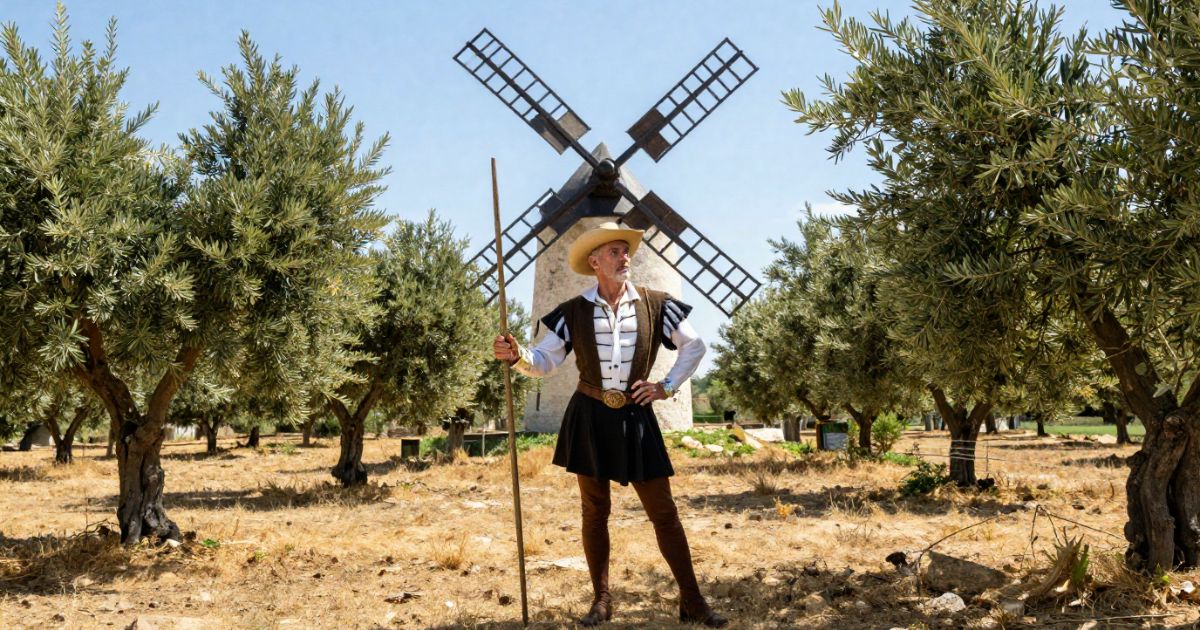
An excerpt from the original text.(complete · 2895 words)
WHEREIN IS RELATED WHAT BEFELL DON QUIXOTE ON HIS WAY TO SEE HIS LADY
DULCINEA DEL TOBOSO
“Blessed be Allah the all-powerful!” says Hamete Benengeli on beginning
this eighth chapter; “blessed be Allah!” he repeats three times; and he
says he utters these thanksgivings at seeing that he has now got Don
Quixote and Sancho fairly afield, and that the readers of his
delightful history may reckon that the achievements and humours of Don
Quixote and his squire are now about to begin; and he urges them to
forget the former chivalries of the ingenious gentleman and to fix
their eyes on those that are to come, which now begin on the road to El
Toboso, as the others began on the plains of Montiel; nor is it much
that he asks in consideration of all he promises, and so he goes on to
say:
Don Quixote and Sancho were left alone, and the moment Samson took his
departure, Rocinante began to neigh, and Dapple to sigh, which, by both
knight and squire, was accepted as a good sign and a very happy omen;
though, if the truth is to be told, the sighs and brays of Dapple were
louder than the neighings of the hack, from which Sancho inferred that
his good fortune was to exceed and overtop that of his master,
building, perhaps, upon some judicial astrology that he may have known,
though the history says nothing about it; all that can be said is, that
when he stumbled or fell, he was heard to say he wished he had not come
out, for by stumbling or falling there was nothing to be got but a
damaged shoe or a broken rib; and, fool as he was, he was not much
astray in this.
Said Don Quixote, “Sancho, my friend, night is drawing on upon us as we
go, and more darkly than will allow us to reach El Toboso by daylight;
for there I am resolved to go before I engage in another adventure, and
there I shall obtain the blessing and generous permission of the
peerless Dulcinea, with which permission I expect and feel assured that
I shall conclude and bring to a happy termination every perilous
adventure; for nothing in life makes knights-errant more valorous than
finding themselves favoured by their ladies.”
“So I believe,” replied Sancho; “but I think it will be difficult for
your worship to speak with her or see her, at any rate where you will
be able to receive her blessing; unless, indeed, she throws it over the
wall of the yard where I saw her the time before, when I took her the
letter that told of the follies and mad things your worship was doing
in the heart of Sierra Morena.”
“Didst thou take that for a yard wall, Sancho,” said Don Quixote,
“where or at which thou sawest that never sufficiently extolled grace
and beauty? It must have been the gallery, corridor, or portico of some
rich and royal palace.”
“It might have been all that,” returned Sancho, “but to me it looked
like a wall, unless I am short of memory.”
“At all events, let us go there, Sancho,” said Don Quixote; “for, so
that I see her, it is the same to me whether it be over a wall, or at a
window, or through the chink of a door, or the grate of a garden; for
any beam of the sun of her beauty that reaches my eyes will give light
to my reason and strength to my heart, so that I shall be unmatched and
unequalled in wisdom and valour.”
“Well, to tell the truth, señor,” said Sancho, “when I saw that sun of
the lady Dulcinea del Toboso, it was not bright enough to throw out
beams at all; it must have been, that as her grace was sifting that
wheat I told you of, the thick dust she raised came before her face
like a cloud and dimmed it.”
“What! dost thou still persist, Sancho,” said Don Quixote, “in saying,
thinking, believing, and maintaining that my lady Dulcinea was sifting
wheat, that being an occupation and task entirely at variance with what
is and should be the employment of persons of distinction, who are
constituted and reserved for other avocations and pursuits that show
their rank a bowshot off? Thou hast forgotten, O Sancho, those lines of
our poet wherein he paints for us how, in their crystal abodes, those
four nymphs employed themselves who rose from their loved Tagus and
seated themselves in a verdant meadow to embroider those tissues which
the ingenious poet there describes to us, how they were worked and
woven with gold and silk and pearls; and something of this sort must
have been the employment of my lady when thou sawest her, only that the
spite which some wicked enchanter seems to have against everything of
mine changes all those things that give me pleasure, and turns them
into shapes unlike their own; and so I fear that in that history of my
achievements which they say is now in print, if haply its author was
some sage who is an enemy of mine, he will have put one thing for
another, mingling a thousand lies with one truth, and amusing himself
by relating transactions which have nothing to do with the sequence of
a true history. O envy, root of all countless evils, and cankerworm of
the virtues! All the vices, Sancho, bring some kind of pleasure with
them; but envy brings nothing but irritation, bitterness, and rage.”
“So I say too,” replied Sancho; “and I suspect in that legend or
history of us that the bachelor Samson Carrasco told us he saw, my
honour goes dragged in the dirt, knocked about, up and down, sweeping
the streets, as they say. And yet, on the faith of an honest man, I
never spoke ill of any enchanter, and I am not so well off that I am to
be envied; to be sure, I am rather sly, and I have a certain spice of
the rogue in me; but all is covered by the great cloak of my
simplicity, always natural and never acted; and if I had no other merit
save that I believe, as I always do, firmly and truly in God, and all
the holy Roman Catholic Church holds and believes, and that I am a
mortal enemy of the Jews, the historians ought to have mercy on me and
treat me well in their writings. But let them say what they like; naked
was I born, naked I find myself, I neither lose nor gain; nay, while I
see myself put into a book and passed on from hand to hand over the
world, I don’t care a fig, let them say what they like of me.”
“That, Sancho,” returned Don Quixote, “reminds me of what happened to a
famous poet of our own day, who, having written a bitter satire against
all the courtesan ladies, did not insert or name in it a certain lady
of whom it was questionable whether she was one or not. She, seeing she
was not in the list of the poet, asked him what he had seen in her that
he did not include her in the number of the others, telling him he must
add to his satire and put her in the new part, or else look out for the
consequences. The poet did as she bade him, and left her without a
shred of reputation, and she was satisfied by getting fame though it
was infamy. In keeping with this is what they relate of that shepherd
who set fire to the famous temple of Diana, by repute one of the seven
wonders of the world, and burned it with the sole object of making his
name live in after ages; and, though it was forbidden to name him, or
mention his name by word of mouth or in writing, lest the object of his
ambition should be attained, nevertheless it became known that he was
called Erostratus. And something of the same sort is what happened in
the case of the great emperor Charles V. and a gentleman in Rome. The
emperor was anxious to see that famous temple of the Rotunda, called in
ancient times the temple ‘of all the gods,’ but now-a-days, by a better
nomenclature, ‘of all the saints,’ which is the best preserved building
of all those of pagan construction in Rome, and the one which best
sustains the reputation of mighty works and magnificence of its
founders. It is in the form of a half orange, of enormous dimensions,
and well lighted, though no light penetrates it save that which is
admitted by a window, or rather round skylight, at the top; and it was
from this that the emperor examined the building. A Roman gentleman
stood by his side and explained to him the skilful construction and
ingenuity of the vast fabric and its wonderful architecture, and when
they had left the skylight he said to the emperor, ‘A thousand times,
your Sacred Majesty, the impulse came upon me to seize your Majesty in
my arms and fling myself down from yonder skylight, so as to leave
behind me in the world a name that would last for ever.’ ‘I am thankful
to you for not carrying such an evil thought into effect,’ said the
emperor, ‘and I shall give you no opportunity in future of again
putting your loyalty to the test; and I therefore forbid you ever to
speak to me or to be where I am; and he followed up these words by
bestowing a liberal bounty upon him. My meaning is, Sancho, that the
desire of acquiring fame is a very powerful motive. What, thinkest
thou, was it that flung Horatius in full armour down from the bridge
into the depths of the Tiber? What burned the hand and arm of Mutius?
What impelled Curtius to plunge into the deep burning gulf that opened
in the midst of Rome? What, in opposition to all the omens that
declared against him, made Julius Cæsar cross the Rubicon? And to come
to more modern examples, what scuttled the ships, and left stranded and
cut off the gallant Spaniards under the command of the most courteous
Cortés in the New World? All these and a variety of other great
exploits are, were and will be, the work of fame that mortals desire as
a reward and a portion of the immortality their famous deeds deserve;
though we Catholic Christians and knights-errant look more to that
future glory that is everlasting in the ethereal regions of heaven than
to the vanity of the fame that is to be acquired in this present
transitory life; a fame that, however long it may last, must after all
end with the world itself, which has its own appointed end. So that, O
Sancho, in what we do we must not overpass the bounds which the
Christian religion we profess has assigned to us. We have to slay pride
in giants, envy by generosity and nobleness of heart, anger by calmness
of demeanour and equanimity, gluttony and sloth by the spareness of our
diet and the length of our vigils, lust and lewdness by the loyalty we
preserve to those whom we have made the mistresses of our thoughts,
indolence by traversing the world in all directions seeking
opportunities of making ourselves, besides Christians, famous knights.
Such, Sancho, are the means by which we reach those extremes of praise
that fair fame carries with it.”
“All that your worship has said so far,” said Sancho, “I have
understood quite well; but still I would be glad if your worship would
dissolve a doubt for me, which has just this minute come into my mind.”
“Solve, thou meanest, Sancho,” said Don Quixote; “say on, in God’s
name, and I will answer as well as I can.”
“Tell me, señor,” Sancho went on to say, “those Julys or Augusts, and
all those venturous knights that you say are now dead—where are they
now?”
“The heathens,” replied Don Quixote, “are, no doubt, in hell; the
Christians, if they were good Christians, are either in purgatory or in
heaven.”
“Very good,” said Sancho; “but now I want to know—the tombs where the
bodies of those great lords are, have they silver lamps before them, or
are the walls of their chapels ornamented with crutches,
winding-sheets, tresses of hair, legs and eyes in wax? Or what are they
ornamented with?”
To which Don Quixote made answer: “The tombs of the heathens were
generally sumptuous temples; the ashes of Julius Cæsar’s body were
placed on the top of a stone pyramid of vast size, which they now call
in Rome Saint Peter’s needle. The emperor Hadrian had for a tomb a
castle as large as a good-sized village, which they called the Moles
Adriani, and is now the castle of St. Angelo in Rome. The queen
Artemisia buried her husband Mausolus in a tomb which was reckoned one
of the seven wonders of the world; but none of these tombs, or of the
many others of the heathens, were ornamented with winding-sheets or any
of those other offerings and tokens that show that they who are buried
there are saints.”
“That’s the point I’m coming to,” said Sancho; “and now tell me, which
is the greater work, to bring a dead man to life or to kill a giant?”
“The answer is easy,” replied Don Quixote; “it is a greater work to
bring to life a dead man.”
“Now I have got you,” said Sancho; “in that case the fame of them who
bring the dead to life, who give sight to the blind, cure cripples,
restore health to the sick, and before whose tombs there are lamps
burning, and whose chapels are filled with devout folk on their knees
adoring their relics be a better fame in this life and in the other
than that which all the heathen emperors and knights-errant that have
ever been in the world have left or may leave behind them?”
“That I grant, too,” said Don Quixote.
“Then this fame, these favours, these privileges, or whatever you call
it,” said Sancho, “belong to the bodies and relics of the saints who,
with the approbation and permission of our holy mother Church, have
lamps, tapers, winding-sheets, crutches, pictures, eyes and legs, by
means of which they increase devotion and add to their own Christian
reputation. Kings carry the bodies or relics of saints on their
shoulders, and kiss bits of their bones, and enrich and adorn their
oratories and favourite altars with them.”
“What wouldst thou have me infer from all thou hast said, Sancho?”
asked Don Quixote.
“My meaning is,” said Sancho, “let us set about becoming saints, and we
shall obtain more quickly the fair fame we are striving after; for you
know, señor, yesterday or the day before yesterday (for it is so lately
one may say so) they canonised and beatified two little barefoot
friars, and it is now reckoned the greatest good luck to kiss or touch
the iron chains with which they girt and tortured their bodies, and
they are held in greater veneration, so it is said, than the sword of
Roland in the armoury of our lord the King, whom God preserve. So that,
señor, it is better to be an humble little friar of no matter what
order, than a valiant knight-errant; with God a couple of dozen of
penance lashings are of more avail than two thousand lance-thrusts, be
they given to giants, or monsters, or dragons.”
“All that is true,” returned Don Quixote, “but we cannot all be friars,
and many are the ways by which God takes his own to heaven; chivalry is
a religion, there are sainted knights in glory.”
“Yes,” said Sancho, “but I have heard say that there are more friars in
heaven than knights-errant.”
“That,” said Don Quixote, “is because those in religious orders are
more numerous than knights.”
“The errants are many,” said Sancho.
“Many,” replied Don Quixote, “but few they who deserve the name of
knights.”
With these, and other discussions of the same sort, they passed that
night and the following day, without anything worth mention happening
to them, whereat Don Quixote was not a little dejected; but at length
the next day, at daybreak, they descried the great city of El Toboso,
at the sight of which Don Quixote’s spirits rose and Sancho’s fell, for
he did not know Dulcinea’s house, nor in all his life had he ever seen
her, any more than his master; so that they were both uneasy, the one
to see her, the other at not having seen her, and Sancho was at a loss
to know what he was to do when his master sent him to El Toboso. In the
end, Don Quixote made up his mind to enter the city at nightfall, and
they waited until the time came among some oak trees that were near El
Toboso; and when the moment they had agreed upon arrived, they made
their entrance into the city, where something happened them that may
fairly be called something.
Master this chapter. Complete your experience
Purchase the complete book to access all chapters and support classic literature
As an Amazon Associate, we earn a small commission from qualifying purchases at no additional cost to you.
Available in paperback, hardcover, and e-book formats
Let's Analyse the Pattern
People with different emotional or practical stakes in a situation will genuinely perceive different versions of the same events.
Why This Matters
Connect literature to life
This chapter teaches how to recognize when high emotional stakes are filtering what you and others can see clearly.
Practice This Today
This week, notice when you and someone else describe the same situation completely differently - then ask what each person needs to be true.
Now let's explore the literary elements.
Key Quotes & Analysis
"if fame is the goal, wouldn't becoming a saint be more effective than being a knight-errant?"
Context: When Don Quixote talks about achieving eternal fame through knightly deeds
This shows Sancho's practical wisdom cutting through his master's elaborate theories. He's pointing out that if you really want to be remembered and honored, there are more effective paths than wandering around fighting imaginary enemies.
In Today's Words:
If you want to be famous, why not do something that actually helps people instead of this weird hobby?
"any mundane appearance was surely the work of evil enchanters"
Context: Describing how Don Quixote explains away Sancho's description of Dulcinea doing peasant work
This reveals Don Quixote's core defense mechanism - whenever reality contradicts his fantasy, he blames supernatural interference. He literally cannot accept that his perfect lady might be an ordinary person.
In Today's Words:
When the facts don't match what you want to believe, blame someone else for messing with your head.
"Christian knights should pursue eternal fame through virtuous acts"
Context: Explaining why his quest is different from pagan heroes seeking earthly glory
Don Quixote genuinely believes he's on a holy mission, not just seeking personal recognition. This shows he's not entirely selfish - he's trying to live up to an impossible moral standard that exists only in his imagination.
In Today's Words:
I'm not doing this for likes and followers - I'm doing it because it's the right thing to do.
Thematic Threads
Identity
In This Chapter
Don Quixote's identity as a knight requires Dulcinea's nobility, forcing him to reinterpret reality
Development
Evolved from simple self-creation to desperate reality maintenance under pressure
In Your Life:
You might reshape facts to protect your sense of who you are or what you've built your life around
Class
In This Chapter
The wheat-sifting versus embroidery debate centers on what activities define nobility versus peasantry
Development
Developed from external class markers to internalized assumptions about worth and behavior
In Your Life:
You might judge others' worthiness based on surface activities rather than deeper qualities
Recognition
In This Chapter
Don Quixote's discussion of fame reveals how the desire for recognition drives behavior and choices
Development
Introduced here as a driving force behind both heroic and foolish actions
In Your Life:
You might make decisions based more on how they'll be perceived than their actual value
Practical Wisdom
In This Chapter
Sancho's observation that sainthood brings more lasting fame than knighthood shows shrewd analysis
Development
Evolved from simple common sense to sophisticated strategic thinking
In Your Life:
You might find that unconventional paths sometimes lead to better outcomes than prestigious ones
You now have the context. Time to form your own thoughts.
Discussion Questions
- 1
Why does Don Quixote see embroidery work where Sancho sees wheat-sifting when they both describe the same encounter with Dulcinea?
analysis • surface - 2
What does each character need to be true about Dulcinea, and how do those different needs shape what they're willing to see?
analysis • medium - 3
Think about a recent disagreement at work or home - were you and the other person actually seeing different versions of the same situation? What did each of you need to be true?
application • medium - 4
When Sancho suggests becoming a saint would bring more lasting fame than being a knight, what does this reveal about how practical people challenge idealistic thinking?
analysis • deep - 5
How can you tell when your own high stakes in a situation might be filtering what you're willing to see or admit?
application • deep
Critical Thinking Exercise
Map the Reality Gap
Think of a current situation where you and someone else see things completely differently - maybe about money, parenting, work priorities, or a relationship. Write down what you see happening, then write what you think they see happening. Finally, identify what each of you needs to be true and what you'd lose if you accepted the other person's version.
Consider:
- •Focus on what each person's emotional or practical stakes are, not who's 'right'
- •Look for how different needs create different filters on the same information
- •Consider what small step might help bridge the gap without forcing anyone to abandon their core needs
Journaling Prompt
Write about a time when you later realized you had been seeing only what you needed to see in a situation. What finally helped you recognize the fuller picture, and how did that change your approach?
Coming Up Next...
Chapter 81: The Search for What Never Was
Don Quixote and Sancho enter the sleeping town of El Toboso at midnight, where the silence is broken only by barking dogs. In the darkness, they must somehow locate Dulcinea's house - but Sancho faces a terrible problem that could expose his earlier deception.