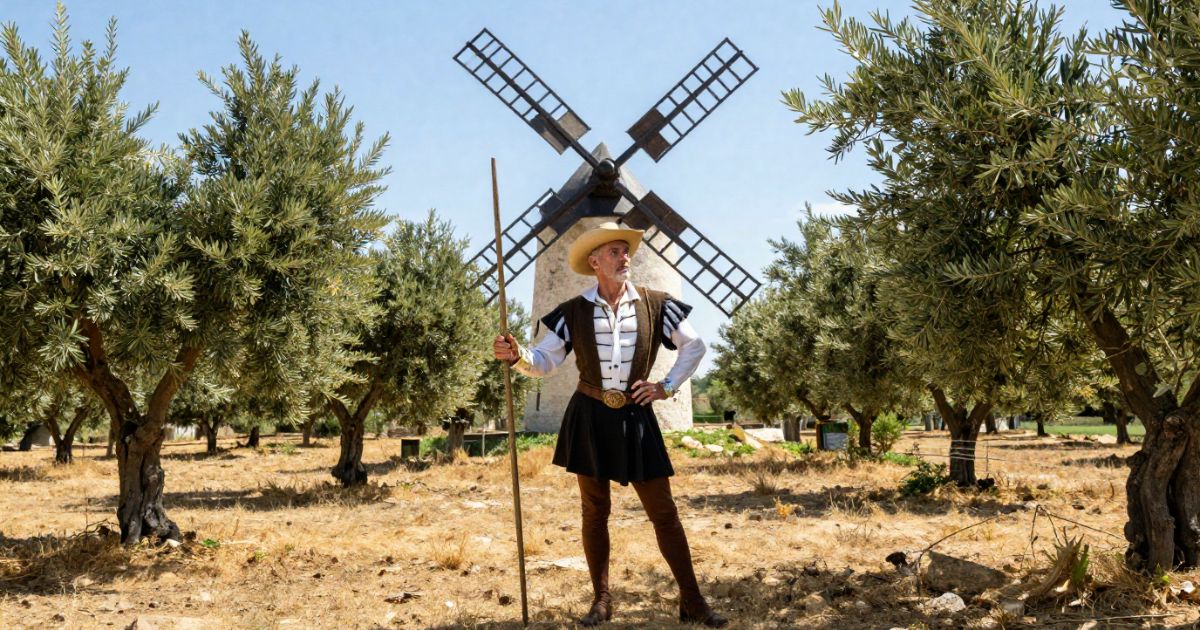
An excerpt from the original text.(complete · 2786 words)
F WHAT PASSED BETWEEN DON QUIXOTE AND HIS SQUIRE, TOGETHER WITH OTHER
VERY NOTABLE INCIDENTS
The instant the housekeeper saw Sancho Panza shut himself in with her
master, she guessed what they were about; and suspecting that the
result of the consultation would be a resolve to undertake a third
sally, she seized her mantle, and in deep anxiety and distress, ran to
find the bachelor Samson Carrasco, as she thought that, being a
well-spoken man, and a new friend of her master’s, he might be able to
persuade him to give up any such crazy notion. She found him pacing the
patio of his house, and, perspiring and flurried, she fell at his feet
the moment she saw him.
Carrasco, seeing how distressed and overcome she was, said to her,
“What is this, mistress housekeeper? What has happened to you? One
would think you heart-broken.”
“Nothing, Señor Samson,” said she, “only that my master is breaking
out, plainly breaking out.”
“Whereabouts is he breaking out, señora?” asked Samson; “has any part
of his body burst?”
“He is only breaking out at the door of his madness,” she replied; “I
mean, dear señor bachelor, that he is going to break out again (and
this will be the third time) to hunt all over the world for what he
calls ventures, though I can’t make out why he gives them that name.
The first time he was brought back to us slung across the back of an
ass, and belaboured all over; and the second time he came in an
ox-cart, shut up in a cage, in which he persuaded himself he was
enchanted, and the poor creature was in such a state that the mother
that bore him would not have known him; lean, yellow, with his eyes
sunk deep in the cells of his skull; so that to bring him round again,
ever so little, cost me more than six hundred eggs, as God knows, and
all the world, and my hens too, that won’t let me tell a lie.”
“That I can well believe,” replied the bachelor, “for they are so good
and so fat, and so well-bred, that they would not say one thing for
another, though they were to burst for it. In short then, mistress
housekeeper, that is all, and there is nothing the matter, except what
it is feared Don Quixote may do?”
“No, señor,” said she.
“Well then,” returned the bachelor, “don’t be uneasy, but go home in
peace; get me ready something hot for breakfast, and while you are on
the way say the prayer of Santa Apollonia, that is if you know it; for
I will come presently and you will see miracles.”
“Woe is me,” cried the housekeeper, “is it the prayer of Santa
Apollonia you would have me say? That would do if it was the toothache
my master had; but it is in the brains, what he has got.”
“I know what I am saying, mistress housekeeper; go, and don’t set
yourself to argue with me, for you know I am a bachelor of Salamanca,
and one can’t be more of a bachelor than that,” replied Carrasco; and
with this the housekeeper retired, and the bachelor went to look for
the curate, and arrange with him what will be told in its proper place.
While Don Quixote and Sancho were shut up together, they had a
discussion which the history records with great precision and
scrupulous exactness. Sancho said to his master, “Señor, I have educed
my wife to let me go with your worship wherever you choose to take me.”
“Induced, you should say, Sancho,” said Don Quixote; “not educed.”
“Once or twice, as well as I remember,” replied Sancho, “I have begged
of your worship not to mend my words, if so be as you understand what I
mean by them; and if you don’t understand them to say ‘Sancho,’ or
‘devil,’ ‘I don’t understand thee; and if I don’t make my meaning
plain, then you may correct me, for I am so focile—”
“I don’t understand thee, Sancho,” said Don Quixote at once; “for I
know not what ‘I am so focile’ means.”
“‘So focile’ means I am so much that way,” replied Sancho.
“I understand thee still less now,” said Don Quixote.
“Well, if you can’t understand me,” said Sancho, “I don’t know how to
put it; I know no more, God help me.”
“Oh, now I have hit it,” said Don Quixote; “thou wouldst say thou art
so docile, tractable, and gentle that thou wilt take what I say to
thee, and submit to what I teach thee.”
“I would bet,” said Sancho, “that from the very first you understood
me, and knew what I meant, but you wanted to put me out that you might
hear me make another couple of dozen blunders.”
“May be so,” replied Don Quixote; “but to come to the point, what does
Teresa say?”
“Teresa says,” replied Sancho, “that I should make sure with your
worship, and ‘let papers speak and beards be still,’ for ‘he who binds
does not wrangle,’ since one ‘take’ is better than two ‘I’ll give
thee’s;’ and I say a woman’s advice is no great thing, and he who won’t
take it is a fool.”
“And so say I,” said Don Quixote; “continue, Sancho my friend; go on;
you talk pearls to-day.”
“The fact is,” continued Sancho, “that, as your worship knows better
than I do, we are all of us liable to death, and to-day we are, and
to-morrow we are not, and the lamb goes as soon as the sheep, and
nobody can promise himself more hours of life in this world than God
may be pleased to give him; for death is deaf, and when it comes to
knock at our life’s door, it is always urgent, and neither prayers, nor
struggles, nor sceptres, nor mitres, can keep it back, as common talk
and report say, and as they tell us from the pulpits every day.”
“All that is very true,” said Don Quixote; “but I cannot make out what
thou art driving at.”
“What I am driving at,” said Sancho, “is that your worship settle some
fixed wages for me, to be paid monthly while I am in your service, and
that the same be paid me out of your estate; for I don’t care to stand
on rewards which either come late, or ill, or never at all; God help me
with my own. In short, I would like to know what I am to get, be it
much or little; for the hen will lay on one egg, and many littles make
a much, and so long as one gains something there is nothing lost. To be
sure, if it should happen (what I neither believe nor expect) that your
worship were to give me that island you have promised me, I am not so
ungrateful nor so grasping but that I would be willing to have the
revenue of such island valued and stopped out of my wages in due
promotion.”
“Sancho, my friend,” replied Don Quixote, “sometimes proportion may be
as good as promotion.”
“I see,” said Sancho; “I’ll bet I ought to have said proportion, and
not promotion; but it is no matter, as your worship has understood me.”
“And so well understood,” returned Don Quixote, “that I have seen into
the depths of thy thoughts, and know the mark thou art shooting at with
the countless shafts of thy proverbs. Look here, Sancho, I would
readily fix thy wages if I had ever found any instance in the histories
of the knights-errant to show or indicate, by the slightest hint, what
their squires used to get monthly or yearly; but I have read all or the
best part of their histories, and I cannot remember reading of any
knight-errant having assigned fixed wages to his squire; I only know
that they all served on reward, and that when they least expected it,
if good luck attended their masters, they found themselves recompensed
with an island or something equivalent to it, or at the least they were
left with a title and lordship. If with these hopes and additional
inducements you, Sancho, please to return to my service, well and good;
but to suppose that I am going to disturb or unhinge the ancient usage
of knight-errantry, is all nonsense. And so, my Sancho, get you back to
your house and explain my intentions to your Teresa, and if she likes
and you like to be on reward with me, bene quidem; if not, we remain
friends; for if the pigeon-house does not lack food, it will not lack
pigeons; and bear in mind, my son, that a good hope is better than a
bad holding, and a good grievance better than a bad compensation. I
speak in this way, Sancho, to show you that I can shower down proverbs
just as well as yourself; and in short, I mean to say, and I do say,
that if you don’t like to come on reward with me, and run the same
chance that I run, God be with you and make a saint of you; for I shall
find plenty of squires more obedient and painstaking, and not so
thickheaded or talkative as you are.”
When Sancho heard his master’s firm, resolute language, a cloud came
over the sky with him and the wings of his heart drooped, for he had
made sure that his master would not go without him for all the wealth
of the world; and as he stood there dumbfoundered and moody, Samson
Carrasco came in with the housekeeper and niece, who were anxious to
hear by what arguments he was about to dissuade their master from going
to seek adventures. The arch wag Samson came forward, and embracing him
as he had done before, said with a loud voice, “O flower of
knight-errantry! O shining light of arms! O honour and mirror of the
Spanish nation! may God Almighty in his infinite power grant that any
person or persons, who would impede or hinder thy third sally, may find
no way out of the labyrinth of their schemes, nor ever accomplish what
they most desire!” And then, turning to the housekeeper, he said,
“Mistress housekeeper may just as well give over saying the prayer of
Santa Apollonia, for I know it is the positive determination of the
spheres that Señor Don Quixote shall proceed to put into execution his
new and lofty designs; and I should lay a heavy burden on my conscience
did I not urge and persuade this knight not to keep the might of his
strong arm and the virtue of his valiant spirit any longer curbed and
checked, for by his inactivity he is defrauding the world of the
redress of wrongs, of the protection of orphans, of the honour of
virgins, of the aid of widows, and of the support of wives, and other
matters of this kind appertaining, belonging, proper and peculiar to
the order of knight-errantry. On, then, my lord Don Quixote, beautiful
and brave, let your worship and highness set out to-day rather than
to-morrow; and if anything be needed for the execution of your purpose,
here am I ready in person and purse to supply the want; and were it
requisite to attend your magnificence as squire, I should esteem it the
happiest good fortune.”
At this, Don Quixote, turning to Sancho, said, “Did I not tell thee,
Sancho, there would be squires enough and to spare for me? See now who
offers to become one; no less than the illustrious bachelor Samson
Carrasco, the perpetual joy and delight of the courts of the Salamancan
schools, sound in body, discreet, patient under heat or cold, hunger or
thirst, with all the qualifications requisite to make a knight-errant’s
squire! But heaven forbid that, to gratify my own inclination, I should
shake or shatter this pillar of letters and vessel of the sciences, and
cut down this towering palm of the fair and liberal arts. Let this new
Samson remain in his own country, and, bringing honour to it, bring
honour at the same time on the grey heads of his venerable parents; for
I will be content with any squire that comes to hand, as Sancho does
not deign to accompany me.”
“I do deign,” said Sancho, deeply moved and with tears in his eyes; “it
shall not be said of me, master mine,” he continued, “‘the bread eaten
and the company dispersed.’ Nay, I come of no ungrateful stock, for all
the world knows, but particularly my own town, who the Panzas from whom
I am descended were; and, what is more, I know and have learned, by
many good words and deeds, your worship’s desire to show me favour; and
if I have been bargaining more or less about my wages, it was only to
please my wife, who, when she sets herself to press a point, no hammer
drives the hoops of a cask as she drives one to do what she wants; but,
after all, a man must be a man, and a woman a woman; and as I am a man
anyhow, which I can’t deny, I will be one in my own house too, let who
will take it amiss; and so there’s nothing more to do but for your
worship to make your will with its codicil in such a way that it can’t
be provoked, and let us set out at once, to save Señor Samson’s soul
from suffering, as he says his conscience obliges him to persuade your
worship to sally out upon the world a third time; so I offer again to
serve your worship faithfully and loyally, as well and better than all
the squires that served knights-errant in times past or present.”
The bachelor was filled with amazement when he heard Sancho’s
phraseology and style of talk, for though he had read the first part of
his master’s history he never thought that he could be so droll as he
was there described; but now, hearing him talk of a “will and codicil
that could not be provoked,” instead of “will and codicil that could
not be revoked,” he believed all he had read of him, and set him down
as one of the greatest simpletons of modern times; and he said to
himself that two such lunatics as master and man the world had never
seen. In fine, Don Quixote and Sancho embraced one another and made
friends, and by the advice and with the approval of the great Carrasco,
who was now their oracle, it was arranged that their departure should
take place three days thence, by which time they could have all that
was requisite for the journey ready, and procure a closed helmet, which
Don Quixote said he must by all means take. Samson offered him one, as
he knew a friend of his who had it would not refuse it to him, though
it was more dingy with rust and mildew than bright and clean like
burnished steel.
The curses which both housekeeper and niece poured out on the bachelor
were past counting; they tore their hair, they clawed their faces, and
in the style of the hired mourners that were once in fashion, they
raised a lamentation over the departure of their master and uncle, as
if it had been his death. Samson’s intention in persuading him to sally
forth once more was to do what the history relates farther on; all by
the advice of the curate and barber, with whom he had previously
discussed the subject. Finally, then, during those three days, Don
Quixote and Sancho provided themselves with what they considered
necessary, and Sancho having pacified his wife, and Don Quixote his
niece and housekeeper, at nightfall, unseen by anyone except the
bachelor, who thought fit to accompany them half a league out of the
village, they set out for El Toboso, Don Quixote on his good Rocinante
and Sancho on his old Dapple, his alforjas furnished with certain
matters in the way of victuals, and his purse with money that Don
Quixote gave him to meet emergencies. Samson embraced him, and
entreated him to let him hear of his good or evil fortunes, so that he
might rejoice over the former or condole with him over the latter, as
the laws of friendship required. Don Quixote promised him he would do
so, and Samson returned to the village, and the other two took the road
for the great city of El Toboso.
p07e.jpg (24K)
Master this chapter. Complete your experience
Purchase the complete book to access all chapters and support classic literature
As an Amazon Associate, we earn a small commission from qualifying purchases at no additional cost to you.
Available in paperback, hardcover, and e-book formats
Let's Analyse the Pattern
When people pursue the same goal for completely different reasons, their unstated motivations eventually create conflict that derails the shared objective.
Why This Matters
Connect literature to life
This chapter teaches how to identify when people's stated goals don't match their actual motivations in group situations.
Practice This Today
This week, notice when someone's actions contradict their stated support—ask yourself what they're really trying to protect or gain.
Now let's explore the literary elements.
Key Quotes & Analysis
"He is only breaking out at the door of his madness"
Context: She's explaining to Samson Carrasco that Don Quixote is planning another adventure
This vivid metaphor shows how she sees his condition as something barely contained that keeps escaping. It reveals her genuine fear and frustration with his repeated episodes.
In Today's Words:
He's losing it again and there's no stopping him this time
"Knight-errantry operates on hope and eventual rewards, not regular paychecks"
Context: He's refusing Sancho's demand for fixed wages
This reveals the fundamental conflict between idealistic dreams and practical needs. Don Quixote genuinely believes in his system, but Sancho needs to eat today, not someday.
In Today's Words:
This isn't about steady money, it's about believing in something bigger
"I mean to stick by my master through thick and thin"
Context: After being threatened with replacement by Samson Carrasco
Despite his practical concerns about money, Sancho chooses loyalty when push comes to shove. It shows their relationship has genuine affection beneath the practical arrangements.
In Today's Words:
I'm not going anywhere - we're in this together
Thematic Threads
Class
In This Chapter
Sancho demands wages like a working person while Don Quixote offers only aristocratic promises of future glory
Development
Deepening from earlier chapters where class differences were mostly comedic
In Your Life:
You might recognize this when your boss offers 'growth opportunities' instead of the raise you actually need
Loyalty
In This Chapter
Sancho chooses loyalty over practical concerns when faced with losing his position to Carrasco
Development
Evolution from simple master-servant relationship to complex emotional bond
In Your Life:
You might face this when choosing between a secure job and staying with a struggling company you care about
Manipulation
In This Chapter
Carrasco pretends to support Don Quixote's quest while having secret ulterior motives
Development
Introduced here as new layer of deception beyond Don Quixote's self-delusion
In Your Life:
You might encounter this when someone offers help that serves their agenda more than yours
Financial Security
In This Chapter
Sancho's practical demand for wages versus Don Quixote's idealistic rejection of monetary concerns
Development
Growing from background concern to central relationship tension
In Your Life:
You might struggle with this when passion projects don't pay the bills but feel more meaningful than regular work
Power Dynamics
In This Chapter
The threat of replacement forces Sancho to negotiate from a position of vulnerability
Development
Building from earlier chapters where power seemed more straightforward
In Your Life:
You might experience this when a new team member threatens your role or relationship with your supervisor
You now have the context. Time to form your own thoughts.
Discussion Questions
- 1
Why does the housekeeper run to Carrasco for help, and what goes wrong with her plan?
analysis • surface - 2
What does Sancho's demand for wages reveal about the difference between his priorities and Don Quixote's?
analysis • medium - 3
Think about a group project or team situation you've been in. How did different people's hidden agendas create problems?
application • medium - 4
When someone offers to help you with something important, how can you figure out what they really want from the situation?
application • deep - 5
Why do people so rarely say what they actually want, and what happens when someone finally does?
reflection • deep
Critical Thinking Exercise
Map the Hidden Agendas
Think of a current situation where multiple people are involved in the same project or decision—at work, in your family, or in your community. Write down what each person claims they want, then write what you think they actually want. Look for the gaps between stated goals and real motivations.
Consider:
- •Pay attention to whose actions don't match their words
- •Notice who benefits most if things go their way
- •Consider what each person is afraid of losing
Journaling Prompt
Write about a time when you discovered someone's real agenda was different from what they claimed. How did that change how you handled the situation, and what would you do differently now?
Coming Up Next...
Chapter 80: The Journey to El Toboso
Don Quixote and Sancho set out for El Toboso to visit Dulcinea, but this quest will test their partnership in unexpected ways. The road ahead holds challenges that will force both master and servant to confront the reality behind their shared delusions.