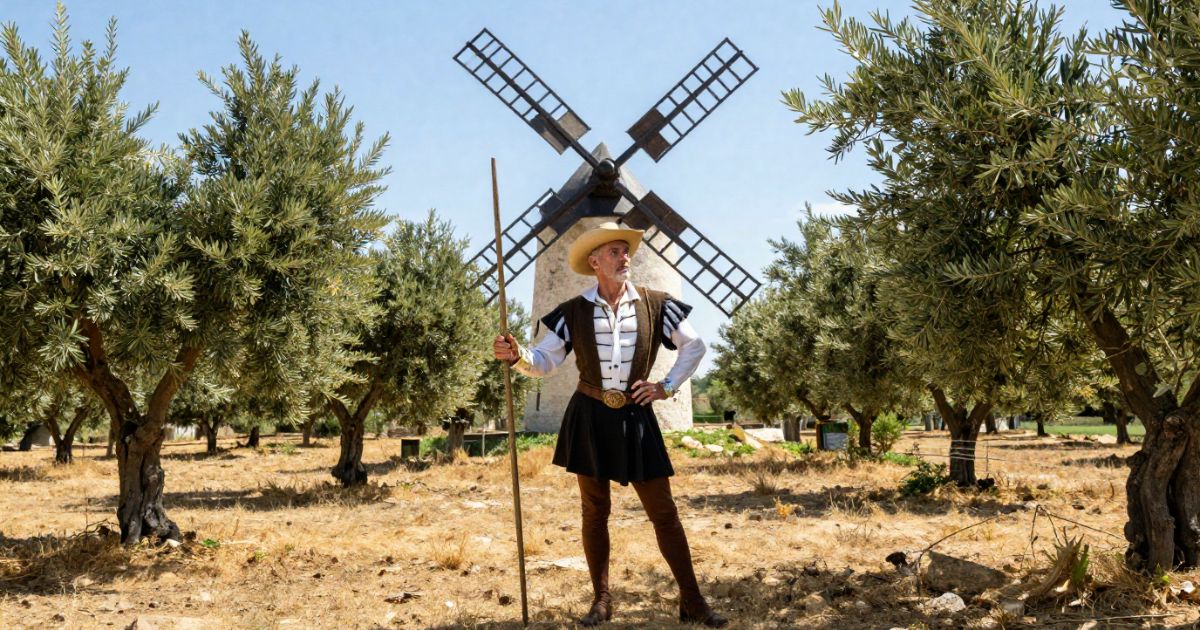
An excerpt from the original text.(complete · 3531 words)
N WHICH ARE CONTINUED THE UNHEARD-OF ADVENTURES OF THE INN
So loud, in fact, were the shouts of Don Quixote, that the landlord
opening the gate of the inn in all haste, came out in dismay, and ran
to see who was uttering such cries, and those who were outside joined
him. Maritornes, who had been by this time roused up by the same
outcry, suspecting what it was, ran to the loft and, without anyone
seeing her, untied the halter by which Don Quixote was suspended, and
down he came to the ground in the sight of the landlord and the
travellers, who approaching asked him what was the matter with him that
he shouted so. He without replying a word took the rope off his wrist,
and rising to his feet leaped upon Rocinante, braced his buckler on his
arm, put his lance in rest, and making a considerable circuit of the
plain came back at a half-gallop exclaiming:
“Whoever shall say that I have been enchanted with just cause, provided
my lady the Princess Micomicona grants me permission to do so, I give
him the lie, challenge him and defy him to single combat.”
The newly arrived travellers were amazed at the words of Don Quixote;
but the landlord removed their surprise by telling them who he was, and
not to mind him as he was out of his senses. They then asked the
landlord if by any chance a youth of about fifteen years of age had
come to that inn, one dressed like a muleteer, and of such and such an
appearance, describing that of Doña Clara’s lover. The landlord replied
that there were so many people in the inn he had not noticed the person
they were inquiring for; but one of them observing the coach in which
the Judge had come, said, “He is here no doubt, for this is the coach
he is following: let one of us stay at the gate, and the rest go in to
look for him; or indeed it would be as well if one of us went round the
inn, lest he should escape over the wall of the yard.” “So be it,” said
another; and while two of them went in, one remained at the gate and
the other made the circuit of the inn; observing all which, the
landlord was unable to conjecture for what reason they were taking all
these precautions, though he understood they were looking for the youth
whose description they had given him.
It was by this time broad daylight; and for that reason, as well as in
consequence of the noise Don Quixote had made, everybody was awake and
up, but particularly Doña Clara and Dorothea; for they had been able to
sleep but badly that night, the one from agitation at having her lover
so near her, the other from curiosity to see him. Don Quixote, when he
saw that not one of the four travellers took any notice of him or
replied to his challenge, was furious and ready to die with indignation
and wrath; and if he could have found in the ordinances of chivalry
that it was lawful for a knight-errant to undertake or engage in
another enterprise, when he had plighted his word and faith not to
involve himself in any until he had made an end of the one to which he
was pledged, he would have attacked the whole of them, and would have
made them return an answer in spite of themselves. But considering that
it would not become him, nor be right, to begin any new emprise until
he had established Micomicona in her kingdom, he was constrained to
hold his peace and wait quietly to see what would be the upshot of the
proceedings of those same travellers; one of whom found the youth they
were seeking lying asleep by the side of a muleteer, without a thought
of anyone coming in search of him, much less finding him.
The man laid hold of him by the arm, saying, “It becomes you well
indeed, Señor Don Luis, to be in the dress you wear, and well the bed
in which I find you agrees with the luxury in which your mother reared
you.”
The youth rubbed his sleepy eyes and stared for a while at him who held
him, but presently recognised him as one of his father’s servants, at
which he was so taken aback that for some time he could not find or
utter a word; while the servant went on to say, “There is nothing for
it now, Señor Don Luis, but to submit quietly and return home, unless
it is your wish that my lord, your father, should take his departure
for the other world, for nothing else can be the consequence of the
grief he is in at your absence.”
“But how did my father know that I had gone this road and in this
dress?” said Don Luis.
“It was a student to whom you confided your intentions,” answered the
servant, “that disclosed them, touched with pity at the distress he saw
your father suffer on missing you; he therefore despatched four of his
servants in quest of you, and here we all are at your service, better
pleased than you can imagine that we shall return so soon and be able
to restore you to those eyes that so yearn for you.”
“That shall be as I please, or as heaven orders,” returned Don Luis.
“What can you please or heaven order,” said the other, “except to agree
to go back? Anything else is impossible.”
All this conversation between the two was overheard by the muleteer at
whose side Don Luis lay, and rising, he went to report what had taken
place to Don Fernando, Cardenio, and the others, who had by this time
dressed themselves; and told them how the man had addressed the youth
as “Don,” and what words had passed, and how he wanted him to return to
his father, which the youth was unwilling to do. With this, and what
they already knew of the rare voice that heaven had bestowed upon him,
they all felt very anxious to know more particularly who he was, and
even to help him if it was attempted to employ force against him; so
they hastened to where he was still talking and arguing with his
servant. Dorothea at this instant came out of her room, followed by
Doña Clara all in a tremor; and calling Cardenio aside, she told him in
a few words the story of the musician and Doña Clara, and he at the
same time told her what had happened, how his father’s servants had
come in search of him; but in telling her so, he did not speak low
enough but that Doña Clara heard what he said, at which she was so much
agitated that had not Dorothea hastened to support her she would have
fallen to the ground. Cardenio then bade Dorothea return to her room,
as he would endeavour to make the whole matter right, and they did as
he desired. All the four who had come in quest of Don Luis had now come
into the inn and surrounded him, urging him to return and console his
father at once and without a moment’s delay. He replied that he could
not do so on any account until he had concluded some business in which
his life, honour, and heart were at stake. The servants pressed him,
saying that most certainly they would not return without him, and that
they would take him away whether he liked it or not.
“You shall not do that,” replied Don Luis, “unless you take me dead;
though however you take me, it will be without life.”
By this time most of those in the inn had been attracted by the
dispute, but particularly Cardenio, Don Fernando, his companions, the
Judge, the curate, the barber, and Don Quixote; for he now considered
there was no necessity for mounting guard over the castle any longer.
Cardenio being already acquainted with the young man’s story, asked the
men who wanted to take him away, what object they had in seeking to
carry off this youth against his will.
“Our object,” said one of the four, “is to save the life of his father,
who is in danger of losing it through this gentleman’s disappearance.”
Upon this Don Luis exclaimed, “There is no need to make my affairs
public here; I am free, and I will return if I please; and if not, none
of you shall compel me.”
“Reason will compel your worship,” said the man, “and if it has no
power over you, it has power over us, to make us do what we came for,
and what it is our duty to do.”
“Let us hear what the whole affair is about,” said the Judge at this;
but the man, who knew him as a neighbour of theirs, replied, “Do you
not know this gentleman, Señor Judge? He is the son of your neighbour,
who has run away from his father’s house in a dress so unbecoming his
rank, as your worship may perceive.”
The judge on this looked at him more carefully and recognised him, and
embracing him said, “What folly is this, Señor Don Luis, or what can
have been the cause that could have induced you to come here in this
way, and in this dress, which so ill becomes your condition?”
Tears came into the eyes of the young man, and he was unable to utter a
word in reply to the Judge, who told the four servants not to be
uneasy, for all would be satisfactorily settled; and then taking Don
Luis by the hand, he drew him aside and asked the reason of his having
come there.
But while he was questioning him they heard a loud outcry at the gate
of the inn, the cause of which was that two of the guests who had
passed the night there, seeing everybody busy about finding out what it
was the four men wanted, had conceived the idea of going off without
paying what they owed; but the landlord, who minded his own affairs
more than other people’s, caught them going out of the gate and
demanded his reckoning, abusing them for their dishonesty with such
language that he drove them to reply with their fists, and so they
began to lay on him in such a style that the poor man was forced to cry
out, and call for help. The landlady and her daughter could see no one
more free to give aid than Don Quixote, and to him the daughter said,
“Sir knight, by the virtue God has given you, help my poor father, for
two wicked men are beating him to a mummy.”
To which Don Quixote very deliberately and phlegmatically replied,
“Fair damsel, at the present moment your request is inopportune, for I
am debarred from involving myself in any adventure until I have brought
to a happy conclusion one to which my word has pledged me; but that
which I can do for you is what I will now mention: run and tell your
father to stand his ground as well as he can in this battle, and on no
account to allow himself to be vanquished, while I go and request
permission of the Princess Micomicona to enable me to succour him in
his distress; and if she grants it, rest assured I will relieve him
from it.”
“Sinner that I am,” exclaimed Maritornes, who stood by; “before you
have got your permission my master will be in the other world.”
“Give me leave, señora, to obtain the permission I speak of,” returned
Don Quixote; “and if I get it, it will matter very little if he is in
the other world; for I will rescue him thence in spite of all the same
world can do; or at any rate I will give you such a revenge over those
who shall have sent him there that you will be more than moderately
satisfied;” and without saying anything more he went and knelt before
Dorothea, requesting her Highness in knightly and errant phrase to be
pleased to grant him permission to aid and succour the castellan of
that castle, who now stood in grievous jeopardy. The princess granted
it graciously, and he at once, bracing his buckler on his arm and
drawing his sword, hastened to the inn-gate, where the two guests were
still handling the landlord roughly; but as soon as he reached the spot
he stopped short and stood still, though Maritornes and the landlady
asked him why he hesitated to help their master and husband.
“I hesitate,” said Don Quixote, “because it is not lawful for me to
draw sword against persons of squirely condition; but call my squire
Sancho to me; for this defence and vengeance are his affair and
business.”
Thus matters stood at the inn-gate, where there was a very lively
exchange of fisticuffs and punches, to the sore damage of the landlord
and to the wrath of Maritornes, the landlady, and her daughter, who
were furious when they saw the pusillanimity of Don Quixote, and the
hard treatment their master, husband and father was undergoing. But let
us leave him there; for he will surely find someone to help him, and if
not, let him suffer and hold his tongue who attempts more than his
strength allows him to do; and let us go back fifty paces to see what
Don Luis said in reply to the Judge whom we left questioning him
privately as to his reasons for coming on foot and so meanly dressed.
To which the youth, pressing his hand in a way that showed his heart
was troubled by some great sorrow, and shedding a flood of tears, made
answer:
“Señor, I have no more to tell you than that from the moment when,
through heaven’s will and our being near neighbours, I first saw Doña
Clara, your daughter and my lady, from that instant I made her the
mistress of my will, and if yours, my true lord and father, offers no
impediment, this very day she shall become my wife. For her I left my
father’s house, and for her I assumed this disguise, to follow her
whithersoever she may go, as the arrow seeks its mark or the sailor the
pole-star. She knows nothing more of my passion than what she may have
learned from having sometimes seen from a distance that my eyes were
filled with tears. You know already, señor, the wealth and noble birth
of my parents, and that I am their sole heir; if this be a sufficient
inducement for you to venture to make me completely happy, accept me at
once as your son; for if my father, influenced by other objects of his
own, should disapprove of this happiness I have sought for myself, time
has more power to alter and change things, than human will.”
With this the love-smitten youth was silent, while the Judge, after
hearing him, was astonished, perplexed, and surprised, as well at the
manner and intelligence with which Don Luis had confessed the secret of
his heart, as at the position in which he found himself, not knowing
what course to take in a matter so sudden and unexpected. All the
answer, therefore, he gave him was to bid him to make his mind easy for
the present, and arrange with his servants not to take him back that
day, so that there might be time to consider what was best for all
parties. Don Luis kissed his hands by force, nay, bathed them with his
tears, in a way that would have touched a heart of marble, not to say
that of the Judge, who, as a shrewd man, had already perceived how
advantageous the marriage would be to his daughter; though, were it
possible, he would have preferred that it should be brought about with
the consent of the father of Don Luis, who he knew looked for a title
for his son.
The guests had by this time made peace with the landlord, for, by
persuasion and Don Quixote’s fair words more than by threats, they had
paid him what he demanded, and the servants of Don Luis were waiting
for the end of the conversation with the Judge and their master’s
decision, when the devil, who never sleeps, contrived that the barber,
from whom Don Quixote had taken Mambrino’s helmet, and Sancho Panza the
trappings of his ass in exchange for those of his own, should at this
instant enter the inn; which said barber, as he led his ass to the
stable, observed Sancho Panza engaged in repairing something or other
belonging to the pack-saddle; and the moment he saw it he knew it, and
made bold to attack Sancho, exclaiming, “Ho, sir thief, I have caught
you! hand over my basin and my pack-saddle, and all my trappings that
you robbed me of.”
Sancho, finding himself so unexpectedly assailed, and hearing the abuse
poured upon him, seized the pack-saddle with one hand, and with the
other gave the barber a cuff that bathed his teeth in blood. The
barber, however, was not so ready to relinquish the prize he had made
in the pack-saddle; on the contrary, he raised such an outcry that
everyone in the inn came running to know what the noise and quarrel
meant. “Here, in the name of the king and justice!” he cried, “this
thief and highwayman wants to kill me for trying to recover my
property.”
“You lie,” said Sancho, “I am no highwayman; it was in fair war my
master Don Quixote won these spoils.”
Don Quixote was standing by at the time, highly pleased to see his
squire’s stoutness, both offensive and defensive, and from that time
forth he reckoned him a man of mettle, and in his heart resolved to dub
him a knight on the first opportunity that presented itself, feeling
sure that the order of chivalry would be fittingly bestowed upon him.
In the course of the altercation, among other things the barber said,
“Gentlemen, this pack-saddle is mine as surely as I owe God a death,
and I know it as well as if I had given birth to it, and here is my ass
in the stable who will not let me lie; only try it, and if it does not
fit him like a glove, call me a rascal; and what is more, the same day
I was robbed of this, they robbed me likewise of a new brass basin,
never yet handselled, that would fetch a crown any day.”
At this Don Quixote could not keep himself from answering; and
interposing between the two, and separating them, he placed the
pack-saddle on the ground, to lie there in sight until the truth was
established, and said, “Your worships may perceive clearly and plainly
the error under which this worthy squire lies when he calls a basin
which was, is, and shall be the helmet of Mambrino which I won from him
in fair war, and made myself master of by legitimate and lawful
possession. With the pack-saddle I do not concern myself; but I may
tell you on that head that my squire Sancho asked my permission to
strip off the caparison of this vanquished poltroon’s steed, and with
it adorn his own; I allowed him, and he took it; and as to its having
been changed from a caparison into a pack-saddle, I can give no
explanation except the usual one, that such transformations will take
place in adventures of chivalry. To confirm all which, run, Sancho my
son, and fetch hither the helmet which this good fellow calls a basin.”
“Egad, master,” said Sancho, “if we have no other proof of our case
than what your worship puts forward, Mambrino’s helmet is just as much
a basin as this good fellow’s caparison is a pack-saddle.”
“Do as I bid thee,” said Don Quixote; “it cannot be that everything in
this castle goes by enchantment.”
Sancho hastened to where the basin was, and brought it back with him,
and when Don Quixote saw it, he took hold of it and said:
“Your worships may see with what a face this squire can assert that
this is a basin and not the helmet I told you of; and I swear by the
order of chivalry I profess, that this helmet is the identical one I
took from him, without anything added to or taken from it.”
“There is no doubt of that,” said Sancho, “for from the time my master
won it until now he has only fought one battle in it, when he let loose
those unlucky men in chains; and if it had not been for this
basin-helmet he would not have come off over well that time, for there
was plenty of stone-throwing in that affair.”
c44e.jpg (13K)
Master this chapter. Complete your experience
Purchase the complete book to access all chapters and support classic literature
As an Amazon Associate, we earn a small commission from qualifying purchases at no additional cost to you.
Available in paperback, hardcover, and e-book formats
Let's Analyse the Pattern
When people operating from incompatible versions of reality try to share the same space, conflict multiplies exponentially because nobody is arguing about the same thing.
Why This Matters
Connect literature to life
This chapter teaches how to identify when conflicts escalate because people are operating from incompatible versions of reality rather than disagreeing about facts.
Practice This Today
This week, when arguments erupt around you, ask 'What story is each person telling themselves?' and notice how often people argue past each other because they're not even discussing the same issue.
Now let's explore the literary elements.
Key Quotes & Analysis
"Whoever shall say that I have been enchanted with just cause, provided my lady the Princess Micomicona grants me permission to do so, I give him the lie, challenge him and defy him to single combat."
Context: After being freed from the rope, he immediately challenges the travelers who witnessed his humiliation
This shows how Don Quixote deals with embarrassment - by creating bigger drama to distract from the original problem. He can't admit he was just stuck, so he frames it as magical enchantment and picks fights with innocent bystanders.
In Today's Words:
Anyone who says I screwed up is lying, and I'll fight them about it - but only if my girlfriend says it's okay.
"I would rather die than return home without achieving the object that has brought me here."
Context: When confronted by his father's servants who want to take him home
Don Luis shows the same all-or-nothing thinking as Don Quixote, just about love instead of knighthood. His dramatic declaration reveals how young passion can feel like life-or-death stakes.
In Today's Words:
I'm not going home until I get what I came for, even if it kills me.
"They then asked the landlord if by any chance a youth of about fifteen years of age had come to the inn."
Context: The servants arrive looking for Don Luis, not knowing he's been there all along in disguise
This simple question sets off a chain reaction that will expose Don Luis and create more chaos. It shows how one person's secret can involve many innocent bystanders.
In Today's Words:
Have you seen a teenage boy around here?
Thematic Threads
Identity
In This Chapter
Don Quixote's knightly identity increasingly conflicts with reality while Luis constructs a romantic hero identity
Development
Evolved from individual delusion to multiple competing identities creating chaos
In Your Life:
You might see this when family members have different ideas about who should handle caregiving responsibilities
Class
In This Chapter
The Judge must navigate the delicate social situation of his neighbor's son refusing to return home
Development
Continued exploration of how class expectations create impossible choices
In Your Life:
You might see this when your family has different expectations about your career choices based on your background
Authority
In This Chapter
Don Quixote requires permission from his imaginary princess before helping with real violence
Development
Shows how invented authority structures can paralyze practical action
In Your Life:
You might see this when workplace hierarchy prevents you from solving obvious problems
Property
In This Chapter
The barber's legitimate claim to his basin conflicts with Don Quixote's fantasy about Mambrino's helmet
Development
Introduced here as material reality versus imaginative transformation
In Your Life:
You might see this when family members disagree about inherited items that hold different meanings for each person
Consequences
In This Chapter
Individual delusions create practical problems for the entire inn community
Development
Shows how personal fantasies inevitably impact others
In Your Life:
You might see this when one person's financial decisions affect the whole household's stability
You now have the context. Time to form your own thoughts.
Discussion Questions
- 1
What happens when Don Quixote tries to challenge the travelers to combat, and how does their reaction affect him?
analysis • surface - 2
Why does Luis refuse to return home even when faced with authority figures, and what does this reveal about the power of personal conviction?
analysis • medium - 3
Where have you seen this pattern of multiple people operating from completely different versions of the same situation in your workplace, family, or community?
application • medium - 4
When you're caught in a situation where everyone seems to be arguing about different things, what strategies help you identify what's really driving each person's behavior?
application • deep - 5
What does this chaotic scene teach us about the difference between having strong convictions and being so locked into our own perspective that we can't function in shared reality?
reflection • deep
Critical Thinking Exercise
Map the Competing Realities
Think of a recent conflict or confusing situation you witnessed or experienced. Write down each person involved and the story they were telling themselves about what was happening. Don't focus on who was right—focus on understanding what each person believed was at stake and what they thought the situation was really about.
Consider:
- •Look for underlying fears or desires driving each person's version of events
- •Notice how the same facts can support completely different narratives
- •Identify moments where people were arguing past each other rather than with each other
Journaling Prompt
Write about a time when you realized you and someone else were having completely different conversations about the same situation. How did you bridge that gap, or what would you do differently now?
Coming Up Next...
Chapter 65: When Everyone Plays Along With Delusion
The great debate over Mambrino's helmet reaches its climax as the entire inn becomes divided over what constitutes reality versus delusion. Don Quixote's most fundamental beliefs about his knightly identity will be put to the ultimate test.