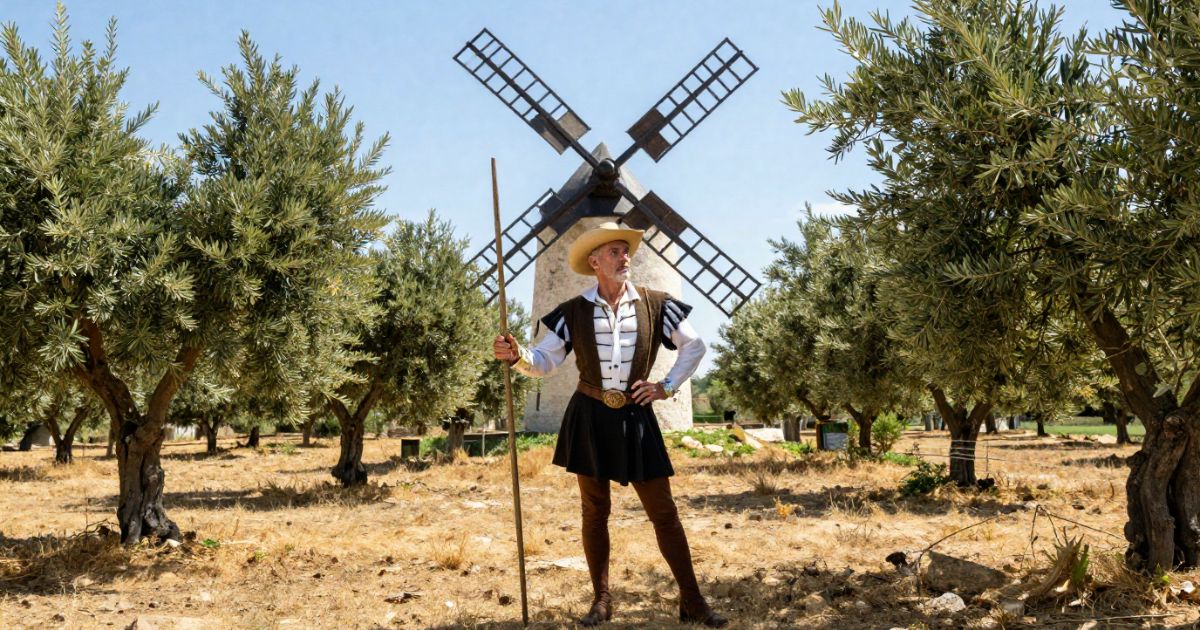
An excerpt from the original text.(complete · 3954 words)
HEREIN IS RELATED THE PLEASANT STORY OF THE MULETEER, TOGETHER WITH
OTHER STRANGE THINGS THAT CAME TO PASS IN THE INN
Ah me, Love’s mariner am I
On Love’s deep ocean sailing;
I know not where the haven lies,
I dare not hope to gain it.
One solitary distant star
Is all I have to guide me,
A brighter orb than those of old
That Palinurus lighted.
And vaguely drifting am I borne,
I know not where it leads me;
I fix my gaze on it alone,
Of all beside it heedless.
But over-cautious prudery,
And coyness cold and cruel,
When most I need it, these, like clouds,
Its longed-for light refuse me.
Bright star, goal of my yearning eyes
As thou above me beamest,
When thou shalt hide thee from my sight
I’ll know that death is near me.
The singer had got so far when it struck Dorothea that it was not fair
to let Clara miss hearing such a sweet voice, so, shaking her from side
to side, she woke her, saying:
“Forgive me, child, for waking thee, but I do so that thou mayest have
the pleasure of hearing the best voice thou hast ever heard, perhaps,
in all thy life.”
Clara awoke quite drowsy, and not understanding at the moment what
Dorothea said, asked her what it was; she repeated what she had said,
and Clara became attentive at once; but she had hardly heard two lines,
as the singer continued, when a strange trembling seized her, as if she
were suffering from a severe attack of quartan ague, and throwing her
arms round Dorothea she said:
“Ah, dear lady of my soul and life! why did you wake me? The greatest
kindness fortune could do me now would be to close my eyes and ears so
as neither to see or hear that unhappy musician.”
“What art thou talking about, child?” said Dorothea. “Why, they say
this singer is a muleteer!”
“Nay, he is the lord of many places,” replied Clara, “and that one in
my heart which he holds so firmly shall never be taken from him, unless
he be willing to surrender it.”
Dorothea was amazed at the ardent language of the girl, for it seemed
to be far beyond such experience of life as her tender years gave any
promise of, so she said to her:
“You speak in such a way that I cannot understand you, Señora Clara;
explain yourself more clearly, and tell me what is this you are saying
about hearts and places and this musician whose voice has so moved you?
But do not tell me anything now; I do not want to lose the pleasure I
get from listening to the singer by giving my attention to your
transports, for I perceive he is beginning to sing a new strain and a
new air.”
“Let him, in Heaven’s name,” returned Clara; and not to hear him she
stopped both ears with her hands, at which Dorothea was again
surprised; but turning her attention to the song she found that it ran
in this fashion:
Sweet Hope, my stay,
That onward to the goal of thy intent
Dost make thy way,
Heedless of hindrance or impediment,
Have thou no fear
If at each step thou findest death is near.
No victory,
No joy of triumph doth the faint heart know;
Unblest is he
That a bold front to Fortune dares not show,
But soul and sense
In bondage yieldeth up to indolence.
If Love his wares
Do dearly sell, his right must be contest;
What gold compares
With that whereon his stamp he hath imprest?
And all men know
What costeth little that we rate but low.
Love resolute
Knows not the word “impossibility;”
And though my suit
Beset by endless obstacles I see,
Yet no despair
Shall hold me bound to earth while heaven is there.
Here the voice ceased and Clara’s sobs began afresh, all which excited
Dorothea’s curiosity to know what could be the cause of singing so
sweet and weeping so bitter, so she again asked her what it was she was
going to say before. On this Clara, afraid that Luscinda might overhear
her, winding her arms tightly round Dorothea put her mouth so close to
her ear that she could speak without fear of being heard by anyone
else, and said:
“This singer, dear señora, is the son of a gentleman of Aragon, lord of
two villages, who lives opposite my father’s house at Madrid; and
though my father had curtains to the windows of his house in winter,
and lattice-work in summer, in some way—I know not how—this gentleman,
who was pursuing his studies, saw me, whether in church or elsewhere, I
cannot tell, and, in fact, fell in love with me, and gave me to know it
from the windows of his house, with so many signs and tears that I was
forced to believe him, and even to love him, without knowing what it
was he wanted of me. One of the signs he used to make me was to link
one hand in the other, to show me he wished to marry me; and though I
should have been glad if that could be, being alone and motherless I
knew not whom to open my mind to, and so I left it as it was, showing
him no favour, except when my father, and his too, were from home, to
raise the curtain or the lattice a little and let him see me plainly,
at which he would show such delight that he seemed as if he were going
mad. Meanwhile the time for my father’s departure arrived, which he
became aware of, but not from me, for I had never been able to tell him
of it. He fell sick, of grief I believe, and so the day we were going
away I could not see him to take farewell of him, were it only with the
eyes. But after we had been two days on the road, on entering the
posada of a village a day’s journey from this, I saw him at the inn
door in the dress of a muleteer, and so well disguised, that if I did
not carry his image graven on my heart it would have been impossible
for me to recognise him. But I knew him, and I was surprised, and glad;
he watched me, unsuspected by my father, from whom he always hides
himself when he crosses my path on the road, or in the posadas where we
halt; and, as I know what he is, and reflect that for love of me he
makes this journey on foot in all this hardship, I am ready to die of
sorrow; and where he sets foot there I set my eyes. I know not with
what object he has come; or how he could have got away from his father,
who loves him beyond measure, having no other heir, and because he
deserves it, as you will perceive when you see him. And moreover, I can
tell you, all that he sings is out of his own head; for I have heard
them say he is a great scholar and poet; and what is more, every time I
see him or hear him sing I tremble all over, and am terrified lest my
father should recognise him and come to know of our loves. I have never
spoken a word to him in my life; and for all that I love him so that I
could not live without him. This, dear señora, is all I have to tell
you about the musician whose voice has delighted you so much; and from
it alone you might easily perceive he is no muleteer, but a lord of
hearts and towns, as I told you already.”
“Say no more, Doña Clara,” said Dorothea at this, at the same time
kissing her a thousand times over, “say no more, I tell you, but wait
till day comes; when I trust in God to arrange this affair of yours so
that it may have the happy ending such an innocent beginning deserves.”
“Ah, señora,” said Doña Clara, “what end can be hoped for when his
father is of such lofty position, and so wealthy, that he would think I
was not fit to be even a servant to his son, much less wife? And as to
marrying without the knowledge of my father, I would not do it for all
the world. I would not ask anything more than that this youth should go
back and leave me; perhaps with not seeing him, and the long distance
we shall have to travel, the pain I suffer now may become easier;
though I daresay the remedy I propose will do me very little good. I
don’t know how the devil this has come about, or how this love I have
for him got in; I such a young girl, and he such a mere boy; for I
verily believe we are both of an age, and I am not sixteen yet; for I
will be sixteen Michaelmas Day, next, my father says.”
Dorothea could not help laughing to hear how like a child Doña Clara
spoke. “Let us go to sleep now, señora,” said she, “for the little of
the night that I fancy is left to us: God will soon send us daylight,
and we will set all to rights, or it will go hard with me.”
With this they fell asleep, and deep silence reigned all through the
inn. The only persons not asleep were the landlady’s daughter and her
servant Maritornes, who, knowing the weak point of Don Quixote’s
humour, and that he was outside the inn mounting guard in armour and on
horseback, resolved, the pair of them, to play some trick upon him, or
at any rate to amuse themselves for a while by listening to his
nonsense. As it so happened there was not a window in the whole inn
that looked outwards except a hole in the wall of a straw-loft through
which they used to throw out the straw. At this hole the two
demi-damsels posted themselves, and observed Don Quixote on his horse,
leaning on his pike and from time to time sending forth such deep and
doleful sighs, that he seemed to pluck up his soul by the roots with
each of them; and they could hear him, too, saying in a soft, tender,
loving tone, “Oh my lady Dulcinea del Toboso, perfection of all beauty,
summit and crown of discretion, treasure house of grace, depositary of
virtue, and finally, ideal of all that is good, honourable, and
delectable in this world! What is thy grace doing now? Art thou,
perchance, mindful of thy enslaved knight who of his own free will hath
exposed himself to so great perils, and all to serve thee? Give me
tidings of her, oh luminary of the three faces! Perhaps at this moment,
envious of hers, thou art regarding her, either as she paces to and fro
some gallery of her sumptuous palaces, or leans over some balcony,
meditating how, whilst preserving her purity and greatness, she may
mitigate the tortures this wretched heart of mine endures for her sake,
what glory should recompense my sufferings, what repose my toil, and
lastly what death my life, and what reward my services? And thou, oh
sun, that art now doubtless harnessing thy steeds in haste to rise
betimes and come forth to see my lady; when thou seest her I entreat of
thee to salute her on my behalf: but have a care, when thou shalt see
her and salute her, that thou kiss not her face; for I shall be more
jealous of thee than thou wert of that light-footed ingrate that made
thee sweat and run so on the plains of Thessaly, or on the banks of the
Peneus (for I do not exactly recollect where it was thou didst run on
that occasion) in thy jealousy and love.”
Don Quixote had got so far in his pathetic speech when the landlady’s
daughter began to signal to him, saying, “Señor, come over here,
please.”
At these signals and voice Don Quixote turned his head and saw by the
light of the moon, which then was in its full splendour, that someone
was calling to him from the hole in the wall, which seemed to him to be
a window, and what is more, with a gilt grating, as rich castles, such
as he believed the inn to be, ought to have; and it immediately
suggested itself to his imagination that, as on the former occasion,
the fair damsel, the daughter of the lady of the castle, overcome by
love for him, was once more endeavouring to win his affections; and
with this idea, not to show himself discourteous, or ungrateful, he
turned Rocinante’s head and approached the hole, and as he perceived
the two wenches he said:
“I pity you, beauteous lady, that you should have directed your
thoughts of love to a quarter from whence it is impossible that such a
return can be made to you as is due to your great merit and gentle
birth, for which you must not blame this unhappy knight-errant whom
love renders incapable of submission to any other than her whom, the
first moment his eyes beheld her, he made absolute mistress of his
soul. Forgive me, noble lady, and retire to your apartment, and do not,
by any further declaration of your passion, compel me to show myself
more ungrateful; and if, of the love you bear me, you should find that
there is anything else in my power wherein I can gratify you, provided
it be not love itself, demand it of me; for I swear to you by that
sweet absent enemy of mine to grant it this instant, though it be that
you require of me a lock of Medusa’s hair, which was all snakes, or
even the very beams of the sun shut up in a vial.”
“My mistress wants nothing of that sort, sir knight,” said Maritornes
at this.
“What then, discreet dame, is it that your mistress wants?” replied Don
Quixote.
“Only one of your fair hands,” said Maritornes, “to enable her to vent
over it the great passion, passion which has brought her to this
loophole, so much to the risk of her honour; for if the lord her father
had heard her, the least slice he would cut off her would be her ear.”
“I should like to see that tried,” said Don Quixote; “but he had better
beware of that, if he does not want to meet the most disastrous end
that ever father in the world met for having laid hands on the tender
limbs of a love-stricken daughter.”
Maritornes felt sure that Don Quixote would present the hand she had
asked, and making up her mind what to do, she got down from the hole
and went into the stable, where she took the halter of Sancho Panza’s
ass, and in all haste returned to the hole, just as Don Quixote had
planted himself standing on Rocinante’s saddle in order to reach the
grated window where he supposed the lovelorn damsel to be; and giving
her his hand, he said, “Lady, take this hand, or rather this scourge of
the evil-doers of the earth; take, I say, this hand which no other hand
of woman has ever touched, not even hers who has complete possession of
my entire body. I present it to you, not that you may kiss it, but that
you may observe the contexture of the sinews, the close network of the
muscles, the breadth and capacity of the veins, whence you may infer
what must be the strength of the arm that has such a hand.”
“That we shall see presently,” said Maritornes, and making a running
knot on the halter, she passed it over his wrist and coming down from
the hole tied the other end very firmly to the bolt of the door of the
straw-loft.
Don Quixote, feeling the roughness of the rope on his wrist, exclaimed,
“Your grace seems to be grating rather than caressing my hand; treat it
not so harshly, for it is not to blame for the offence my resolution
has given you, nor is it just to wreak all your vengeance on so small a
part; remember that one who loves so well should not revenge herself so
cruelly.”
But there was nobody now to listen to these words of Don Quixote’s, for
as soon as Maritornes had tied him she and the other made off, ready to
die with laughing, leaving him fastened in such a way that it was
impossible for him to release himself.
He was, as has been said, standing on Rocinante, with his arm passed
through the hole and his wrist tied to the bolt of the door, and in
mighty fear and dread of being left hanging by the arm if Rocinante
were to stir one side or the other; so he did not dare to make the
least movement, although from the patience and imperturbable
disposition of Rocinante, he had good reason to expect that he would
stand without budging for a whole century. Finding himself fast, then,
and that the ladies had retired, he began to fancy that all this was
done by enchantment, as on the former occasion when in that same castle
that enchanted Moor of a carrier had belaboured him; and he cursed in
his heart his own want of sense and judgment in venturing to enter the
castle again, after having come off so badly the first time; it being a
settled point with knights-errant that when they have tried an
adventure, and have not succeeded in it, it is a sign that it is not
reserved for them but for others, and that therefore they need not try
it again. Nevertheless he pulled his arm to see if he could release
himself, but it had been made so fast that all his efforts were in
vain. It is true he pulled it gently lest Rocinante should move, but
try as he might to seat himself in the saddle, he had nothing for it
but to stand upright or pull his hand off. Then it was he wished for
the sword of Amadis, against which no enchantment whatever had any
power; then he cursed his ill fortune; then he magnified the loss the
world would sustain by his absence while he remained there enchanted,
for that he believed he was beyond all doubt; then he once more took to
thinking of his beloved Dulcinea del Toboso; then he called to his
worthy squire Sancho Panza, who, buried in sleep and stretched upon the
pack-saddle of his ass, was oblivious, at that moment, of the mother
that bore him; then he called upon the sages Lirgandeo and Alquife to
come to his aid; then he invoked his good friend Urganda to succour
him; and then, at last, morning found him in such a state of
desperation and perplexity that he was bellowing like a bull, for he
had no hope that day would bring any relief to his suffering, which he
believed would last for ever, inasmuch as he was enchanted; and of this
he was convinced by seeing that Rocinante never stirred, much or
little, and he felt persuaded that he and his horse were to remain in
this state, without eating or drinking or sleeping, until the malign
influence of the stars was overpast, or until some other more sage
enchanter should disenchant him.
But he was very much deceived in this conclusion, for daylight had
hardly begun to appear when there came up to the inn four men on
horseback, well equipped and accoutred, with firelocks across their
saddle-bows. They called out and knocked loudly at the gate of the inn,
which was still shut; on seeing which, Don Quixote, even there where he
was, did not forget to act as sentinel, and said in a loud and
imperious tone, “Knights, or squires, or whatever ye be, ye have no
right to knock at the gates of this castle; for it is plain enough that
they who are within are either asleep, or else are not in the habit of
throwing open the fortress until the sun’s rays are spread over the
whole surface of the earth. Withdraw to a distance, and wait till it is
broad daylight, and then we shall see whether it will be proper or not
to open to you.”
“What the devil fortress or castle is this,” said one, “to make us
stand on such ceremony? If you are the innkeeper bid them open to us;
we are travellers who only want to feed our horses and go on, for we
are in haste.”
“Do you think, gentlemen, that I look like an innkeeper?” said Don
Quixote.
“I don’t know what you look like,” replied the other; “but I know that
you are talking nonsense when you call this inn a castle.”
“A castle it is,” returned Don Quixote, “nay, more, one of the best in
this whole province, and it has within it people who have had the
sceptre in the hand and the crown on the head.”
“It would be better if it were the other way,” said the traveller, “the
sceptre on the head and the crown in the hand; but if so, maybe there
is within some company of players, with whom it is a common thing to
have those crowns and sceptres you speak of; for in such a small inn as
this, and where such silence is kept, I do not believe any people
entitled to crowns and sceptres can have taken up their quarters.”
“You know but little of the world,” returned Don Quixote, “since you
are ignorant of what commonly occurs in knight-errantry.”
But the comrades of the spokesman, growing weary of the dialogue with
Don Quixote, renewed their knocks with great vehemence, so much so that
the host, and not only he but everybody in the inn, awoke, and he got
up to ask who knocked. It happened at this moment that one of the
horses of the four who were seeking admittance went to smell Rocinante,
who melancholy, dejected, and with drooping ears stood motionless,
supporting his sorely stretched master; and as he was, after all,
flesh, though he looked as if he were made of wood, he could not help
giving way and in return smelling the one who had come to offer him
attentions. But he had hardly moved at all when Don Quixote lost his
footing; and slipping off the saddle, he would have come to the ground,
but for being suspended by the arm, which caused him such agony that he
believed either his wrist would be cut through or his arm torn off; and
he hung so near the ground that he could just touch it with his feet,
which was all the worse for him; for, finding how little was wanted to
enable him to plant his feet firmly, he struggled and stretched himself
as much as he could to gain a footing; just like those undergoing the
torture of the strappado, when they are fixed at “touch and no touch,”
who aggravate their own sufferings by their violent efforts to stretch
themselves, deceived by the hope which makes them fancy that with a
very little more they will reach the ground.
c43e.jpg (20K)
Master this chapter. Complete your experience
Purchase the complete book to access all chapters and support classic literature
As an Amazon Associate, we earn a small commission from qualifying purchases at no additional cost to you.
Available in paperback, hardcover, and e-book formats
Let's Analyse the Pattern
When our romantic ideals and emotional investments make us vulnerable to manipulation by those who recognize and exploit our blindness to reality.
Why This Matters
Connect literature to life
This chapter teaches how manipulators exploit our deepest hopes by offering exactly what we want to hear when we're most vulnerable.
Practice This Today
Next time someone offers you exactly what you've been hoping for, pause and ask: what concrete evidence do I have of their ability and intention to deliver?
Now let's explore the literary elements.
Key Quotes & Analysis
"Ah me, Love's mariner am I / On Love's deep ocean sailing; / I know not where the haven lies, / I dare not hope to gain it."
Context: He sings this love song outside the inn, not knowing Clara can hear him.
The metaphor of love as a dangerous sea voyage captures how uncertain and risky romantic feelings can be. The singer admits he's lost and hopeless, which reveals his genuine vulnerability despite his disguise.
In Today's Words:
I'm totally lost when it comes to love and I don't think this is going anywhere good.
"Forgive me, child, for waking thee, but I do so that thou mayest have the pleasure of hearing the best voice thou hast ever heard."
Context: She wakes Clara because she wants her to enjoy the beautiful singing.
This shows Dorothea's generous nature and her appreciation for beauty. She doesn't know yet that this voice will cause Clara emotional pain rather than pleasure.
In Today's Words:
Sorry to wake you up, but you have to hear this amazing singer.
"When thou shalt hide thee from my sight / I'll know that death is near me."
Context: Part of his love song about following a guiding star.
He's saying he'd rather die than lose sight of his beloved. This dramatic declaration shows the intensity of courtly love traditions, where lovers claimed they couldn't live without their beloved.
In Today's Words:
If I lose you, I might as well be dead.
Thematic Threads
Class
In This Chapter
Clara's love is impossible due to social class differences between her family and the nobleman's son who follows her
Development
Continues the exploration of how social barriers prevent genuine connections
In Your Life:
You might feel this when you're attracted to someone from a different economic or social background and face family pressure.
Identity
In This Chapter
The nobleman disguises himself as a muleteer to pursue love, while Don Quixote's knight identity makes him vulnerable to tricks
Development
Shows how both authentic and delusional identities can create problems
In Your Life:
You might see this when you change how you present yourself to fit in somewhere, or when your self-image doesn't match reality.
Deception
In This Chapter
The servant girls deliberately trick Don Quixote by pretending to be a damsel in distress
Development
Introduced here as cruel mockery rather than protective lies seen earlier
In Your Life:
You might encounter this when people take advantage of your good nature or strong beliefs to manipulate you.
Love
In This Chapter
Clara experiences genuine but painful love while Don Quixote performs romantic gestures based on fantasy
Development
Contrasts real emotional connection with performative romantic idealism
In Your Life:
You might recognize this when distinguishing between authentic feelings and what you think love should look like.
Vulnerability
In This Chapter
Both Clara and Don Quixote suffer because their emotional openness exposes them to pain and exploitation
Development
Shows how genuine feeling and delusion can both create dangerous exposure
In Your Life:
You might feel this when your caring nature or strong convictions make you an easy target for others.
You now have the context. Time to form your own thoughts.
Discussion Questions
- 1
What tricks do the servant girls play on Don Quixote, and how does his romantic fantasy make him vulnerable to their deception?
analysis • surface - 2
Why does Clara cry when she hears the muleteer's songs, and how does her situation differ from Don Quixote's romantic delusions?
analysis • medium - 3
Where do you see people today getting 'strung along' because their hopes or ideals make them ignore red flags?
application • medium - 4
How can you tell the difference between someone genuinely asking for help versus someone exploiting your good nature?
application • deep - 5
What does this chapter reveal about how our strongest values can become our greatest vulnerabilities?
reflection • deep
Critical Thinking Exercise
Reality-Check Your Romantic Investments
Think of a situation where you're emotionally invested - a relationship, job opportunity, or dream you're pursuing. Write down what you hope will happen, then list only the concrete evidence you have that supports this hope. Finally, imagine what a skeptical friend might point out about your situation.
Consider:
- •Distinguish between what someone says and what they actually do
- •Notice if you're making excuses for behavior you wouldn't accept from others
- •Ask yourself: Am I responding to reality or to my fantasy of what this could become?
Journaling Prompt
Write about a time when your idealism or good intentions made you vulnerable to being taken advantage of. What warning signs did you miss, and how would you handle a similar situation now?
Coming Up Next...
Chapter 64: When Reality and Fantasy Collide
Don Quixote's cries for help finally wake the entire inn, and his rescue leads to new complications. The mysterious horsemen demanding entry will bring unexpected revelations about the true identities of several guests.