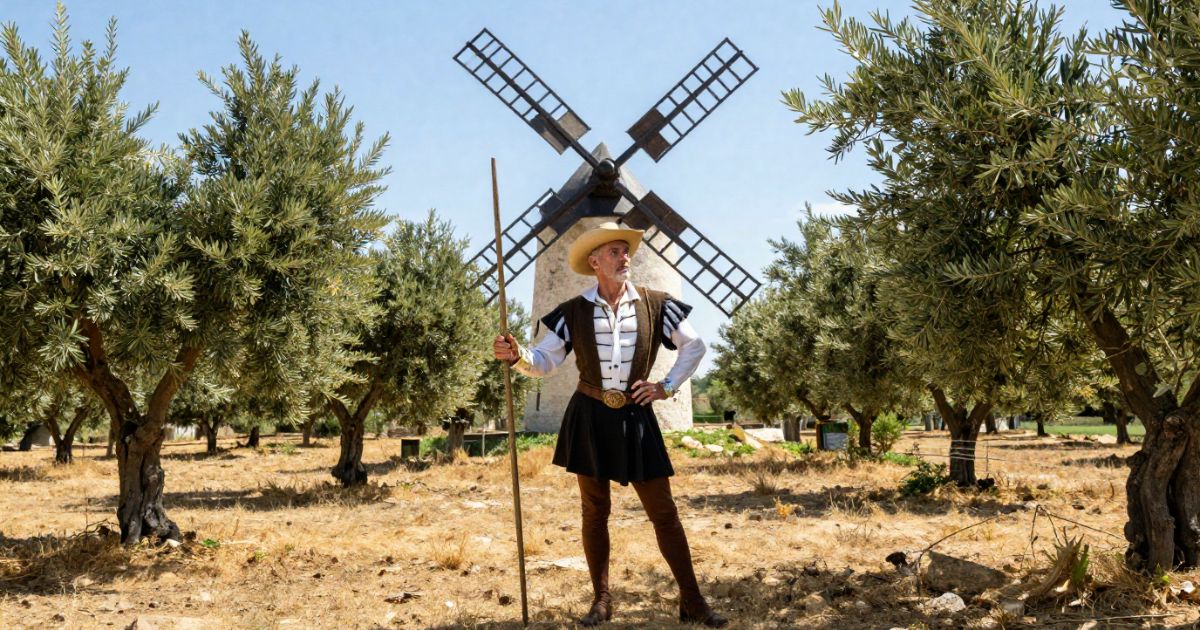
An excerpt from the original text.(complete · 3130 words)
WHICH THE DOUBTFUL QUESTION OF MAMBRINO’S HELMET AND THE PACK-SADDLE
IS FINALLY SETTLED, WITH OTHER ADVENTURES THAT OCCURRED IN TRUTH AND
EARNEST
“What do you think now, gentlemen,” said the barber, “of what these
gentles say, when they want to make out that this is a helmet?”
“And whoever says the contrary,” said Don Quixote, “I will let him know
he lies if he is a knight, and if he is a squire that he lies again a
thousand times.”
Our own barber, who was present at all this, and understood Don
Quixote’s humour so thoroughly, took it into his head to back up his
delusion and carry on the joke for the general amusement; so addressing
the other barber he said:
“Señor barber, or whatever you are, you must know that I belong to your
profession too, and have had a licence to practise for more than twenty
years, and I know the implements of the barber craft, every one of
them, perfectly well; and I was likewise a soldier for some time in the
days of my youth, and I know also what a helmet is, and a morion, and a
headpiece with a visor, and other things pertaining to soldiering, I
meant to say to soldiers’ arms; and I say—saving better opinions and
always with submission to sounder judgments—that this piece we have now
before us, which this worthy gentleman has in his hands, not only is no
barber’s basin, but is as far from being one as white is from black,
and truth from falsehood; I say, moreover, that this, although it is a
helmet, is not a complete helmet.”
“Certainly not,” said Don Quixote, “for half of it is wanting, that is
to say the beaver.”
“It is quite true,” said the curate, who saw the object of his friend
the barber; and Cardenio, Don Fernando and his companions agreed with
him, and even the Judge, if his thoughts had not been so full of Don
Luis’s affair, would have helped to carry on the joke; but he was so
taken up with the serious matters he had on his mind that he paid
little or no attention to these facetious proceedings.
“God bless me!” exclaimed their butt the barber at this; “is it
possible that such an honourable company can say that this is not a
basin but a helmet? Why, this is a thing that would astonish a whole
university, however wise it might be! That will do; if this basin is a
helmet, why, then the pack-saddle must be a horse’s caparison, as this
gentleman has said.”
“To me it looks like a pack-saddle,” said Don Quixote; “but I have
already said that with that question I do not concern myself.”
“As to whether it be pack-saddle or caparison,” said the curate, “it is
only for Señor Don Quixote to say; for in these matters of chivalry all
these gentlemen and I bow to his authority.”
“By God, gentlemen,” said Don Quixote, “so many strange things have
happened to me in this castle on the two occasions on which I have
sojourned in it, that I will not venture to assert anything positively
in reply to any question touching anything it contains; for it is my
belief that everything that goes on within it goes by enchantment. The
first time, an enchanted Moor that there is in it gave me sore trouble,
nor did Sancho fare well among certain followers of his; and last night
I was kept hanging by this arm for nearly two hours, without knowing
how or why I came by such a mishap. So that now, for me to come forward
to give an opinion in such a puzzling matter, would be to risk a rash
decision. As regards the assertion that this is a basin and not a
helmet I have already given an answer; but as to the question whether
this is a pack-saddle or a caparison I will not venture to give a
positive opinion, but will leave it to your worships’ better judgment.
Perhaps as you are not dubbed knights like myself, the enchantments of
this place have nothing to do with you, and your faculties are
unfettered, and you can see things in this castle as they really and
truly are, and not as they appear to me.”
“There can be no question,” said Don Fernando on this, “but that Señor
Don Quixote has spoken very wisely, and that with us rests the decision
of this matter; and that we may have surer ground to go on, I will take
the votes of the gentlemen in secret, and declare the result clearly
and fully.”
To those who were in on the secret of Don Quixote’s humour all this
afforded great amusement; but to those who knew nothing about it, it
seemed the greatest nonsense in the world, in particular to the four
servants of Don Luis, as well as to Don Luis himself, and to three
other travellers who had by chance come to the inn, and had the
appearance of officers of the Holy Brotherhood, as indeed they were;
but the one who above all was at his wits’ end was the barber whose
basin, there before his very eyes, had been turned into Mambrino’s
helmet, and whose pack-saddle he had no doubt whatever was about to
become a rich caparison for a horse. All laughed to see Don Fernando
going from one to another collecting the votes, and whispering to them
to give him their private opinion whether the treasure over which there
had been so much fighting was a pack-saddle or a caparison; but after
he had taken the votes of those who knew Don Quixote, he said aloud,
“The fact is, my good fellow, that I am tired collecting such a number
of opinions, for I find that there is not one of whom I ask what I
desire to know, who does not tell me that it is absurd to say that this
is the pack-saddle of an ass, and not the caparison of a horse, nay, of
a thoroughbred horse; so you must submit, for, in spite of you and your
ass, this is a caparison and no pack-saddle, and you have stated and
proved your case very badly.”
“May I never share heaven,” said the poor barber, “if your worships are
not all mistaken; and may my soul appear before God as that appears to
me a pack-saddle and not a caparison; but, ‘laws go,’—I say no more;
and indeed I am not drunk, for I am fasting, except it be from sin.”
The simple talk of the barber did not afford less amusement than the
absurdities of Don Quixote, who now observed:
“There is no more to be done now than for each to take what belongs to
him, and to whom God has given it, may St. Peter add his blessing.”
But said one of the four servants, “Unless, indeed, this is a
deliberate joke, I cannot bring myself to believe that men so
intelligent as those present are, or seem to be, can venture to declare
and assert that this is not a basin, and that not a pack-saddle; but as
I perceive that they do assert and declare it, I can only come to the
conclusion that there is some mystery in this persistence in what is so
opposed to the evidence of experience and truth itself; for I swear
by”—and here he rapped out a round oath—“all the people in the world
will not make me believe that this is not a barber’s basin and that a
jackass’s pack-saddle.”
“It might easily be a she-ass’s,” observed the curate.
“It is all the same,” said the servant; “that is not the point; but
whether it is or is not a pack-saddle, as your worships say.”
On hearing this one of the newly arrived officers of the Brotherhood,
who had been listening to the dispute and controversy, unable to
restrain his anger and impatience, exclaimed, “It is a pack-saddle as
sure as my father is my father, and whoever has said or will say
anything else must be drunk.”
“You lie like a rascally clown,” returned Don Quixote; and lifting his
pike, which he had never let out of his hand, he delivered such a blow
at his head that, had not the officer dodged it, it would have
stretched him at full length. The pike was shivered in pieces against
the ground, and the rest of the officers, seeing their comrade
assaulted, raised a shout, calling for help for the Holy Brotherhood.
The landlord, who was of the fraternity, ran at once to fetch his staff
of office and his sword, and ranged himself on the side of his
comrades; the servants of Don Luis clustered round him, lest he should
escape from them in the confusion; the barber, seeing the house turned
upside down, once more laid hold of his pack-saddle and Sancho did the
same; Don Quixote drew his sword and charged the officers; Don Luis
cried out to his servants to leave him alone and go and help Don
Quixote, and Cardenio and Don Fernando, who were supporting him; the
curate was shouting at the top of his voice, the landlady was
screaming, her daughter was wailing, Maritornes was weeping, Dorothea
was aghast, Luscinda terror-stricken, and Doña Clara in a faint. The
barber cudgelled Sancho, and Sancho pommelled the barber; Don Luis gave
one of his servants, who ventured to catch him by the arm to keep him
from escaping, a cuff that bathed his teeth in blood; the Judge took
his part; Don Fernando had got one of the officers down and was
belabouring him heartily; the landlord raised his voice again calling
for help for the Holy Brotherhood; so that the whole inn was nothing
but cries, shouts, shrieks, confusion, terror, dismay, mishaps,
sword-cuts, fisticuffs, cudgellings, kicks, and bloodshed; and in the
midst of all this chaos, complication, and general entanglement, Don
Quixote took it into his head that he had been plunged into the thick
of the discord of Agramante’s camp; and, in a voice that shook the inn
like thunder, he cried out:
“Hold all, let all sheathe their swords, let all be calm and attend to
me as they value their lives!”
All paused at his mighty voice, and he went on to say, “Did I not tell
you, sirs, that this castle was enchanted, and that a legion or so of
devils dwelt in it? In proof whereof I call upon you to behold with
your own eyes how the discord of Agramante’s camp has come hither, and
been transferred into the midst of us. See how they fight, there for
the sword, here for the horse, on that side for the eagle, on this for
the helmet; we are all fighting, and all at cross purposes. Come then,
you, Señor Judge, and you, señor curate; let the one represent King
Agramante and the other King Sobrino, and make peace among us; for by
God Almighty it is a sorry business that so many persons of quality as
we are should slay one another for such trifling cause.” The officers,
who did not understand Don Quixote’s mode of speaking, and found
themselves roughly handled by Don Fernando, Cardenio, and their
companions, were not to be appeased; the barber was, however, for both
his beard and his pack-saddle were the worse for the struggle; Sancho
like a good servant obeyed the slightest word of his master; while the
four servants of Don Luis kept quiet when they saw how little they
gained by not being so. The landlord alone insisted upon it that they
must punish the insolence of this madman, who at every turn raised a
disturbance in the inn; but at length the uproar was stilled for the
present; the pack-saddle remained a caparison till the day of judgment,
and the basin a helmet and the inn a castle in Don Quixote’s
imagination.
All having been now pacified and made friends by the persuasion of the
Judge and the curate, the servants of Don Luis began again to urge him
to return with them at once; and while he was discussing the matter
with them, the Judge took counsel with Don Fernando, Cardenio, and the
curate as to what he ought to do in the case, telling them how it
stood, and what Don Luis had said to him. It was agreed at length that
Don Fernando should tell the servants of Don Luis who he was, and that
it was his desire that Don Luis should accompany him to Andalusia,
where he would receive from the marquis his brother the welcome his
quality entitled him to; for, otherwise, it was easy to see from the
determination of Don Luis that he would not return to his father at
present, though they tore him to pieces. On learning the rank of Don
Fernando and the resolution of Don Luis the four then settled it
between themselves that three of them should return to tell his father
how matters stood, and that the other should remain to wait upon Don
Luis, and not leave him until they came back for him, or his father’s
orders were known. Thus by the authority of Agramante and the wisdom of
King Sobrino all this complication of disputes was arranged; but the
enemy of concord and hater of peace, feeling himself slighted and made
a fool of, and seeing how little he had gained after having involved
them all in such an elaborate entanglement, resolved to try his hand
once more by stirring up fresh quarrels and disturbances.
It came about in this wise: the officers were pacified on learning the
rank of those with whom they had been engaged, and withdrew from the
contest, considering that whatever the result might be they were likely
to get the worst of the battle; but one of them, the one who had been
thrashed and kicked by Don Fernando, recollected that among some
warrants he carried for the arrest of certain delinquents, he had one
against Don Quixote, whom the Holy Brotherhood had ordered to be
arrested for setting the galley slaves free, as Sancho had, with very
good reason, apprehended. Suspecting how it was, then, he wished to
satisfy himself as to whether Don Quixote’s features corresponded; and
taking a parchment out of his bosom he lit upon what he was in search
of, and setting himself to read it deliberately, for he was not a quick
reader, as he made out each word he fixed his eyes on Don Quixote, and
went on comparing the description in the warrant with his face, and
discovered that beyond all doubt he was the person described in it. As
soon as he had satisfied himself, folding up the parchment, he took the
warrant in his left hand and with his right seized Don Quixote by the
collar so tightly that he did not allow him to breathe, and shouted
aloud, “Help for the Holy Brotherhood! and that you may see I demand it
in earnest, read this warrant which says this highwayman is to be
arrested.”
The curate took the warrant and saw that what the officer said was
true, and that it agreed with Don Quixote’s appearance, who, on his
part, when he found himself roughly handled by this rascally clown,
worked up to the highest pitch of wrath, and all his joints cracking
with rage, with both hands seized the officer by the throat with all
his might, so that had he not been helped by his comrades he would have
yielded up his life ere Don Quixote released his hold. The landlord,
who had perforce to support his brother officers, ran at once to aid
them. The landlady, when she saw her husband engaged in a fresh
quarrel, lifted up her voice afresh, and its note was immediately
caught up by Maritornes and her daughter, calling upon heaven and all
present for help; and Sancho, seeing what was going on, exclaimed, “By
the Lord, it is quite true what my master says about the enchantments
of this castle, for it is impossible to live an hour in peace in it!”
Don Fernando parted the officer and Don Quixote, and to their mutual
contentment made them relax the grip by which they held, the one the
coat collar, the other the throat of his adversary; for all this,
however, the officers did not cease to demand their prisoner and call
on them to help, and deliver him over bound into their power, as was
required for the service of the King and of the Holy Brotherhood, on
whose behalf they again demanded aid and assistance to effect the
capture of this robber and footpad of the highways.
Don Quixote smiled when he heard these words, and said very calmly,
“Come now, base, ill-born brood; call ye it highway robbery to give
freedom to those in bondage, to release the captives, to succour the
miserable, to raise up the fallen, to relieve the needy? Infamous
beings, who by your vile grovelling intellects deserve that heaven
should not make known to you the virtue that lies in knight-errantry,
or show you the sin and ignorance in which ye lie when ye refuse to
respect the shadow, not to say the presence, of any knight-errant! Come
now; band, not of officers, but of thieves; footpads with the licence
of the Holy Brotherhood; tell me who was the ignoramus who signed a
warrant of arrest against such a knight as I am? Who was he that did
not know that knights-errant are independent of all jurisdictions, that
their law is their sword, their charter their prowess, and their edicts
their will? Who, I say again, was the fool that knows not that there
are no letters patent of nobility that confer such privileges or
exemptions as a knight-errant acquires the day he is dubbed a knight,
and devotes himself to the arduous calling of chivalry? What
knight-errant ever paid poll-tax, duty, queen’s pin-money, king’s dues,
toll or ferry? What tailor ever took payment of him for making his
clothes? What castellan that received him in his castle ever made him
pay his shot? What king did not seat him at his table? What damsel was
not enamoured of him and did not yield herself up wholly to his will
and pleasure? And, lastly, what knight-errant has there been, is there,
or will there ever be in the world, not bold enough to give,
single-handed, four hundred cudgellings to four hundred officers of the
Holy Brotherhood if they come in his way?”
Master this chapter. Complete your experience
Purchase the complete book to access all chapters and support classic literature
As an Amazon Associate, we earn a small commission from qualifying purchases at no additional cost to you.
Available in paperback, hardcover, and e-book formats
Let's Analyse the Pattern
When groups validate someone's harmful delusions for entertainment or convenience, reality becomes negotiable until consequences force a violent reckoning.
Why This Matters
Connect literature to life
This chapter teaches how to recognize when people are validating your delusions rather than supporting your actual success.
Practice This Today
This week, notice when someone agrees with you too easily - ask yourself if they're helping you succeed or just avoiding conflict.
Now let's explore the literary elements.
Key Quotes & Analysis
"And whoever says the contrary, I will let him know he lies if he is a knight, and if he is a squire that he lies again a thousand times."
Context: When challenged about whether the basin is really Mambrino's helmet
Shows how Don Quixote uses threats and his supposed status to shut down anyone who questions his delusions. He can't handle being contradicted and immediately escalates to violence and intimidation.
In Today's Words:
Anyone who disagrees with me is a liar and I'll fight them about it.
"I know the implements of the barber craft, every one of them, perfectly well... and I say this piece we have now before us is as far from being a barber's basin as white is from black."
Context: When he pretends to use professional expertise to support Don Quixote's delusion
Demonstrates how people can abuse their credibility to support lies. He uses his real professional knowledge as a barber to make a completely false claim seem legitimate.
In Today's Words:
Trust me, I'm an expert, and I'm telling you that obvious thing isn't what you think it is.
"Knights-errant are exempt from all judicial investigation, their law is their sword, their charter their prowess, their edicts their will."
Context: When the officer tries to arrest him for his past crimes
Reveals how Don Quixote believes his self-appointed status puts him above consequences. He thinks declaring himself special means he doesn't have to follow the same rules as everyone else.
In Today's Words:
I don't have to follow laws because I've decided I'm special and can do whatever I want.
Thematic Threads
Social Manipulation
In This Chapter
The inn's patrons manipulate Don Quixote's delusions for their own amusement, turning his mental illness into entertainment
Development
Evolved from earlier chapters where individuals humored Don Quixote to now showing how groups can collectively exploit someone's vulnerability
In Your Life:
You might see this when coworkers encourage a difficult boss's unrealistic ideas rather than risk confrontation
Reality vs Fantasy
In This Chapter
A democratic vote is held to declare a barber's basin is actually a magical helmet, showing how groups can collectively deny obvious truth
Development
Developed from Don Quixote's private delusions to showing how entire communities can be drawn into rejecting reality
In Your Life:
You might encounter this in family dynamics where everyone agrees to pretend an obvious problem doesn't exist
Consequences of Privilege
In This Chapter
Don Quixote declares knights are above the law when faced with arrest, showing how perceived status can create dangerous entitlement
Development
Built from earlier themes of class expectations to now showing how privilege can blind someone to real-world accountability
In Your Life:
You might see this when someone with authority refuses to follow rules they expect others to obey
Violence as Last Resort
In This Chapter
When someone insists on calling things by their real names, the fantasy bubble explodes into a massive brawl involving everyone
Development
Escalated from Don Quixote's individual acts of violence to showing how collective delusions often end in widespread conflict
In Your Life:
You might experience this when long-avoided family tensions finally explode during a holiday gathering
Abandonment
In This Chapter
After encouraging Don Quixote's delusions for entertainment, his enablers abandon him when real legal consequences arrive
Development
New theme showing how fair-weather supporters disappear when situations become serious
In Your Life:
You might face this when friends who encouraged risky behavior distance themselves when you face the consequences
You now have the context. Time to form your own thoughts.
Discussion Questions
- 1
What happens when the inn's patrons decide to play along with Don Quixote's belief that the barber's basin is a magical helmet?
analysis • surface - 2
Why do you think Don Quixote's friends choose to enable his delusions rather than help him see reality?
analysis • medium - 3
Where have you seen groups go along with someone's false beliefs to avoid conflict, even when it causes bigger problems later?
application • medium - 4
If you were the visiting barber watching everyone insist your basin was a helmet, how would you handle the situation without making things worse?
application • deep - 5
What does this chapter reveal about the difference between being kind and being enabling when someone is struggling with reality?
reflection • deep
Critical Thinking Exercise
Track the Enablement Chain
Think of a situation where you've seen people go along with someone's unrealistic beliefs or demands to avoid immediate conflict. Map out how the enabling started small, who participated and why, and what the eventual consequences were for everyone involved.
Consider:
- •Notice who benefits from the enabling and who pays the real costs
- •Identify the moment when harmless agreement became harmful participation
- •Consider what early intervention might have prevented the escalation
Journaling Prompt
Write about a time when you had to choose between going along with a group lie and speaking an uncomfortable truth. What helped you decide, and what would you do differently now?
Coming Up Next...
Chapter 66: The Curate's Clever Deception
The officers aren't backing down from arresting Don Quixote, but the curate has a plan to convince them that our knight's madness makes him untouchable by law. Meanwhile, the consequences of everyone's games are about to catch up with them in unexpected ways.