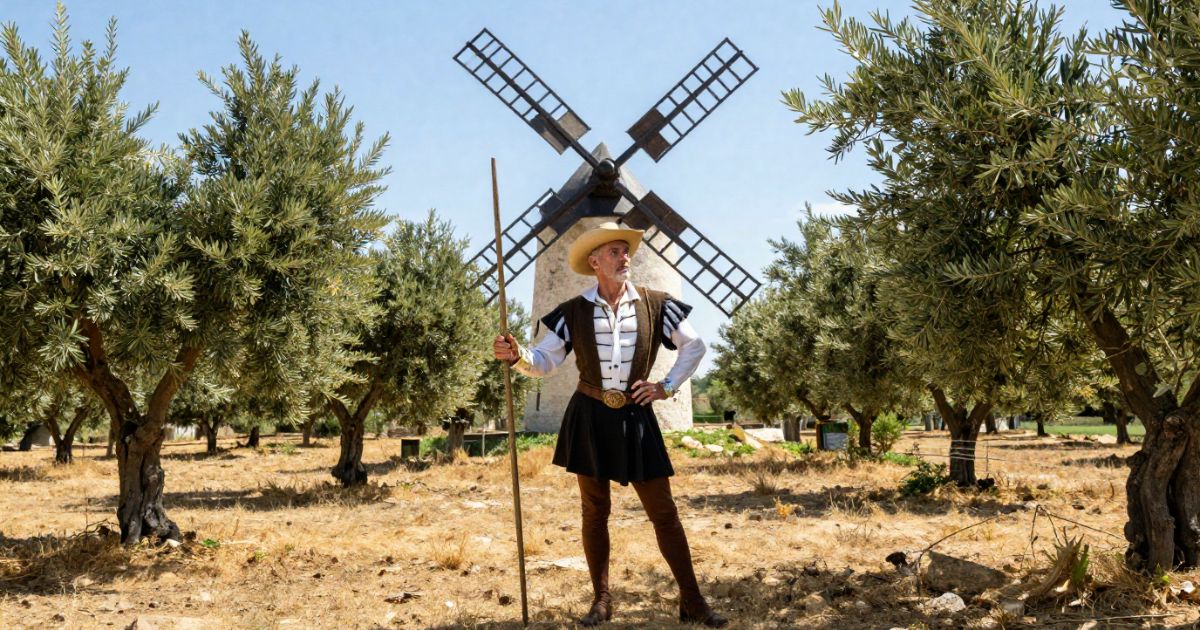
An excerpt from the original text.(complete · 3287 words)
WHEREIN THE CAPTIVE RELATES HIS LIFE AND ADVENTURES
My family had its origin in a village in the mountains of Leon, and
nature had been kinder and more generous to it than fortune; though in
the general poverty of those communities my father passed for being
even a rich man; and he would have been so in reality had he been as
clever in preserving his property as he was in spending it. This
tendency of his to be liberal and profuse he had acquired from having
been a soldier in his youth, for the soldier’s life is a school in
which the niggard becomes free-handed and the free-handed prodigal; and
if any soldiers are to be found who are misers, they are monsters of
rare occurrence. My father went beyond liberality and bordered on
prodigality, a disposition by no means advantageous to a married man
who has children to succeed to his name and position. My father had
three, all sons, and all of sufficient age to make choice of a
profession. Finding, then, that he was unable to resist his propensity,
he resolved to divest himself of the instrument and cause of his
prodigality and lavishness, to divest himself of wealth, without which
Alexander himself would have seemed parsimonious; and so calling us all
three aside one day into a room, he addressed us in words somewhat to
the following effect:
“My sons, to assure you that I love you, no more need be known or said
than that you are my sons; and to encourage a suspicion that I do not
love you, no more is needed than the knowledge that I have no
self-control as far as preservation of your patrimony is concerned;
therefore, that you may for the future feel sure that I love you like a
father, and have no wish to ruin you like a stepfather, I propose to do
with you what I have for some time back meditated, and after mature
deliberation decided upon. You are now of an age to choose your line of
life or at least make choice of a calling that will bring you honour
and profit when you are older; and what I have resolved to do is to
divide my property into four parts; three I will give to you, to each
his portion without making any difference, and the other I will retain
to live upon and support myself for whatever remainder of life Heaven
may be pleased to grant me. But I wish each of you on taking possession
of the share that falls to him to follow one of the paths I shall
indicate. In this Spain of ours there is a proverb, to my mind very
true—as they all are, being short aphorisms drawn from long practical
experience—and the one I refer to says, ‘The church, or the sea, or the
king’s house;’ as much as to say, in plainer language, whoever wants to
flourish and become rich, let him follow the church, or go to sea,
adopting commerce as his calling, or go into the king’s service in his
household, for they say, ‘Better a king’s crumb than a lord’s favour.’
I say so because it is my will and pleasure that one of you should
follow letters, another trade, and the third serve the king in the
wars, for it is a difficult matter to gain admission to his service in
his household, and if war does not bring much wealth it confers great
distinction and fame. Eight days hence I will give you your full shares
in money, without defrauding you of a farthing, as you will see in the
end. Now tell me if you are willing to follow out my idea and advice as
I have laid it before you.”
Having called upon me as the eldest to answer, I, after urging him not
to strip himself of his property but to spend it all as he pleased, for
we were young men able to gain our living, consented to comply with his
wishes, and said that mine were to follow the profession of arms and
thereby serve God and my king. My second brother having made the same
proposal, decided upon going to the Indies, embarking the portion that
fell to him in trade. The youngest, and in my opinion the wisest, said
he would rather follow the church, or go to complete his studies at
Salamanca. As soon as we had come to an understanding, and made choice
of our professions, my father embraced us all, and in the short time he
mentioned carried into effect all he had promised; and when he had
given to each his share, which as well as I remember was three thousand
ducats apiece in cash (for an uncle of ours bought the estate and paid
for it down, not to let it go out of the family), we all three on the
same day took leave of our good father; and at the same time, as it
seemed to me inhuman to leave my father with such scanty means in his
old age, I induced him to take two of my three thousand ducats, as the
remainder would be enough to provide me with all a soldier needed. My
two brothers, moved by my example, gave him each a thousand ducats, so
that there was left for my father four thousand ducats in money,
besides three thousand, the value of the portion that fell to him which
he preferred to retain in land instead of selling it. Finally, as I
said, we took leave of him, and of our uncle whom I have mentioned, not
without sorrow and tears on both sides, they charging us to let them
know whenever an opportunity offered how we fared, whether well or ill.
We promised to do so, and when he had embraced us and given us his
blessing, one set out for Salamanca, the other for Seville, and I for
Alicante, where I had heard there was a Genoese vessel taking in a
cargo of wool for Genoa.
It is now some twenty-two years since I left my father’s house, and all
that time, though I have written several letters, I have had no news
whatever of him or of my brothers; my own adventures during that period
I will now relate briefly. I embarked at Alicante, reached Genoa after
a prosperous voyage, and proceeded thence to Milan, where I provided
myself with arms and a few soldier’s accoutrements; thence it was my
intention to go and take service in Piedmont, but as I was already on
the road to Alessandria della Paglia, I learned that the great Duke of
Alva was on his way to Flanders. I changed my plans, joined him, served
under him in the campaigns he made, was present at the deaths of the
Counts Egmont and Horn, and was promoted to be ensign under a famous
captain of Guadalajara, Diego de Urbina by name. Some time after my
arrival in Flanders news came of the league that his Holiness Pope Pius
V. of happy memory, had made with Venice and Spain against the common
enemy, the Turk, who had just then with his fleet taken the famous
island of Cyprus, which belonged to the Venetians, a loss deplorable
and disastrous. It was known as a fact that the Most Serene Don John of
Austria, natural brother of our good king Don Philip, was coming as
commander-in-chief of the allied forces, and rumours were abroad of the
vast warlike preparations which were being made, all which stirred my
heart and filled me with a longing to take part in the campaign which
was expected; and though I had reason to believe, and almost certain
promises, that on the first opportunity that presented itself I should
be promoted to be captain, I preferred to leave all and betake myself,
as I did, to Italy; and it was my good fortune that Don John had just
arrived at Genoa, and was going on to Naples to join the Venetian
fleet, as he afterwards did at Messina. I may say, in short, that I
took part in that glorious expedition, promoted by this time to be a
captain of infantry, to which honourable charge my good luck rather
than my merits raised me; and that day—so fortunate for Christendom,
because then all the nations of the earth were disabused of the error
under which they lay in imagining the Turks to be invincible on sea—on
that day, I say, on which the Ottoman pride and arrogance were broken,
among all that were there made happy (for the Christians who died that
day were happier than those who remained alive and victorious) I alone
was miserable; for, instead of some naval crown that I might have
expected had it been in Roman times, on the night that followed that
famous day I found myself with fetters on my feet and manacles on my
hands.
It happened in this way: El Uchali, the king of Algiers, a daring and
successful corsair, having attacked and taken the leading Maltese
galley (only three knights being left alive in it, and they badly
wounded), the chief galley of John Andrea, on board of which I and my
company were placed, came to its relief, and doing as was bound to do
in such a case, I leaped on board the enemy’s galley, which, sheering
off from that which had attacked it, prevented my men from following
me, and so I found myself alone in the midst of my enemies, who were in
such numbers that I was unable to resist; in short I was taken, covered
with wounds; El Uchali, as you know, sirs, made his escape with his
entire squadron, and I was left a prisoner in his power, the only sad
being among so many filled with joy, and the only captive among so many
free; for there were fifteen thousand Christians, all at the oar in the
Turkish fleet, that regained their longed-for liberty that day.
They carried me to Constantinople, where the Grand Turk, Selim, made my
master general at sea for having done his duty in the battle and
carried off as evidence of his bravery the standard of the Order of
Malta. The following year, which was the year seventy-two, I found
myself at Navarino rowing in the leading galley with the three
lanterns. There I saw and observed how the opportunity of capturing the
whole Turkish fleet in harbour was lost; for all the marines and
janizzaries that belonged to it made sure that they were about to be
attacked inside the very harbour, and had their kits and pasamaques, or
shoes, ready to flee at once on shore without waiting to be assailed,
in so great fear did they stand of our fleet. But Heaven ordered it
otherwise, not for any fault or neglect of the general who commanded on
our side, but for the sins of Christendom, and because it was God’s
will and pleasure that we should always have instruments of punishment
to chastise us. As it was, El Uchali took refuge at Modon, which is an
island near Navarino, and landing forces fortified the mouth of the
harbour and waited quietly until Don John retired. On this expedition
was taken the galley called the Prize, whose captain was a son of the
famous corsair Barbarossa. It was taken by the chief Neapolitan galley
called the She-wolf, commanded by that thunderbolt of war, that father
of his men, that successful and unconquered captain Don Álvaro de
Bazan, Marquis of Santa Cruz; and I cannot help telling you what took
place at the capture of the Prize.
The son of Barbarossa was so cruel, and treated his slaves so badly,
that, when those who were at the oars saw that the She-wolf galley was
bearing down upon them and gaining upon them, they all at once dropped
their oars and seized their captain who stood on the stage at the end
of the gangway shouting to them to row lustily; and passing him on from
bench to bench, from the poop to the prow, they so bit him that before
he had got much past the mast his soul had already got to hell; so
great, as I said, was the cruelty with which he treated them, and the
hatred with which they hated him.
We returned to Constantinople, and the following year, seventy-three,
it became known that Don John had seized Tunis and taken the kingdom
from the Turks, and placed Muley Hamet in possession, putting an end to
the hopes which Muley Hamida, the cruelest and bravest Moor in the
world, entertained of returning to reign there. The Grand Turk took the
loss greatly to heart, and with the cunning which all his race possess,
he made peace with the Venetians (who were much more eager for it than
he was), and the following year, seventy-four, he attacked the Goletta
and the fort which Don John had left half built near Tunis. While all
these events were occurring, I was labouring at the oar without any
hope of freedom; at least I had no hope of obtaining it by ransom, for
I was firmly resolved not to write to my father telling him of my
misfortunes. At length the Goletta fell, and the fort fell, before
which places there were seventy-five thousand regular Turkish soldiers,
and more than four hundred thousand Moors and Arabs from all parts of
Africa, and in the train of all this great host such munitions and
engines of war, and so many pioneers that with their hands they might
have covered the Goletta and the fort with handfuls of earth. The first
to fall was the Goletta, until then reckoned impregnable, and it fell,
not by any fault of its defenders, who did all that they could and
should have done, but because experiment proved how easily
entrenchments could be made in the desert sand there; for water used to
be found at two palms depth, while the Turks found none at two yards;
and so by means of a quantity of sandbags they raised their works so
high that they commanded the walls of the fort, sweeping them as if
from a cavalier, so that no one was able to make a stand or maintain
the defence.
It was a common opinion that our men should not have shut themselves up
in the Goletta, but should have waited in the open at the
landing-place; but those who say so talk at random and with little
knowledge of such matters; for if in the Goletta and in the fort there
were barely seven thousand soldiers, how could such a small number,
however resolute, sally out and hold their own against numbers like
those of the enemy? And how is it possible to help losing a stronghold
that is not relieved, above all when surrounded by a host of determined
enemies in their own country? But many thought, and I thought so too,
that it was special favour and mercy which Heaven showed to Spain in
permitting the destruction of that source and hiding place of mischief,
that devourer, sponge, and moth of countless money, fruitlessly wasted
there to no other purpose save preserving the memory of its capture by
the invincible Charles V.; as if to make that eternal, as it is and
will be, these stones were needed to support it. The fort also fell;
but the Turks had to win it inch by inch, for the soldiers who defended
it fought so gallantly and stoutly that the number of the enemy killed
in twenty-two general assaults exceeded twenty-five thousand. Of three
hundred that remained alive not one was taken unwounded, a clear and
manifest proof of their gallantry and resolution, and how sturdily they
had defended themselves and held their post. A small fort or tower
which was in the middle of the lagoon under the command of Don Juan
Zanoguera, a Valencian gentleman and a famous soldier, capitulated upon
terms. They took prisoner Don Pedro Puertocarrero, commandant of the
Goletta, who had done all in his power to defend his fortress, and took
the loss of it so much to heart that he died of grief on the way to
Constantinople, where they were carrying him a prisoner. They also took
the commandant of the fort, Gabrio Cerbellon by name, a Milanese
gentleman, a great engineer and a very brave soldier. In these two
fortresses perished many persons of note, among whom was Pagano Doria,
knight of the Order of St. John, a man of generous disposition, as was
shown by his extreme liberality to his brother, the famous John Andrea
Doria; and what made his death the more sad was that he was slain by
some Arabs to whom, seeing that the fort was now lost, he entrusted
himself, and who offered to conduct him in the disguise of a Moor to
Tabarca, a small fort or station on the coast held by the Genoese
employed in the coral fishery. These Arabs cut off his head and carried
it to the commander of the Turkish fleet, who proved on them the truth
of our Castilian proverb, that “though the treason may please, the
traitor is hated;” for they say he ordered those who brought him the
present to be hanged for not having brought him alive.
Among the Christians who were taken in the fort was one named Don Pedro
de Aguilar, a native of some place, I know not what, in Andalusia, who
had been ensign in the fort, a soldier of great repute and rare
intelligence, who had in particular a special gift for what they call
poetry. I say so because his fate brought him to my galley and to my
bench, and made him a slave to the same master; and before we left the
port this gentleman composed two sonnets by way of epitaphs, one on the
Goletta and the other on the fort; indeed, I may as well repeat them,
for I have them by heart, and I think they will be liked rather than
disliked.
The instant the captive mentioned the name of Don Pedro de Aguilar, Don
Fernando looked at his companions and they all three smiled; and when
he came to speak of the sonnets one of them said, “Before your worship
proceeds any further I entreat you to tell me what became of that Don
Pedro de Aguilar you have spoken of.”
“All I know is,” replied the captive, “that after having been in
Constantinople two years, he escaped in the disguise of an Arnaut, in
company with a Greek spy; but whether he regained his liberty or not I
cannot tell, though I fancy he did, because a year afterwards I saw the
Greek at Constantinople, though I was unable to ask him what the result
of the journey was.”
“Well then, you are right,” returned the gentleman, “for that Don Pedro
is my brother, and he is now in our village in good health, rich,
married, and with three children.”
“Thanks be to God for all the mercies he has shown him,” said the
captive; “for to my mind there is no happiness on earth to compare with
recovering lost liberty.”
“And what is more,” said the gentleman, “I know the sonnets my brother
made.”
“Then let your worship repeat them,” said the captive, “for you will
recite them better than I can.”
“With all my heart,” said the gentleman; “that on the Goletta runs
thus.”
c39e.jpg (38K)
Master this chapter. Complete your experience
Purchase the complete book to access all chapters and support classic literature
As an Amazon Associate, we earn a small commission from qualifying purchases at no additional cost to you.
Available in paperback, hardcover, and e-book formats
Let's Analyse the Pattern
Calculated short-term sacrifice that creates diversified long-term security and generates reciprocal loyalty.
Why This Matters
Connect literature to life
This chapter teaches how to distinguish between smart sacrifice that creates future returns and wasteful sacrifice that just drains resources.
Practice This Today
This week, notice when someone offers help or asks for sacrifice—ask yourself: 'Is this creating a pathway to stability or just solving today's problem?'
Now let's explore the literary elements.
Key Quotes & Analysis
"The soldier's life is a school in which the niggard becomes free-handed and the free-handed prodigal"
Context: Explaining why his father became such a spendthrift after his military service
This reveals how military culture encourages generosity and living in the moment, since soldiers never know if they'll survive the next battle. It explains the father's character and sets up the family's financial problems.
In Today's Words:
Military life teaches you to spend money freely because you might not be around to spend it tomorrow
"My sons, to assure you that I love you, no more need be known or said than that you are my sons"
Context: Beginning his speech to divide his inheritance among his three sons
This simple statement establishes the father's love before he explains his difficult decision. It shows that his actions come from care, not rejection, making his sacrifice more meaningful.
In Today's Words:
Boys, you know I love you just because you're mine
"The church, or the sea, or the king's house"
Context: Advising his sons on the three paths to success in life
This Spanish proverb encapsulates practical wisdom about career choices. It shows the father giving his sons a roadmap for success while acknowledging that each path has different risks and rewards.
In Today's Words:
Become a priest, go into business, or serve your country - those are your best bets for a good life
Thematic Threads
Class
In This Chapter
The father's wisdom about career paths—'church, sea, or king's house'—reveals how working families must strategically navigate limited opportunities for advancement
Development
Deepens from earlier exploration of social mobility to show practical family strategies for class advancement
In Your Life:
You might see this when families push different children toward different careers to spread risk and maximize opportunities
Identity
In This Chapter
Each son chooses a different path that will fundamentally shape who he becomes—soldier, merchant, or priest
Development
Continues the theme of how external circumstances forge identity, now showing deliberate identity construction
In Your Life:
You might see this when making career choices that you know will change not just what you do, but who you are
Personal Growth
In This Chapter
The narrator's military service and eventual capture show how growth often comes through hardship and unexpected turns
Development
Evolves from Don Quixote's delusional growth to show realistic personal development through real-world challenges
In Your Life:
You might see this when setbacks in your career or life force you to develop resilience and new skills you never expected to need
Human Relationships
In This Chapter
The sons' decision to give back to their father demonstrates how wise investment in relationships creates lasting bonds
Development
Shifts from Don Quixote's idealized relationships to show practical relationship-building through mutual benefit
In Your Life:
You might see this when deciding whether to help family members financially, knowing it strengthens long-term family stability
Social Expectations
In This Chapter
The traditional career paths reflect society's structured opportunities while the family's strategy shows how to work within these constraints
Development
Continues exploring how individuals navigate social structures, now showing successful adaptation rather than rebellion
In Your Life:
You might see this when choosing between following expected career paths or finding ways to make traditional roles work for your goals
You now have the context. Time to form your own thoughts.
Discussion Questions
- 1
Why does the father divide his wealth equally among his three sons instead of keeping it for himself or giving it all to one heir?
analysis • surface - 2
What makes the sons' decision to give back portions of their inheritance smart strategy rather than just nice gesture?
analysis • medium - 3
Where do you see this 'strategic sacrifice' pattern in your own life or community - someone giving up something now to create better opportunities later?
application • medium - 4
If you had to choose between the church, commerce, or military service today, which modern equivalent would you pick and why?
application • deep - 5
What does this family's approach reveal about building security in an uncertain world?
reflection • deep
Critical Thinking Exercise
Design Your Own Three-Path Strategy
Think about a major decision you're facing or a goal you want to achieve. Following the father's wisdom, identify three different paths you could take to reach that goal. Write down the pros, cons, and required sacrifices for each path. Then consider: which path would you choose, and how might you 'diversify' by keeping elements of all three options open?
Consider:
- •What resources (time, money, relationships) would each path require?
- •Which path offers the most security versus the most potential reward?
- •How could you maintain backup options while committing to your primary choice?
Journaling Prompt
Write about a time when you or someone you know made a sacrifice that seemed costly at the time but created unexpected opportunities later. What made that sacrifice 'strategic' rather than just generous?
Coming Up Next...
Chapter 60: Letters from a Hidden Window
The captive's tale continues as we learn more about his years in captivity and hear the sonnets composed by his fellow prisoner, Don Pedro de Aguilar—whose identity will surprise his listeners in an unexpected twist of fate.