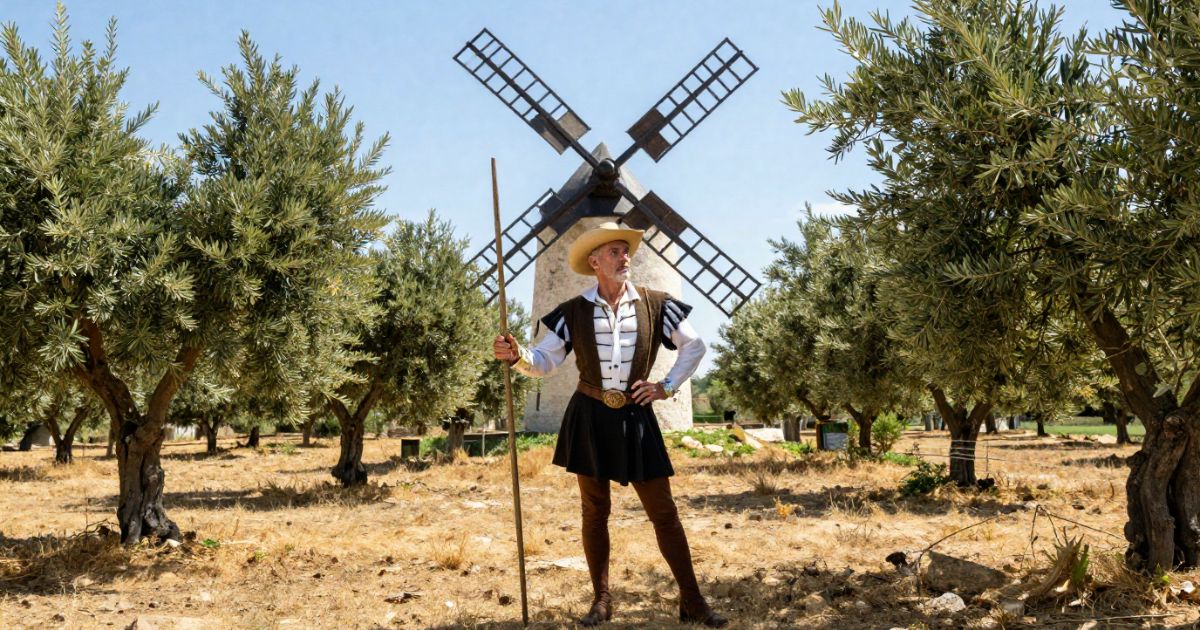
An excerpt from the original text.(complete · 1643 words)
WHICH TREATS OF THE CURIOUS DISCOURSE DON QUIXOTE DELIVERED ON ARMS AND
LETTERS
Continuing his discourse Don Quixote said: “As we began in the
student’s case with poverty and its accompaniments, let us see now if
the soldier is richer, and we shall find that in poverty itself there
is no one poorer; for he is dependent on his miserable pay, which comes
late or never, or else on what he can plunder, seriously imperilling
his life and conscience; and sometimes his nakedness will be so great
that a slashed doublet serves him for uniform and shirt, and in the
depth of winter he has to defend himself against the inclemency of the
weather in the open field with nothing better than the breath of his
mouth, which I need not say, coming from an empty place, must come out
cold, contrary to the laws of nature. To be sure he looks forward to
the approach of night to make up for all these discomforts on the bed
that awaits him, which, unless by some fault of his, never sins by
being over narrow, for he can easily measure out on the ground as he
likes, and roll himself about in it to his heart’s content without any
fear of the sheets slipping away from him. Then, after all this,
suppose the day and hour for taking his degree in his calling to have
come; suppose the day of battle to have arrived, when they invest him
with the doctor’s cap made of lint, to mend some bullet-hole, perhaps,
that has gone through his temples, or left him with a crippled arm or
leg. Or if this does not happen, and merciful Heaven watches over him
and keeps him safe and sound, it may be he will be in the same poverty
he was in before, and he must go through more engagements and more
battles, and come victorious out of all before he betters himself; but
miracles of that sort are seldom seen. For tell me, sirs, if you have
ever reflected upon it, by how much do those who have gained by war
fall short of the number of those who have perished in it? No doubt you
will reply that there can be no comparison, that the dead cannot be
numbered, while the living who have been rewarded may be summed up with
three figures. All which is the reverse in the case of men of letters;
for by skirts, to say nothing of sleeves, they all find means of
support; so that though the soldier has more to endure, his reward is
much less. But against all this it may be urged that it is easier to
reward two thousand soldiers, for the former may be remunerated by
giving them places, which must perforce be conferred upon men of their
calling, while the latter can only be recompensed out of the very
property of the master they serve; but this impossibility only
strengthens my argument.
“Putting this, however, aside, for it is a puzzling question for which
it is difficult to find a solution, let us return to the superiority of
arms over letters, a matter still undecided, so many are the arguments
put forward on each side; for besides those I have mentioned, letters
say that without them arms cannot maintain themselves, for war, too,
has its laws and is governed by them, and laws belong to the domain of
letters and men of letters. To this arms make answer that without them
laws cannot be maintained, for by arms states are defended, kingdoms
preserved, cities protected, roads made safe, seas cleared of pirates;
and, in short, if it were not for them, states, kingdoms, monarchies,
cities, ways by sea and land would be exposed to the violence and
confusion which war brings with it, so long as it lasts and is free to
make use of its privileges and powers. And then it is plain that
whatever costs most is valued and deserves to be valued most. To attain
to eminence in letters costs a man time, watching, hunger, nakedness,
headaches, indigestions, and other things of the sort, some of which I
have already referred to. But for a man to come in the ordinary course
of things to be a good soldier costs him all the student suffers, and
in an incomparably higher degree, for at every step he runs the risk of
losing his life. For what dread of want or poverty that can reach or
harass the student can compare with what the soldier feels, who finds
himself beleaguered in some stronghold mounting guard in some ravelin
or cavalier, knows that the enemy is pushing a mine towards the post
where he is stationed, and cannot under any circumstances retire or fly
from the imminent danger that threatens him? All he can do is to inform
his captain of what is going on so that he may try to remedy it by a
counter-mine, and then stand his ground in fear and expectation of the
moment when he will fly up to the clouds without wings and descend into
the deep against his will. And if this seems a trifling risk, let us
see whether it is equalled or surpassed by the encounter of two galleys
stem to stem, in the midst of the open sea, locked and entangled one
with the other, when the soldier has no more standing room than two
feet of the plank of the spur; and yet, though he sees before him
threatening him as many ministers of death as there are cannon of the
foe pointed at him, not a lance length from his body, and sees too that
with the first heedless step he will go down to visit the profundities
of Neptune’s bosom, still with dauntless heart, urged on by honour that
nerves him, he makes himself a target for all that musketry, and
struggles to cross that narrow path to the enemy’s ship. And what is
still more marvellous, no sooner has one gone down into the depths he
will never rise from till the end of the world, than another takes his
place; and if he too falls into the sea that waits for him like an
enemy, another and another will succeed him without a moment’s pause
between their deaths: courage and daring the greatest that all the
chances of war can show. Happy the blest ages that knew not the dread
fury of those devilish engines of artillery, whose inventor I am
persuaded is in hell receiving the reward of his diabolical invention,
by which he made it easy for a base and cowardly arm to take the life
of a gallant gentleman; and that, when he knows not how or whence, in
the height of the ardour and enthusiasm that fire and animate brave
hearts, there should come some random bullet, discharged perhaps by one
who fled in terror at the flash when he fired off his accursed machine,
which in an instant puts an end to the projects and cuts off the life
of one who deserved to live for ages to come. And thus when I reflect
on this, I am almost tempted to say that in my heart I repent of having
adopted this profession of knight-errant in so detestable an age as we
live in now; for though no peril can make me fear, still it gives me
some uneasiness to think that powder and lead may rob me of the
opportunity of making myself famous and renowned throughout the known
earth by the might of my arm and the edge of my sword. But Heaven’s
will be done; if I succeed in my attempt I shall be all the more
honoured, as I have faced greater dangers than the knights-errant of
yore exposed themselves to.”
All this lengthy discourse Don Quixote delivered while the others
supped, forgetting to raise a morsel to his lips, though Sancho more
than once told him to eat his supper, as he would have time enough
afterwards to say all he wanted. It excited fresh pity in those who had
heard him to see a man of apparently sound sense, and with rational
views on every subject he discussed, so hopelessly wanting in all, when
his wretched unlucky chivalry was in question. The curate told him he
was quite right in all he had said in favour of arms, and that he
himself, though a man of letters and a graduate, was of the same
opinion.
They finished their supper, the cloth was removed, and while the
hostess, her daughter, and Maritornes were getting Don Quixote of La
Mancha’s garret ready, in which it was arranged that the women were to
be quartered by themselves for the night, Don Fernando begged the
captive to tell them the story of his life, for it could not fail to be
strange and interesting, to judge by the hints he had let fall on his
arrival in company with Zoraida. To this the captive replied that he
would very willingly yield to his request, only he feared his tale
would not give them as much pleasure as he wished; nevertheless, not to
be wanting in compliance, he would tell it. The curate and the others
thanked him and added their entreaties, and he finding himself so
pressed said there was no occasion to ask, where a command had such
weight, and added, “If your worships will give me your attention you
will hear a true story which, perhaps, fictitious ones constructed with
ingenious and studied art cannot come up to.” These words made them
settle themselves in their places and preserve a deep silence, and he
seeing them waiting on his words in mute expectation, began thus in a
pleasant quiet voice.
c38e.jpg (18K)
Master this chapter. Complete your experience
Purchase the complete book to access all chapters and support classic literature
As an Amazon Associate, we earn a small commission from qualifying purchases at no additional cost to you.
Available in paperback, hardcover, and e-book formats
Let's Analyse the Pattern
Competence in one area creates overconfidence that spreads to areas where we lack expertise or judgment.
Why This Matters
Connect literature to life
This chapter teaches how expertise in one area can create dangerous overconfidence in unrelated areas.
Practice This Today
This week, notice when your success in one area makes you dismiss feedback in another—that's competence creep in action.
Now let's explore the literary elements.
Key Quotes & Analysis
"In poverty itself there is no one poorer than the soldier; for he is dependent on his miserable pay, which comes late or never"
Context: Explaining why soldiers suffer more than scholars in his comparison of the two professions
This shows Don Quixote's genuine understanding of economic injustice and how society treats those who risk their lives. His insight is completely accurate about military life, making his own romantic view of knighthood even more tragic.
In Today's Words:
Nobody's broker than a soldier - they barely get paid, and when they do, it's always late
"Sometimes his nakedness will be so great that a slashed doublet serves him for uniform and shirt"
Context: Describing how poorly equipped and clothed soldiers often were
Don Quixote paints a vivid picture of military poverty, showing he understands the reality of warfare even as he romanticizes it. The detail reveals his genuine empathy for suffering.
In Today's Words:
Sometimes they're so broke they're wearing rags for a uniform
"The breath of his mouth, which coming from an empty place, must come out cold, contrary to the laws of nature"
Context: Explaining how hungry soldiers try to warm themselves with their own breath
This poetic but practical observation shows Don Quixote's ability to find profound meaning in simple hardships. He combines scientific thinking with genuine compassion for human suffering.
In Today's Words:
When you're starving, even your breath is cold because there's nothing warm inside you
Thematic Threads
Class
In This Chapter
Don Quixote analyzes how society values scholars over soldiers despite soldiers facing greater hardship and risk
Development
Builds on earlier themes about social hierarchy, now examining how different types of service are rewarded
In Your Life:
You might notice how certain jobs get respect while others doing harder work get ignored.
Identity
In This Chapter
Don Quixote's identity as a wise man conflicts with his identity as a deluded knight-errant
Development
Continues exploring how we can hold contradictory self-images simultaneously
In Your Life:
You might be the responsible one at work but the mess in your personal relationships.
Social Expectations
In This Chapter
The speech reveals expectations about who deserves recognition and reward in society
Development
Expands from personal expectations to societal systems of value and recognition
In Your Life:
You might see how society rewards certain contributions while taking others for granted.
Human Relationships
In This Chapter
His companions experience the complex dynamic of admiring someone's wisdom while worrying about their judgment
Development
Shows how relationships navigate the tension between respect and concern
In Your Life:
You might love someone's strengths while being frustrated by their blind spots.
Personal Growth
In This Chapter
Don Quixote demonstrates that insight and delusion can coexist in the same person
Development
Challenges earlier assumptions about growth being linear or consistent across all areas
In Your Life:
You might be growing in some ways while staying stuck in others.
You now have the context. Time to form your own thoughts.
Discussion Questions
- 1
What argument does Don Quixote make about soldiers versus scholars, and how do his companions react to his speech?
analysis • surface - 2
Why can Don Quixote deliver such brilliant insights about real military hardship while simultaneously chasing impossible dreams of knight-errantry?
analysis • medium - 3
Think of someone you know who gives great advice in one area but makes poor decisions in another. What pattern do you notice?
application • medium - 4
How do you recognize when your expertise in one area might be making you overconfident about your judgment in other areas?
application • deep - 5
What does this chapter reveal about the relationship between intelligence, wisdom, and self-awareness?
reflection • deep
Critical Thinking Exercise
Map Your Expertise Blind Spots
Draw three circles on paper. In the first, write an area where you have real expertise or competence. In the second, write an area where you struggle or make poor decisions. In the third, identify any connections between your confidence from area one and your blind spots in area two. Consider how your proven abilities might be creating overconfidence in unrelated areas.
Consider:
- •Notice if you use phrases like 'I know what I'm doing' when people question your choices outside your expertise
- •Look for times when your track record in one area made you dismiss advice about another
- •Consider whether your competence has become a shield against learning in new areas
Journaling Prompt
Write about a time when your expertise in one area led you to ignore good advice in another area. What would you do differently now that you recognize this pattern?
Coming Up Next...
Chapter 59: A Father's Wisdom and War's Price
The mysterious captive begins to share his extraordinary tale of war, captivity, and adventure—a real soldier's story that will contrast sharply with Don Quixote's romantic notions of military glory.