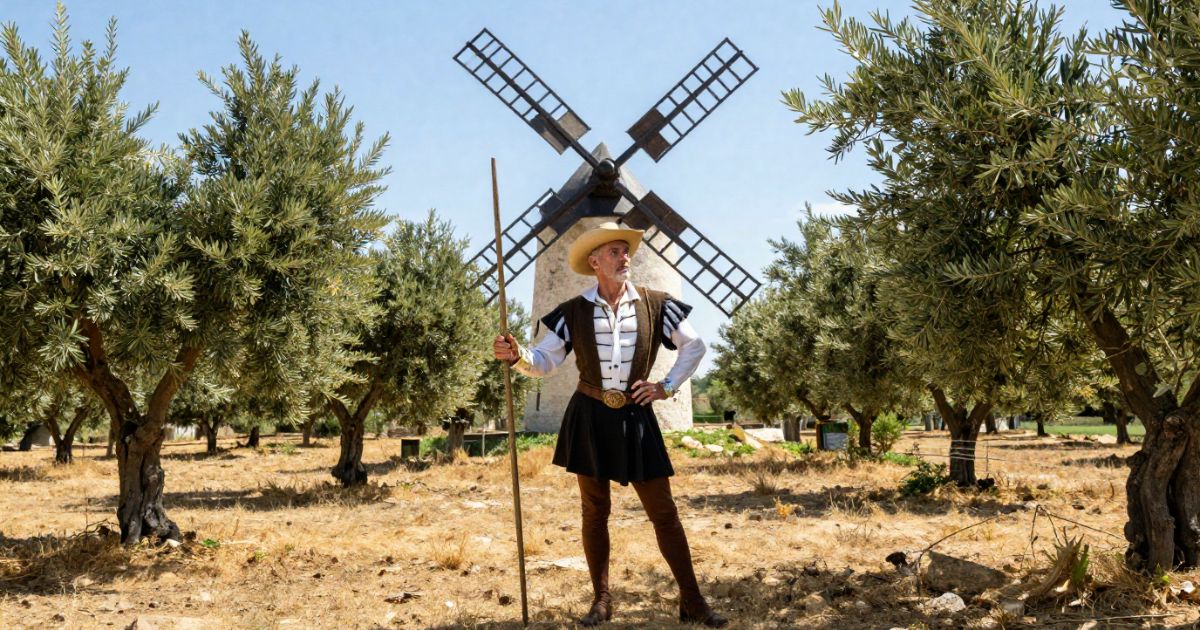
An excerpt from the original text.(complete · 4246 words)
WHICH IS CONTINUED THE STORY OF THE FAMOUS PRINCESS MICOMICONA, WITH
OTHER DROLL ADVENTURES
To all this Sancho listened with no little sorrow at heart to see how
his hopes of dignity were fading away and vanishing in smoke, and how
the fair Princess Micomicona had turned into Dorothea, and the giant
into Don Fernando, while his master was sleeping tranquilly, totally
unconscious of all that had come to pass. Dorothea was unable to
persuade herself that her present happiness was not all a dream;
Cardenio was in a similar state of mind, and Luscinda’s thoughts ran in
the same direction. Don Fernando gave thanks to Heaven for the favour
shown to him and for having been rescued from the intricate labyrinth
in which he had been brought so near the destruction of his good name
and of his soul; and in short everybody in the inn was full of
contentment and satisfaction at the happy issue of such a complicated
and hopeless business. The curate as a sensible man made sound
reflections upon the whole affair, and congratulated each upon his good
fortune; but the one that was in the highest spirits and good humour
was the landlady, because of the promise Cardenio and the curate had
given her to pay for all the losses and damage she had sustained
through Don Quixote’s means. Sancho, as has been already said, was the
only one who was distressed, unhappy, and dejected; and so with a long
face he went in to his master, who had just awoke, and said to him:
“Sir Rueful Countenance, your worship may as well sleep on as much as
you like, without troubling yourself about killing any giant or
restoring her kingdom to the princess; for that is all over and settled
now.”
“I should think it was,” replied Don Quixote, “for I have had the most
prodigious and stupendous battle with the giant that I ever remember
having had all the days of my life; and with one back-stroke—swish!—I
brought his head tumbling to the ground, and so much blood gushed forth
from him that it ran in rivulets over the earth like water.”
“Like red wine, your worship had better say,” replied Sancho; “for I
would have you know, if you don’t know it, that the dead giant is a
hacked wine-skin, and the blood four-and-twenty gallons of red wine
that it had in its belly, and the cut-off head is the bitch that bore
me; and the devil take it all.”
“What art thou talking about, fool?” said Don Quixote; “art thou in thy
senses?”
“Let your worship get up,” said Sancho, “and you will see the nice
business you have made of it, and what we have to pay; and you will see
the queen turned into a private lady called Dorothea, and other things
that will astonish you, if you understand them.”
“I shall not be surprised at anything of the kind,” returned Don
Quixote; “for if thou dost remember the last time we were here I told
thee that everything that happened here was a matter of enchantment,
and it would be no wonder if it were the same now.”
“I could believe all that,” replied Sancho, “if my blanketing was the
same sort of thing also; only it wasn’t, but real and genuine; for I
saw the landlord, who is here to-day, holding one end of the blanket
and jerking me up to the skies very neatly and smartly, and with as
much laughter as strength; and when it comes to be a case of knowing
people, I hold for my part, simple and sinner as I am, that there is no
enchantment about it at all, but a great deal of bruising and bad
luck.”
“Well, well, God will give a remedy,” said Don Quixote; “hand me my
clothes and let me go out, for I want to see these transformations and
things thou speakest of.”
Sancho fetched him his clothes; and while he was dressing, the curate
gave Don Fernando and the others present an account of Don Quixote’s
madness and of the stratagem they had made use of to withdraw him from
that Pena Pobre where he fancied himself stationed because of his
lady’s scorn. He described to them also nearly all the adventures that
Sancho had mentioned, at which they marvelled and laughed not a little,
thinking it, as all did, the strangest form of madness a crazy
intellect could be capable of. But now, the curate said, that the lady
Dorothea’s good fortune prevented her from proceeding with their
purpose, it would be necessary to devise or discover some other way of
getting him home.
Cardenio proposed to carry out the scheme they had begun, and suggested
that Luscinda would act and support Dorothea’s part sufficiently well.
“No,” said Don Fernando, “that must not be, for I want Dorothea to
follow out this idea of hers; and if the worthy gentleman’s village is
not very far off, I shall be happy if I can do anything for his
relief.”
“It is not more than two days’ journey from this,” said the curate.
“Even if it were more,” said Don Fernando, “I would gladly travel so
far for the sake of doing so good a work.”
At this moment Don Quixote came out in full panoply, with Mambrino’s
helmet, all dinted as it was, on his head, his buckler on his arm, and
leaning on his staff or pike. The strange figure he presented filled
Don Fernando and the rest with amazement as they contemplated his lean
yellow face half a league long, his armour of all sorts, and the
solemnity of his deportment. They stood silent waiting to see what he
would say, and he, fixing his eyes on the fair Dorothea, addressed her
with great gravity and composure:
“I am informed, fair lady, by my squire here that your greatness has
been annihilated and your being abolished, since, from a queen and lady
of high degree as you used to be, you have been turned into a private
maiden. If this has been done by the command of the magician king your
father, through fear that I should not afford you the aid you need and
are entitled to, I may tell you he did not know and does not know half
the mass, and was little versed in the annals of chivalry; for, if he
had read and gone through them as attentively and deliberately as I
have, he would have found at every turn that knights of less renown
than mine have accomplished things more difficult: it is no great
matter to kill a whelp of a giant, however arrogant he may be; for it
is not many hours since I myself was engaged with one, and—I will not
speak of it, that they may not say I am lying; time, however, that
reveals all, will tell the tale when we least expect it.”
“You were engaged with a couple of wine-skins, and not a giant,” said
the landlord at this; but Don Fernando told him to hold his tongue and
on no account interrupt Don Quixote, who continued, “I say in
conclusion, high and disinherited lady, that if your father has brought
about this metamorphosis in your person for the reason I have
mentioned, you ought not to attach any importance to it; for there is
no peril on earth through which my sword will not force a way, and with
it, before many days are over, I will bring your enemy’s head to the
ground and place on yours the crown of your kingdom.”
Don Quixote said no more, and waited for the reply of the princess, who
aware of Don Fernando’s determination to carry on the deception until
Don Quixote had been conveyed to his home, with great ease of manner
and gravity made answer, “Whoever told you, valiant Knight of the
Rueful Countenance, that I had undergone any change or transformation
did not tell you the truth, for I am the same as I was yesterday. It is
true that certain strokes of good fortune, that have given me more than
I could have hoped for, have made some alteration in me; but I have not
therefore ceased to be what I was before, or to entertain the same
desire I have had all through of availing myself of the might of your
valiant and invincible arm. And so, señor, let your goodness reinstate
the father that begot me in your good opinion, and be assured that he
was a wise and prudent man, since by his craft he found out such a sure
and easy way of remedying my misfortune; for I believe, señor, that had
it not been for you I should never have lit upon the good fortune I now
possess; and in this I am saying what is perfectly true; as most of
these gentlemen who are present can fully testify. All that remains is
to set out on our journey to-morrow, for to-day we could not make much
way; and for the rest of the happy result I am looking forward to, I
trust to God and the valour of your heart.”
So said the sprightly Dorothea, and on hearing her Don Quixote turned
to Sancho, and said to him, with an angry air, “I declare now, little
Sancho, thou art the greatest little villain in Spain. Say, thief and
vagabond, hast thou not just now told me that this princess had been
turned into a maiden called Dorothea, and that the head which I am
persuaded I cut off from a giant was the bitch that bore thee, and
other nonsense that put me in the greatest perplexity I have ever been
in all my life? I vow” (and here he looked to heaven and ground his
teeth) “I have a mind to play the mischief with thee, in a way that
will teach sense for the future to all lying squires of knights-errant
in the world.”
“Let your worship be calm, señor,” returned Sancho, “for it may well be
that I have been mistaken as to the change of the lady princess
Micomicona; but as to the giant’s head, or at least as to the piercing
of the wine-skins, and the blood being red wine, I make no mistake, as
sure as there is a God; because the wounded skins are there at the head
of your worship’s bed, and the wine has made a lake of the room; if not
you will see when the eggs come to be fried; I mean when his worship
the landlord calls for all the damages: for the rest, I am heartily
glad that her ladyship the queen is as she was, for it concerns me as
much as anyone.”
“I tell thee again, Sancho, thou art a fool,” said Don Quixote;
“forgive me, and that will do.”
“That will do,” said Don Fernando; “let us say no more about it; and as
her ladyship the princess proposes to set out to-morrow because it is
too late to-day, so be it, and we will pass the night in pleasant
conversation, and to-morrow we will all accompany Señor Don Quixote;
for we wish to witness the valiant and unparalleled achievements he is
about to perform in the course of this mighty enterprise which he has
undertaken.”
“It is I who shall wait upon and accompany you,” said Don Quixote; “and
I am much gratified by the favour that is bestowed upon me, and the
good opinion entertained of me, which I shall strive to justify or it
shall cost me my life, or even more, if it can possibly cost me more.”
Many were the compliments and expressions of politeness that passed
between Don Quixote and Don Fernando; but they were brought to an end
by a traveller who at this moment entered the inn, and who seemed from
his attire to be a Christian lately come from the country of the Moors,
for he was dressed in a short-skirted coat of blue cloth with
half-sleeves and without a collar; his breeches were also of blue
cloth, and his cap of the same colour, and he wore yellow buskins and
had a Moorish cutlass slung from a baldric across his breast. Behind
him, mounted upon an ass, there came a woman dressed in Moorish
fashion, with her face veiled and a scarf on her head, and wearing a
little brocaded cap, and a mantle that covered her from her shoulders
to her feet. The man was of a robust and well-proportioned frame, in
age a little over forty, rather swarthy in complexion, with long
moustaches and a full beard, and, in short, his appearance was such
that if he had been well dressed he would have been taken for a person
of quality and good birth. On entering he asked for a room, and when
they told him there was none in the inn he seemed distressed, and
approaching her who by her dress seemed to be a Moor, he took her down
from the saddle in his arms. Luscinda, Dorothea, the landlady, her
daughter and Maritornes, attracted by the strange, and to them entirely
new costume, gathered round her; and Dorothea, who was always kindly,
courteous, and quick-witted, perceiving that both she and the man who
had brought her were annoyed at not finding a room, said to her, “Do
not be put out, señora, by the discomfort and want of luxuries here,
for it is the way of road-side inns to be without them; still, if you
will be pleased to share our lodging with us (pointing to Luscinda)
perhaps you will have found worse accommodation in the course of your
journey.”
To this the veiled lady made no reply; all she did was to rise from her
seat, crossing her hands upon her bosom, bowing her head and bending
her body as a sign that she returned thanks. From her silence they
concluded that she must be a Moor and unable to speak a Christian
tongue.
At this moment the captive came up, having been until now otherwise
engaged, and seeing that they all stood round his companion and that
she made no reply to what they addressed to her, he said, “Ladies, this
damsel hardly understands my language and can speak none but that of
her own country, for which reason she does not and cannot answer what
has been asked of her.”
“Nothing has been asked of her,” returned Luscinda; “she has only been
offered our company for this evening and a share of the quarters we
occupy, where she shall be made as comfortable as the circumstances
allow, with the good-will we are bound to show all strangers that stand
in need of it, especially if it be a woman to whom the service is
rendered.”
“On her part and my own, señora,” replied the captive, “I kiss your
hands, and I esteem highly, as I ought, the favour you have offered,
which, on such an occasion and coming from persons of your appearance,
is, it is plain to see, a very great one.”
“Tell me, señor,” said Dorothea, “is this lady a Christian or a Moor?
for her dress and her silence lead us to imagine that she is what we
could wish she was not.”
“In dress and outwardly,” said he, “she is a Moor, but at heart she is
a thoroughly good Christian, for she has the greatest desire to become
one.”
“Then she has not been baptised?” returned Luscinda.
“There has been no opportunity for that,” replied the captive, “since
she left Algiers, her native country and home; and up to the present
she has not found herself in any such imminent danger of death as to
make it necessary to baptise her before she has been instructed in all
the ceremonies our holy mother Church ordains; but, please God, ere
long she shall be baptised with the solemnity befitting her which is
higher than her dress or mine indicates.”
By these words he excited a desire in all who heard him, to know who
the Moorish lady and the captive were, but no one liked to ask just
then, seeing that it was a fitter moment for helping them to rest
themselves than for questioning them about their lives. Dorothea took
the Moorish lady by the hand and leading her to a seat beside herself,
requested her to remove her veil. She looked at the captive as if to
ask him what they meant and what she was to do. He said to her in
Arabic that they asked her to take off her veil, and thereupon she
removed it and disclosed a countenance so lovely, that to Dorothea she
seemed more beautiful than Luscinda, and to Luscinda more beautiful
than Dorothea, and all the bystanders felt that if any beauty could
compare with theirs it was the Moorish lady’s, and there were even
those who were inclined to give it somewhat the preference. And as it
is the privilege and charm of beauty to win the heart and secure
good-will, all forthwith became eager to show kindness and attention to
the lovely Moor.
Don Fernando asked the captive what her name was, and he replied that
it was Lela Zoraida; but the instant she heard him, she guessed what
the Christian had asked, and said hastily, with some displeasure and
energy, “No, not Zoraida; Maria, Maria!” giving them to understand that
she was called “Maria” and not “Zoraida.” These words, and the touching
earnestness with which she uttered them, drew more than one tear from
some of the listeners, particularly the women, who are by nature
tender-hearted and compassionate. Luscinda embraced her affectionately,
saying, “Yes, yes, Maria, Maria,” to which the Moor replied, “Yes, yes,
Maria; Zoraida macange,” which means “not Zoraida.”
Night was now approaching, and by the orders of those who accompanied
Don Fernando the landlord had taken care and pains to prepare for them
the best supper that was in his power. The hour therefore having
arrived they all took their seats at a long table like a refectory one,
for round or square table there was none in the inn, and the seat of
honour at the head of it, though he was for refusing it, they assigned
to Don Quixote, who desired the lady Micomicona to place herself by his
side, as he was her protector. Luscinda and Zoraida took their places
next her, opposite to them were Don Fernando and Cardenio, and next the
captive and the other gentlemen, and by the side of the ladies, the
curate and the barber. And so they supped in high enjoyment, which was
increased when they observed Don Quixote leave off eating, and, moved
by an impulse like that which made him deliver himself at such length
when he supped with the goatherds, begin to address them:
“Verily, gentlemen, if we reflect upon it, great and marvellous are the
things they see, who make profession of the order of knight-errantry.
Say, what being is there in this world, who entering the gate of this
castle at this moment, and seeing us as we are here, would suppose or
imagine us to be what we are? Who would say that this lady who is
beside me was the great queen that we all know her to be, or that I am
that Knight of the Rueful Countenance, trumpeted far and wide by the
mouth of Fame? Now, there can be no doubt that this art and calling
surpasses all those that mankind has invented, and is the more
deserving of being held in honour in proportion as it is the more
exposed to peril. Away with those who assert that letters have the
preeminence over arms; I will tell them, whosoever they may be, that
they know not what they say. For the reason which such persons commonly
assign, and upon which they chiefly rest, is, that the labours of the
mind are greater than those of the body, and that arms give employment
to the body alone; as if the calling were a porter’s trade, for which
nothing more is required than sturdy strength; or as if, in what we who
profess them call arms, there were not included acts of vigour for the
execution of which high intelligence is requisite; or as if the soul of
the warrior, when he has an army, or the defence of a city under his
care, did not exert itself as much by mind as by body. Nay; see whether
by bodily strength it be possible to learn or divine the intentions of
the enemy, his plans, stratagems, or obstacles, or to ward off
impending mischief; for all these are the work of the mind, and in them
the body has no share whatever. Since, therefore, arms have need of the
mind, as much as letters, let us see now which of the two minds, that
of the man of letters or that of the warrior, has most to do; and this
will be seen by the end and goal that each seeks to attain; for that
purpose is the more estimable which has for its aim the nobler object.
The end and goal of letters—I am not speaking now of divine letters,
the aim of which is to raise and direct the soul to Heaven; for with an
end so infinite no other can be compared—I speak of human letters, the
end of which is to establish distributive justice, give to every man
that which is his, and see and take care that good laws are observed:
an end undoubtedly noble, lofty, and deserving of high praise, but not
such as should be given to that sought by arms, which have for their
end and object peace, the greatest boon that men can desire in this
life. The first good news the world and mankind received was that which
the angels announced on the night that was our day, when they sang in
the air, ‘Glory to God in the highest, and peace on earth to men of
good-will;’ and the salutation which the great Master of heaven and
earth taught his disciples and chosen followers when they entered any
house, was to say, ‘Peace be on this house;’ and many other times he
said to them, ‘My peace I give unto you, my peace I leave you, peace be
with you;’ a jewel and a precious gift given and left by such a hand: a
jewel without which there can be no happiness either on earth or in
heaven. This peace is the true end of war; and war is only another name
for arms. This, then, being admitted, that the end of war is peace, and
that so far it has the advantage of the end of letters, let us turn to
the bodily labours of the man of letters, and those of him who follows
the profession of arms, and see which are the greater.”
Don Quixote delivered his discourse in such a manner and in such
correct language, that for the time being he made it impossible for any
of his hearers to consider him a madman; on the contrary, as they were
mostly gentlemen, to whom arms are an appurtenance by birth, they
listened to him with great pleasure as he continued: “Here, then, I say
is what the student has to undergo; first of all poverty: not that all
are poor, but to put the case as strongly as possible: and when I have
said that he endures poverty, I think nothing more need be said about
his hard fortune, for he who is poor has no share of the good things of
life. This poverty he suffers from in various ways, hunger, or cold, or
nakedness, or all together; but for all that it is not so extreme but
that he gets something to eat, though it may be at somewhat
unseasonable hours and from the leavings of the rich; for the greatest
misery of the student is what they themselves call ‘going out for
soup,’ and there is always some neighbour’s brazier or hearth for them,
which, if it does not warm, at least tempers the cold to them, and
lastly, they sleep comfortably at night under a roof. I will not go
into other particulars, as for example want of shirts, and no
superabundance of shoes, thin and threadbare garments, and gorging
themselves to surfeit in their voracity when good luck has treated them
to a banquet of some sort. By this road that I have described, rough
and hard, stumbling here, falling there, getting up again to fall
again, they reach the rank they desire, and that once attained, we have
seen many who have passed these Syrtes and Scyllas and Charybdises, as
if borne flying on the wings of favouring fortune; we have seen them, I
say, ruling and governing the world from a chair, their hunger turned
into satiety, their cold into comfort, their nakedness into fine
raiment, their sleep on a mat into repose in holland and damask, the
justly earned reward of their virtue; but, contrasted and compared with
what the warrior undergoes, all they have undergone falls far short of
it, as I am now about to show.”
c37e.jpg (13K)
Master this chapter. Complete your experience
Purchase the complete book to access all chapters and support classic literature
As an Amazon Associate, we earn a small commission from qualifying purchases at no additional cost to you.
Available in paperback, hardcover, and e-book formats
Let's Analyse the Pattern
When cherished hopes are revealed as illusions, people either adapt and grow or retreat deeper into fantasy to protect their identity.
Why This Matters
Connect literature to life
This chapter teaches how to recognize when optimism becomes self-destructive denial that hurts the people depending on you.
Practice This Today
This week, notice when you explain away setbacks with increasingly elaborate justifications—that's your signal to pause and ask what adapting would look like instead of retreating.
Now let's explore the literary elements.
Key Quotes & Analysis
"Sancho listened with no little sorrow at heart to see how his hopes of dignity were fading away and vanishing in smoke"
Context: As Sancho realizes the princess was fake and his dreams of governorship are over
This captures the heartbreak of realizing you've been chasing an impossible dream. Sancho's pain is real even though his hopes were based on lies.
In Today's Words:
Sancho felt his heart break watching his big break turn out to be complete BS
"Arms and letters each have their own particular end; that of letters is to establish and give every man his own rights; to understand good laws and cause them to be observed"
Context: During his dinner speech comparing warriors to scholars
Don Quixote argues that while scholars work for justice through law, warriors work for peace through strength. He's making a case for action over theory.
In Today's Words:
Lawyers try to make things fair on paper, but soldiers actually keep the peace in the real world
"The end and goal of war is peace, for war is nothing else but the means to obtain peace"
Context: Continuing his argument about the nobility of the warrior's profession
This reveals Don Quixote's idealistic view that violence can serve noble purposes. He sees himself as fighting for a better world, not just causing chaos.
In Today's Words:
We only fight wars to end wars - the whole point is getting to peace
Thematic Threads
Shattered Dreams
In This Chapter
Sancho's governorship dissolves as the deception unravels, forcing him to confront that his hopes were built on lies
Development
Evolution from earlier naive optimism—now facing the cost of believing in impossible promises
In Your Life:
You might recognize this when a job promotion you counted on goes to someone else, or a relationship you invested in ends suddenly.
Denial vs Acceptance
In This Chapter
Don Quixote insists everything is 'enchantment' when confronted with evidence, while others adapt to revealed truths
Development
Deepening of Don Quixote's pattern of rejecting reality when it conflicts with his worldview
In Your Life:
You see this when you keep making excuses for someone's behavior instead of accepting they've shown you who they are.
Protective Deception
In This Chapter
The group decides to continue the charade to get Don Quixote home safely, showing how lies can serve kindness
Development
Growing complexity around truth and deception—not all lies are malicious
In Your Life:
You might face this when deciding whether to tell a harsh truth to someone who isn't ready to handle it.
Class and Worth
In This Chapter
Don Quixote argues that warriors seeking peace are nobler than scholars seeking justice
Development
Continued exploration of how different types of work and contribution are valued in society
In Your Life:
You might feel this tension when your hands-on work experience isn't valued as much as someone's formal education.
New Beginnings
In This Chapter
Mysterious travelers arrive with their own stories of transformation—Zoraida becoming Maria, starting fresh
Development
Introduction of themes around reinvention and the possibility of new identities
In Your Life:
You might recognize this when you're ready to leave behind an old version of yourself and start over somewhere new.
You now have the context. Time to form your own thoughts.
Discussion Questions
- 1
What happens to Sancho's dreams of becoming a governor when the truth comes out about Princess Micomicona and the giant?
analysis • surface - 2
Why does Don Quixote insist everything is 'enchantment' when faced with clear evidence he destroyed wine-skins, not fought a giant?
analysis • medium - 3
Where do you see this same pattern today—people choosing fantasy over painful reality when their dreams fall apart?
application • medium - 4
When you've had to face a hard truth that threatened something important to you, what helped you adapt rather than retreat into denial?
application • deep - 5
What does the contrast between Sancho's disappointment and Don Quixote's denial teach us about different ways people handle shattered illusions?
reflection • deep
Critical Thinking Exercise
Map Your Response to Shattered Dreams
Think of a time when something you really wanted or believed in turned out to be false or impossible. Write down what your 'Don Quixote response' would look like (denial, blame, fantasy) versus your 'Sancho response' (disappointment but acceptance). Then identify which path you actually took and what the results were.
Consider:
- •Notice how your pride or fear might pull you toward the denial path
- •Consider what you gained or lost by the choice you made
- •Think about what support or time you needed to process the disappointment healthily
Journaling Prompt
Write about a current situation where you might be choosing comfortable illusion over difficult truth. What would adapting look like, and what's holding you back from taking that path?
Coming Up Next...
Chapter 58: The Soldier's Burden and Glory
Don Quixote's passionate defense of the warrior's life continues as he details the hardships soldiers endure. But will his philosophical musings be interrupted by the mysterious story of the captive and the beautiful Moorish woman who chose love over everything she knew?