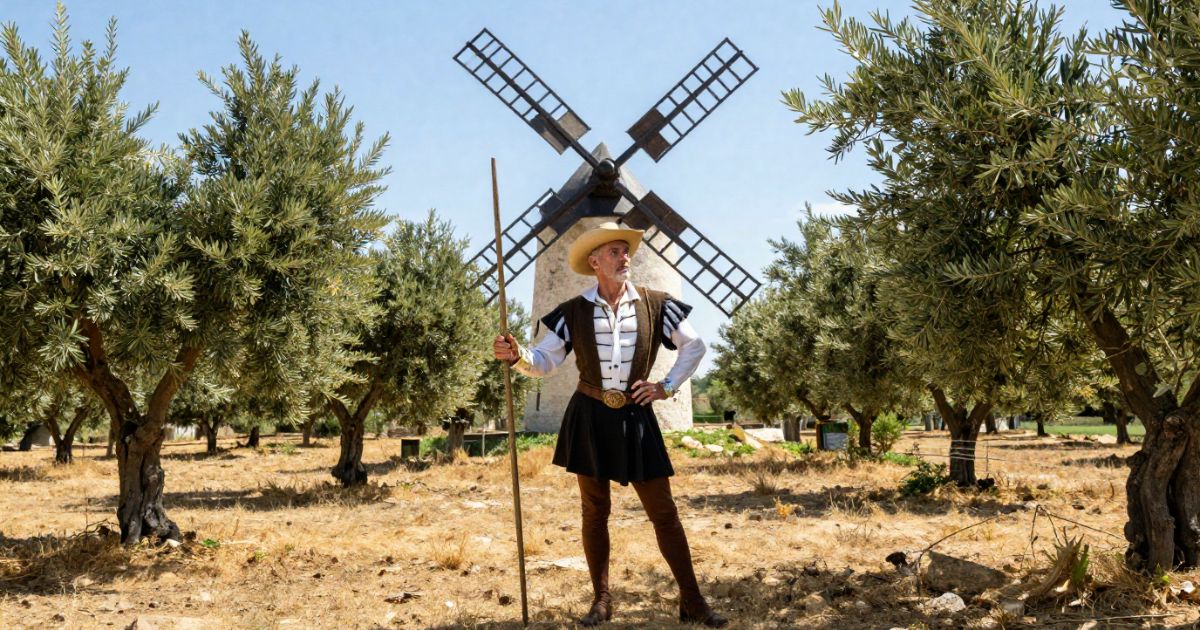
An excerpt from the original text.(complete · 3895 words)
WHICH TREATS OF MORE CURIOUS INCIDENTS THAT OCCURRED AT THE INN
Just at that instant the landlord, who was standing at the gate of the
inn, exclaimed, “Here comes a fine troop of guests; if they stop here
we may say gaudeamus.”
“What are they?” said Cardenio.
“Four men,” said the landlord, “riding à la jineta, with lances and
bucklers, and all with black veils, and with them there is a woman in
white on a side-saddle, whose face is also veiled, and two attendants
on foot.”
“Are they very near?” said the curate.
“So near,” answered the landlord, “that here they come.”
Hearing this Dorothea covered her face, and Cardenio retreated into Don
Quixote’s room, and they hardly had time to do so before the whole
party the host had described entered the inn, and the four that were on
horseback, who were of highbred appearance and bearing, dismounted, and
came forward to take down the woman who rode on the side-saddle, and
one of them taking her in his arms placed her in a chair that stood at
the entrance of the room where Cardenio had hidden himself. All this
time neither she nor they had removed their veils or spoken a word,
only on sitting down on the chair the woman gave a deep sigh and let
her arms fall like one that was ill and weak. The attendants on foot
then led the horses away to the stable. Observing this the curate,
curious to know who these people in such a dress and preserving such
silence were, went to where the servants were standing and put the
question to one of them, who answered him.
“Faith, sir, I cannot tell you who they are, I only know they seem to
be people of distinction, particularly he who advanced to take the lady
you saw in his arms; and I say so because all the rest show him
respect, and nothing is done except what he directs and orders.”
“And the lady, who is she?” asked the curate.
“That I cannot tell you either,” said the servant, “for I have not seen
her face all the way: I have indeed heard her sigh many times and utter
such groans that she seems to be giving up the ghost every time; but it
is no wonder if we do not know more than we have told you, as my
comrade and I have only been in their company two days, for having met
us on the road they begged and persuaded us to accompany them to
Andalusia, promising to pay us well.”
“And have you heard any of them called by his name?” asked the curate.
“No, indeed,” replied the servant; “they all preserve a marvellous
silence on the road, for not a sound is to be heard among them except
the poor lady’s sighs and sobs, which make us pity her; and we feel
sure that wherever it is she is going, it is against her will, and as
far as one can judge from her dress she is a nun or, what is more
likely, about to become one; and perhaps it is because taking the vows
is not of her own free will, that she is so unhappy as she seems to
be.”
“That may well be,” said the curate, and leaving them he returned to
where Dorothea was, who, hearing the veiled lady sigh, moved by natural
compassion drew near to her and said, “What are you suffering from,
señora? If it be anything that women are accustomed and know how to
relieve, I offer you my services with all my heart.”
To this the unhappy lady made no reply; and though Dorothea repeated
her offers more earnestly she still kept silence, until the gentleman
with the veil, who, the servant said, was obeyed by the rest,
approached and said to Dorothea, “Do not give yourself the trouble,
señora, of making any offers to that woman, for it is her way to give
no thanks for anything that is done for her; and do not try to make her
answer unless you want to hear some lie from her lips.”
“I have never told a lie,” was the immediate reply of her who had been
silent until now; “on the contrary, it is because I am so truthful and
so ignorant of lying devices that I am now in this miserable condition;
and this I call you yourself to witness, for it is my unstained truth
that has made you false and a liar.”
Cardenio heard these words clearly and distinctly, being quite close to
the speaker, for there was only the door of Don Quixote’s room between
them, and the instant he did so, uttering a loud exclamation he cried,
“Good God! what is this I hear? What voice is this that has reached my
ears?” Startled at the voice the lady turned her head; and not seeing
the speaker she stood up and attempted to enter the room; observing
which the gentleman held her back, preventing her from moving a step.
In her agitation and sudden movement the silk with which she had
covered her face fell off and disclosed a countenance of incomparable
and marvellous beauty, but pale and terrified; for she kept turning her
eyes, everywhere she could direct her gaze, with an eagerness that made
her look as if she had lost her senses, and so marked that it excited
the pity of Dorothea and all who beheld her, though they knew not what
caused it. The gentleman grasped her firmly by the shoulders, and being
so fully occupied with holding her back, he was unable to put a hand to
his veil which was falling off, as it did at length entirely, and
Dorothea, who was holding the lady in her arms, raising her eyes saw
that he who likewise held her was her husband, Don Fernando. The
instant she recognised him, with a prolonged plaintive cry drawn from
the depths of her heart, she fell backwards fainting, and but for the
barber being close by to catch her in his arms, she would have fallen
completely to the ground. The curate at once hastened to uncover her
face and throw water on it, and as he did so Don Fernando, for he it
was who held the other in his arms, recognised her and stood as if
death-stricken by the sight; not, however, relaxing his grasp of
Luscinda, for it was she that was struggling to release herself from
his hold, having recognised Cardenio by his voice, as he had recognised
her. Cardenio also heard Dorothea’s cry as she fell fainting, and
imagining that it came from his Luscinda burst forth in terror from the
room, and the first thing he saw was Don Fernando with Luscinda in his
arms. Don Fernando, too, knew Cardenio at once; and all three,
Luscinda, Cardenio, and Dorothea, stood in silent amazement scarcely
knowing what had happened to them.
They gazed at one another without speaking, Dorothea at Don Fernando,
Don Fernando at Cardenio, Cardenio at Luscinda, and Luscinda at
Cardenio. The first to break silence was Luscinda, who thus addressed
Don Fernando: “Leave me, Señor Don Fernando, for the sake of what you
owe to yourself; if no other reason will induce you, leave me to cling
to the wall of which I am the ivy, to the support from which neither
your importunities, nor your threats, nor your promises, nor your gifts
have been able to detach me. See how Heaven, by ways strange and hidden
from our sight, has brought me face to face with my true husband; and
well you know by dear-bought experience that death alone will be able
to efface him from my memory. May this plain declaration, then, lead
you, as you can do nothing else, to turn your love into rage, your
affection into resentment, and so to take my life; for if I yield it up
in the presence of my beloved husband I count it well bestowed; it may
be by my death he will be convinced that I kept my faith to him to the
last moment of life.”
Meanwhile Dorothea had come to herself, and had heard Luscinda’s words,
by means of which she divined who she was; but seeing that Don Fernando
did not yet release her or reply to her, summoning up her resolution as
well as she could she rose and knelt at his feet, and with a flood of
bright and touching tears addressed him thus:
“If, my lord, the beams of that sun that thou holdest eclipsed in thine
arms did not dazzle and rob thine eyes of sight thou wouldst have seen
by this time that she who kneels at thy feet is, so long as thou wilt
have it so, the unhappy and unfortunate Dorothea. I am that lowly
peasant girl whom thou in thy goodness or for thy pleasure wouldst
raise high enough to call herself thine; I am she who in the seclusion
of innocence led a contented life until at the voice of thy
importunity, and thy true and tender passion, as it seemed, she opened
the gates of her modesty and surrendered to thee the keys of her
liberty; a gift received by thee but thanklessly, as is clearly shown
by my forced retreat to the place where thou dost find me, and by thy
appearance under the circumstances in which I see thee. Nevertheless, I
would not have thee suppose that I have come here driven by my shame;
it is only grief and sorrow at seeing myself forgotten by thee that
have led me. It was thy will to make me thine, and thou didst so follow
thy will, that now, even though thou repentest, thou canst not help
being mine. Bethink thee, my lord, the unsurpassable affection I bear
thee may compensate for the beauty and noble birth for which thou
wouldst desert me. Thou canst not be the fair Luscinda’s because thou
art mine, nor can she be thine because she is Cardenio’s; and it will
be easier, remember, to bend thy will to love one who adores thee, than
to lead one to love thee who abhors thee now. Thou didst address
thyself to my simplicity, thou didst lay siege to my virtue, thou wert
not ignorant of my station, well dost thou know how I yielded wholly to
thy will; there is no ground or reason for thee to plead deception, and
if it be so, as it is, and if thou art a Christian as thou art a
gentleman, why dost thou by such subterfuges put off making me as happy
at last as thou didst at first? And if thou wilt not have me for what I
am, thy true and lawful wife, at least take and accept me as thy slave,
for so long as I am thine I will count myself happy and fortunate. Do
not by deserting me let my shame become the talk of the gossips in the
streets; make not the old age of my parents miserable; for the loyal
services they as faithful vassals have ever rendered thine are not
deserving of such a return; and if thou thinkest it will debase thy
blood to mingle it with mine, reflect that there is little or no
nobility in the world that has not travelled the same road, and that in
illustrious lineages it is not the woman’s blood that is of account;
and, moreover, that true nobility consists in virtue, and if thou art
wanting in that, refusing me what in justice thou owest me, then even I
have higher claims to nobility than thine. To make an end, señor, these
are my last words to thee: whether thou wilt, or wilt not, I am thy
wife; witness thy words, which must not and ought not to be false, if
thou dost pride thyself on that for want of which thou scornest me;
witness the pledge which thou didst give me, and witness Heaven, which
thou thyself didst call to witness the promise thou hadst made me; and
if all this fail, thy own conscience will not fail to lift up its
silent voice in the midst of all thy gaiety, and vindicate the truth of
what I say and mar thy highest pleasure and enjoyment.”
All this and more the injured Dorothea delivered with such earnest
feeling and such tears that all present, even those who came with Don
Fernando, were constrained to join her in them. Don Fernando listened
to her without replying, until, ceasing to speak, she gave way to such
sobs and sighs that it must have been a heart of brass that was not
softened by the sight of so great sorrow. Luscinda stood regarding her
with no less compassion for her sufferings than admiration for her
intelligence and beauty, and would have gone to her to say some words
of comfort to her, but was prevented by Don Fernando’s grasp which held
her fast. He, overwhelmed with confusion and astonishment, after
regarding Dorothea for some moments with a fixed gaze, opened his arms,
and, releasing Luscinda, exclaimed:
“Thou hast conquered, fair Dorothea, thou hast conquered, for it is
impossible to have the heart to deny the united force of so many
truths.”
Luscinda in her feebleness was on the point of falling to the ground
when Don Fernando released her, but Cardenio, who stood near, having
retreated behind Don Fernando to escape recognition, casting fear aside
and regardless of what might happen, ran forward to support her, and
said as he clasped her in his arms, “If Heaven in its compassion is
willing to let thee rest at last, mistress of my heart, true, constant,
and fair, nowhere canst thou rest more safely than in these arms that
now receive thee, and received thee before when fortune permitted me to
call thee mine.”
At these words Luscinda looked up at Cardenio, at first beginning to
recognise him by his voice and then satisfying herself by her eyes that
it was he, and hardly knowing what she did, and heedless of all
considerations of decorum, she flung her arms around his neck and
pressing her face close to his, said, “Yes, my dear lord, you are the
true master of this your slave, even though adverse fate interpose
again, and fresh dangers threaten this life that hangs on yours.”
A strange sight was this for Don Fernando and those that stood around,
filled with surprise at an incident so unlooked for. Dorothea fancied
that Don Fernando changed colour and looked as though he meant to take
vengeance on Cardenio, for she observed him put his hand to his sword;
and the instant the idea struck her, with wonderful quickness she
clasped him round the knees, and kissing them and holding him so as to
prevent his moving, she said, while her tears continued to flow, “What
is it thou wouldst do, my only refuge, in this unforeseen event? Thou
hast thy wife at thy feet, and she whom thou wouldst have for thy wife
is in the arms of her husband: reflect whether it will be right for
thee, whether it will be possible for thee to undo what Heaven has
done, or whether it will be becoming in thee to seek to raise her to be
thy mate who in spite of every obstacle, and strong in her truth and
constancy, is before thine eyes, bathing with the tears of love the
face and bosom of her lawful husband. For God’s sake I entreat of thee,
for thine own I implore thee, let not this open manifestation rouse thy
anger; but rather so calm it as to allow these two lovers to live in
peace and quiet without any interference from thee so long as Heaven
permits them; and in so doing thou wilt prove the generosity of thy
lofty noble spirit, and the world shall see that with thee reason has
more influence than passion.”
All the time Dorothea was speaking, Cardenio, though he held Luscinda
in his arms, never took his eyes off Don Fernando, determined, if he
saw him make any hostile movement, to try and defend himself and resist
as best he could all who might assail him, though it should cost him
his life. But now Don Fernando’s friends, as well as the curate and the
barber, who had been present all the while, not forgetting the worthy
Sancho Panza, ran forward and gathered round Don Fernando, entreating
him to have regard for the tears of Dorothea, and not suffer her
reasonable hopes to be disappointed, since, as they firmly believed,
what she said was but the truth; and bidding him observe that it was
not, as it might seem, by accident, but by a special disposition of
Providence that they had all met in a place where no one could have
expected a meeting. And the curate bade him remember that only death
could part Luscinda from Cardenio; that even if some sword were to
separate them they would think their death most happy; and that in a
case that admitted of no remedy his wisest course was, by conquering
and putting a constraint upon himself, to show a generous mind, and of
his own accord suffer these two to enjoy the happiness Heaven had
granted them. He bade him, too, turn his eyes upon the beauty of
Dorothea and he would see that few if any could equal much less excel
her; while to that beauty should be added her modesty and the
surpassing love she bore him. But besides all this, he reminded him
that if he prided himself on being a gentleman and a Christian, he
could not do otherwise than keep his plighted word; and that in doing
so he would obey God and meet the approval of all sensible people, who
know and recognised it to be the privilege of beauty, even in one of
humble birth, provided virtue accompany it, to be able to raise itself
to the level of any rank, without any slur upon him who places it upon
an equality with himself; and furthermore that when the potent sway of
passion asserts itself, so long as there be no mixture of sin in it, he
is not to be blamed who gives way to it.
To be brief, they added to these such other forcible arguments that Don
Fernando’s manly heart, being after all nourished by noble blood, was
touched, and yielded to the truth which, even had he wished it, he
could not gainsay; and he showed his submission, and acceptance of the
good advice that had been offered to him, by stooping down and
embracing Dorothea, saying to her, “Rise, dear lady, it is not right
that what I hold in my heart should be kneeling at my feet; and if
until now I have shown no sign of what I own, it may have been by
Heaven’s decree in order that, seeing the constancy with which you love
me, I may learn to value you as you deserve. What I entreat of you is
that you reproach me not with my transgression and grievous
wrong-doing; for the same cause and force that drove me to make you
mine impelled me to struggle against being yours; and to prove this,
turn and look at the eyes of the now happy Luscinda, and you will see
in them an excuse for all my errors: and as she has found and gained
the object of her desires, and I have found in you what satisfies all
my wishes, may she live in peace and contentment as many happy years
with her Cardenio, as on my knees I pray Heaven to allow me to live
with my Dorothea;” and with these words he once more embraced her and
pressed his face to hers with so much tenderness that he had to take
great heed to keep his tears from completing the proof of his love and
repentance in the sight of all. Not so Luscinda, and Cardenio, and
almost all the others, for they shed so many tears, some in their own
happiness, some at that of the others, that one would have supposed a
heavy calamity had fallen upon them all. Even Sancho Panza was weeping;
though afterwards he said he only wept because he saw that Dorothea was
not as he fancied the queen Micomicona, of whom he expected such great
favours. Their wonder as well as their weeping lasted some time, and
then Cardenio and Luscinda went and fell on their knees before Don
Fernando, returning him thanks for the favour he had rendered them in
language so grateful that he knew not how to answer them, and raising
them up embraced them with every mark of affection and courtesy.
He then asked Dorothea how she had managed to reach a place so far
removed from her own home, and she in a few fitting words told all that
she had previously related to Cardenio, with which Don Fernando and his
companions were so delighted that they wished the story had been
longer; so charmingly did Dorothea describe her misadventures. When she
had finished Don Fernando recounted what had befallen him in the city
after he had found in Luscinda’s bosom the paper in which she declared
that she was Cardenio’s wife, and never could be his. He said he meant
to kill her, and would have done so had he not been prevented by her
parents, and that he quitted the house full of rage and shame, and
resolved to avenge himself when a more convenient opportunity should
offer. The next day he learned that Luscinda had disappeared from her
father’s house, and that no one could tell whither she had gone.
Finally, at the end of some months he ascertained that she was in a
convent and meant to remain there all the rest of her life, if she were
not to share it with Cardenio; and as soon as he had learned this,
taking these three gentlemen as his companions, he arrived at the place
where she was, but avoided speaking to her, fearing that if it were
known he was there stricter precautions would be taken in the convent;
and watching a time when the porter’s lodge was open he left two to
guard the gate, and he and the other entered the convent in quest of
Luscinda, whom they found in the cloisters in conversation with one of
the nuns, and carrying her off without giving her time to resist, they
reached a place with her where they provided themselves with what they
required for taking her away; all which they were able to do in
complete safety, as the convent was in the country at a considerable
distance from the city. He added that when Luscinda found herself in
his power she lost all consciousness, and after returning to herself
did nothing but weep and sigh without speaking a word; and thus in
silence and tears they reached that inn, which for him was reaching
heaven where all the mischances of earth are over and at an end.
c36e.jpg (36K)
Master this chapter. Complete your experience
Purchase the complete book to access all chapters and support classic literature
As an Amazon Associate, we earn a small commission from qualifying purchases at no additional cost to you.
Available in paperback, hardcover, and e-book formats
Let's Analyse the Pattern
Avoiding difficult conversations compounds problems exponentially, while facing truth directly creates manageable solutions.
Why This Matters
Connect literature to life
This chapter teaches how to distinguish between genuine accountability and strategic reconciliation that serves the apologizer's interests more than justice.
Practice This Today
This week, notice when someone's apology or offer to 'make things right' coincides suspiciously with their need for something from you - timing reveals true motivation.
Now let's explore the literary elements.
Key Quotes & Analysis
"I am your wife, my lord, whether you like it or not"
Context: When she reveals herself to Don Fernando and asserts her legal claim on him
This shows Dorothea's strength and legal knowledge. She's not begging or pleading - she's stating facts about their binding marriage contract and refusing to let him pretend it didn't happen.
In Today's Words:
We're married, and you can't just pretend we're not because it's inconvenient for you now.
"You cannot be beautiful Luscinda's, because you are mine, nor can she be yours because she is Cardenio's"
Context: Confronting Don Fernando about trying to possess someone who loves another
Dorothea points out the impossibility of forcing love and the futility of trying to build happiness on others' misery. She appeals to both logic and morality.
In Today's Words:
You can't force someone to love you, and you can't steal someone else's relationship and expect it to work.
"Consider that you cannot satisfy the appetite of your desires without committing sin"
Context: Appealing to Don Fernando's religious conscience about his behavior
She frames his actions in moral terms that he cannot ignore as a Christian nobleman. This hits him where his social identity and religious training demand he respond.
In Today's Words:
What you're doing is wrong, and deep down you know it.
Thematic Threads
Truth
In This Chapter
Dorothea's direct confrontation with Don Fernando breaks through months of deception and forces honest reckoning
Development
Evolved from earlier themes of hidden identities to the power of speaking truth to power
In Your Life:
You might recognize this when you finally have that conversation you've been avoiding for months.
Honor
In This Chapter
Don Fernando must choose between what he wants and what he promised, ultimately choosing integrity over impulse
Development
Builds on earlier explorations of chivalric ideals to show honor as keeping commitments despite changed feelings
In Your Life:
You see this when you have to decide whether to honor a promise that no longer serves your interests.
Power
In This Chapter
Dorothea challenges Don Fernando's abuse of his social position, refusing to accept that rank excuses broken promises
Development
Continues the book's examination of how power corrupts, but shows it can be challenged through moral courage
In Your Life:
You encounter this when someone with more authority tries to escape consequences you would face.
Identity
In This Chapter
All disguises are dropped as characters must face who they really are and what they've done
Development
Culminates the book's exploration of assumed identities by forcing authentic self-revelation
In Your Life:
You experience this when circumstances force you to drop pretenses and show your true character.
Consequences
In This Chapter
Don Fernando learns that running from problems only makes them worse, while facing them creates resolution
Development
Developed from earlier episodes showing how avoiding responsibility multiplies difficulties
In Your Life:
You see this when procrastination on a difficult task makes it exponentially harder to complete.
You now have the context. Time to form your own thoughts.
Discussion Questions
- 1
What caused the dramatic revelation at the inn when the veiled travelers arrived?
analysis • surface - 2
Why did Don Fernando's attempts to avoid his commitment to Dorothea make his situation worse rather than better?
analysis • medium - 3
Where do you see people in your life or community avoiding difficult conversations that need to happen?
application • medium - 4
How would you approach someone who owes you a difficult conversation but keeps avoiding it?
application • deep - 5
What does Dorothea's approach to confronting Don Fernando teach us about speaking truth to power?
reflection • deep
Critical Thinking Exercise
Map Your Avoidance Pattern
Think of a difficult conversation you've been avoiding - at work, with family, or in your personal life. Write down what you're avoiding, why you're avoiding it, and what complications this avoidance has already created. Then outline what a direct, honest approach might look like, using Dorothea's method of stating facts rather than making accusations.
Consider:
- •Focus on what needs to happen now, not punishment for past mistakes
- •Consider how the other person might be trapped by the situation too
- •Think about what timeline would prevent further complications
Journaling Prompt
Write about a time when you finally had a difficult conversation you'd been avoiding. What happened? How did the reality compare to what you'd feared would happen?
Coming Up Next...
Chapter 57: Reality Checks and New Arrivals
With the romantic entanglements finally resolved, attention turns back to the slumbering Don Quixote and poor Sancho, whose dreams of governing an island have just evaporated along with Princess Micomicona's true identity. Reality is about to collide with fantasy once again.