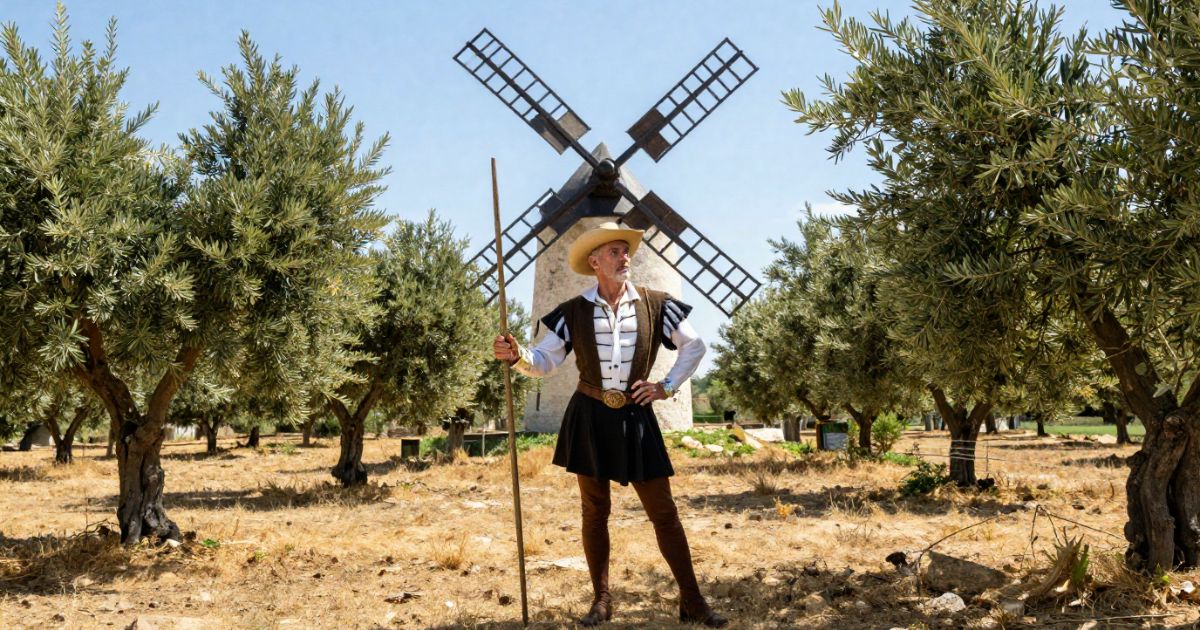
An excerpt from the original text.(complete · 3599 words)
WHICH TREATS OF THE HEROIC AND PRODIGIOUS BATTLE DON QUIXOTE HAD WITH
CERTAIN SKINS OF RED WINE, AND BRINGS THE NOVEL OF “THE ILL-ADVISED
CURIOSITY” TO A CLOSE
There remained but little more of the novel to be read, when Sancho
Panza burst forth in wild excitement from the garret where Don Quixote
was lying, shouting, “Run, sirs! quick; and help my master, who is in
the thick of the toughest and stiffest battle I ever laid eyes on. By
the living God he has given the giant, the enemy of my lady the
Princess Micomicona, such a slash that he has sliced his head clean off
as if it were a turnip.”
“What are you talking about, brother?” said the curate, pausing as he
was about to read the remainder of the novel. “Are you in your senses,
Sancho? How the devil can it be as you say, when the giant is two
thousand leagues away?”
Here they heard a loud noise in the chamber, and Don Quixote shouting
out, “Stand, thief, brigand, villain; now I have got thee, and thy
scimitar shall not avail thee!” And then it seemed as though he were
slashing vigorously at the wall.
“Don’t stop to listen,” said Sancho, “but go in and part them or help
my master: though there is no need of that now, for no doubt the giant
is dead by this time and giving account to God of his past wicked life;
for I saw the blood flowing on the ground, and the head cut off and
fallen on one side, and it is as big as a large wine-skin.”
“May I die,” said the landlord at this, “if Don Quixote or Don Devil
has not been slashing some of the skins of red wine that stand full at
his bed’s head, and the spilt wine must be what this good fellow takes
for blood;” and so saying he went into the room and the rest after him,
and there they found Don Quixote in the strangest costume in the world.
He was in his shirt, which was not long enough in front to cover his
thighs completely and was six fingers shorter behind; his legs were
very long and lean, covered with hair, and anything but clean; on his
head he had a little greasy red cap that belonged to the host, round
his left arm he had rolled the blanket of the bed, to which Sancho, for
reasons best known to himself, owed a grudge, and in his right hand he
held his unsheathed sword, with which he was slashing about on all
sides, uttering exclamations as if he were actually fighting some
giant: and the best of it was his eyes were not open, for he was fast
asleep, and dreaming that he was doing battle with the giant. For his
imagination was so wrought upon by the adventure he was going to
accomplish, that it made him dream he had already reached the kingdom
of Micomicon, and was engaged in combat with his enemy; and believing
he was laying on the giant, he had given so many sword cuts to the
skins that the whole room was full of wine. On seeing this the landlord
was so enraged that he fell on Don Quixote, and with his clenched fist
began to pummel him in such a way, that if Cardenio and the curate had
not dragged him off, he would have brought the war of the giant to an
end. But in spite of all the poor gentleman never woke until the barber
brought a great pot of cold water from the well and flung it with one
dash all over his body, on which Don Quixote woke up, but not so
completely as to understand what was the matter. Dorothea, seeing how
short and slight his attire was, would not go in to witness the battle
between her champion and her opponent. As for Sancho, he went searching
all over the floor for the head of the giant, and not finding it he
said, “I see now that it’s all enchantment in this house; for the last
time, on this very spot where I am now, I got ever so many thumps
without knowing who gave them to me, or being able to see anybody; and
now this head is not to be seen anywhere about, though I saw it cut off
with my own eyes and the blood running from the body as if from a
fountain.”
“What blood and fountains are you talking about, enemy of God and his
saints?” said the landlord. “Don’t you see, you thief, that the blood
and the fountain are only these skins here that have been stabbed and
the red wine swimming all over the room?—and I wish I saw the soul of
him that stabbed them swimming in hell.”
“I know nothing about that,” said Sancho; “all I know is it will be my
bad luck that through not finding this head my county will melt away
like salt in water;”—for Sancho awake was worse than his master asleep,
so much had his master’s promises addled his wits.
The landlord was beside himself at the coolness of the squire and the
mischievous doings of the master, and swore it should not be like the
last time when they went without paying; and that their privileges of
chivalry should not hold good this time to let one or other of them off
without paying, even to the cost of the plugs that would have to be put
to the damaged wine-skins. The curate was holding Don Quixote’s hands,
who, fancying he had now ended the adventure and was in the presence of
the Princess Micomicona, knelt before the curate and said, “Exalted and
beauteous lady, your highness may live from this day forth fearless of
any harm this base being could do you; and I too from this day forth am
released from the promise I gave you, since by the help of God on high
and by the favour of her by whom I live and breathe, I have fulfilled
it so successfully.”
“Did not I say so?” said Sancho on hearing this. “You see I wasn’t
drunk; there you see my master has already salted the giant; there’s no
doubt about the bulls; my county is all right!”
Who could have helped laughing at the absurdities of the pair, master
and man? And laugh they did, all except the landlord, who cursed
himself; but at length the barber, Cardenio, and the curate contrived
with no small trouble to get Don Quixote on the bed, and he fell asleep
with every appearance of excessive weariness. They left him to sleep,
and came out to the gate of the inn to console Sancho Panza on not
having found the head of the giant; but much more work had they to
appease the landlord, who was furious at the sudden death of his
wine-skins; and said the landlady half scolding, half crying, “At an
evil moment and in an unlucky hour he came into my house, this
knight-errant—would that I had never set eyes on him, for dear he has
cost me; the last time he went off with the overnight score against him
for supper, bed, straw, and barley, for himself and his squire and a
hack and an ass, saying he was a knight adventurer—God send unlucky
adventures to him and all the adventurers in the world—and therefore
not bound to pay anything, for it was so settled by the knight-errantry
tariff: and then, all because of him, came the other gentleman and
carried off my tail, and gives it back more than two cuartillos the
worse, all stripped of its hair, so that it is no use for my husband’s
purpose; and then, for a finishing touch to all, to burst my wine-skins
and spill my wine! I wish I saw his own blood spilt! But let him not
deceive himself, for, by the bones of my father and the shade of my
mother, they shall pay me down every quarto; or my name is not what it
is, and I am not my father’s daughter.” All this and more to the same
effect the landlady delivered with great irritation, and her good maid
Maritornes backed her up, while the daughter held her peace and smiled
from time to time. The curate smoothed matters by promising to make
good all losses to the best of his power, not only as regarded the
wine-skins but also the wine, and above all the depreciation of the
tail which they set such store by. Dorothea comforted Sancho, telling
him that she pledged herself, as soon as it should appear certain that
his master had decapitated the giant, and she found herself peacefully
established in her kingdom, to bestow upon him the best county there
was in it. With this Sancho consoled himself, and assured the princess
she might rely upon it that he had seen the head of the giant, and more
by token it had a beard that reached to the girdle, and that if it was
not to be seen now it was because everything that happened in that
house went by enchantment, as he himself had proved the last time he
had lodged there. Dorothea said she fully believed it, and that he need
not be uneasy, for all would go well and turn out as he wished. All
therefore being appeased, the curate was anxious to go on with the
novel, as he saw there was but little more left to read. Dorothea and
the others begged him to finish it, and he, as he was willing to please
them, and enjoyed reading it himself, continued the tale in these
words:
The result was, that from the confidence Anselmo felt in Camilla’s
virtue, he lived happy and free from anxiety, and Camilla purposely
looked coldly on Lothario, that Anselmo might suppose her feelings
towards him to be the opposite of what they were; and the better to
support the position, Lothario begged to be excused from coming to the
house, as the displeasure with which Camilla regarded his presence was
plain to be seen. But the befooled Anselmo said he would on no account
allow such a thing, and so in a thousand ways he became the author of
his own dishonour, while he believed he was insuring his happiness.
Meanwhile the satisfaction with which Leonela saw herself empowered to
carry on her amour reached such a height that, regardless of everything
else, she followed her inclinations unrestrainedly, feeling confident
that her mistress would screen her, and even show her how to manage it
safely. At last one night Anselmo heard footsteps in Leonela’s room,
and on trying to enter to see who it was, he found that the door was
held against him, which made him all the more determined to open it;
and exerting his strength he forced it open, and entered the room in
time to see a man leaping through the window into the street. He ran
quickly to seize him or discover who he was, but he was unable to
effect either purpose, for Leonela flung her arms round him crying, “Be
calm, señor; do not give way to passion or follow him who has escaped
from this; he belongs to me, and in fact he is my husband.”
Anselmo would not believe it, but blind with rage drew a dagger and
threatened to stab Leonela, bidding her tell the truth or he would kill
her. She, in her fear, not knowing what she was saying, exclaimed, “Do
not kill me, señor, for I can tell you things more important than any
you can imagine.”
“Tell me then at once or thou diest,” said Anselmo.
“It would be impossible for me now,” said Leonela, “I am so agitated:
leave me till to-morrow, and then you shall hear from me what will fill
you with astonishment; but rest assured that he who leaped through the
window is a young man of this city, who has given me his promise to
become my husband.”
Anselmo was appeased with this, and was content to wait the time she
asked of him, for he never expected to hear anything against Camilla,
so satisfied and sure of her virtue was he; and so he quitted the room,
and left Leonela locked in, telling her she should not come out until
she had told him all she had to make known to him. He went at once to
see Camilla, and tell her, as he did, all that had passed between him
and her handmaid, and the promise she had given him to inform him
matters of serious importance.
There is no need of saying whether Camilla was agitated or not, for so
great was her fear and dismay, that, making sure, as she had good
reason to do, that Leonela would tell Anselmo all she knew of her
faithlessness, she had not the courage to wait and see if her
suspicions were confirmed; and that same night, as soon as she thought
that Anselmo was asleep, she packed up the most valuable jewels she had
and some money, and without being observed by anybody escaped from the
house and betook herself to Lothario’s, to whom she related what had
occurred, imploring him to convey her to some place of safety or fly
with her where they might be safe from Anselmo. The state of perplexity
to which Camilla reduced Lothario was such that he was unable to utter
a word in reply, still less to decide upon what he should do. At length
he resolved to conduct her to a convent of which a sister of his was
prioress; Camilla agreed to this, and with the speed which the
circumstances demanded, Lothario took her to the convent and left her
there, and then himself quitted the city without letting anyone know of
his departure.
As soon as daylight came Anselmo, without missing Camilla from his
side, rose eager to learn what Leonela had to tell him, and hastened to
the room where he had locked her in. He opened the door, entered, but
found no Leonela; all he found was some sheets knotted to the window, a
plain proof that she had let herself down from it and escaped. He
returned, uneasy, to tell Camilla, but not finding her in bed or
anywhere in the house he was lost in amazement. He asked the servants
of the house about her, but none of them could give him any
explanation. As he was going in search of Camilla it happened by chance
that he observed her boxes were lying open, and that the greater part
of her jewels were gone; and now he became fully aware of his disgrace,
and that Leonela was not the cause of his misfortune; and, just as he
was, without delaying to dress himself completely, he repaired, sad at
heart and dejected, to his friend Lothario to make known his sorrow to
him; but when he failed to find him and the servants reported that he
had been absent from his house all night and had taken with him all the
money he had, he felt as though he were losing his senses; and to make
all complete on returning to his own house he found it deserted and
empty, not one of all his servants, male or female, remaining in it. He
knew not what to think, or say, or do, and his reason seemed to be
deserting him little by little. He reviewed his position, and saw
himself in a moment left without wife, friend, or servants, abandoned,
he felt, by the heaven above him, and more than all robbed of his
honour, for in Camilla’s disappearance he saw his own ruin. After long
reflection he resolved at last to go to his friend’s village, where he
had been staying when he afforded opportunities for the contrivance of
this complication of misfortune. He locked the doors of his house,
mounted his horse, and with a broken spirit set out on his journey; but
he had hardly gone half-way when, harassed by his reflections, he had
to dismount and tie his horse to a tree, at the foot of which he threw
himself, giving vent to piteous heartrending sighs; and there he
remained till nearly nightfall, when he observed a man approaching on
horseback from the city, of whom, after saluting him, he asked what was
the news in Florence.
The citizen replied, “The strangest that have been heard for many a
day; for it is reported abroad that Lothario, the great friend of the
wealthy Anselmo, who lived at San Giovanni, carried off last night
Camilla, the wife of Anselmo, who also has disappeared. All this has
been told by a maid-servant of Camilla’s, whom the governor found last
night lowering herself by a sheet from the windows of Anselmo’s house.
I know not indeed, precisely, how the affair came to pass; all I know
is that the whole city is wondering at the occurrence, for no one could
have expected a thing of the kind, seeing the great and intimate
friendship that existed between them, so great, they say, that they
were called ‘The Two Friends.’”
“Is it known at all,” said Anselmo, “what road Lothario and Camilla
took?”
“Not in the least,” said the citizen, “though the governor has been
very active in searching for them.”
“God speed you, señor,” said Anselmo.
“God be with you,” said the citizen and went his way.
This disastrous intelligence almost robbed Anselmo not only of his
senses but of his life. He got up as well as he was able and reached
the house of his friend, who as yet knew nothing of his misfortune, but
seeing him come pale, worn, and haggard, perceived that he was
suffering some heavy affliction. Anselmo at once begged to be allowed
to retire to rest, and to be given writing materials. His wish was
complied with and he was left lying down and alone, for he desired
this, and even that the door should be locked. Finding himself alone he
so took to heart the thought of his misfortune that by the signs of
death he felt within him he knew well his life was drawing to a close,
and therefore he resolved to leave behind him a declaration of the
cause of his strange end. He began to write, but before he had put down
all he meant to say, his breath failed him and he yielded up his life,
a victim to the suffering which his ill-advised curiosity had entailed
upon him. The master of the house observing that it was now late and
that Anselmo did not call, determined to go in and ascertain if his
indisposition was increasing, and found him lying on his face, his body
partly in the bed, partly on the writing-table, on which he lay with
the written paper open and the pen still in his hand. Having first
called to him without receiving any answer, his host approached him,
and taking him by the hand, found that it was cold, and saw that he was
dead. Greatly surprised and distressed he summoned the household to
witness the sad fate which had befallen Anselmo; and then he read the
paper, the handwriting of which he recognised as his, and which
contained these words:
“A foolish and ill-advised desire has robbed me of life. If the news of
my death should reach the ears of Camilla, let her know that I forgive
her, for she was not bound to perform miracles, nor ought I to have
required her to perform them; and since I have been the author of my
own dishonour, there is no reason why—”
So far Anselmo had written, and thus it was plain that at this point,
before he could finish what he had to say, his life came to an end. The
next day his friend sent intelligence of his death to his relatives,
who had already ascertained his misfortune, as well as the convent
where Camilla lay almost on the point of accompanying her husband on
that inevitable journey, not on account of the tidings of his death,
but because of those she received of her lover’s departure. Although
she saw herself a widow, it is said she refused either to quit the
convent or take the veil, until, not long afterwards, intelligence
reached her that Lothario had been killed in a battle in which M. de
Lautrec had been recently engaged with the Great Captain Gonzalo
Fernandez de Cordova in the kingdom of Naples, whither her too late
repentant lover had repaired. On learning this Camilla took the veil,
and shortly afterwards died, worn out by grief and melancholy. This was
the end of all three, an end that came of a thoughtless beginning.
“I like this novel,” said the curate; “but I cannot persuade myself of
its truth; and if it has been invented, the author’s invention is
faulty, for it is impossible to imagine any husband so foolish as to
try such a costly experiment as Anselmo’s. If it had been represented
as occurring between a gallant and his mistress it might pass; but
between husband and wife there is something of an impossibility about
it. As to the way in which the story is told, however, I have no fault
to find.”
Master this chapter. Complete your experience
Purchase the complete book to access all chapters and support classic literature
As an Amazon Associate, we earn a small commission from qualifying purchases at no additional cost to you.
Available in paperback, hardcover, and e-book formats
Let's Analyse the Pattern
The compulsive need to test or verify what should remain trusted, which inevitably destroys the very thing being tested.
Why This Matters
Connect literature to life
This chapter teaches how to identify when our protective behaviors actually create the problems we're trying to prevent.
Practice This Today
This week, notice when you feel compelled to test or verify something that's already working—ask yourself if you're solving a real problem or creating one.
Now let's explore the literary elements.
Key Quotes & Analysis
"Stand, thief, brigand, villain; now I have got thee, and thy scimitar shall not avail thee!"
Context: Shouted while attacking wine skins in his sleep, believing he's fighting a giant
Shows how completely Don Quixote's delusions have taken over his mind - even unconscious, he's living in his fantasy world. The heroic language contrasts comically with the reality of attacking wine containers.
In Today's Words:
Take that, you piece of garbage! Your fancy weapon won't save you now!
"I saw the blood flowing"
Context: Describing what he thinks is the giant's blood, which is actually red wine
Demonstrates how Sancho gets pulled into his master's delusions, interpreting evidence to fit the fantasy rather than seeing the obvious truth.
In Today's Words:
I saw him bleeding out all over the place!
"He has given the giant such a slash that he has sliced his head clean off as if it were a turnip"
Context: Excitedly reporting Don Quixote's 'victory' to the others at the inn
The vivid, specific imagery shows how completely Sancho believes in the fantasy. The turnip comparison makes the violence both comic and absurd.
In Today's Words:
He totally destroyed that guy - chopped his head right off like he was cutting vegetables!
Thematic Threads
Trust
In This Chapter
Anselmo's marriage crumbles because he cannot trust without testing, while Don Quixote trusts his delusions completely
Development
Evolved from earlier chapters about believing in ideals to examining the destructive side of misplaced trust
In Your Life:
You might find yourself checking up on people who have given you no reason to doubt them
Self-Destruction
In This Chapter
Anselmo authors his own tragedy by orchestrating the test that destroys his happiness
Development
Builds on previous themes of characters creating their own problems through misguided actions
In Your Life:
You might recognize times when your attempts to prevent problems actually caused them
Reality vs Fantasy
In This Chapter
Don Quixote battles wine skins believing they're giants, while Anselmo refuses to accept his wife's natural faithfulness
Development
Central theme throughout—both men prefer their constructed reality to accepting what actually exists
In Your Life:
You might catch yourself preferring dramatic explanations over simple, boring truths
Obsession
In This Chapter
Anselmo's fixation on proving Camilla's virtue becomes more important to him than actually enjoying their relationship
Development
Developed from Don Quixote's obsession with chivalry to show how fixations destroy what they claim to protect
In Your Life:
You might notice when your need to be right becomes more important than being happy
Consequences
In This Chapter
All characters face the results of their choices—death, exile, and broken relationships follow from their actions
Development
Consistent theme showing that actions have inevitable outcomes, whether comic or tragic
In Your Life:
You might see how your small daily choices compound into major life changes over time
You now have the context. Time to form your own thoughts.
Discussion Questions
- 1
What drives Anselmo to test his wife's faithfulness, and how does his plan backfire?
analysis • surface - 2
Why does demanding proof of loyalty often destroy the very thing we're trying to protect?
analysis • medium - 3
Where do you see people today testing relationships instead of trusting them - in families, workplaces, or friendships?
application • medium - 4
How can you tell the difference between reasonable caution and destructive testing in your own relationships?
application • deep - 5
What does Anselmo's story reveal about the human need for certainty versus the acceptance that love requires risk?
reflection • deep
Critical Thinking Exercise
Map Your Testing Patterns
Think of a relationship where you've felt the urge to 'test' someone's loyalty, reliability, or commitment. Write down what you actually wanted to know versus what you were afraid of discovering. Then identify what you could do to invest in the relationship instead of investigating it.
Consider:
- •Consider whether your need to test comes from their behavior or your own insecurity
- •Think about how the other person might experience your 'tests'
- •Reflect on whether you're solving a real problem or creating one
Journaling Prompt
Write about a time when someone tested your loyalty or trustworthiness. How did it feel, and what did it do to the relationship? What would you have preferred they do instead?
Coming Up Next...
Chapter 56: When All Masks Fall Away
New travelers arrive at the inn, promising fresh adventures and complications. The landlord hopes for paying customers after Don Quixote's expensive mishaps, but more surprises await the growing company of guests.