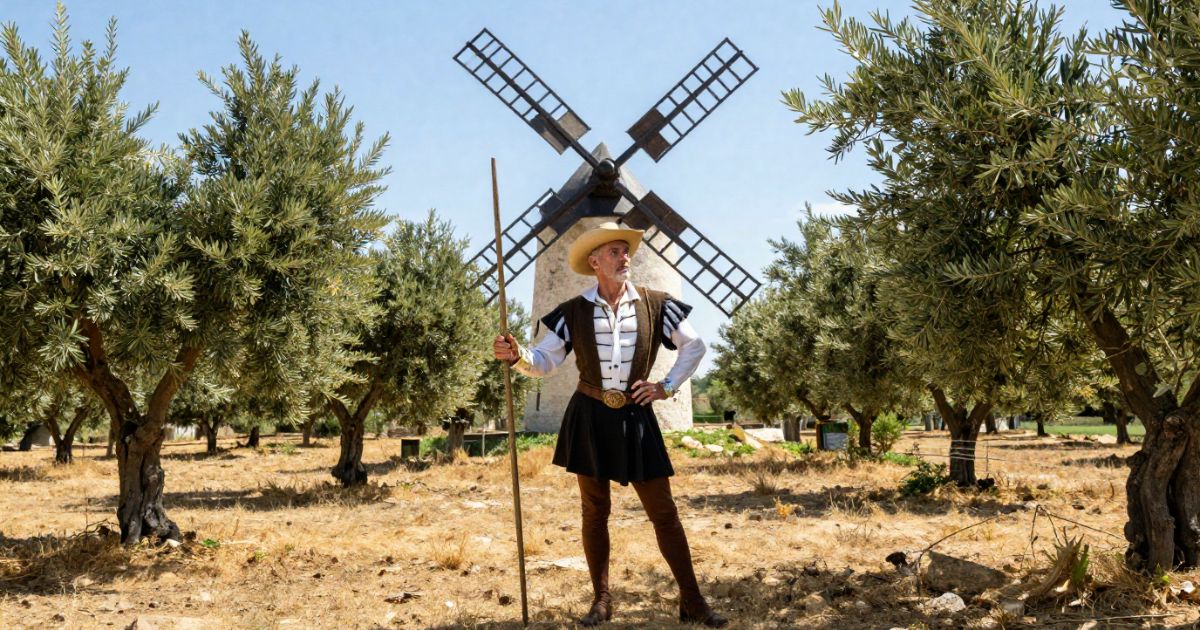
An excerpt from the original text.(complete · 5128 words)
WHICH THE STORY OF THE CAPTIVE IS CONTINUED.
SONNET
“Blest souls, that, from this mortal husk set free,
In guerdon of brave deeds beatified,
Above this lowly orb of ours abide
Made heirs of heaven and immortality,
With noble rage and ardour glowing ye
Your strength, while strength was yours, in battle plied,
And with your own blood and the foeman’s dyed
The sandy soil and the encircling sea.
It was the ebbing life-blood first that failed
The weary arms; the stout hearts never quailed.
Though vanquished, yet ye earned the victor’s crown:
Though mourned, yet still triumphant was your fall
For there ye won, between the sword and wall,
In Heaven glory and on earth renown.”
“That is it exactly, according to my recollection,” said the captive.
“Well then, that on the fort,” said the gentleman, “if my memory serves
me, goes thus:
SONNET
“Up from this wasted soil, this shattered shell,
Whose walls and towers here in ruin lie,
Three thousand soldier souls took wing on high,
In the bright mansions of the blest to dwell.
The onslaught of the foeman to repel
By might of arm all vainly did they try,
And when at length ’twas left them but to die,
Wearied and few the last defenders fell.
And this same arid soil hath ever been
A haunt of countless mournful memories,
As well in our day as in days of yore.
But never yet to Heaven it sent, I ween,
From its hard bosom purer souls than these,
Or braver bodies on its surface bore.”
The sonnets were not disliked, and the captive was rejoiced at the
tidings they gave him of his comrade, and continuing his tale, he went
on to say:
The Goletta and the fort being thus in their hands, the Turks gave
orders to dismantle the Goletta—for the fort was reduced to such a
state that there was nothing left to level—and to do the work more
quickly and easily they mined it in three places; but nowhere were they
able to blow up the part which seemed to be the least strong, that is
to say, the old walls, while all that remained standing of the new
fortifications that the Fratin had made came to the ground with the
greatest ease. Finally the fleet returned victorious and triumphant to
Constantinople, and a few months later died my master, El Uchali,
otherwise Uchali Fartax, which means in Turkish “the scabby renegade;”
for that he was; it is the practice with the Turks to name people from
some defect or virtue they may possess; the reason being that there are
among them only four surnames belonging to families tracing their
descent from the Ottoman house, and the others, as I have said, take
their names and surnames either from bodily blemishes or moral
qualities. This “scabby one” rowed at the oar as a slave of the Grand
Signor’s for fourteen years, and when over thirty-four years of age, in
resentment at having been struck by a Turk while at the oar, turned
renegade and renounced his faith in order to be able to revenge
himself; and such was his valour that, without owing his advancement to
the base ways and means by which most favourites of the Grand Signor
rise to power, he came to be king of Algiers, and afterwards
general-on-sea, which is the third place of trust in the realm. He was
a Calabrian by birth, and a worthy man morally, and he treated his
slaves with great humanity. He had three thousand of them, and after
his death they were divided, as he directed by his will, between the
Grand Signor (who is heir of all who die and shares with the children
of the deceased) and his renegades. I fell to the lot of a Venetian
renegade who, when a cabin boy on board a ship, had been taken by
Uchali and was so much beloved by him that he became one of his most
favoured youths. He came to be the most cruel renegade I ever saw: his
name was Hassan Aga, and he grew very rich and became king of Algiers.
With him I went there from Constantinople, rather glad to be so near
Spain, not that I intended to write to anyone about my unhappy lot, but
to try if fortune would be kinder to me in Algiers than in
Constantinople, where I had attempted in a thousand ways to escape
without ever finding a favourable time or chance; but in Algiers I
resolved to seek for other means of effecting the purpose I cherished
so dearly; for the hope of obtaining my liberty never deserted me; and
when in my plots and schemes and attempts the result did not answer my
expectations, without giving way to despair I immediately began to look
out for or conjure up some new hope to support me, however faint or
feeble it might be.
In this way I lived on immured in a building or prison called by the
Turks a baño in which they confine the Christian captives, as well
those that are the king’s as those belonging to private individuals,
and also what they call those of the Almacen, which is as much as to
say the slaves of the municipality, who serve the city in the public
works and other employments; but captives of this kind recover their
liberty with great difficulty, for, as they are public property and
have no particular master, there is no one with whom to treat for their
ransom, even though they may have the means. To these baños, as I have
said, some private individuals of the town are in the habit of bringing
their captives, especially when they are to be ransomed; because there
they can keep them in safety and comfort until their ransom arrives.
The king’s captives also, that are on ransom, do not go out to work
with the rest of the crew, unless when their ransom is delayed; for
then, to make them write for it more pressingly, they compel them to
work and go for wood, which is no light labour.
I, however, was one of those on ransom, for when it was discovered that
I was a captain, although I declared my scanty means and want of
fortune, nothing could dissuade them from including me among the
gentlemen and those waiting to be ransomed. They put a chain on me,
more as a mark of this than to keep me safe, and so I passed my life in
that baño with several other gentlemen and persons of quality marked
out as held to ransom; but though at times, or rather almost always, we
suffered from hunger and scanty clothing, nothing distressed us so much
as hearing and seeing at every turn the unexampled and unheard-of
cruelties my master inflicted upon the Christians. Every day he hanged
a man, impaled one, cut off the ears of another; and all with so little
provocation, or so entirely without any, that the Turks acknowledged he
did it merely for the sake of doing it, and because he was by nature
murderously disposed towards the whole human race. The only one that
fared at all well with him was a Spanish soldier, something de Saavedra
by name, to whom he never gave a blow himself, or ordered a blow to be
given, or addressed a hard word, although he had done things that will
dwell in the memory of the people there for many a year, and all to
recover his liberty; and for the least of the many things he did we all
dreaded that he would be impaled, and he himself was in fear of it more
than once; and only that time does not allow, I could tell you now
something of what that soldier did, that would interest and astonish
you much more than the narration of my own tale.
To go on with my story; the courtyard of our prison was overlooked by
the windows of the house belonging to a wealthy Moor of high position;
and these, as is usual in Moorish houses, were rather loopholes than
windows, and besides were covered with thick and close lattice-work. It
so happened, then, that as I was one day on the terrace of our prison
with three other comrades, trying, to pass away the time, how far we
could leap with our chains, we being alone, for all the other
Christians had gone out to work, I chanced to raise my eyes, and from
one of these little closed windows I saw a reed appear with a cloth
attached to the end of it, and it kept waving to and fro, and moving as
if making signs to us to come and take it. We watched it, and one of
those who were with me went and stood under the reed to see whether
they would let it drop, or what they would do, but as he did so the
reed was raised and moved from side to side, as if they meant to say
“no” by a shake of the head. The Christian came back, and it was again
lowered, making the same movements as before. Another of my comrades
went, and with him the same happened as with the first, and then the
third went forward, but with the same result as the first and second.
Seeing this I did not like not to try my luck, and as soon as I came
under the reed it was dropped and fell inside the baño at my feet. I
hastened to untie the cloth, in which I perceived a knot, and in this
were ten cianis, which are coins of base gold, current among the Moors,
and each worth ten reals of our money.
It is needless to say I rejoiced over this godsend, and my joy was not
less than my wonder as I strove to imagine how this good fortune could
have come to us, but to me specially; for the evident unwillingness to
drop the reed for any but me showed that it was for me the favour was
intended. I took my welcome money, broke the reed, and returned to the
terrace, and looking up at the window, I saw a very white hand put out
that opened and shut very quickly. From this we gathered or fancied
that it must be some woman living in that house that had done us this
kindness, and to show that we were grateful for it, we made salaams
after the fashion of the Moors, bowing the head, bending the body, and
crossing the arms on the breast. Shortly afterwards at the same window
a small cross made of reeds was put out and immediately withdrawn. This
sign led us to believe that some Christian woman was a captive in the
house, and that it was she who had been so good to us; but the
whiteness of the hand and the bracelets we had perceived made us
dismiss that idea, though we thought it might be one of the Christian
renegades whom their masters very often take as lawful wives, and
gladly, for they prefer them to the women of their own nation. In all
our conjectures we were wide of the truth; so from that time forward
our sole occupation was watching and gazing at the window where the
cross had appeared to us, as if it were our pole-star; but at least
fifteen days passed without our seeing either it or the hand, or any
other sign and though meanwhile we endeavoured with the utmost pains to
ascertain who it was that lived in the house, and whether there were
any Christian renegade in it, nobody could ever tell us anything more
than that he who lived there was a rich Moor of high position, Hadji
Morato by name, formerly alcaide of La Pata, an office of high dignity
among them. But when we least thought it was going to rain any more
cianis from that quarter, we saw the reed suddenly appear with another
cloth tied in a larger knot attached to it, and this at a time when, as
on the former occasion, the baño was deserted and unoccupied.
We made trial as before, each of the same three going forward before I
did; but the reed was delivered to none but me, and on my approach it
was let drop. I untied the knot and I found forty Spanish gold crowns
with a paper written in Arabic, and at the end of the writing there was
a large cross drawn. I kissed the cross, took the crowns and returned
to the terrace, and we all made our salaams; again the hand appeared, I
made signs that I would read the paper, and then the window was closed.
We were all puzzled, though filled with joy at what had taken place;
and as none of us understood Arabic, great was our curiosity to know
what the paper contained, and still greater the difficulty of finding
someone to read it. At last I resolved to confide in a renegade, a
native of Murcia, who professed a very great friendship for me, and had
given pledges that bound him to keep any secret I might entrust to him;
for it is the custom with some renegades, when they intend to return to
Christian territory, to carry about them certificates from captives of
mark testifying, in whatever form they can, that such and such a
renegade is a worthy man who has always shown kindness to Christians,
and is anxious to escape on the first opportunity that may present
itself. Some obtain these testimonials with good intentions, others put
them to a cunning use; for when they go to pillage on Christian
territory, if they chance to be cast away, or taken prisoners, they
produce their certificates and say that from these papers may be seen
the object they came for, which was to remain on Christian ground, and
that it was to this end they joined the Turks in their foray. In this
way they escape the consequences of the first outburst and make their
peace with the Church before it does them any harm, and then when they
have the chance they return to Barbary to become what they were before.
Others, however, there are who procure these papers and make use of
them honestly, and remain on Christian soil. This friend of mine, then,
was one of these renegades that I have described; he had certificates
from all our comrades, in which we testified in his favour as strongly
as we could; and if the Moors had found the papers they would have
burned him alive.
I knew that he understood Arabic very well, and could not only speak
but also write it; but before I disclosed the whole matter to him, I
asked him to read for me this paper which I had found by accident in a
hole in my cell. He opened it and remained some time examining it and
muttering to himself as he translated it. I asked him if he understood
it, and he told me he did perfectly well, and that if I wished him to
tell me its meaning word for word, I must give him pen and ink that he
might do it more satisfactorily. We at once gave him what he required,
and he set about translating it bit by bit, and when he had done he
said:
“All that is here in Spanish is what the Moorish paper contains, and
you must bear in mind that when it says ‘Lela Marien’ it means ‘Our
Lady the Virgin Mary.’”
We read the paper and it ran thus:
“When I was a child my father had a slave who taught me to pray the
Christian prayer in my own language, and told me many things about Lela
Marien. The Christian died, and I know that she did not go to the fire,
but to Allah, because since then I have seen her twice, and she told me
to go to the land of the Christians to see Lela Marien, who had great
love for me. I know not how to go. I have seen many Christians, but
except thyself none has seemed to me to be a gentleman. I am young and
beautiful, and have plenty of money to take with me. See if thou canst
contrive how we may go, and if thou wilt thou shalt be my husband
there, and if thou wilt not it will not distress me, for Lela Marien
will find me someone to marry me. I myself have written this: have a
care to whom thou givest it to read: trust no Moor, for they are all
perfidious. I am greatly troubled on this account, for I would not have
thee confide in anyone, because if my father knew it he would at once
fling me down a well and cover me with stones. I will put a thread to
the reed; tie the answer to it, and if thou hast no one to write for
thee in Arabic, tell it to me by signs, for Lela Marien will make me
understand thee. She and Allah and this cross, which I often kiss as
the captive bade me, protect thee.”
Judge, sirs, whether we had reason for surprise and joy at the words of
this paper; and both one and the other were so great, that the renegade
perceived that the paper had not been found by chance, but had been in
reality addressed to someone of us, and he begged us, if what he
suspected were the truth, to trust him and tell him all, for he would
risk his life for our freedom; and so saying he took out from his
breast a metal crucifix, and with many tears swore by the God the image
represented, in whom, sinful and wicked as he was, he truly and
faithfully believed, to be loyal to us and keep secret whatever we
chose to reveal to him; for he thought and almost foresaw that by means
of her who had written that paper, he and all of us would obtain our
liberty, and he himself obtain the object he so much desired, his
restoration to the bosom of the Holy Mother Church, from which by his
own sin and ignorance he was now severed like a corrupt limb. The
renegade said this with so many tears and such signs of repentance,
that with one consent we all agreed to tell him the whole truth of the
matter, and so we gave him a full account of all, without hiding
anything from him. We pointed out to him the window at which the reed
appeared, and he by that means took note of the house, and resolved to
ascertain with particular care who lived in it. We agreed also that it
would be advisable to answer the Moorish lady’s letter, and the
renegade without a moment’s delay took down the words I dictated to
him, which were exactly what I shall tell you, for nothing of
importance that took place in this affair has escaped my memory, or
ever will while life lasts. This, then, was the answer returned to the
Moorish lady:
“The true Allah protect thee, Lady, and that blessed Marien who is the
true mother of God, and who has put it into thy heart to go to the land
of the Christians, because she loves thee. Entreat her that she be
pleased to show thee how thou canst execute the command she gives thee,
for she will, such is her goodness. On my own part, and on that of all
these Christians who are with me, I promise to do all that we can for
thee, even to death. Fail not to write to me and inform me what thou
dost mean to do, and I will always answer thee; for the great Allah has
given us a Christian captive who can speak and write thy language well,
as thou mayest see by this paper; without fear, therefore, thou canst
inform us of all thou wouldst. As to what thou sayest, that if thou
dost reach the land of the Christians thou wilt be my wife, I give thee
my promise upon it as a good Christian; and know that the Christians
keep their promises better than the Moors. Allah and Marien his mother
watch over thee, my Lady.”
The paper being written and folded I waited two days until the baño was
empty as before, and immediately repaired to the usual walk on the
terrace to see if there were any sign of the reed, which was not long
in making its appearance. As soon as I saw it, although I could not
distinguish who put it out, I showed the paper as a sign to attach the
thread, but it was already fixed to the reed, and to it I tied the
paper; and shortly afterwards our star once more made its appearance
with the white flag of peace, the little bundle. It was dropped, and I
picked it up, and found in the cloth, in gold and silver coins of all
sorts, more than fifty crowns, which fifty times more strengthened our
joy and doubled our hope of gaining our liberty. That very night our
renegade returned and said he had learned that the Moor we had been
told of lived in that house, that his name was Hadji Morato, that he
was enormously rich, that he had one only daughter the heiress of all
his wealth, and that it was the general opinion throughout the city
that she was the most beautiful woman in Barbary, and that several of
the viceroys who came there had sought her for a wife, but that she had
been always unwilling to marry; and he had learned, moreover, that she
had a Christian slave who was now dead; all which agreed with the
contents of the paper. We immediately took counsel with the renegade as
to what means would have to be adopted in order to carry off the
Moorish lady and bring us all to Christian territory; and in the end it
was agreed that for the present we should wait for a second
communication from Zoraida (for that was the name of her who now
desires to be called Maria), because we saw clearly that she and no one
else could find a way out of all these difficulties. When we had
decided upon this the renegade told us not to be uneasy, for he would
lose his life or restore us to liberty. For four days the baño was
filled with people, for which reason the reed delayed its appearance
for four days, but at the end of that time, when the baño was, as it
generally was, empty, it appeared with the cloth so bulky that it
promised a happy birth. Reed and cloth came down to me, and I found
another paper and a hundred crowns in gold, without any other coin. The
renegade was present, and in our cell we gave him the paper to read,
which was to this effect:
“I cannot think of a plan, señor, for our going to Spain, nor has Lela
Marien shown me one, though I have asked her. All that can be done is
for me to give you plenty of money in gold from this window. With it
ransom yourself and your friends, and let one of you go to the land of
the Christians, and there buy a vessel and come back for the others;
and he will find me in my father’s garden, which is at the Babazon gate
near the seashore, where I shall be all this summer with my father and
my servants. You can carry me away from there by night without any
danger, and bring me to the vessel. And remember thou art to be my
husband, else I will pray to Marien to punish thee. If thou canst not
trust anyone to go for the vessel, ransom thyself and do thou go, for I
know thou wilt return more surely than any other, as thou art a
gentleman and a Christian. Endeavour to make thyself acquainted with
the garden; and when I see thee walking yonder I shall know that the
baño is empty and I will give thee abundance of money. Allah protect
thee, señor.”
These were the words and contents of the second paper, and on hearing
them, each declared himself willing to be the ransomed one, and
promised to go and return with scrupulous good faith; and I too made
the same offer; but to all this the renegade objected, saying that he
would not on any account consent to one being set free before all went
together, as experience had taught him how ill those who have been set
free keep promises which they made in captivity; for captives of
distinction frequently had recourse to this plan, paying the ransom of
one who was to go to Valencia or Majorca with money to enable him to
arm a bark and return for the others who had ransomed him, but who
never came back; for recovered liberty and the dread of losing it again
efface from the memory all the obligations in the world. And to prove
the truth of what he said, he told us briefly what had happened to a
certain Christian gentleman almost at that very time, the strangest
case that had ever occurred even there, where astonishing and
marvellous things are happening every instant. In short, he ended by
saying that what could and ought to be done was to give the money
intended for the ransom of one of us Christians to him, so that he
might with it buy a vessel there in Algiers under the pretence of
becoming a merchant and trader at Tetuan and along the coast; and when
master of the vessel, it would be easy for him to hit on some way of
getting us all out of the baño and putting us on board; especially if
the Moorish lady gave, as she said, money enough to ransom all, because
once free it would be the easiest thing in the world for us to embark
even in open day; but the greatest difficulty was that the Moors do not
allow any renegade to buy or own any craft, unless it be a large vessel
for going on roving expeditions, because they are afraid that anyone
who buys a small vessel, especially if he be a Spaniard, only wants it
for the purpose of escaping to Christian territory. This however he
could get over by arranging with a Tagarin Moor to go shares with him
in the purchase of the vessel, and in the profit on the cargo; and
under cover of this he could become master of the vessel, in which case
he looked upon all the rest as accomplished. But though to me and my
comrades it had seemed a better plan to send to Majorca for the vessel,
as the Moorish lady suggested, we did not dare to oppose him, fearing
that if we did not do as he said he would denounce us, and place us in
danger of losing all our lives if he were to disclose our dealings with
Zoraida, for whose life we would have all given our own. We therefore
resolved to put ourselves in the hands of God and in the renegade’s;
and at the same time an answer was given to Zoraida, telling her that
we would do all she recommended, for she had given as good advice as if
Lela Marien had delivered it, and that it depended on her alone whether
we were to defer the business or put it in execution at once. I renewed
my promise to be her husband; and thus the next day that the baño
chanced to be empty she at different times gave us by means of the reed
and cloth two thousand gold crowns and a paper in which she said that
the next Juma, that is to say Friday, she was going to her father’s
garden, but that before she went she would give us more money; and if
it were not enough we were to let her know, as she would give us as
much as we asked, for her father had so much he would not miss it, and
besides she kept all the keys.
We at once gave the renegade five hundred crowns to buy the vessel, and
with eight hundred I ransomed myself, giving the money to a Valencian
merchant who happened to be in Algiers at the time, and who had me
released on his word, pledging it that on the arrival of the first ship
from Valencia he would pay my ransom; for if he had given the money at
once it would have made the king suspect that my ransom money had been
for a long time in Algiers, and that the merchant had for his own
advantage kept it secret. In fact my master was so difficult to deal
with that I dared not on any account pay down the money at once. The
Thursday before the Friday on which the fair Zoraida was to go to the
garden she gave us a thousand crowns more, and warned us of her
departure, begging me, if I were ransomed, to find out her father’s
garden at once, and by all means to seek an opportunity of going there
to see her. I answered in a few words that I would do so, and that she
must remember to commend us to Lela Marien with all the prayers the
captive had taught her. This having been done, steps were taken to
ransom our three comrades, so as to enable them to quit the baño, and
lest, seeing me ransomed and themselves not, though the money was
forthcoming, they should make a disturbance about it and the devil
should prompt them to do something that might injure Zoraida; for
though their position might be sufficient to relieve me from this
apprehension, nevertheless I was unwilling to run any risk in the
matter; and so I had them ransomed in the same way as I was, handing
over all the money to the merchant so that he might with safety and
confidence give security; without, however, confiding our arrangement
and secret to him, which might have been dangerous.
c40e.jpg (34K)
Master this chapter. Complete your experience
Purchase the complete book to access all chapters and support classic literature
As an Amazon Associate, we earn a small commission from qualifying purchases at no additional cost to you.
Available in paperback, hardcover, and e-book formats
Let's Analyse the Pattern
Salvation often comes from unlikely sources when desperation creates openness and mutual benefit aligns strangers' interests.
Why This Matters
Connect literature to life
This chapter teaches how to identify potential allies and resources that exist outside your obvious social circle.
Practice This Today
This week, notice who you interact with but don't really see—the security guard, the bus driver, the person at the corner store—and consider what knowledge or connections they might have that could benefit you.
Now let's explore the literary elements.
Key Quotes & Analysis
"It was the ebbing life-blood first that failed the weary arms; the stout hearts never quailed."
Context: From a sonnet about fallen soldiers, setting the theme of courage in desperate circumstances
This establishes the chapter's central theme - that true courage isn't about winning, but about maintaining hope and determination even when everything seems lost. It foreshadows the prisoners' situation.
In Today's Words:
Their bodies gave out before their spirits did.
"Three thousand soldier souls took wing on high, in the bright mansions of the blest to dwell."
Context: Continuing the sonnet about soldiers who died defending their fort
This shows how people find meaning in suffering by believing it serves a higher purpose. The captives will need this same faith to risk everything for freedom.
In Today's Words:
They died but went to a better place.
"This same arid soil hath ever been a haunt of countless mournful memories."
Context: Describing the battlefield where so many have died over the years
Cervantes acknowledges that some places are marked by repeated tragedy and conflict. This sets up the prisoners' location as a place where hope must be actively chosen.
In Today's Words:
This place has seen way too much sadness over the years.
Thematic Threads
Trust
In This Chapter
The prisoners must decide whether to trust Zoraida based on her actions rather than her background
Development
Builds on earlier themes of misplaced trust, now showing how trust can be earned through consistent proof
In Your Life:
You might struggle to trust help from unexpected sources, missing opportunities because of preconceptions.
Class
In This Chapter
A wealthy Moorish woman and Christian prisoners find common ground despite their different social positions
Development
Continues exploring how circumstances can break down class barriers when survival is at stake
In Your Life:
You might find your best allies come from different social or economic backgrounds than your own.
Identity
In This Chapter
Zoraida secretly practices Christianity while living as a Moor, showing how identity can be hidden and complex
Development
Deepens the theme of hidden versus public identity, showing how people may not be who they appear
In Your Life:
You might discover that people around you have hidden depths, struggles, or beliefs that could create unexpected connections.
Hope
In This Chapter
Just when escape seems impossible, an unexpected opportunity appears through Zoraida's intervention
Development
Shows how hope can be rekindled through external help when internal resources are exhausted
In Your Life:
You might find that when you've tried everything you can think of, help appears from directions you never considered.
Risk
In This Chapter
Both the prisoners and Zoraida must risk everything on trusting strangers for their respective freedoms
Development
Builds on ongoing themes of calculated risk, showing how mutual risk can create stronger bonds
In Your Life:
You might need to take calculated risks with new people when traditional support systems aren't available.
You now have the context. Time to form your own thoughts.
Discussion Questions
- 1
Why does Zoraida choose to help the narrator specifically, and what does her method of first contact tell us about how she approaches risk?
analysis • surface - 2
What makes the prisoners willing to trust someone they've never met, especially someone from the 'enemy' side?
analysis • medium - 3
Think about a time when help came from an unexpected source in your life. What made you open to accepting it?
application • medium - 4
If you were in the prisoners' situation, what signs would convince you that Zoraida's offer was genuine versus a trap?
application • deep - 5
What does this chapter reveal about how desperation changes our ability to see opportunities and form alliances?
reflection • deep
Critical Thinking Exercise
Map Your Unexpected Allies
Think about your current challenges at work, home, or in your community. List three people who might seem like unlikely helpers but actually have resources, connections, or knowledge you need. For each person, identify what you could offer them in return that would make helping you worthwhile for them too.
Consider:
- •Don't dismiss people based on age, background, or department - focus on what they actually have access to
- •Look for genuine mutual benefit, not one-sided requests for help
- •Consider people who are positioned differently than you, not just those who seem similar
Journaling Prompt
Write about a time when you were someone else's unexpected ally. What motivated you to help, and how did that experience change your perspective on asking for help from others?
Coming Up Next...
Chapter 61: The Daring Escape from Algiers
The escape plan moves into action as the renegade begins purchasing a vessel. But buying a ship in Algiers without arousing suspicion requires careful maneuvering, and Zoraida prepares for the most dangerous part of their scheme.