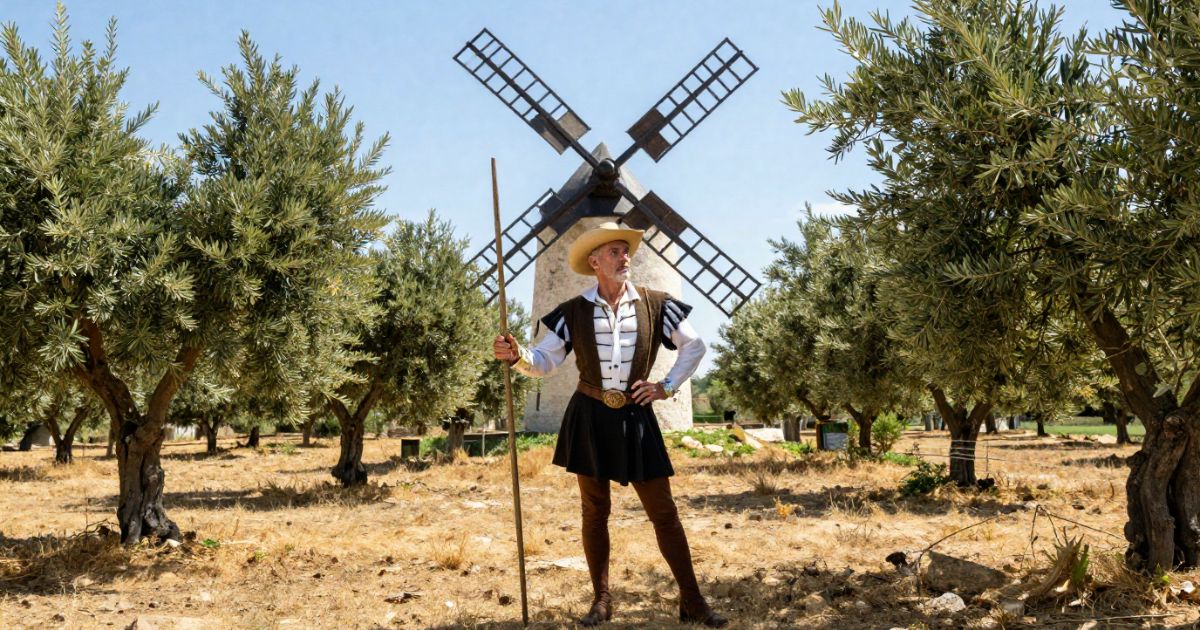
An excerpt from the original text.(complete · 3470 words)
N WHICH ARE CONTAINED THE INNUMERABLE TROUBLES WHICH THE BRAVE DON
QUIXOTE AND HIS GOOD SQUIRE SANCHO PANZA ENDURED IN THE INN, WHICH TO
HIS MISFORTUNE HE TOOK TO BE A CASTLE
By this time Don Quixote had recovered from his swoon; and in the same
tone of voice in which he had called to his squire the day before when
he lay stretched “in the vale of the stakes,” he began calling to him
now, “Sancho, my friend, art thou asleep? sleepest thou, friend
Sancho?”
“How can I sleep, curses on it!” returned Sancho discontentedly and
bitterly, “when it is plain that all the devils have been at me this
night?”
“Thou mayest well believe that,” answered Don Quixote, “because, either
I know little, or this castle is enchanted, for thou must know—but this
that I am now about to tell thee thou must swear to keep secret until
after my death.”
“I swear it,” answered Sancho.
“I say so,” continued Don Quixote, “because I hate taking away anyone’s
good name.”
“I say,” replied Sancho, “that I swear to hold my tongue about it till
the end of your worship’s days, and God grant I may be able to let it
out to-morrow.”
“Do I do thee such injuries, Sancho,” said Don Quixote, “that thou
wouldst see me dead so soon?”
“It is not for that,” replied Sancho, “but because I hate keeping
things long, and I don’t want them to grow rotten with me from
over-keeping.”
“At any rate,” said Don Quixote, “I have more confidence in thy
affection and good nature; and so I would have thee know that this
night there befell me one of the strangest adventures that I could
describe, and to relate it to thee briefly thou must know that a little
while ago the daughter of the lord of this castle came to me, and that
she is the most elegant and beautiful damsel that could be found in the
wide world. What I could tell thee of the charms of her person! of her
lively wit! of other secret matters which, to preserve the fealty I owe
to my lady Dulcinea del Toboso, I shall pass over unnoticed and in
silence! I will only tell thee that, either fate being envious of so
great a boon placed in my hands by good fortune, or perhaps (and this
is more probable) this castle being, as I have already said, enchanted,
at the time when I was engaged in the sweetest and most amorous
discourse with her, there came, without my seeing or knowing whence it
came, a hand attached to some arm of some huge giant, that planted such
a cuff on my jaws that I have them all bathed in blood, and then
pummelled me in such a way that I am in a worse plight than yesterday
when the carriers, on account of Rocinante’s misbehaviour, inflicted on
us the injury thou knowest of; whence conjecture that there must be
some enchanted Moor guarding the treasure of this damsel’s beauty, and
that it is not for me.”
“Not for me either,” said Sancho, “for more than four hundred Moors
have so thrashed me that the drubbing of the stakes was cakes and
fancy-bread to it. But tell me, señor, what do you call this excellent
and rare adventure that has left us as we are left now? Though your
worship was not so badly off, having in your arms that incomparable
beauty you spoke of; but I, what did I have, except the heaviest whacks
I think I had in all my life? Unlucky me and the mother that bore me!
for I am not a knight-errant and never expect to be one, and of all the
mishaps, the greater part falls to my share.”
“Then thou hast been thrashed too?” said Don Quixote.
“Didn’t I say so? worse luck to my line!” said Sancho.
“Be not distressed, friend,” said Don Quixote, “for I will now make the
precious balsam with which we shall cure ourselves in the twinkling of
an eye.”
By this time the cuadrillero had succeeded in lighting the lamp, and
came in to see the man that he thought had been killed; and as Sancho
caught sight of him at the door, seeing him coming in his shirt, with a
cloth on his head, and a lamp in his hand, and a very forbidding
countenance, he said to his master, “Señor, can it be that this is the
enchanted Moor coming back to give us more castigation if there be
anything still left in the ink-bottle?”
“It cannot be the Moor,” answered Don Quixote, “for those under
enchantment do not let themselves be seen by anyone.”
“If they don’t let themselves be seen, they let themselves be felt,”
said Sancho; “if not, let my shoulders speak to the point.”
“Mine could speak too,” said Don Quixote, “but that is not a sufficient
reason for believing that what we see is the enchanted Moor.”
The officer came up, and finding them engaged in such a peaceful
conversation, stood amazed; though Don Quixote, to be sure, still lay
on his back unable to move from pure pummelling and plasters. The
officer turned to him and said, “Well, how goes it, good man?”
“I would speak more politely if I were you,” replied Don Quixote; “is
it the way of this country to address knights-errant in that style, you
booby?”
The cuadrillero finding himself so disrespectfully treated by such a
sorry-looking individual, lost his temper, and raising the lamp full of
oil, smote Don Quixote such a blow with it on the head that he gave him
a badly broken pate; then, all being in darkness, he went out, and
Sancho Panza said, “That is certainly the enchanted Moor, Señor, and he
keeps the treasure for others, and for us only the cuffs and
lamp-whacks.”
“That is the truth,” answered Don Quixote, “and there is no use in
troubling oneself about these matters of enchantment or being angry or
vexed at them, for as they are invisible and visionary we shall find no
one on whom to avenge ourselves, do what we may; rise, Sancho, if thou
canst, and call the alcaide of this fortress, and get him to give me a
little oil, wine, salt, and rosemary to make the salutiferous balsam,
for indeed I believe I have great need of it now, because I am losing
much blood from the wound that phantom gave me.”
Sancho got up with pain enough in his bones, and went after the
innkeeper in the dark, and meeting the officer, who was looking to see
what had become of his enemy, he said to him, “Señor, whoever you are,
do us the favour and kindness to give us a little rosemary, oil, salt,
and wine, for it is wanted to cure one of the best knights-errant on
earth, who lies on yonder bed wounded by the hands of the enchanted
Moor that is in this inn.”
When the officer heard him talk in this way, he took him for a man out
of his senses, and as day was now beginning to break, he opened the inn
gate, and calling the host, he told him what this good man wanted. The
host furnished him with what he required, and Sancho brought it to Don
Quixote, who, with his hand to his head, was bewailing the pain of the
blow of the lamp, which had done him no more harm than raising a couple
of rather large lumps, and what he fancied blood was only the sweat
that flowed from him in his sufferings during the late storm. To be
brief, he took the materials, of which he made a compound, mixing them
all and boiling them a good while until it seemed to him they had come
to perfection. He then asked for some vial to pour it into, and as
there was not one in the inn, he decided on putting it into a tin
oil-bottle or flask of which the host made him a free gift; and over
the flask he repeated more than eighty paternosters and as many more
ave-marias, salves, and credos, accompanying each word with a cross by
way of benediction, at all which there were present Sancho, the
innkeeper, and the cuadrillero; for the carrier was now peacefully
engaged in attending to the comfort of his mules.
This being accomplished, he felt anxious to make trial himself, on the
spot, of the virtue of this precious balsam, as he considered it, and
so he drank near a quart of what could not be put into the flask and
remained in the pigskin in which it had been boiled; but scarcely had
he done drinking when he began to vomit in such a way that nothing was
left in his stomach, and with the pangs and spasms of vomiting he broke
into a profuse sweat, on account of which he bade them cover him up and
leave him alone. They did so, and he lay sleeping more than three
hours, at the end of which he awoke and felt very great bodily relief
and so much ease from his bruises that he thought himself quite cured,
and verily believed he had hit upon the balsam of Fierabras; and that
with this remedy he might thenceforward, without any fear, face any
kind of destruction, battle, or combat, however perilous it might be.
Sancho Panza, who also regarded the amendment of his master as
miraculous, begged him to give him what was left in the pigskin, which
was no small quantity. Don Quixote consented, and he, taking it with
both hands, in good faith and with a better will, gulped down and
drained off very little less than his master. But the fact is, that the
stomach of poor Sancho was of necessity not so delicate as that of his
master, and so, before vomiting, he was seized with such gripings and
retchings, and such sweats and faintness, that verily and truly he
believed his last hour had come, and finding himself so racked and
tormented he cursed the balsam and the thief that had given it to him.
Don Quixote seeing him in this state said, “It is my belief, Sancho,
that this mischief comes of thy not being dubbed a knight, for I am
persuaded this liquor cannot be good for those who are not so.”
“If your worship knew that,” returned Sancho—“woe betide me and all my
kindred!—why did you let me taste it?”
At this moment the draught took effect, and the poor squire began to
discharge both ways at such a rate that the rush mat on which he had
thrown himself and the canvas blanket he had covering him were fit for
nothing afterwards. He sweated and perspired with such paroxysms and
convulsions that not only he himself but all present thought his end
had come. This tempest and tribulation lasted about two hours, at the
end of which he was left, not like his master, but so weak and
exhausted that he could not stand. Don Quixote, however, who, as has
been said, felt himself relieved and well, was eager to take his
departure at once in quest of adventures, as it seemed to him that all
the time he loitered there was a fraud upon the world and those in it
who stood in need of his help and protection, all the more when he had
the security and confidence his balsam afforded him; and so, urged by
this impulse, he saddled Rocinante himself and put the pack-saddle on
his squire’s beast, whom likewise he helped to dress and mount the ass;
after which he mounted his horse and turning to a corner of the inn he
laid hold of a pike that stood there, to serve him by way of a lance.
All that were in the inn, who were more than twenty persons, stood
watching him; the innkeeper’s daughter was likewise observing him, and
he too never took his eyes off her, and from time to time fetched a
sigh that he seemed to pluck up from the depths of his bowels; but they
all thought it must be from the pain he felt in his ribs; at any rate
they who had seen him plastered the night before thought so.
As soon as they were both mounted, at the gate of the inn, he called to
the host and said in a very grave and measured voice, “Many and great
are the favours, Señor Alcaide, that I have received in this castle of
yours, and I remain under the deepest obligation to be grateful to you
for them all the days of my life; if I can repay them in avenging you
of any arrogant foe who may have wronged you, know that my calling is
no other than to aid the weak, to avenge those who suffer wrong, and to
chastise perfidy. Search your memory, and if you find anything of this
kind you need only tell me of it, and I promise you by the order of
knighthood which I have received to procure you satisfaction and
reparation to the utmost of your desire.”
The innkeeper replied to him with equal calmness, “Sir Knight, I do not
want your worship to avenge me of any wrong, because when any is done
me I can take what vengeance seems good to me; the only thing I want is
that you pay me the score that you have run up in the inn last night,
as well for the straw and barley for your two beasts, as for supper and
beds.”
“Then this is an inn?” said Don Quixote.
“And a very respectable one,” said the innkeeper.
“I have been under a mistake all this time,” answered Don Quixote, “for
in truth I thought it was a castle, and not a bad one; but since it
appears that it is not a castle but an inn, all that can be done now is
that you should excuse the payment, for I cannot contravene the rule of
knights-errant, of whom I know as a fact (and up to the present I have
read nothing to the contrary) that they never paid for lodging or
anything else in the inn where they might be; for any hospitality that
might be offered them is their due by law and right in return for the
insufferable toil they endure in seeking adventures by night and by
day, in summer and in winter, on foot and on horseback, in hunger and
thirst, cold and heat, exposed to all the inclemencies of heaven and
all the hardships of earth.”
“I have little to do with that,” replied the innkeeper; “pay me what
you owe me, and let us have no more talk of chivalry, for all I care
about is to get my money.”
“You are a stupid, scurvy innkeeper,” said Don Quixote, and putting
spurs to Rocinante and bringing his pike to the slope he rode out of
the inn before anyone could stop him, and pushed on some distance
without looking to see if his squire was following him.
The innkeeper when he saw him go without paying him ran to get payment
of Sancho, who said that as his master would not pay neither would he,
because, being as he was squire to a knight-errant, the same rule and
reason held good for him as for his master with regard to not paying
anything in inns and hostelries. At this the innkeeper waxed very
wroth, and threatened if he did not pay to compel him in a way that he
would not like. To which Sancho made answer that by the law of chivalry
his master had received he would not pay a rap, though it cost him his
life; for the excellent and ancient usage of knights-errant was not
going to be violated by him, nor should the squires of such as were yet
to come into the world ever complain of him or reproach him with
breaking so just a privilege.
The ill-luck of the unfortunate Sancho so ordered it that among the
company in the inn there were four woolcarders from Segovia, three
needle-makers from the Colt of Cordova, and two lodgers from the Fair
of Seville, lively fellows, tender-hearted, fond of a joke, and
playful, who, almost as if instigated and moved by a common impulse,
made up to Sancho and dismounted him from his ass, while one of them
went in for the blanket of the host’s bed; but on flinging him into it
they looked up, and seeing that the ceiling was somewhat lower than
what they required for their work, they decided upon going out into the
yard, which was bounded by the sky, and there, putting Sancho in the
middle of the blanket, they began to raise him high, making sport with
him as they would with a dog at Shrovetide.
The cries of the poor blanketed wretch were so loud that they reached
the ears of his master, who, halting to listen attentively, was
persuaded that some new adventure was coming, until he clearly
perceived that it was his squire who uttered them. Wheeling about he
came up to the inn with a laborious gallop, and finding it shut went
round it to see if he could find some way of getting in; but as soon as
he came to the wall of the yard, which was not very high, he discovered
the game that was being played with his squire. He saw him rising and
falling in the air with such grace and nimbleness that, had his rage
allowed him, it is my belief he would have laughed. He tried to climb
from his horse on to the top of the wall, but he was so bruised and
battered that he could not even dismount; and so from the back of his
horse he began to utter such maledictions and objurgations against
those who were blanketing Sancho as it would be impossible to write
down accurately: they, however, did not stay their laughter or their
work for this, nor did the flying Sancho cease his lamentations,
mingled now with threats, now with entreaties but all to little
purpose, or none at all, until from pure weariness they left off. They
then brought him his ass, and mounting him on top of it they put his
jacket round him; and the compassionate Maritornes, seeing him so
exhausted, thought fit to refresh him with a jug of water, and that it
might be all the cooler she fetched it from the well. Sancho took it,
and as he was raising it to his mouth he was stopped by the cries of
his master exclaiming, “Sancho, my son, drink not water; drink it not,
my son, for it will kill thee; see, here I have the blessed balsam (and
he held up the flask of liquor), and with drinking two drops of it thou
wilt certainly be restored.”
At these words Sancho turned his eyes asquint, and in a still louder
voice said, “Can it be your worship has forgotten that I am not a
knight, or do you want me to end by vomiting up what bowels I have left
after last night? Keep your liquor in the name of all the devils, and
leave me to myself!” and at one and the same instant he left off
talking and began drinking; but as at the first sup he perceived it was
water he did not care to go on with it, and begged Maritornes to fetch
him some wine, which she did with right good will, and paid for it with
her own money; for indeed they say of her that, though she was in that
line of life, there was some faint and distant resemblance to a
Christian about her. When Sancho had done drinking he dug his heels
into his ass, and the gate of the inn being thrown open he passed out
very well pleased at having paid nothing and carried his point, though
it had been at the expense of his usual sureties, his shoulders. It is
true that the innkeeper detained his alforjas in payment of what was
owing to him, but Sancho took his departure in such a flurry that he
never missed them. The innkeeper, as soon as he saw him off, wanted to
bar the gate close, but the blanketers would not agree to it, for they
were fellows who would not have cared two farthings for Don Quixote,
even had he been really one of the knights-errant of the Round Table.
c17e.jpg (47K)
Master this chapter. Complete your experience
Purchase the complete book to access all chapters and support classic literature
As an Amazon Associate, we earn a small commission from qualifying purchases at no additional cost to you.
Available in paperback, hardcover, and e-book formats
Let's Analyse the Pattern
Those with power can escape consequences by reframing reality while their followers absorb the actual damage and costs.
Why This Matters
Connect literature to life
This chapter teaches how to identify who actually pays when grand plans go wrong.
Practice This Today
This week, notice when someone's bold ideas consistently create problems for others to solve, and ask yourself who really bears the risk.
Now let's explore the literary elements.
Key Quotes & Analysis
"How can I sleep, curses on it! when it is plain that all the devils have been at me this night?"
Context: Sancho responds to Don Quixote's cheerful morning greeting after they were both beaten
This shows the stark difference between master and servant - Don Quixote can transform his beating into a romantic fantasy, but Sancho faces the painful reality with no comforting delusions.
In Today's Words:
How am I supposed to be okay when everything went wrong for me?
"Knights-errant never pay anything in any inn where they may be"
Context: Don Quixote refuses to pay the innkeeper for their room and board
This reveals how Don Quixote uses his fantasy identity to avoid real-world responsibilities, expecting others to absorb the costs of his delusions.
In Today's Words:
I shouldn't have to pay because I'm special and the rules don't apply to me.
"I hate keeping things long, and I don't want them to grow rotten with me from over-keeping"
Context: Sancho explains why he wants to reveal Don Quixote's secret immediately rather than wait
This shows Sancho's practical, earthy wisdom and his growing frustration with his master's complicated schemes and secrets.
In Today's Words:
I'm not good at keeping secrets - they just eat at me until I have to tell someone.
Thematic Threads
Class
In This Chapter
Don Quixote claims knightly privileges to avoid paying bills while Sancho faces physical punishment for the same refusal
Development
Evolved from earlier chapters showing how class expectations shape behavior to revealing how class privilege shields from consequences
In Your Life:
You might see this when management makes decisions that workers have to implement and face criticism for
Delusion
In This Chapter
Don Quixote's fantasies now serve as protective armor against harsh realities, turning beatings into romantic encounters
Development
Developed from simple misperception to functional psychological defense mechanism that provides real benefits
In Your Life:
You might recognize how you rationalize situations to protect yourself from painful truths about relationships or work
Loyalty
In This Chapter
Sancho follows his master's lead in refusing payment but receives none of the protection Don Quixote's status provides
Development
Shows how loyalty can become a liability when followers adopt their leader's rules without their leader's privileges
In Your Life:
You might experience this when supporting a boss or friend whose actions create problems you have to handle
Justice
In This Chapter
The innkeeper's friends deliver rough justice through the blanket toss when the legal system can't collect payment
Development
Introduced here as street-level consequence when official channels fail
In Your Life:
You might see this in how communities handle problems when official systems don't work for working-class people
Reality
In This Chapter
Two different versions of reality exist simultaneously - Don Quixote's magical healing versus Sancho's physical suffering
Development
Evolved from shared delusions to showing how privilege determines which version of reality you get to live
In Your Life:
You might notice how your economic situation affects which version of events you experience in conflicts or crises
You now have the context. Time to form your own thoughts.
Discussion Questions
- 1
How does Don Quixote's reaction to getting beaten differ from Sancho's experience with the same situation?
analysis • surface - 2
Why can Don Quixote escape consequences while Sancho faces the blanket toss? What protects one but not the other?
analysis • medium - 3
Where have you seen this pattern of someone with power avoiding consequences while their followers or employees bear the cost?
application • medium - 4
If you were in Sancho's position, how would you protect yourself from bearing the consequences of someone else's decisions?
application • deep - 5
What does this chapter reveal about the relationship between self-deception, privilege, and accountability?
reflection • deep
Critical Thinking Exercise
Map Your Consequence Patterns
Think of a situation in your life where someone else's decisions created problems you had to handle. Write down who made the decision, who faced the consequences, and what protection or privilege allowed that gap to exist. Then identify one specific way you could protect yourself if this pattern repeats.
Consider:
- •Look for patterns where authority and accountability don't match
- •Notice what shields some people from consequences (status, money, connections, delusions)
- •Consider both workplace and personal relationships
Journaling Prompt
Write about a time when you had privilege or power that protected you from consequences someone else faced. How did that feel, and what responsibility do you think comes with that protection?
Coming Up Next...
Chapter 38: When Reality Hits Fantasy Hard
Sancho finally catches up to his master, battered and exhausted from his blanket toss ordeal. Their conversation about the morning's events will force both men to confront some uncomfortable truths about their partnership and the real costs of chasing impossible dreams.