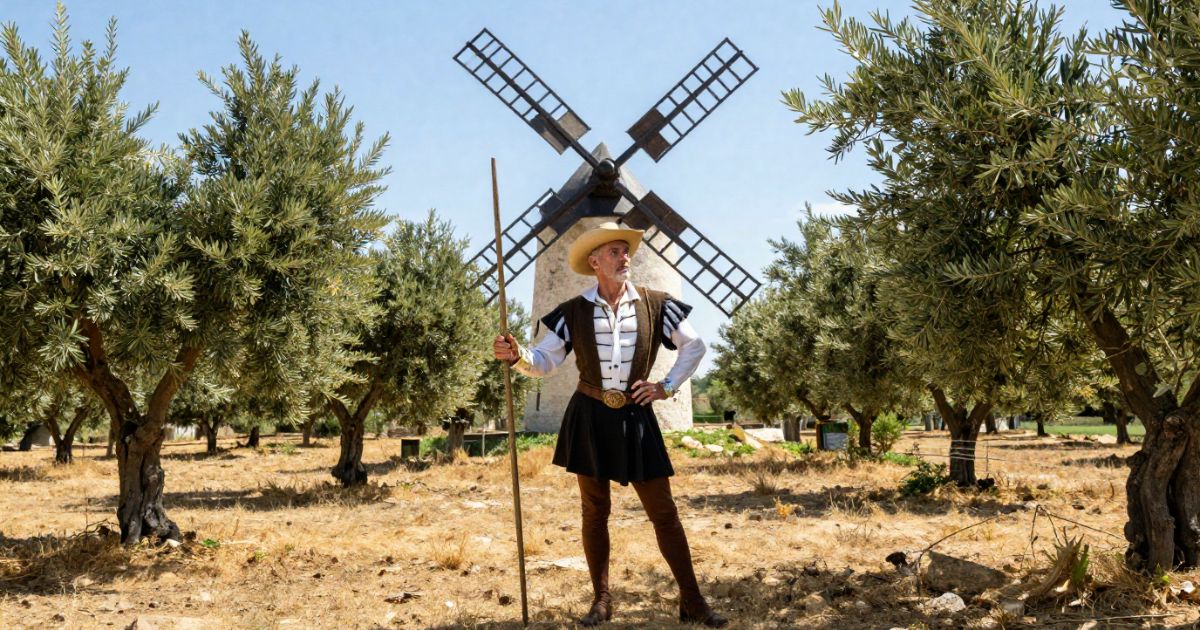
An excerpt from the original text.(complete · 3008 words)
OF WHAT HAPPENED TO THE INGENIOUS GENTLEMAN IN THE INN WHICH HE TOOK TO
BE A CASTLE
The innkeeper, seeing Don Quixote slung across the ass, asked Sancho
what was amiss with him. Sancho answered that it was nothing, only that
he had fallen down from a rock and had his ribs a little bruised. The
innkeeper had a wife whose disposition was not such as those of her
calling commonly have, for she was by nature kind-hearted and felt for
the sufferings of her neighbours, so she at once set about tending Don
Quixote, and made her young daughter, a very comely girl, help her in
taking care of her guest. There was besides in the inn, as servant, an
Asturian lass with a broad face, flat poll, and snub nose, blind of one
eye and not very sound in the other. The elegance of her shape, to be
sure, made up for all her defects; she did not measure seven palms from
head to foot, and her shoulders, which overweighted her somewhat, made
her contemplate the ground more than she liked. This graceful lass,
then, helped the young girl, and the two made up a very bad bed for Don
Quixote in a garret that showed evident signs of having formerly served
for many years as a straw-loft, in which there was also quartered a
carrier whose bed was placed a little beyond our Don Quixote’s, and,
though only made of the pack-saddles and cloths of his mules, had much
the advantage of it, as Don Quixote’s consisted simply of four rough
boards on two not very even trestles, a mattress, that for thinness
might have passed for a quilt, full of pellets which, were they not
seen through the rents to be wool, would to the touch have seemed
pebbles in hardness, two sheets made of buckler leather, and a coverlet
the threads of which anyone that chose might have counted without
missing one in the reckoning.
On this accursed bed Don Quixote stretched himself, and the hostess and
her daughter soon covered him with plasters from top to toe, while
Maritornes—for that was the name of the Asturian—held the light for
them, and while plastering him, the hostess, observing how full of
wheals Don Quixote was in some places, remarked that this had more the
look of blows than of a fall.
It was not blows, Sancho said, but that the rock had many points and
projections, and that each of them had left its mark. “Pray, señora,”
he added, “manage to save some tow, as there will be no want of someone
to use it, for my loins too are rather sore.”
“Then you must have fallen too,” said the hostess.
“I did not fall,” said Sancho Panza, “but from the shock I got at
seeing my master fall, my body aches so that I feel as if I had had a
thousand thwacks.”
“That may well be,” said the young girl, “for it has many a time
happened to me to dream that I was falling down from a tower and never
coming to the ground, and when I awoke from the dream to find myself as
weak and shaken as if I had really fallen.”
“There is the point, señora,” replied Sancho Panza, “that I without
dreaming at all, but being more awake than I am now, find myself with
scarcely less wheals than my master, Don Quixote.”
“How is the gentleman called?” asked Maritornes the Asturian.
“Don Quixote of La Mancha,” answered Sancho Panza, “and he is a
knight-adventurer, and one of the best and stoutest that have been seen
in the world this long time past.”
“What is a knight-adventurer?” said the lass.
“Are you so new in the world as not to know?” answered Sancho Panza.
“Well, then, you must know, sister, that a knight-adventurer is a thing
that in two words is seen drubbed and emperor, that is to-day the most
miserable and needy being in the world, and to-morrow will have two or
three crowns of kingdoms to give his squire.”
“Then how is it,” said the hostess, “that belonging to so good a master
as this, you have not, to judge by appearances, even so much as a
county?”
“It is too soon yet,” answered Sancho, “for we have only been a month
going in quest of adventures, and so far we have met with nothing that
can be called one, for it will happen that when one thing is looked for
another thing is found; however, if my master Don Quixote gets well of
this wound, or fall, and I am left none the worse of it, I would not
change my hopes for the best title in Spain.”
To all this conversation Don Quixote was listening very attentively,
and sitting up in bed as well as he could, and taking the hostess by
the hand he said to her, “Believe me, fair lady, you may call yourself
fortunate in having in this castle of yours sheltered my person, which
is such that if I do not myself praise it, it is because of what is
commonly said, that self-praise debaseth; but my squire will inform you
who I am. I only tell you that I shall preserve for ever inscribed on
my memory the service you have rendered me in order to tender you my
gratitude while life shall last me; and would to Heaven love held me
not so enthralled and subject to its laws and to the eyes of that fair
ingrate whom I name between my teeth, but that those of this lovely
damsel might be the masters of my liberty.”
The hostess, her daughter, and the worthy Maritornes listened in
bewilderment to the words of the knight-errant; for they understood
about as much of them as if he had been talking Greek, though they
could perceive they were all meant for expressions of good-will and
blandishments; and not being accustomed to this kind of language, they
stared at him and wondered to themselves, for he seemed to them a man
of a different sort from those they were used to, and thanking him in
pothouse phrase for his civility they left him, while the Asturian gave
her attention to Sancho, who needed it no less than his master.
The carrier had made an arrangement with her for recreation that night,
and she had given him her word that when the guests were quiet and the
family asleep she would come in search of him and meet his wishes
unreservedly. And it is said of this good lass that she never made
promises of the kind without fulfilling them, even though she made them
in a forest and without any witness present, for she plumed herself
greatly on being a lady and held it no disgrace to be in such an
employment as servant in an inn, because, she said, misfortunes and
ill-luck had brought her to that position. The hard, narrow, wretched,
rickety bed of Don Quixote stood first in the middle of this star-lit
stable, and close beside it Sancho made his, which merely consisted of
a rush mat and a blanket that looked as if it was of threadbare canvas
rather than of wool. Next to these two beds was that of the carrier,
made up, as has been said, of the pack-saddles and all the trappings of
the two best mules he had, though there were twelve of them, sleek,
plump, and in prime condition, for he was one of the rich carriers of
Arévalo, according to the author of this history, who particularly
mentions this carrier because he knew him very well, and they even say
was in some degree a relation of his; besides which Cid Hamete
Benengeli was a historian of great research and accuracy in all things,
as is very evident since he would not pass over in silence those that
have been already mentioned, however trifling and insignificant they
might be, an example that might be followed by those grave historians
who relate transactions so curtly and briefly that we hardly get a
taste of them, all the substance of the work being left in the inkstand
from carelessness, perverseness, or ignorance. A thousand blessings on
the author of “Tablante de Ricamonte” and that of the other book in
which the deeds of the Conde Tomillas are recounted; with what
minuteness they describe everything!
To proceed, then: after having paid a visit to his team and given them
their second feed, the carrier stretched himself on his pack-saddles
and lay waiting for his conscientious Maritornes. Sancho was by this
time plastered and had lain down, and though he strove to sleep the
pain of his ribs would not let him, while Don Quixote with the pain of
his had his eyes as wide open as a hare’s.
The inn was all in silence, and in the whole of it there was no light
except that given by a lantern that hung burning in the middle of the
gateway. This strange stillness, and the thoughts, always present to
our knight’s mind, of the incidents described at every turn in the
books that were the cause of his misfortune, conjured up to his
imagination as extraordinary a delusion as can well be conceived, which
was that he fancied himself to have reached a famous castle (for, as
has been said, all the inns he lodged in were castles to his eyes), and
that the daughter of the innkeeper was daughter of the lord of the
castle, and that she, won by his high-bred bearing, had fallen in love
with him, and had promised to come to his bed for a while that night
without the knowledge of her parents; and holding all this fantasy that
he had constructed as solid fact, he began to feel uneasy and to
consider the perilous risk which his virtue was about to encounter, and
he resolved in his heart to commit no treason to his lady Dulcinea del
Toboso, even though the queen Guinevere herself and the dame Quintañona
should present themselves before him.
While he was taken up with these vagaries, then, the time and the
hour—an unlucky one for him—arrived for the Asturian to come, who in
her smock, with bare feet and her hair gathered into a fustian coif,
with noiseless and cautious steps entered the chamber where the three
were quartered, in quest of the carrier; but scarcely had she gained
the door when Don Quixote perceived her, and sitting up in his bed in
spite of his plasters and the pain of his ribs, he stretched out his
arms to receive his beauteous damsel. The Asturian, who went all
doubled up and in silence with her hands before her feeling for her
lover, encountered the arms of Don Quixote, who grasped her tightly by
the wrist, and drawing her towards him, while she dared not utter a
word, made her sit down on the bed. He then felt her smock, and
although it was of sackcloth it appeared to him to be of the finest and
softest silk: on her wrists she wore some glass beads, but to him they
had the sheen of precious Orient pearls: her hair, which in some
measure resembled a horse’s mane, he rated as threads of the brightest
gold of Araby, whose refulgence dimmed the sun himself: her breath,
which no doubt smelt of yesterday’s stale salad, seemed to him to
diffuse a sweet aromatic fragrance from her mouth; and, in short, he
drew her portrait in his imagination with the same features and in the
same style as that which he had seen in his books of the other
princesses who, smitten by love, came with all the adornments that are
here set down, to see the sorely wounded knight; and so great was the
poor gentleman’s blindness that neither touch, nor smell, nor anything
else about the good lass that would have made any but a carrier vomit,
were enough to undeceive him; on the contrary, he was persuaded he had
the goddess of beauty in his arms, and holding her firmly in his grasp
he went on to say in low, tender voice:
“Would that I found myself, lovely and exalted lady, in a position to
repay such a favour as that which you, by the sight of your great
beauty, have granted me; but fortune, which is never weary of
persecuting the good, has chosen to place me upon this bed, where I lie
so bruised and broken that though my inclination would gladly comply
with yours it is impossible; besides, to this impossibility another yet
greater is to be added, which is the faith that I have pledged to the
peerless Dulcinea del Toboso, sole lady of my most secret thoughts; and
were it not that this stood in the way I should not be so insensible a
knight as to miss the happy opportunity which your great goodness has
offered me.”
Maritornes was fretting and sweating at finding herself held so fast by
Don Quixote, and not understanding or heeding the words he addressed to
her, she strove without speaking to free herself. The worthy carrier,
whose unholy thoughts kept him awake, was aware of his doxy the moment
she entered the door, and was listening attentively to all Don Quixote
said; and jealous that the Asturian should have broken her word with
him for another, drew nearer to Don Quixote’s bed and stood still to
see what would come of this talk which he could not understand; but
when he perceived the wench struggling to get free and Don Quixote
striving to hold her, not relishing the joke he raised his arm and
delivered such a terrible cuff on the lank jaws of the amorous knight
that he bathed all his mouth in blood, and not content with this he
mounted on his ribs and with his feet tramped all over them at a pace
rather smarter than a trot. The bed which was somewhat crazy and not
very firm on its feet, unable to support the additional weight of the
carrier, came to the ground, and at the mighty crash of this the
innkeeper awoke and at once concluded that it must be some brawl of
Maritornes’, because after calling loudly to her he got no answer. With
this suspicion he got up, and lighting a lamp hastened to the quarter
where he had heard the disturbance. The wench, seeing that her master
was coming and knowing that his temper was terrible, frightened and
panic-stricken made for the bed of Sancho Panza, who still slept, and
crouching upon it made a ball of herself.
The innkeeper came in exclaiming, “Where art thou, strumpet? Of course
this is some of thy work.” At this Sancho awoke, and feeling this mass
almost on top of him fancied he had the nightmare and began to
distribute fisticuffs all round, of which a certain share fell upon
Maritornes, who, irritated by the pain and flinging modesty aside, paid
back so many in return to Sancho that she woke him up in spite of
himself. He then, finding himself so handled, by whom he knew not,
raising himself up as well as he could, grappled with Maritornes, and
he and she between them began the bitterest and drollest scrimmage in
the world. The carrier, however, perceiving by the light of the
innkeeper candle how it fared with his ladylove, quitting Don Quixote,
ran to bring her the help she needed; and the innkeeper did the same
but with a different intention, for his was to chastise the lass, as he
believed that beyond a doubt she alone was the cause of all the
harmony. And so, as the saying is, cat to rat, rat to rope, rope to
stick, the carrier pounded Sancho, Sancho the lass, she him, and the
innkeeper her, and all worked away so briskly that they did not give
themselves a moment’s rest; and the best of it was that the innkeeper’s
lamp went out, and as they were left in the dark they all laid on one
upon the other in a mass so unmercifully that there was not a sound
spot left where a hand could light.
It so happened that there was lodging that night in the inn a
caudrillero of what they call the Old Holy Brotherhood of Toledo, who,
also hearing the extraordinary noise of the conflict, seized his staff
and the tin case with his warrants, and made his way in the dark into
the room crying: “Hold! in the name of the Jurisdiction! Hold! in the
name of the Holy Brotherhood!”
The first that he came upon was the pummelled Don Quixote, who lay
stretched senseless on his back upon his broken-down bed, and, his hand
falling on the beard as he felt about, he continued to cry, “Help for
the Jurisdiction!” but perceiving that he whom he had laid hold of did
not move or stir, he concluded that he was dead and that those in the
room were his murderers, and with this suspicion he raised his voice
still higher, calling out, “Shut the inn gate; see that no one goes
out; they have killed a man here!” This cry startled them all, and each
dropped the contest at the point at which the voice reached him. The
innkeeper retreated to his room, the carrier to his pack-saddles, the
lass to her crib; the unlucky Don Quixote and Sancho alone were unable
to move from where they were. The cuadrillero on this let go Don
Quixote’s beard, and went out to look for a light to search for and
apprehend the culprits; but not finding one, as the innkeeper had
purposely extinguished the lantern on retreating to his room, he was
compelled to have recourse to the hearth, where after much time and
trouble he lit another lamp.
c16e.jpg (32K)
Master this chapter. Complete your experience
Purchase the complete book to access all chapters and support classic literature
As an Amazon Associate, we earn a small commission from qualifying purchases at no additional cost to you.
Available in paperback, hardcover, and e-book formats
Let's Analyse the Pattern
The Delusion Cascade - When Fantasy Creates Real Chaos
When someone's refusal to see reality clearly creates escalating chaos that spreads to everyone around them.
Why This Matters
Connect literature to life
This chapter teaches how one person's refusal to see reality clearly creates a domino effect of conflict that entangles everyone around them.
Practice This Today
This week, notice when someone's interpretation of events seems dramatically different from what you witnessed—that's often the first sign of delusion cascade building.
Now let's explore the literary elements.
Key Quotes & Analysis
"The innkeeper had a wife whose disposition was not such as those of her calling commonly have, for she was by nature kind-hearted and felt for the sufferings of her neighbours"
Context: Describing the innkeeper's wife as she tends to Don Quixote's injuries
This shows that kindness can exist anywhere, regardless of social class or occupation. The narrator notes her compassion is unusual, suggesting most innkeepers were seen as rough or uncaring.
In Today's Words:
The innkeeper's wife wasn't like most people in her line of work - she actually cared about people and wanted to help when they were hurting.
"This graceful lass, then, helped the young girl, and the two made up a very bad bed for Don Quixote"
Context: Describing Maritornes helping prepare Don Quixote's sleeping arrangements
The ironic description of Maritornes as 'graceful' when she's actually described as quite plain shows Cervantes' humor. The 'very bad bed' contrasts with Don Quixote's castle fantasies.
In Today's Words:
So this awkward girl helped the innkeeper's daughter throw together a terrible makeshift bed for Don Quixote.
"It is the common lot of knight-errant to sleep in the fields and deserts exposed to the inclemency of heaven"
Context: Don Quixote rationalizing his uncomfortable sleeping conditions
This shows how he transforms every hardship into proof of his noble calling. He can't just admit the bed is uncomfortable - it has to be part of his heroic journey.
In Today's Words:
Knights are supposed to rough it and sleep under the stars anyway.
Thematic Threads
Identity
In This Chapter
Don Quixote's identity as a knight-errant requires him to see romance and adventure everywhere, even in a humble inn
Development
His identity delusions are now actively harming innocent people, not just himself
In Your Life:
When your self-image requires you to rewrite reality, you're heading for trouble
Class
In This Chapter
Don Quixote elevates the working-class innkeeper's family to nobility in his mind, while treating the servant Maritornes as a princess
Development
His class fantasies continue to blind him to people's actual circumstances and needs
In Your Life:
Romanticizing or dismissing someone's actual social position prevents real connection
Social Expectations
In This Chapter
Don Quixote expects the innkeeper's daughter to behave like a lovestruck maiden from romance novels
Development
His unrealistic expectations now create dangerous situations for real people
In Your Life:
When you expect people to fit your fantasy script, you set everyone up for disappointment and conflict
Human Relationships
In This Chapter
Don Quixote's inability to see Maritornes as a real person with her own romantic plans creates chaos for multiple relationships
Development
His relationship delusions are spreading beyond Sancho to affect strangers
In Your Life:
Relationships fail when you love your idea of someone more than the actual person
You now have the context. Time to form your own thoughts.
Discussion Questions
- 1
What chain of events led from Don Quixote's romantic fantasy to the violent brawl that injured multiple people?
analysis • surface - 2
Why does Don Quixote's refusal to see the inn as it really is create problems for everyone else there?
analysis • medium - 3
Where have you seen someone's delusions or false beliefs create real chaos for the people around them?
application • medium - 4
How would you protect yourself if you found yourself caught up in someone else's fantasy or delusion?
application • deep - 5
What does this chapter reveal about the difference between having dreams and being dangerously out of touch with reality?
reflection • deep
Critical Thinking Exercise
Map the Delusion Cascade
Think of someone in your life who consistently misinterprets situations or refuses to see reality clearly. Draw or list the chain reaction: their false belief leads to what action, which causes what response from others, which they then misinterpret how, leading to what escalation. Map out at least three steps in this cascade pattern.
Consider:
- •Notice how each misinterpretation builds on the previous one
- •Identify the point where you could have stepped out of the cascade
- •Consider whether this person genuinely believes their version or is choosing to maintain it
Journaling Prompt
Write about a time when you realized you might have been the one spinning reality to fit what you wanted to believe. What helped you see the situation more clearly?
Coming Up Next...
Chapter 37: The Innkeeper's Bill and Sancho's Blanket Toss
Don Quixote awakens to find himself in even worse condition, but his delusions remain intact. The law officer's investigation threatens to expose the truth about the night's chaotic events, while our knight-errant must somehow explain the inexplicable.