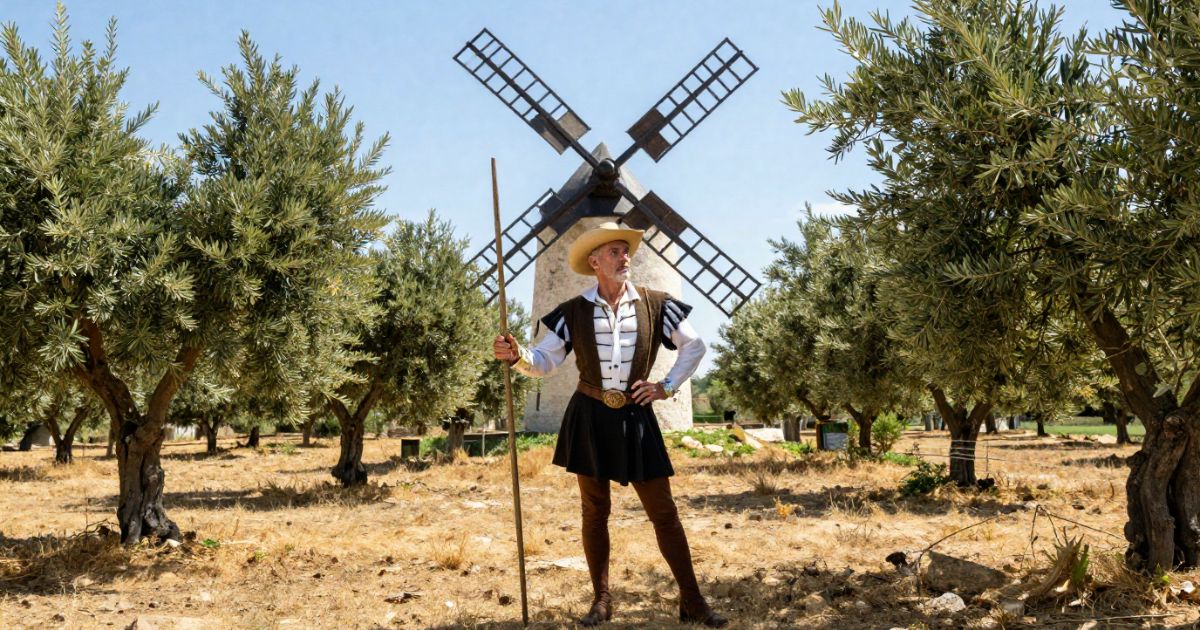
An excerpt from the original text.(complete · 2974 words)
N WHICH IS RELATED THE UNFORTUNATE ADVENTURE THAT DON QUIXOTE FELL IN
WITH WHEN HE FELL OUT WITH CERTAIN HEARTLESS YANGUESANS
The sage Cid Hamete Benengeli relates that as soon as Don Quixote took
leave of his hosts and all who had been present at the burial of
Chrysostom, he and his squire passed into the same wood which they had
seen the shepherdess Marcela enter, and after having wandered for more
than two hours in all directions in search of her without finding her,
they came to a halt in a glade covered with tender grass, beside which
ran a pleasant cool stream that invited and compelled them to pass
there the hours of the noontide heat, which by this time was beginning
to come on oppressively. Don Quixote and Sancho dismounted, and turning
Rocinante and the ass loose to feed on the grass that was there in
abundance, they ransacked the alforjas, and without any ceremony very
peacefully and sociably master and man made their repast on what they
found in them.
Sancho had not thought it worth while to hobble Rocinante, feeling
sure, from what he knew of his staidness and freedom from incontinence,
that all the mares in the Cordova pastures would not lead him into an
impropriety. Chance, however, and the devil, who is not always asleep,
so ordained it that feeding in this valley there was a drove of
Galician ponies belonging to certain Yanguesan carriers, whose way it
is to take their midday rest with their teams in places and spots where
grass and water abound; and that where Don Quixote chanced to be suited
the Yanguesans’ purpose very well. It so happened, then, that Rocinante
took a fancy to disport himself with their ladyships the ponies, and
abandoning his usual gait and demeanour as he scented them, he, without
asking leave of his master, got up a briskish little trot and hastened
to make known his wishes to them; they, however, it seemed, preferred
their pasture to him, and received him with their heels and teeth to
such effect that they soon broke his girths and left him naked without
a saddle to cover him; but what must have been worse to him was that
the carriers, seeing the violence he was offering to their mares, came
running up armed with stakes, and so belaboured him that they brought
him sorely battered to the ground.
By this time Don Quixote and Sancho, who had witnessed the drubbing of
Rocinante, came up panting, and said Don Quixote to Sancho:
“So far as I can see, friend Sancho, these are not knights but base
folk of low birth: I mention it because thou canst lawfully aid me in
taking due vengeance for the insult offered to Rocinante before our
eyes.”
“What the devil vengeance can we take,” answered Sancho, “if they are
more than twenty, and we no more than two, or, indeed, perhaps not more
than one and a half?”
“I count for a hundred,” replied Don Quixote, and without more words he
drew his sword and attacked the Yanguesans and excited and impelled by
the example of his master, Sancho did the same; and to begin with, Don
Quixote delivered a slash at one of them that laid open the leather
jerkin he wore, together with a great portion of his shoulder. The
Yanguesans, seeing themselves assaulted by only two men while they were
so many, betook themselves to their stakes, and driving the two into
the middle they began to lay on with great zeal and energy; in fact, at
the second blow they brought Sancho to the ground, and Don Quixote
fared the same way, all his skill and high mettle availing him nothing,
and fate willed it that he should fall at the feet of Rocinante, who
had not yet risen; whereby it may be seen how furiously stakes can
pound in angry boorish hands.
Then, seeing the mischief they had done, the Yanguesans with all the
haste they could loaded their team and pursued their journey, leaving
the two adventurers a sorry sight and in sorrier mood.
Sancho was the first to come to, and finding himself close to his
master he called to him in a weak and doleful voice, “Señor Don
Quixote, ah, Señor Don Quixote!”
“What wouldst thou, brother Sancho?” answered Don Quixote in the same
feeble suffering tone as Sancho.
“I would like, if it were possible,” answered Sancho Panza, “your
worship to give me a couple of sups of that potion of the fiery Blas,
if it be that you have any to hand there; perhaps it will serve for
broken bones as well as for wounds.”
“If I only had it here, wretch that I am, what more should we want?”
said Don Quixote; “but I swear to thee, Sancho Panza, on the faith of a
knight-errant, ere two days are over, unless fortune orders otherwise,
I mean to have it in my possession, or my hand will have lost its
cunning.”
“But in how many does your worship think we shall have the use of our
feet?” answered Sancho Panza.
“For myself I must say I cannot guess how many,” said the battered
knight Don Quixote; “but I take all the blame upon myself, for I had no
business to put hand to sword against men who where not dubbed knights
like myself, and so I believe that in punishment for having
transgressed the laws of chivalry the God of battles has permitted this
chastisement to be administered to me; for which reason, brother
Sancho, it is well thou shouldst receive a hint on the matter which I
am now about to mention to thee, for it is of much importance to the
welfare of both of us. It is that when thou shalt see rabble of this
sort offering us insult thou art not to wait till I draw sword against
them, for I shall not do so at all; but do thou draw sword and chastise
them to thy heart’s content, and if any knights come to their aid and
defence I will take care to defend thee and assail them with all my
might; and thou hast already seen by a thousand signs and proofs what
the might of this strong arm of mine is equal to”—so uplifted had the
poor gentleman become through the victory over the stout Biscayan.
But Sancho did not so fully approve of his master’s admonition as to
let it pass without saying in reply, “Señor, I am a man of peace, meek
and quiet, and I can put up with any affront because I have a wife and
children to support and bring up; so let it be likewise a hint to your
worship, as it cannot be a mandate, that on no account will I draw
sword either against clown or against knight, and that here before God
I forgive the insults that have been offered me, whether they have
been, are, or shall be offered me by high or low, rich or poor, noble
or commoner, not excepting any rank or condition whatsoever.”
To all which his master said in reply, “I wish I had breath enough to
speak somewhat easily, and that the pain I feel on this side would
abate so as to let me explain to thee, Panza, the mistake thou makest.
Come now, sinner, suppose the wind of fortune, hitherto so adverse,
should turn in our favour, filling the sails of our desires so that
safely and without impediment we put into port in some one of those
islands I have promised thee, how would it be with thee if on winning
it I made thee lord of it? Why, thou wilt make it well-nigh impossible
through not being a knight nor having any desire to be one, nor
possessing the courage nor the will to avenge insults or defend thy
lordship; for thou must know that in newly conquered kingdoms and
provinces the minds of the inhabitants are never so quiet nor so well
disposed to the new lord that there is no fear of their making some
move to change matters once more, and try, as they say, what chance may
do for them; so it is essential that the new possessor should have good
sense to enable him to govern, and valour to attack and defend himself,
whatever may befall him.”
“In what has now befallen us,” answered Sancho, “I’d have been well
pleased to have that good sense and that valour your worship speaks of,
but I swear on the faith of a poor man I am more fit for plasters than
for arguments. See if your worship can get up, and let us help
Rocinante, though he does not deserve it, for he was the main cause of
all this thrashing. I never thought it of Rocinante, for I took him to
be a virtuous person and as quiet as myself. After all, they say right
that it takes a long time to come to know people, and that there is
nothing sure in this life. Who would have said that, after such mighty
slashes as your worship gave that unlucky knight-errant, there was
coming, travelling post and at the very heels of them, such a great
storm of sticks as has fallen upon our shoulders?”
“And yet thine, Sancho,” replied Don Quixote, “ought to be used to such
squalls; but mine, reared in soft cloth and fine linen, it is plain
they must feel more keenly the pain of this mishap, and if it were not
that I imagine—why do I say imagine?—know of a certainty that all these
annoyances are very necessary accompaniments of the calling of arms, I
would lay me down here to die of pure vexation.”
To this the squire replied, “Señor, as these mishaps are what one reaps
of chivalry, tell me if they happen very often, or if they have their
own fixed times for coming to pass; because it seems to me that after
two harvests we shall be no good for the third, unless God in his
infinite mercy helps us.”
“Know, friend Sancho,” answered Don Quixote, “that the life of
knights-errant is subject to a thousand dangers and reverses, and
neither more nor less is it within immediate possibility for
knights-errant to become kings and emperors, as experience has shown in
the case of many different knights with whose histories I am thoroughly
acquainted; and I could tell thee now, if the pain would let me, of
some who simply by might of arm have risen to the high stations I have
mentioned; and those same, both before and after, experienced divers
misfortunes and miseries; for the valiant Amadis of Gaul found himself
in the power of his mortal enemy Arcalaus the magician, who, it is
positively asserted, holding him captive, gave him more than two
hundred lashes with the reins of his horse while tied to one of the
pillars of a court; and moreover there is a certain recondite author of
no small authority who says that the Knight of Phœbus, being caught in
a certain pitfall, which opened under his feet in a certain castle, on
falling found himself bound hand and foot in a deep pit underground,
where they administered to him one of those things they call clysters,
of sand and snow-water, that well-nigh finished him; and if he had not
been succoured in that sore extremity by a sage, a great friend of his,
it would have gone very hard with the poor knight; so I may well suffer
in company with such worthy folk, for greater were the indignities
which they had to suffer than those which we suffer. For I would have
thee know, Sancho, that wounds caused by any instruments which happen
by chance to be in hand inflict no indignity, and this is laid down in
the law of the duel in express words: if, for instance, the cobbler
strikes another with the last which he has in his hand, though it be in
fact a piece of wood, it cannot be said for that reason that he whom he
struck with it has been cudgelled. I say this lest thou shouldst
imagine that because we have been drubbed in this affray we have
therefore suffered any indignity; for the arms those men carried, with
which they pounded us, were nothing more than their stakes, and not one
of them, so far as I remember, carried rapier, sword, or dagger.”
“They gave me no time to see that much,” answered Sancho, “for hardly
had I laid hand on my tizona when they signed the cross on my shoulders
with their sticks in such style that they took the sight out of my eyes
and the strength out of my feet, stretching me where I now lie, and
where thinking of whether all those stake-strokes were an indignity or
not gives me no uneasiness, which the pain of the blows does, for they
will remain as deeply impressed on my memory as on my shoulders.”
“For all that let me tell thee, brother Panza,” said Don Quixote, “that
there is no recollection which time does not put an end to, and no pain
which death does not remove.”
“And what greater misfortune can there be,” replied Panza, “than the
one that waits for time to put an end to it and death to remove it? If
our mishap were one of those that are cured with a couple of plasters,
it would not be so bad; but I am beginning to think that all the
plasters in a hospital almost won’t be enough to put us right.”
“No more of that: pluck strength out of weakness, Sancho, as I mean to
do,” returned Don Quixote, “and let us see how Rocinante is, for it
seems to me that not the least share of this mishap has fallen to the
lot of the poor beast.”
“There is nothing wonderful in that,” replied Sancho, “since he is a
knight-errant too; what I wonder at is that my beast should have come
off scot-free where we come out scotched.”
“Fortune always leaves a door open in adversity in order to bring
relief to it,” said Don Quixote; “I say so because this little beast
may now supply the want of Rocinante, carrying me hence to some castle
where I may be cured of my wounds. And moreover I shall not hold it any
dishonour to be so mounted, for I remember having read how the good old
Silenus, the tutor and instructor of the gay god of laughter, when he
entered the city of the hundred gates, went very contentedly mounted on
a handsome ass.”
“It may be true that he went mounted as your worship says,” answered
Sancho, “but there is a great difference between going mounted and
going slung like a sack of manure.”
To which Don Quixote replied, “Wounds received in battle confer honour
instead of taking it away; and so, friend Panza, say no more, but, as I
told thee before, get up as well as thou canst and put me on top of thy
beast in whatever fashion pleases thee best, and let us go hence ere
night come on and surprise us in these wilds.”
“And yet I have heard your worship say,” observed Panza, “that it is
very meet for knights-errant to sleep in wastes and deserts, and that
they esteem it very good fortune.”
“That is,” said Don Quixote, “when they cannot help it, or when they
are in love; and so true is this that there have been knights who have
remained two years on rocks, in sunshine and shade and all the
inclemencies of heaven, without their ladies knowing anything of it;
and one of these was Amadis, when, under the name of Beltenebros, he
took up his abode on the Peña Pobre for—I know not if it was eight
years or eight months, for I am not very sure of the reckoning; at any
rate he stayed there doing penance for I know not what pique the
Princess Oriana had against him; but no more of this now, Sancho, and
make haste before a mishap like Rocinante’s befalls the ass.”
“The very devil would be in it in that case,” said Sancho; and letting
off thirty “ohs,” and sixty sighs, and a hundred and twenty
maledictions and execrations on whomsoever it was that had brought him
there, he raised himself, stopping half-way bent like a Turkish bow
without power to bring himself upright, but with all his pains he
saddled his ass, who too had gone astray somewhat, yielding to the
excessive licence of the day; he next raised up Rocinante, and as for
him, had he possessed a tongue to complain with, most assuredly neither
Sancho nor his master would have been behind him.
To be brief, Sancho fixed Don Quixote on the ass and secured Rocinante
with a leading rein, and taking the ass by the halter, he proceeded
more or less in the direction in which it seemed to him the high road
might be; and, as chance was conducting their affairs for them from
good to better, he had not gone a short league when the road came in
sight, and on it he perceived an inn, which to his annoyance and to the
delight of Don Quixote must needs be a castle. Sancho insisted that it
was an inn, and his master that it was not one, but a castle, and the
dispute lasted so long that before the point was settled they had time
to reach it, and into it Sancho entered with all his team without any
further controversy.
c15e.jpg (31K)
Master this chapter. Complete your experience
Purchase the complete book to access all chapters and support classic literature
As an Amazon Associate, we earn a small commission from qualifying purchases at no additional cost to you.
Available in paperback, hardcover, and e-book formats
Let's Analyse the Pattern
Protecting self-image through increasingly elaborate explanations rather than accepting uncomfortable feedback about reality.
Why This Matters
Connect literature to life
This chapter teaches how to recognize when we're creating elaborate explanations to avoid admitting we might be wrong.
Practice This Today
This week, notice when you find yourself explaining why the same type of problem isn't really your fault—that's usually your growth opportunity knocking.
Now let's explore the literary elements.
Key Quotes & Analysis
"Chance, however, and the devil, who is not always asleep, so ordained it"
Context: Explaining how trouble found them despite their peaceful intentions
Shows how Cervantes acknowledges that sometimes bad things happen for no good reason. It's not always about moral failings or grand purposes - sometimes life just goes sideways.
In Today's Words:
Murphy's Law kicked in - whatever could go wrong, did go wrong.
"I am a man of peace and hate quarrels, and I have a wife and children to support"
Context: After getting beaten, Sancho declares he won't fight anyone in the future
Sancho represents working-class wisdom - he knows that fighting doesn't put food on the table. His priorities are clear and practical, unlike his master's abstract honor.
In Today's Words:
I've got bills to pay and a family to feed - I'm not getting into fights over stupid stuff.
"It is no dishonor to be beaten by such rabble with sticks, for they are not knights"
Context: Don Quixote trying to explain away their humiliating defeat
This shows how people can rationalize any failure to protect their self-image. Don Quixote creates elaborate rules about when losing 'counts' rather than admitting he made a mistake.
In Today's Words:
It doesn't count because they weren't playing fair according to my made-up rules.
Thematic Threads
Pride
In This Chapter
Don Quixote reframes his beating as not really an insult since his attackers weren't proper knights
Development
Evolved from earlier grandiose claims to active reality distortion under pressure
In Your Life:
You might catch yourself explaining away criticism instead of considering if it contains truth worth examining.
Class
In This Chapter
Don Quixote distinguishes between fighting knights versus 'rabble,' creating hierarchies to justify his failure
Development
Deepened from general social pretensions to specific combat excuses based on social status
In Your Life:
You might dismiss feedback from people you consider 'beneath' your position or education level.
Identity
In This Chapter
Don Quixote maintains his knight identity despite overwhelming evidence against it through mental gymnastics
Development
Intensified from simple role-playing to active denial of contradictory evidence
In Your Life:
You might cling to outdated versions of yourself rather than adapting to new circumstances or feedback.
Leadership
In This Chapter
Don Quixote lectures Sancho about courage while being carried away wounded from his own poor decisions
Development
Introduced here as disconnect between leadership theory and practical results
In Your Life:
You might find yourself giving advice you don't successfully follow yourself.
Reality
In This Chapter
The chapter ends with Don Quixote insisting the inn ahead must be a castle, showing continued reality distortion
Development
Progressed from occasional misperception to systematic reinterpretation of obvious facts
In Your Life:
You might find yourself seeing what you want to see rather than what's actually there in important situations.
You now have the context. Time to form your own thoughts.
Discussion Questions
- 1
What actually happened when Don Quixote tried to defend Rocinante's honor against the carriers?
analysis • surface - 2
Why does Don Quixote immediately start explaining away his beating instead of questioning his approach?
analysis • medium - 3
Where have you seen people create elaborate explanations to avoid admitting they were wrong about something important?
application • medium - 4
How can you tell the difference between having legitimate standards and protecting your ego at all costs?
application • deep - 5
What does this chapter reveal about how we choose between preserving our self-image and learning from failure?
reflection • deep
Critical Thinking Exercise
Track Your Rationalization Patterns
Think of a recent situation where things didn't go as planned - at work, in a relationship, or with a goal. Write down what happened, then list every explanation you gave yourself or others about why it wasn't really your fault. Now rewrite the same situation as if you were advising a friend: what would you tell them they could do differently next time?
Consider:
- •Notice how quickly your mind jumps to external explanations versus internal ones
- •Pay attention to whether your explanations help you improve or just make you feel better
- •Consider what you'd have to admit about yourself if you dropped the defensive explanations
Journaling Prompt
Write about a time when protecting your self-image cost you more than just admitting you were wrong would have. What would you do differently now?
Coming Up Next...
Chapter 36: Mistaken Identity in the Dark
At the inn that Don Quixote insists is a castle, they encounter an innkeeper's wife whose kindness offers a stark contrast to the recent violence. But will Don Quixote's delusions create new complications even in this place of potential refuge?